Future Tense Will VS Going to

Reading Comprehension - English Language

Part 1 – Warm up: Choose the correct option

1. A: Oh no! We don’t have any bread.
  B: Don’t worry, I ______ (go) to the bakery right now. (spontaneous decision)

2. A: Look at those dark clouds!
  B: It ______ (rain). (prediction with evidence)

3. A: Can you help me with my homework later?
  B: Sure, I ______ (help) you. (promise/offer)

4. She ______ (study) medicine when she finishes high school. (planned future action)

Part 2 – Reading & Interpretation

Text 1:
Next Saturday, Mary is going to visit her grandmother. Her brother will probably stay home because he doesn’t like long trips. Their parents think the weather will be nice, but the forecast says it’s going to rain. If it rains, Mary will help her grandma cook inside instead of going for a walk.

1. What is Mary’s planned action for next Saturday?

2. What is her brother’s prediction (opinion)?

3. What does the forecast say (prediction with evidence)?

4. What spontaneous decision might Mary make if it rains?

Part 3 – Identify the Function

Underline the sentences in the text below and classify them as: (a) Spontaneous decision, (b) Promise/offer, (c) Prediction (opinion), (d) Prediction (evidence), (e) Planned future action, (f) Formal statement.

Text 2:
“I’m sure you will love this new restaurant. They’re going to open a branch in our city next month. Look at the long queue already! It’s going to be very successful. Don’t worry, I will book a table for us tomorrow. The mayor will also attend the opening ceremony.”

Part 4 – Writing Practice

Write your own sentences using will or going to for each situation:

1. A spontaneous decision

2. A promise or offer

3. A prediction based on opinion

4. A prediction based on evidence

5. A formal statement

6. An arranged plan

7. An intention

Part 5 – Mixed Reading

Text 3:
Lisa is going to travel to London next month. She bought the tickets yesterday. She thinks she will love the museums there. Her parents will call her every day to make sure she is safe. If she forgets something important, her best friend will send it by mail. Look at the sky—oh no! It’s going to snow on the day of her flight.

1. Which sentence shows a planned action?

2. Which sentence shows a prediction based on opinion?

3. Which sentence shows a promise?

4. Which sentence shows a prediction based on evidence?

5. Which sentence shows a possible spontaneous decision?


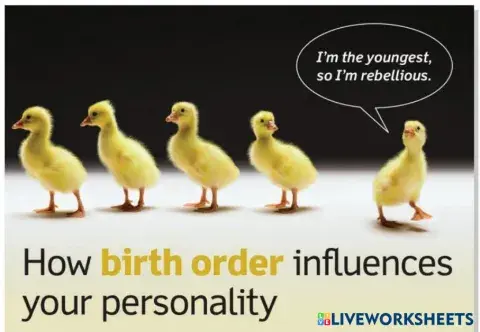
How birth order influences your personality

Reading - ESL

THE OLDEST CHILD

Firstborn children often have to look after their younger brothers and sisters, so they're usually sensible and responsible as adults.

They also tend to be ambitious, and they make good leaders. On the negative side, oldest children can be insecure and anxious. This is because -1-H. when the second child was born, they lost some of their parents' attention, and maybe they felt rejected

THE MIDDLE CHILD

Middle children are more relaxed than the oldest children, probably because -2- C. their parents were more relaxed themselves by the time the second child arrived. They're usually very sociable - the kind

of people who get on with everybody. They are also usually sensitive to what other people need, because -3-A. they grew up between older and younger brothers and sisters. For the same reason, they're often quite good at sorting out arguments, and they're always sympathetic to the ones on the losing side, or in general, to people who are having problems. On the other hand, middle children can sometimes be unambitious, and they can lack direction in life.

THE YOUNGEST CHILD

Youngest children are often very outgoing and charming. This is the way they try to get the attention of both their parents and their older brothers and sisters. They are often more rebellious, and this is probably because

-4-B. it's easier for them to break the rules - by the time they were born, their parents were more relaxed about discipline. They can also be immature and disorganized, and they often depend too much on other people, because -5-E. they have always been the baby of the family.

THE ONLY CHILD

Only children usually do very well at school, because they have a lot of contact with adults. They get a lot of love and attention from their parents, so they're typically self-confident. They're also independent, as they spend so much time by themselves. And because -6-F. they spend a lot of time with adults, they're often very organized. Only children can sometimes be spoilt, because -7-D. they are given everything they ask for by their parents. They can also be quite selfish and get impatient, especially when things go wrong. This is because -8-G. they've never had to sort out problems with other brothers and sisters.

สร้างและปรับแต่งใบงานสำหรับทุกห้องเรียน

LiveWorksheets ทำให้คุณครู ผู้ปกครอง และผู้สอนแบบโฮมสคูล สามารถออกแบบและมอบสื่อการเรียนรู้ที่น่าสนใจได้อย่างง่ายดาย เพียงอัปโหลดไฟล์ PDF หรือเริ่มต้นสร้างใหม่ทั้งหมด คุณก็สามารถทำได้ทุกอย่าง ไม่ว่าจะเป็นใบงานคณิตศาสตร์แบบโต้ตอบ ใบงานอ่านจับใจความ ใบงานการคูณ หรือใบงานสำหรับเด็กอนุบาล ด้วยขั้นตอนเพียงไม่กี่คลิก เครื่องมือแก้ไขแบบลากและวางของเรารองรับทุกระดับชั้นและทุกวิชา ช่วยให้คุณปรับเนื้อหาให้ตรงกับแผนการสอน การบ้าน หรือแบบทดสอบ ครูสอนภาษาอังกฤษ (ESL) ยังสามารถสร้างใบงาน ESL แบบเฉพาะ เพิ่มตารางเสียงภาษาอังกฤษ หรือออกแบบกิจกรรม ESL เพื่อให้การเรียนสนุกและมีส่วนร่วมมากขึ้น สร้างกิจกรรมที่ปรับระดับได้ ตรวจอัตโนมัติ ช่วยประหยัดเวลา และสนับสนุนการเรียนรู้ของนักเรียนให้ดียิ่งขึ้น

คลังสื่อการเรียนรู้ครบวงจรสำหรับ K-12 และ ESL

เข้าถึงใบงานที่พร้อมใช้หลายพันชุด ครอบคลุมทุกวิชาในระดับ K-12 รวมถึงใบงานอนุบาล ใบงานคณิตศาสตร์ แบบฝึกการคูณ แบบฝึกอ่านจับใจความ และทรัพยากร ESL เลือกค้นหาตามชั้นเรียน วิชา หรือระดับทักษะ เพื่อให้ได้สิ่งที่คุณต้องการ ไม่ว่าจะสำหรับห้องเรียนประถม ทบทวนในระดับมัธยมต้น หรือการฝึกในระดับมัธยมปลาย ครู ESL ยังสามารถสำรวจคลังใบงาน ESL และกิจกรรมภาษาอังกฤษที่ออกแบบมาเพื่อรองรับผู้เรียนทุกระดับ เนื้อหาใหม่ถูกเพิ่มเข้ามาอย่างต่อเนื่อง LiveWorksheets จึงเป็นทรัพยากรที่ยืดหยุ่นและช่วยสร้างผลลัพธ์การเรียนรู้ที่ยั่งยืน