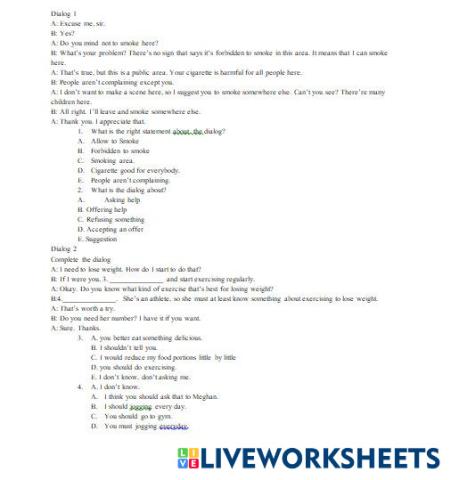
Dialog 1
A: Excuse me, sir.
B: Yes?
A: Do you mind not to smoke here?
B: What’s your problem? There’s no sign that says it’s forbidden to smoke in this area. It means that I can smoke here.
A: That’s true, but this is a public area. Your cigarette is harmful for all people here.
B: People aren’t complaining except you.
A: I don’t want to make a scene here, so I suggest you to smoke somewhere else. Can’t you see? There’re many children here.
B: All right. I’ll leave and smoke somewhere else.
A: Thank you. I appreciate that.
- 1. What is the right statement about the dialog?
- A. Allow to Smoke
- B. Forbidden to smoke
- C. Smoking area.
- D. Cigarette good for everybody.
- E. People aren’t complaining.
- 2. What is the dialog about?
- Asking help
B. Offering help
C. Refusing something
D. Accepting an offer
E. Suggestion
Dialog 2
Complete the dialog
A: I need to lose weight. How do I start to do that?
B: If I were you, 3. _______________ and start exercising regularly.
A: Okay. Do you know what kind of exercise that’s best for losing weight?
B:4._______________. She’s an athlete, so she must at least know something about exercising to lose weight.
A: That’s worth a try.
B: Do you need her number? I have it if you want.
A: Sure. Thanks.
- 3. A. you better eat something delicious.
- B. I shouldn’t tell you.
C. I would reduce my food portions little by little
D. you should do exercising.
E. I don’t know, don’t asking me.
- 4. A. I don’t know.
- B. I think you should ask that to Meghan.
- C. I should jogging every day.
- D. You should go to gym.
- E. You must jogging everyday.
- 5. Mossad : Shall we ….tomorrow morning?
Rapan : Sure, We won’t miss the first flight.
- A. get up late
- B. get up early
- C. to get up late
- D. to get up early
- E. to go up late
- 6. Alfredo : I submitted my essay to English teacher yesterday, but I haven’t received and response from her
Yani :…………………….. go and ask her?
- A.shall us
- B. why don’t we
- C. I think
- D. I will do
- E. you call
- 7. "You should order the bag online because it's cheaper."
The sentence above is used for . . . . .
A. Accepting suggestion
B. Asking for suggestion
C. Giving suggestion
D. Condition sentence
E. Giving Offer
8. The expressions below are for accepting suggestion, except . . . . .
A. I'd better not.
B. Let's do that.
C. I'm up for it.
D. I like your idea
E. Yes, I should.
9.Erika: Look at the sign. You …. not stop here.
Wulan: Oh, I’m sorry. I didn’t see it.
A. Must
B. Have to
C. Had
D. should
E. Will
10. You are at school at the break time, and you see a student's parent trying to look for his son. What probably you say?
a. May I help you?
b. Who are you?
c. Who are you looking for?
d. Can I show you where the office is?
E. What are you doing?
- 11. Steve: I don’t understand chemistry at all.
Banno: ………….
The suitable expression to complete the dialogue is …
A. How about having dinner with me?
B. How about going to the beach?
C. How about studying together with me?
D. How about calling the police?
E. How about going to cinema?
- 12. Ronaldo: Sir, would you like me to close the window for you?
Mr. Adi: Yes, please. It’s very cold inside.
The underlined sentence express:
A. Asking help
B. Offering help
C. Refusing something
D. Accepting an offer
E. Suggestion
- 13. Gina : what’s the matter with you father?
Rony : He has a bad cough
Gina : Why don’t he go to……
- A. take a rest
- B. see the doctor
- C. take a nap
- D. go to work
- E. have morning coffee
- 14. Gil : What would you do tonight?
Joe : I don’t know. I need your ……
Gil : I suggest you study hard
- A. suggest
- B. suggestion
- C. suggested
- D. suggesting
- E. helping
- 15. Nona : ……the lesson
Mega : How about asking your teacher to explain it again?
- A. I don’t understand
- B. I wonder
- C. I don’t like
- D. I don’t explain
- E. I love
- 16. Mossad : Shall we ….tomorrow morning?
Rapan : Sure, We won’t miss the first flight.
- A. get up late
- B. get up early
- C. to get up late
- D. to get up early
- E. to go up late
- 17. Alfredo : I submitted my essay to English teacher yesterday, but I haven’t received and response from her
Yani :…………………….. go and ask her?
- A. shall us
- B. why don’t we
- C. I think
- D. I will do
- E. you call
- 18.….…I help you, sir?
- A. can
- B. may
- C. will
- D. would
- E. could
- 19…… you come to fix my car tomorrow?
- A. can
- B. may
- C. will
- D. would
- E. could
- 20 …….mind taking this for us?
- A. can
- B. may
- C. will
- D. would
- E. could


 Switch to New Search Page
 อยากได้แบบฝึกหัดฟรีนับพัน (ไม่มีสิ่งรบกวนเลย)?
Here’s how
อยากได้แบบฝึกหัดฟรีนับพัน (ไม่มีสิ่งรบกวนเลย)?
Here’s how