Grammar

Vocabulary - English Language


1️⃣ Nhắc nhanh lý thuyết thì Hiện tại đơn

🔹 Cách dùng

  • Diễn tả thói quen, việc lặp lại thường xuyên
    👉 always, usually, often, every day/week, once a week…

  • Diễn tả sự thật hiển nhiên
    👉 Water boils at 100°C.

🔹 Công thức

1. Khẳng định

  • I / You / We / They + V nguyên mẫu

  • He / She / It + V-s / V-es

👉 Ví dụ:

  • I go to school.

  • He goes to school.

2. Phủ định

  • I / You / We / They + do not (don’t) + V

  • He / She / It + does not (doesn’t) + V

3. Nghi vấn

  • Do + I / you / we / they + V…?

  • Does + he / she / it + V…?

⚠️ Lưu ý: Sau do/does → động từ luôn ở dạng nguyên mẫu

2️⃣ Hướng dẫn từng câu + đáp án

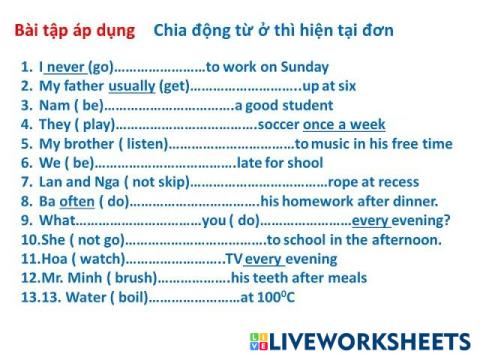
1. I never (go) … to work on Sunday

👉 Chủ ngữ I → V nguyên mẫu
go

➡️ I never go to work on Sunday.

2. My father usually (get) … up at six

👉 Chủ ngữ My father (He) → V-s
gets

➡️ My father usually gets up at six.

3. Nam (be) … a good student

👉 Chủ ngữ Nam (He) → be = is
is

➡️ Nam is a good student.

4. They (play) … soccer once a week

👉 Chủ ngữ They → V nguyên mẫu
play

➡️ They play soccer once a week.

5. My brother (listen) … to music in his free time

👉 Chủ ngữ My brother (He) → V-s
listens

➡️ My brother listens to music in his free time.

6. We (be) … late for school

👉 Chủ ngữ We → be = are
are

➡️ We are late for school.

7. Lan and Nga (not skip) … rope at recess

👉 Chủ ngữ Lan and Nga (They)
👉 Phủ định: do not + V
do not skip / don’t skip

➡️ Lan and Nga don’t skip rope at recess.

8. Ba often (do) … his homework after dinner

👉 Chủ ngữ Ba (He) → V-s
does

➡️ Ba often does his homework after dinner.

9. What … you (do) … every evening?

👉 Câu hỏi – chủ ngữ you
👉 Do + you + V
do / do

➡️ What do you do every evening?

10. She (not go) … to school in the afternoon

👉 Chủ ngữ She
👉 Phủ định: does not + V
does not go / doesn’t go

➡️ She doesn’t go to school in the afternoon.

11. Hoa (watch) … TV every evening

👉 Chủ ngữ Hoa (She) → V-s
watches

➡️ Hoa watches TV every evening.

12. Mr. Minh (brush) … his teeth after meals

👉 Chủ ngữ Mr. Minh (He) → V-s
👉 brush → brushes
brushes

➡️ Mr. Minh brushes his teeth after meals.

13. Water (boil) … at 100°C

👉 Sự thật hiển nhiên → thì HTĐ
👉 Chủ ngữ Water (It) → V-s
boils

➡️ Water boils at 100°C.

3️⃣ Tổng hợp đáp án nhanh

  1. go

  2. gets

  3. is

  4. play

  5. listens

  6. are

  7. don’t skip

  8. does

  9. do – do

  10. doesn’t go

  11. watches

  12. brushes

  13. boils


BRIGHT 10 GIỮA KỲ 1 LISTENING TEST 1

Vocabulary - English Language

TEST 1

For questions (1–5), choose the best answer (A, B or C).

Listen to a dialogue between Mark and Nancy.

1. Where does Mark go on Saturdays?

A. the mall                                        B. basketball practice                                   C. the supermarket

2. Who likes shopping for clothes?

A. Nancy                                          B. Mark                                                             C. Mark’s sister

3. Nancy doesn’t ______ .

A. do the washing-up                     B. do the laundry                                                         C. vacuum the rugs

4. What does Mark usually do in summer?

A. He goes on a picnic.                      B. He visits a museum.                                                             C. He visits his cousin.

5. What time do Mark and Nancy agree to meet?

A. 7:00                                              B. 10:00                                                             C. 11:30

Phần 2.

For questions 6 - 10

Write one word or a number or a date or a time.

You will hear a radio presenter giving some information about a music festival.

Redlands Music Festival

Starts on:

(6) …………………… August

Place:

Prospect Park, (7) …………………… Redlands

Tickets:

phone 730498 or buy from the festival (8) ……………………

Price of tickets:

(9) …………………… pounds

You can also buy:       food, T-shirts, hats and (10) …………………… at the festival.


Present Perfect Tense

Writing - English Language

📝 Student Instruction: Present Perfect Tense

  1. When do we use Present Perfect?
  • To talk about actions or experiences at an unspecified time in the past.

    • I have visited Japan.
  • To talk about actions that started in the past and continue until now.

    • She has lived here for 10 years.
  • To talk about actions that happened in the past but still have a result now.

    • He has broken his leg (he can’t walk now).
  1. Form
  • Affirmative (+): Subject + have/has + past participle (V3)

    • I have eaten breakfast.
    • She has finished her homework.
  • Negative (–): Subject + have/has + not + past participle

    • I haven’t seen that movie.
    • He hasn’t called me.
  • Question (?): Have/Has + subject + past participle

    • Have you visited London?
    • Has she done her homework?
  1. Time expressions used with Present Perfect
  • just → I have just finished my homework.
  • already → She has already eaten.
  • yet → Have you finished yet? / I haven’t finished yet.
  • ever → Have you ever been to Paris?
  • never → I have never seen snow.
  • for (a period of time) → for 5 years
  • since (a starting point) → since 2010
  1. Examples
  • We have studied English for three years.
  • He has never played basketball.
  • Have they arrived yet?

👉 Practice Example:
Change the verb into Present Perfect.

  1. I (see) that movie three times. → I have seen that movie three times.
  2. She (not finish) her homework yet. → She hasn’t finished her homework yet.
  3. (they / travel) to London before? → Have they traveled to London before?

Crea y personaliza fichas interactivas para cada aula

LiveWorksheets facilita a profesorado, familias y personas que educan en casa el diseño y la entrega de materiales de aprendizaje atractivos. Solo tienes que subir un PDF o empezar desde cero para crear lo que necesites: desde fichas interactivas de matemáticas hasta ejercicios de comprensión lectora, fichas de multiplicación o actividades para infantil, todo en unos pocos clics. Nuestro editor de arrastrar y soltar funciona en todos los cursos y asignaturas, lo que te permite adaptar el contenido a tus programaciones, deberes o evaluaciones. Quienes enseñan inglés como segunda lengua (ESL) también pueden crear sus propias fichas, añadir cuadros de sonidos comunes o integrar actividades de ESL para hacer cada clase más participativa. Además, podrás diseñar fácilmente tareas diferenciadas y autocorregidas que ahorran tiempo y apoyan un mejor aprendizaje del alumnado.

Una biblioteca completa de recursos para K-12 y ESL

Accede a miles de fichas listas para usar en todas las asignaturas de K-12, incluidas actividades para infantil, matemáticas, práctica de multiplicación, comprensión lectora y recursos de ESL. Filtra por curso, materia o nivel de competencia para encontrar exactamente lo que necesitas, ya sea para un aula de primaria, una revisión en secundaria o actividades de práctica en bachillerato. El profesorado de ESL puede explorar nuestra colección en constante crecimiento de fichas y actividades de inglés como segunda lengua, diseñadas para apoyar a estudiantes de todos los niveles. Con nuevo contenido añadido de forma regular, LiveWorksheets es un recurso flexible que ayuda a lograr aprendizajes duraderos.