 ¿Quieres miles de fichas gratuitas (y cero distracciones)?


-
Lengua y Literatura
-
Bachillerato
-
4º de ESO
-
Escritura
-
English
Instrucciones del autor
📝 Student Instruction: Present Perfect Tense
- When do we use Present Perfect?
-
To talk about actions or experiences at an unspecified time in the past.
- I have visited Japan.
-
To talk about actions that started in the past and continue until now.
- She has lived here for 10 years.
-
To talk about actions that happened in the past but still have a result now.
- He has broken his leg (he can’t walk now).
- Form
-
Affirmative (+): Subject + have/has + past participle (V3)
- I have eaten breakfast.
- She has finished her homework.
-
Negative (–): Subject + have/has + not + past participle
- I haven’t seen that movie.
- He hasn’t called me.
-
Question (?): Have/Has + subject + past participle
- Have you visited London?
- Has she done her homework?
- Time expressions used with Present Perfect
- just → I have just finished my homework.
- already → She has already eaten.
- yet → Have you finished yet? / I haven’t finished yet.
- ever → Have you ever been to Paris?
- never → I have never seen snow.
- for (a period of time) → for 5 years
- since (a starting point) → since 2010
- Examples
- We have studied English for three years.
- He has never played basketball.
- Have they arrived yet?
👉 Practice Example:
Change the verb into Present Perfect.
- I (see) that movie three times. → I have seen that movie three times.
- She (not finish) her homework yet. → She hasn’t finished her homework yet.
- (they / travel) to London before? → Have they traveled to London before?
My Google Classroom Courses

Quick Access
All Classes




-
Lengua y Literatura
-
Bachillerato
-
4º de ESO
-
Escritura
-
English
Instrucciones del autor
📝 Student Instruction: Present Perfect Tense
- When do we use Present Perfect?
-
To talk about actions or experiences at an unspecified time in the past.
- I have visited Japan.
-
To talk about actions that started in the past and continue until now.
- She has lived here for 10 years.
-
To talk about actions that happened in the past but still have a result now.
- He has broken his leg (he can’t walk now).
- Form
-
Affirmative (+): Subject + have/has + past participle (V3)
- I have eaten breakfast.
- She has finished her homework.
-
Negative (–): Subject + have/has + not + past participle
- I haven’t seen that movie.
- He hasn’t called me.
-
Question (?): Have/Has + subject + past participle
- Have you visited London?
- Has she done her homework?
- Time expressions used with Present Perfect
- just → I have just finished my homework.
- already → She has already eaten.
- yet → Have you finished yet? / I haven’t finished yet.
- ever → Have you ever been to Paris?
- never → I have never seen snow.
- for (a period of time) → for 5 years
- since (a starting point) → since 2010
- Examples
- We have studied English for three years.
- He has never played basketball.
- Have they arrived yet?
👉 Practice Example:
Change the verb into Present Perfect.
- I (see) that movie three times. → I have seen that movie three times.
- She (not finish) her homework yet. → She hasn’t finished her homework yet.
- (they / travel) to London before? → Have they traveled to London before?
Explora las hojas de trabajo
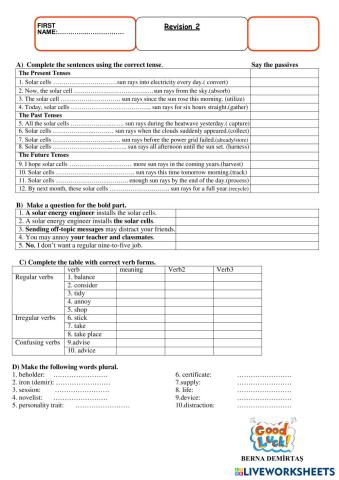
Revision-2 10th Grade 2026
- English Language
- 10th grade

Solutions pre unit 2 review
- English Language
- 10th grade

E1U2 Writing exercise 1
- English Language
- 10th grade
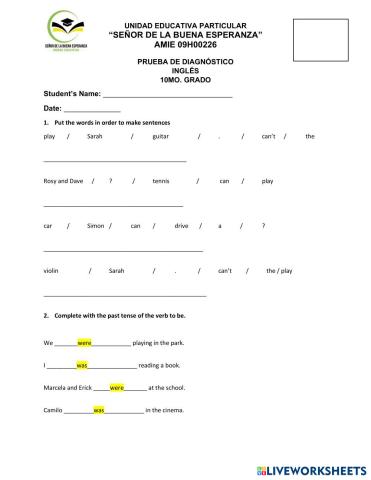
TEST 10TH
- English Language
- 10th grade