Simple Present tense, Wh-Questions

Grammar - English Language

Part 1: Matching Wh-Questions (Section 1)

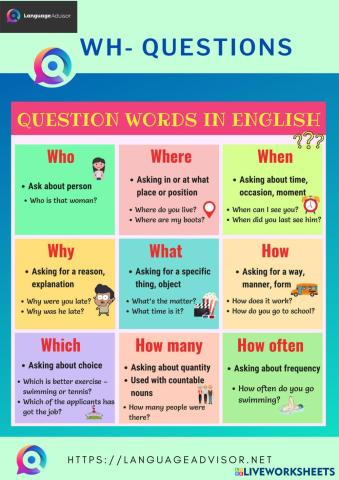
  1. Review the Visual Guide: Look at the large table of WH- QUESTIONS to remind yourself what information each word asks for (Person? Place? Reason? Quantity?).

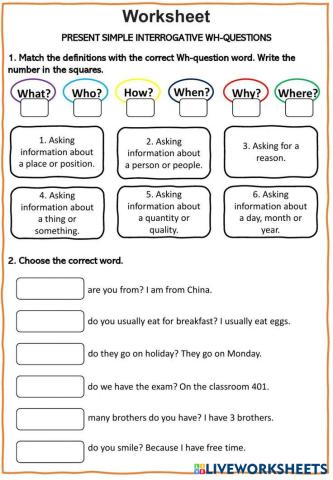
  2. Match Them Up! Read the definitions in Section 1 (e.g., "Asking information about a reason") and write the number of the correct question word (What, Who, How, When, Why, Where) in the corresponding box.

  3. Part 2: Choose the Correct Question Word (Section 2)

    You need to be a detective here. Look closely at the answer already provided to determine what kind of information is being given.

  4. Analyze the Answer:

    • If the answer is a place (I am from China or On the classroom 401), use the word for place.

    • If the answer gives a reason (Because I have free time), use the word for reason

  5. If the answer gives a quantity (I have 3 brothers), use the word for quantity.

  6. If the answer gives a date or day (They go on Monday), use the word for time.

  7. If the answer is a thing or food (I usually eat eggs), use the word for object/thing.

  8. Complete the Question: Write the correct Wh-Question word in the empty box for the question.

  9.  

    Remember! All these questions follow the Simple Present Interrogative structure (Wh-word + Auxiliary Do/Does + Subject + Base Verb?). Pay close attention to the auxiliary verb already used in the sentence!

  10. Finished?

    When you are sure you have chosen the correct Wh-Question for each response and completed all the matching, click the button to check your answers and see your score!

    Good luck!

The Last Name Project - African-American History

History - Social Studies

📝 My Last Name Project Worksheet
Discovering the Meaning Behind Your Family Name

Name: _________________________  Date: _________________________


🔍 Part 1: Discover Your Name

1. What Does My Last Name Mean?
Go to a name website like BehindTheName.com or talk to a family member.

My last name is: _______________________________

It comes from (country or culture): _______________________________

It means: ________________________________________________________


2. How Did African Americans Get Their Last Names?
Read, research, or discuss how African Americans received their last names (from enslavers, free ancestors, or choosing their own).

Write 3–4 sentences:

🏡 Part 2: Family & Identity

1. Ask a Family Member
Talk to a parent, grandparent, or guardian and write what you learn.

  • Do you know where our last name comes from?
  • Has it changed over time?
  • What does it mean to our family?

Write 2–3 sentences about what you learned:

2. If You Could Choose a Last Name...
If you could pick a last name that shows who you are, what would it be?

My chosen name would be: _______________________________________

Why?

🎨 Part 3: Show What You Learned

✅ Choose ONE way to show what you discovered about your name:

Poster – Draw your name, its meaning, and pictures or symbols that represent your family.
Short Report – Write 1 page (or a paragraph) explaining everything you learned.
Family Tree – Draw a simple family tree that shows people with your last name.
Video or Audio Interview – Record yourself explaining what you learned!

🧠 Need Help?

  • Ask your teacher for a printed family interview sheet.
  • Use a sentence starter if you're stuck.
  • Draw instead of writing where needed!

Crea y personaliza fichas interactivas para cada aula

LiveWorksheets facilita a profesorado, familias y personas que educan en casa el diseño y la entrega de materiales de aprendizaje atractivos. Solo tienes que subir un PDF o empezar desde cero para crear lo que necesites: desde fichas interactivas de matemáticas hasta ejercicios de comprensión lectora, fichas de multiplicación o actividades para infantil, todo en unos pocos clics. Nuestro editor de arrastrar y soltar funciona en todos los cursos y asignaturas, lo que te permite adaptar el contenido a tus programaciones, deberes o evaluaciones. Quienes enseñan inglés como segunda lengua (ESL) también pueden crear sus propias fichas, añadir cuadros de sonidos comunes o integrar actividades de ESL para hacer cada clase más participativa. Además, podrás diseñar fácilmente tareas diferenciadas y autocorregidas que ahorran tiempo y apoyan un mejor aprendizaje del alumnado.

Una biblioteca completa de recursos para K-12 y ESL

Accede a miles de fichas listas para usar en todas las asignaturas de K-12, incluidas actividades para infantil, matemáticas, práctica de multiplicación, comprensión lectora y recursos de ESL. Filtra por curso, materia o nivel de competencia para encontrar exactamente lo que necesitas, ya sea para un aula de primaria, una revisión en secundaria o actividades de práctica en bachillerato. El profesorado de ESL puede explorar nuestra colección en constante crecimiento de fichas y actividades de inglés como segunda lengua, diseñadas para apoyar a estudiantes de todos los niveles. Con nuevo contenido añadido de forma regular, LiveWorksheets es un recurso flexible que ayuda a lograr aprendizajes duraderos.