Task 1 : Jumbled Paragraph

Narrative Text

Once upon a time, a mother duck sat on her eggs. She felt tired of sitting on them. She just wished the eggs would break out.


Several days later, she got her wish. The eggs cracked and some cute little ducklings appeared. “Peep, peep” the little ducklings cried. “Quack, quack” their mother greeted in return. However the largest egg had not cracked. The mother duck sat on it for several days.


Finally, it cracked and a huge ugly duckling waddled out. The mother duck looked at him in surprise. He was so big and very gray. He didn’t look like the others at all. He was like a turkey.
 

When the mother duck brought the children to the pond for their first swimming lesson. The huge grey duckling splashed and paddled about just as nicely as the other ducklings did. “That is not a turkey chick.


He is my very own son and quite handsome” the mother said proudly. However, the other animals didn’t agree. They hissed and made fun of him day by day.


Even his own sisters and brothers were very unkind. “You are very ugly” they quacked. The little poor duckling was very unhappy. “I wish I looked like them” he thought to himself.


One day, the ugly duckling run away and hid in the bushes. The sad duckling lived alone through the cold and snow winter.


Finally the spring flowers began to bloom. While he was swimming in the pond, he saw three large white swans swimming toward him. “Oh, dear. These beautiful birds will laugh and peck me too” he said to himself.


But the swans did not attack him. Instead, they swam around him and stroked him with their bills.


As the ugly duckling bent his neck to speak to them, he saw his reflection in the water. He could not believe his eyes. “I am not an ugly duckling but a beautiful swam” he exclaimed.
 

He was very happy. From that day on, he swam and played with his new friends and was happier than he had never been.

Adjective suffixes

Vocabulary - English Language

🌟 Exercise 1: Choose the Correct Adjective
(Use -ed or -ing)

  1. The movie was really __________ (bore). I almost fell asleep.
  2. She felt __________ (disappoint) after she failed the exam.
  3. That was a very __________ (confuse) question.
  4. I’m so __________ (excite) about our trip to Japan!
  5. The lecture was __________ (interest), and everyone listened carefully.
  6. He looks __________ (tire) after working all night.
  7. The story was __________ (amaze); I didn’t expect that ending!
  8. I felt __________ (frustrate) when my phone stopped working.

💡 Exercise 2: Complete the Sentences with -ful or -less

  1. Be __________ (care) when you cross the road.
  2. She’s so __________ (hope); she never gives up!
  3. Don’t be __________ (fear); everything will be fine.
  4. That was a very __________ (use) idea — thank you!
  5. This pen is __________ (use); it doesn’t even write.
  6. He is always __________ (help); he loves to assist others.
  7. The child looked __________ (care); he didn’t notice the danger.
  8. She gave me a __________ (meaning) gift — I’ll always remember it.

✍️ Exercise 3: Fill in the Blanks with the Correct Adjective

(bored – boring – helpful – careless – excited – tiring – hopeful – useless)

  1. The teacher was very __________ and explained everything clearly.
  2. I felt __________ after running for two hours.
  3. Don’t be __________; pay attention to what you’re doing!
  4. This tool is completely __________ — it doesn’t work at all.
  5. The kids were __________ when they saw the fireworks.
  6. That was the most __________ class I’ve ever had.
  7. He’s still __________ about finding a new job soon.
  8. I was so __________ that I started scrolling my phone during the movie.

Thanksgiving

Writing - ESL

A Time for Thanks... and Reflection: The Story of

Thanksgiving is like, the most American holiday ever, right? We picture Pilgrims, turkeys, and a big

feast, all about being thankful. But there's way more to it than just that. It's got a long history, and

not all of it is as simple as the stories we hear in elementary school.

Harvest festivals and giving thanks have been around forever. Think ancient Greeks honoring

Demeter or Jewish celebrations like the Feast of the Tabernacles. Even way back in 1607, British

colonists in Maine gave thanks for arriving safely. But the Thanksgiving we know today? That story

gets a little more complicated.

Some people think the first Thanksgiving actually happened in Virginia in 1619. A colony called

Berkley Hundred held a religious service to celebrate their ship's arrival and said they'd do it every

year. But that colony didn't last, so the Pilgrims got all the credit. The Pilgrims, who landed near

Plymouth Rock, are usually credited with holding a harvest celebration with the Wampanoag tribe

in 1621. They ate things like lobster, clams, and, of course, "wild turkeys".

Here's where it gets tricky. The story we usually hear is all about Pilgrims and Native Americans

having a friendly meal together. But that's only one side of the story. Many Native Americans see

Thanksgiving as a reminder of what they lost when Europeans came to America. After that first

Thanksgiving, things changed quickly. There were massacres and wars, and Native Americans lost

their land and independence. So, for them, Thanksgiving isn't always a happy holiday.

Created with web.diffit.meIt's important to remember that history isn't always simple. There are different perspectives, and

it's good to hear them all. Some people might argue that focusing on the negative aspects of

Thanksgiving is disrespectful to the Pilgrims and the idea of giving thanks. They might say that it's

important to celebrate the good things in our history, even if they're not perfect. But others would

say that ignoring the negative aspects is disrespectful to Native Americans and their experiences.

They might argue that it's important to acknowledge the full history of Thanksgiving, both the

good and the bad.

Over time, Thanksgiving became more than just a harvest celebration. Presidents started

declaring days of Thanksgiving, and Abraham Lincoln made it a national holiday in 1863. The White

House even has its own Thanksgiving traditions, like the turkey pardon. The turkey pardon became

a tradition when President George H.W. Bush pardoned a turkey in 1989.

Today, Thanksgiving is a mix of traditions. We travel to see family, eat a big feast, watch parades

and football, and maybe even break a wishbone. Some people volunteer to help others in need.

But it's also a time to remember the real history of Thanksgiving, with all its complexities, and to

be respectful of different viewpoints. It's a time to be thankful, but also to think about the past

and how it affects the present

Illness Collocations

Writing - English Language

Illness Collocations


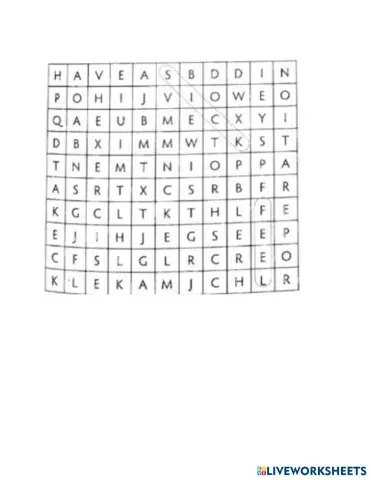
I. Find five verbs and five nouns or adjectives to make illness collocations:


0. FEEL SICK

1. _________________

2. _________________

3. _________________

4. _________________

5. _________________


II. Put the letters in order to make collocations.

    a). leef ciks

    b). ese a rctood

    c). amek na mpitntpoean

    d). vaeh na oiranpteo

    e). teg teertb

    f). etka rome scexiere


III. Complete the text with collocations from exercise 2. Use the correct form of the verbs.

     I was __0  feeling sick __  one day a few months ago. I didn`t think much about it, but the next day I was still feeling ill and I was also feeling very tired. It was the same the next day and the day after that. My wife told me I should __1 ________ . Now, I don`t really like going to the doctor`s, but I was starting to get a bit worried. Something just didn`t feel right. So I phoned the surgery that afternoon to __ 2 _________ for the next day.

   The doctor did a few tests and and he seemed really quite worried. In fact, he was so worried that he phoned immediately for an ambulance. I was rushed to hospital, where they did more tests. Finally, after about five hours, a doctor came and saw me. He said I could have a heart attack at any moment and that I needed to __ 3 __________ immediately.

    It was a real shock, but what could I say? So I followed the doctor`s orders and spent the next few months __ 4 __________ . I went for a check – up the other day and the doctor says I`m fine. I just need to eat a little less and __ 5 ________ .


Media

English language

STUDENTS THINK FAKE NEWS IS FACT AND ARE USING IT IN THEIR SCHOOLWORK, SAY TEACHERS

Teachers are frustrated that students can’t accept that some stories on social networks are false, while experts suggest that students need better education about online dangers. Students believe that fake news is a fact, and are repeating it in lessons and using it in written work, teachers have warned. More than a third of teachers say their students have used false information that they found online, according to a survey by a teacher’s union.

The union’s general secretary Chris Keates said that the information was "worrying" and it showed that internet companies have a lot of power to influence people’s opinions, especially young people. International education experts are becoming more worried about the situation and say that teachers will need to teach children how to spot fake news. Others were frustrated that students didn’t believe that news they had seen on Facebook and other social media sites was not true, even when the problem was explained to them. One teacher said that students often thought that fake news sites were real, and also that anything that President Donald Trump said was a fact. Last week, German officials said they would give fines of up to 50 million euro to social networks if they didn’t take down illegal fake news posts. The new law would give social networks 24 hours to delete or block the content and seven days to concentrate on more complicated cases. Commenting on the results of the survey, Ms. Keates said that she was worried about the trend, particularly because many young people have never known a world without internet, and are less able to judge whether information that they read online is real or fake. She added that: "It is important for children and young people to be made aware that not everything they see and read online is real."

She said that teachers are trying to help educate students about using false information, but added that it was important for internet providers and websites to take responsibility for any material that is available, and also to deal with people who misuse their services. Last month, Andreas Schleicher, the director of education and skills at OECD (The Organization of Economic co-operation and Development) said that in the modern age, being able to tell the difference between what is real and what is fake is a critical skill. He added that: "This is something that we believe schools can do something about."

Adapted from the Independent by Rachel Pells, April 12th, 2017

Betzabeth Aleixo

English

REVIEW WORKSHOP: PRONOUNS, RELATIVE CLAUSES AND MODAL VERBS


  1. Choose the right pronoun to correctly finish this sentence:

1._________ need to follow me closely.

A) You                   B) He                     C) She                                   D) It

2. Lewis, Luke and Thomas were mad because ________  waited ages for the bus.

A) them                 B) he                      C) they                                  D) it

3. Melanie and I are going soon so you can come with _________ .

A) we                    B) them                   C) our                                   D) us

4. Thank you for picking ______ up .

A) me                    B) he                       C) she                                  D) they

5. My boss told ____ that _____ had to finish the report today.

A) me/my             B) I /we                     C) we/us                               D) me/we

6. They took the money. Please run after ________.

A) they                   B) she                     C) we                                   D) them

7. What is wrong with ______?

A) he                     B) them                    C) she                                  D) they

8. Ali and Marcus would like to invite you to ______ party.

A) your                   B) they                    C) their                                 D) his

9. I couldn't find _____ book anywhere, but in the meantime, you can use ________.

A) its / its               B) mine / yours         C) your / mine                    D) my / your

10. There is a message for ______ boss on the notepad.

A) yours                    B) you                     C) your                              D) hers

11. My jumper has yellow stripes, but _______ is plain red.

A) yours                  B) him                     C) its                                  D) your

12. ____ house is in the northern part of the city.

A)John                       B) John’                   C) John’s                           D) Johns

13. I adopted a cute cat. _____ name is Larry.

A)it’s                       B) my                       C) its                                 D) our

14. Henry completed the report all by  _________.

A) himself               B) myself                C)herself                            D) themselves

15. Can you three finish the cleaning by __________?

A) themselves        B) yourself                 C) ourselves                   D) yourselves

16. The wife _________ killed the husband with a knife.

A) herself                B) himself                 C) herselves                    D) yourself

17. We should be proud of __________ for passing the test.

A) themselves        B) ours                     C) ourselves                   D) yourselves

18. The flashlight turned ______ on, I didn’t even touch the phone.

A) it                         B) itself                     C) itsself                          D) herself

19. My friend is mad at _______ for not going to the concert.

A) himself               B) hisself                  C) myself                        D) themselves


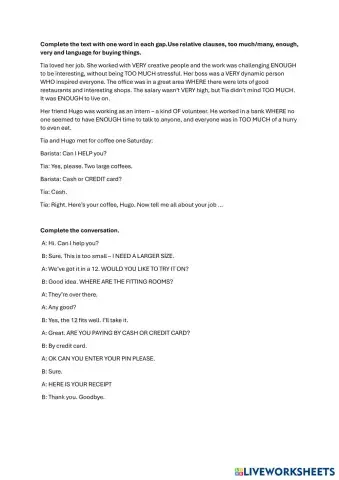
  1. Complete using relative pronouns: 

                                      which, where, that, who, whose, when. 

Examples:

 A laptop is a device which is used for work and entertainment. This device offers many tools that are considered essential nowadays.


A hotel is a place 1)  _______ people can stay for a period of time. Hotels offer many amenities and facilities 2) _______ are designed to make their experience more enjoyable. 

The hotel staff are the people 3)  ________ are in charge of helping guests with what they need. 

As part of the staff, you can find receptionists, doormen, bellboys, and more. 


Receptionists are the people 4) _______  work at the front desk and help people with the check-in and the check-out; and bellboys are the ones 5) _______ carry the luggage to their rooms.


There are many famous hotels, but one of the best is The Four Seasons Hotel, 6) ______ is in the top 50 highest ranked hotels in the world. Bogota is one of the cities 7) _______ you can find one of its branches. This hotel, 8) _________ location is very convenient, is considered one of the most luxurious in the city.


Create and Customize Worksheets for Every Classroom

LiveWorksheets makes it easy for teachers, parents and homeschool educators to design and deliver engaging learning materials. Upload a PDF or start from scratch to create what you need: anything from interactive math worksheets to reading comprehension worksheets, multiplication worksheets, and kindergarten worksheets in just a few clicks. Our drag-and-drop editor works across all grade levels and subjects, so you can tailor content to your lesson plans, homework, or assessments. ESL teachers can also build custom ESL worksheets, add a common sound chart, or integrate ESL activities to make each class more engaging. Easily create differentiated, auto-graded activities that save valuable time and support better student learning.

A Complete Library of Learning Resources for K-12 and ESL

Access thousands of ready-to-use worksheets across K-12 subjects, including kindergarten worksheets, math worksheets, multiplication practice, reading comprehension exercises, and ESL resources. Filter by grade, subject, or skill level to find exactly what you need, whether it’s for an elementary classroom, middle school review, or high school practice. ESL teachers can explore our growing collection of ESL worksheets and English as a Second Language activities designed to support all levels of learners. With new content added regularly, LiveWorksheets is a flexible resource that helps build lasting learning outcomes.