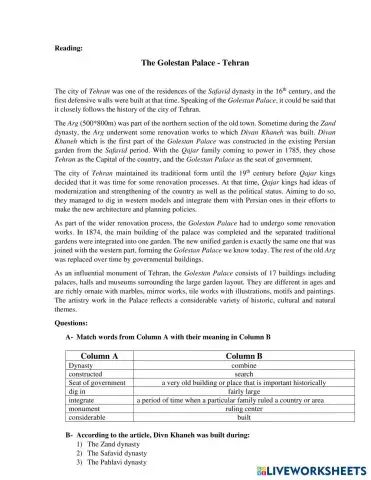
Reading Comprehension - The Golestan Palace in Tehran

Reading Comprehension

Reading Comprehension - The Golestan Palace in Tehran


Resources:

UNESCO “Nomination of Golestan Palace For Inscription on the world heritage list”


Disclaimer:

I’m neither a native speaker of English nor a professional educationalist. I’m just a simple person whose native tongue is Arabic. I’m trying to make a positive impact on this world, and I believe that passing knowledge to them young minds coming after us is one way to do that. If you have any suggestions regarding the content of this worksheet, please don’t hesitate to reach out to me at Skype: [email protected]. Please remember that I’d always be pleased to hear from you all!!


Call to donate:

Hi there!! If you are reading this, then you probably are either a learner or having a career in the educational sector. In each case, you mostly are having enough to deal with in your own life. Please remember that you are free to print this worksheet and distribute it in the way you find suitable and promoting to learners. Yet, if you have a suggestion regarding modifying part or all of it, then I’d be really pleased to hear from you first so that we can help as many learners as possible. I know this is not the perfect place to ask this, but if you think that you can donate to help me produce more worksheets similar to this one, then please reach out to me at my Skype account: [email protected] so I can send you my credit card number or see how you can do that some other possible ways. Thanks in advance!!

Interview with a celebrity

Grammar - English Language

Fill in the gap with a suitable word of the following interview. 


Instructions:
Complete the interview with the correct verb tense (Present Simple or Present Continuous) or a suitable missing word.

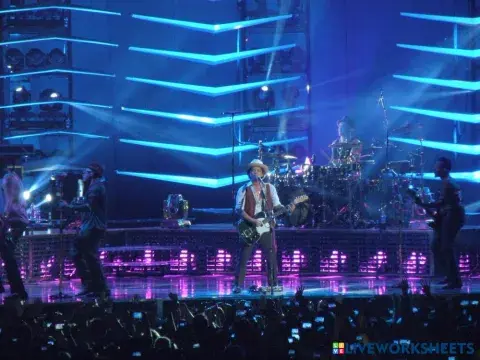
Interviewer: Hello everyone, and welcome to our show! Today we’re joined by the super talented Bruno Mars. Welcome, Bruno!
Bruno Mars: Hey! Thanks for [1] ______. I’m excited to be here.

1. Interviewer: How [2] ______ you [3] ______ today?
Bruno Mars: I’m doing great! I’m just [4] ______ after a long week in the studio.

2. Interviewer: [5] ______ you [6] ______ new songs right now?
Bruno Mars: Yes, I [7] ______. I’m working on some funky tracks with my band.

3. Interviewer: What kind of music do you usually [8] ______?
Bruno Mars: I usually make pop and funk music, but I also [9] ______ R&B.

4. Interviewer: [10] ______ you [11] ______ this year?
Bruno Mars: Not yet, but we [12] ______ a big tour for next summer.

5. Interviewer: How often do you [13] ______ with your band?
Bruno Mars: We practise almost every day when we’re preparing for a concert.

6. Interviewer: Who [14] ______ the lyrics for your songs?
Bruno Mars: I do! But sometimes I write together with my bandmates.

7. Interviewer: Do you [15] ______ any instruments?
Bruno Mars: Yes, I play the guitar, drums, and piano.

8. Interviewer: [16] ______ you [17] ______ any new instruments these days?
Bruno Mars: I’m trying to learn the trumpet — it’s harder than I [18] ______!

9. Interviewer: What’s your favourite song that you’ve [19] ______?
Bruno Mars: Probably “Treasure” — it always makes people smile.

10. Interviewer: Are you [20] ______ at any festivals this year?
Bruno Mars: Yes, I’m performing at Coachella and a few others.

11. Interviewer: What do you do when you’re not [21] ______ music?
Bruno Mars: I spend time with my family, play basketball, and watch movies.

12. Interviewer: Do you [22] ______ nervous before going on stage?
Bruno Mars: Always! But once I start singing, the nerves [23] ______.

13. Interviewer: [24] ______ you [25] ______ any love songs at the moment?
Bruno Mars: Yes, I am. Love songs are my favourite — they never get old!

14. Interviewer: How many hours a day [26] ______ you [27] ______ in the studio?
Bruno Mars: About six or seven hours. Time [28] ______ when I’m making music.

15. Interviewer: Who [29] ______ you the most as an artist?
Bruno Mars: Michael Jackson, Elvis Presley, and Prince — they’re legends.

16. Interviewer: Are you [30] ______ to collaborate with anyone soon?
Bruno Mars: Yes, I’m talking to Anderson .Paak about a new Silk Sonic project.

17. Interviewer: Do you [31] ______ travelling for concerts?
Bruno Mars: Yes, I love meeting fans all over the world.

18. Interviewer: How do you [32] ______ after a show?
Bruno Mars: I hang out with the band, eat good food, and listen to old records.

19. Interviewer: What advice [33] ______ you [34] ______ to young musicians?
Bruno Mars: Work hard, stay humble, and keep practising every day.

20. Interviewer: Thank you, Bruno, for [35] ______ us today!
Bruno Mars: Thank you! It’s been a pleasure. See you on tour!

Answer key

  1. having
  2. are
  3. doing
  4. relaxing
  5. Are
  6. recording
  7. am
  8. make
  9. love
  10. Are
  11. touring
  12. are planning
  13. practise
  14. writes
  15. play
  16. Are
  17. learning
  18. expected
  19. written
  20. performing
  21. making
  22. get
  23. disappear
  24. Are
  25. writing
  26. do
  27. work
  28. flies
  29. inspires
  30. planning
  31. enjoy
  32. relax
  33. would
  34. give
  35. joining

Midiendo Nuestro huerto escolar y Nuestros Sueños

Measurement - Math

  1.  
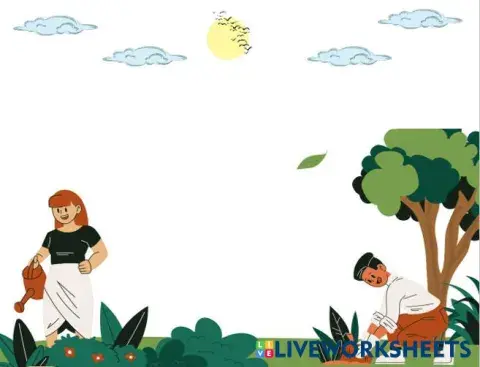
  2. En la Sede Varones tenemos un huerto escolar, es un laboratorio de aprendizaje al aire libre. Este espacio  rectangular, que con tanto esmero cultivamos, tiene unas medidas muy claras: 6 metros de largo por 4 metros de ancho. Estas dimensiones nos permiten observar  la magnitud de nuestro trabajo y planificar el futuro de nuestras cultivos.

    Cuando pensamos en cuánto espacio  tenemos para sembrar  dentro del huerto, estamos hablando de su área. Si imaginamos que cada metro cuadrado es un cuadrito en un baldosa  nuestro huerto tiene 6×4=24 cuadritos de espacio fértil. Esto nos dice que hay suficiente lugar para una  variedad de plantas, desde  ñame  que se esconden bajo tierra hasta las caraotas  que crecen enrrredandose y buscando   el sol. Conocer el área nos permite inferir la posible diversidad de cultivos y la cantidad de alimento que podemos producir.

    Pero el huerto no es solo el espacio interior; también tiene un borde, una línea que lo rodea. Esa línea es su perímetro. Para calcularla, simplemente sumamos la longitud de todos sus lados: 6+4+6+4=20 metros. El perímetro es importante si pensamos en proteger nuestro huerto con una cerca, o si quisiéramos trazar un camino alrededor para no pisar las plantas. De hecho, el perímetro nos sugiere la longitud de la barrera que necesitaríamos para protegerlo de   pisadas de personas no autorizadas  que maltraten las plantas  y  animales curiosos o para delimitarlo visualmente, lo que implica una inversión en materiales.

    Además de las medidas físicas, también gestionamos un presupuesto para que nuestro huerto sea una realidad. Cada gasto, desde las semillas hasta las herramientas que usamos para remover la tierra, es un dato valioso. Por ejemplo, si los datos recopilados nos muestran que la mayor parte del presupuesto se destinó a "herramientas" en lugar de "semillas y plántulas", podemos inferir que la inversión inicial se enfocó en la infraestructura y en la durabilidad del proyecto. Si analizamos  estos gastos en un gráfico, como un diagrama de barras, podemos "observar  a simple vista en qué se invirtió más dinero y dónde podríamos ajustar para futuras cosechas. Un presupuesto detallado nos permite decidir, anticipar necesidades y, asegurar la sostenibilidad de nuestro huerto.

    Así, el huerto escolar se convierte en un aula viva donde los números y las mediciones son herramientas prácticas para planificar, crecer y soñar con una cosecha.

  3.  
  4. Si el presupuesto inicial para la manguera de riego ($40.000) resultó ser insuficiente porque se necesitaba una manguera más larga y de mejor calidad, ¿qué se puede inferir sobre la planificación de este gasto?


a) Que la manguera no era un elemento esencial para el huerto.

b) Que la estimación inicial del costo de la manguera fue  incompleta.

c) Que se gastó demasiado dinero en otros materiales.

d) Que el huerto no necesitaba ser regado con una manguera.

  1. El texto menciona que el área nos permite inferir la "posible diversidad de cultivos y la cantidad de alimento que podemos producir". ¿Qué implica esto si el área del huerto fuera solo de 2 metros cuadrados?

a) Se podrían sembrar muchos más tipos de plantas.

 b) La diversidad de cultivos y la cantidad de alimento serían muy reducido.

 c) Solo se podrían sembrar plantas que crecen muy alto.

 d) No sería necesario regar el huerto.

  1. Si al revisar el gráfico de barras del presupuesto, la barra correspondiente a "Tierra abonada" fuera casi tan alta como la de "Herramientas pequeñas", ¿qué conclusión es más probable que se pueda sacar sobre la estrategia de inversión para el huerto?

 a) Se priorizó sobre herramientas  del huerto para  su productividad.

 b) Se invirtió significativamente en mejorar la calidad del suelo para las plantas

c) Las herramientas eran de muy baja calidad.

d) Se compraron demasiadas semillas que no se usaron.

  1. Si la escuela decidiera expandir el huerto, agregando un espacio adicional que duplique el perímetro total, pero mantiene la forma rectangular, ¿qué se podría inferir sobre la necesidad de materiales como cercas o caminos para el nuevo huerto?

a) Se necesitarían los mismos materiales que para el huerto inicial .

 b) Se necesitaría el doble de la longitud de materiales para cercas o caminos.

 c) No sería necesario invertir en cercas o caminos para la expansión.

 d) El costo de los materiales disminuiría.

สร้างและปรับแต่งใบงานสำหรับทุกห้องเรียน

LiveWorksheets ทำให้คุณครู ผู้ปกครอง และผู้สอนแบบโฮมสคูล สามารถออกแบบและมอบสื่อการเรียนรู้ที่น่าสนใจได้อย่างง่ายดาย เพียงอัปโหลดไฟล์ PDF หรือเริ่มต้นสร้างใหม่ทั้งหมด คุณก็สามารถทำได้ทุกอย่าง ไม่ว่าจะเป็นใบงานคณิตศาสตร์แบบโต้ตอบ ใบงานอ่านจับใจความ ใบงานการคูณ หรือใบงานสำหรับเด็กอนุบาล ด้วยขั้นตอนเพียงไม่กี่คลิก เครื่องมือแก้ไขแบบลากและวางของเรารองรับทุกระดับชั้นและทุกวิชา ช่วยให้คุณปรับเนื้อหาให้ตรงกับแผนการสอน การบ้าน หรือแบบทดสอบ ครูสอนภาษาอังกฤษ (ESL) ยังสามารถสร้างใบงาน ESL แบบเฉพาะ เพิ่มตารางเสียงภาษาอังกฤษ หรือออกแบบกิจกรรม ESL เพื่อให้การเรียนสนุกและมีส่วนร่วมมากขึ้น สร้างกิจกรรมที่ปรับระดับได้ ตรวจอัตโนมัติ ช่วยประหยัดเวลา และสนับสนุนการเรียนรู้ของนักเรียนให้ดียิ่งขึ้น

คลังสื่อการเรียนรู้ครบวงจรสำหรับ K-12 และ ESL

เข้าถึงใบงานที่พร้อมใช้หลายพันชุด ครอบคลุมทุกวิชาในระดับ K-12 รวมถึงใบงานอนุบาล ใบงานคณิตศาสตร์ แบบฝึกการคูณ แบบฝึกอ่านจับใจความ และทรัพยากร ESL เลือกค้นหาตามชั้นเรียน วิชา หรือระดับทักษะ เพื่อให้ได้สิ่งที่คุณต้องการ ไม่ว่าจะสำหรับห้องเรียนประถม ทบทวนในระดับมัธยมต้น หรือการฝึกในระดับมัธยมปลาย ครู ESL ยังสามารถสำรวจคลังใบงาน ESL และกิจกรรมภาษาอังกฤษที่ออกแบบมาเพื่อรองรับผู้เรียนทุกระดับ เนื้อหาใหม่ถูกเพิ่มเข้ามาอย่างต่อเนื่อง LiveWorksheets จึงเป็นทรัพยากรที่ยืดหยุ่นและช่วยสร้างผลลัพธ์การเรียนรู้ที่ยั่งยืน