Fill in the gaps

English as a Second Language (ESL)

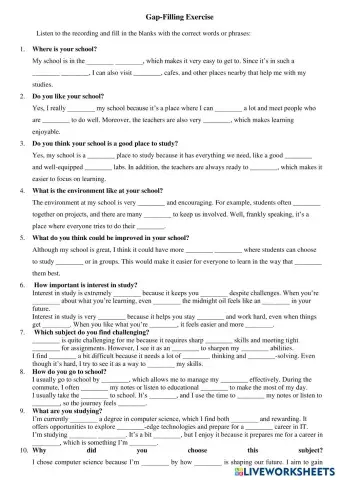
  1. Where is your school?
    My school is in the ________ ________, which makes it very easy to get to. Since it’s in such a ________ ________, I can also visit ________, cafes, and other places nearby that help me with my studies.
  2. Do you like your school?
    Yes, I really ________ my school because it’s a place where I can ________ a lot and meet people who are ________ to do well. Moreover, the teachers are also very ________, which makes learning enjoyable.
  3. Do you think your school is a good place to study?
    Yes, my school is a ________ place to study because it has everything we need, like a good ________ and well-equipped ________ labs. In addition, the teachers are always ready to ________, which makes it easier to focus on learning.
  4. What is the environment like at your school?
    The environment at my school is very ________ and encouraging. For example, students often ________ together on projects, and there are many ________ to keep us involved. Well, frankly speaking, it’s a place where everyone tries to do their ________.
  5. What do you think could be improved in your school?
    Although my school is great, I think it could have more ________ ________ where students can choose to study ________ or in groups. This would make it easier for everyone to learn in the way that ________ them best.
  6.  How important is interest in study?
    Interest in study is extremely ________ because it keeps you ________ despite challenges. When you’re ________ about what you’re learning, even ________ the midnight oil feels like an ________ in your future.
    Interest in study is very ________ because it helps you stay ________ and work hard, even when things get ________. When you like what you’re ________, it feels easier and more ________.
  7.  Which subject do you find challenging?
    ________ is quite challenging for me because it requires sharp ________ skills and meeting tight ________ for assignments. However, I see it as an ________ to sharpen my ________ abilities.
    I find ________ a bit difficult because it needs a lot of ________ thinking and ________-solving. Even though it’s hard, I try to see it as a way to ________ my skills.
  8. How do you go to school?
    I usually go to school by ________, which allows me to manage my ________ effectively. During the commute, I often ________ my notes or listen to educational ________ to make the most of my day.
    I usually take the ________ to school. It’s ________, and I use the time to ________ my notes or listen to ________, so the journey feels ________.
  9. What are you studying?
    I’m currently ________ a degree in computer science, which I find both ________ and rewarding. It offers opportunities to explore ________-edge technologies and prepare for a ________ career in IT.
    I’m studying ________ ________. It’s a bit ________, but I enjoy it because it prepares me for a career in ________, which is something I’m ________.
  10. Why did you choose this subject?
    I chose computer science because I’m ________ by how ________ is shaping our future. I aim to gain ________ in this field and use it to climb the ________ ladder.
    Well, I chose computer science because I’m really ________ in ________ and how it is ________ the world. I want to learn more about it and use this ________ to build my ________ career.

11.            What do you like most about your studies?

……………..is the balance between theoretical knowledge and practical application. For instance, during lab sessions, I gain hands-on …………………..which helps me sharpen my skills and stay ………………..

I like that my studies include both …………. and practice. For example, we have lab sessions where I can ………………. what I’ve learned. This makes studying more interesting and ……………….

     12.            Are you more interested in theoretical or practical subjects? Why?

I prefer …………… subjects because they allow me to gain hands-on experience and ………………….. real-world scenarios. This approach not only sharpens my skills but also builds my …………………. for future challenges.

I prefer practical subjects because I like to apply what I’ve learned in real situations. It makes learning more fun and gives me …………………… I can use in the future.

     13.            Do you find your studies difficult? Why or why not?

Sometimes, the workload can be…………………., especially when I have to meet tight deadlines. However, I stay motivated by setting ……………….. and managing my schedule effectively.

Sometimes my studies are a bit hard, especially when I have a lot of assignments or……………….. But I try to manage my time well and stay ………………….. which helps me deal with the workload.

14.  How do you usually prepare for exams?

I prepare for exams by ………………..a study schedule that helps me balance my workload. I also collaborate with classmates for group discussions and …………………. past papers to improve my understanding.

I prepare for exams by making a study plan so I can manage my time well. I also study with my classmates and practice past papers to …………………. my understanding of the topics.

15.  Do you prefer studying alone or with others? Why?

I prefer a mix of both. Studying alone helps me focus and ……………… my time effectively, while group study sessions are engaging and help me explore ………………….. perspectives.

I like both. When I study alone, I can ………………. better, but studying with others helps me learn from different ………………… and understand things more clearly

16.  What are your future plans after finishing your studies?

After completing my studies, I plan to ……………….. a career in software engineering. My ultimate goal is to climb the career ladder by gaining expertise in my field and making a meaningful impact in a reputable company.

After I …………….. my studies, I plan to work as a software engineer. I want to keep learning and improving my skills so I can build a ……………..career and contribute to interesting projects

  1.  
  2.  
  3.  


Digital life

Bahasa Inggris

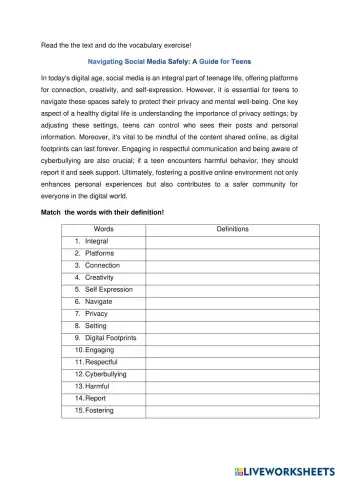
Read the the text and do the vocabulary exercise!

Navigating Social Media Safely: A Guide for Teens

In today's digital age, social media is an integral part of teenage life, offering platforms for connection, creativity, and self-expression. However, it is essential for teens to navigate these spaces safely to protect their privacy and mental well-being. One key aspect of a healthy digital life is understanding the importance of privacy settings; by adjusting these settings, teens can control who sees their posts and personal information. Moreover, it's vital to be mindful of the content shared online, as digital footprints can last forever. Engaging in respectful communication and being aware of cyberbullying are also crucial; if a teen encounters harmful behavior, they should report it and seek support. Ultimately, fostering a positive online environment not only enhances personal experiences but also contributes to a safer community for everyone in the digital world.

Match  the words with their definition!

Words

Definitions

  1. Integral


  1. Platforms


  1. Connection


  1. Creativity


  1. Self Expression


  1. Navigate


  1. Privacy


  1. Setting


  1. Digital Footprints


  1. Engaging


  1. Respectful


  1. Cyberbullying


  1. Harmful


  1. Report


  1. Fostering


  1. Digital spaces or applications that facilitate social interaction, creation, and sharing of content.
  2. The act of linking or joining together; in this context, it refers to relationships formed through social media.
  3. Encouraging the development or growth of something; in this context, it refers to creating a positive online environment.
  4. Essential or necessary for completeness; a fundamental part of something.
  5. The ability to produce original ideas or content; often expressed through artistic or innovative means.
  6. The expression of one’s thoughts, feelings, or ideas, particularly through creative outlets.
  7. The state of being free from public attention or scrutiny; protecting personal information from being shared without consent.
  8. Configurable options that allow users to control their online experience and manage their privacy.
  9. The trail of data one leaves behind when using the internet, which can be permanent and may have lasting implications.
  10. Involving oneself or participating actively in an activity or discussion.
  11. To find one's way through a complex environment or situation; in this case, refers to managing online interactions safely.
  12. Showing consideration and regard for others; important for positive interactions in online communication.
  13. The use of digital platforms to harass, threaten, or harm others; a serious issue in online communities.
  14. Causing or capable of causing damage or injury; can refer to negative behaviors or content encountered online.
  15. To inform authorities or relevant parties about inappropriate or harmful behavior, often used in the context of online safety.


Interactive Quiz

Methodology

  1. 1) Multiple choice

If we talk about very young learners , what age is correct?

  • 7-12 years old 
  • 2-5 years old
  • 3-6 years old

If we talk about young learners , what ages are incorrect?

  • 2-5 years old
  • 3-6 years old
  • 7-12 years old

According to these ages of the learners , which of these characteristics are correct?

  • Active processors of information 
  • Great range life of experiences
  • Spontaneous and eager to participate 
  • Participate with abstract concepts.
  • They decide what and why to study.
  • Enthusiastic to learn new things.

According to The Stages of  Cognitive Development . Choose the correct answer

Sensorimotor

  • The child is egocentric and he assumes that other people see the world as he does.
  • Children still have difficulties with abstract thinking.
  • Children only know the present.

Preoperational

  • The thinking is influenced by the way things appear rather than logical reasoning.
  • The infant learns about the world through their senses and actions .
  • They become less egocentric. 

Concrete Operational

  • They can think systematically and reason about what might be as well as what is .
  • Children still have difficulties with abstract thinking.
  • Children only know the present.

Formal Operational 

  • Children begin to think logically about concrete events.
  • The thinking is still intuitive and also demonstrates animism.
  • They can deal  with abstract  ideas and hypothetical with possible solutions. 


  1. 2) Match each disability  with the correct characteristic:


  1. 1. Visual Impairment                                         a. Difficulty with speech fluency
  2. 2. Hearing Disorder                                          b.  Cramped grip,sore hand
  3. 3. Speech and Language Impairment              c. Difficulty perceiving visual information
  4. 4. Mobility Impairment                                      d. Poor balance and posture
  5. 5. Down Syndrome                                          e. Difficulty with fine or gross motor coordination
  6. 6. Intellectual Disability                                    f. Difficulty sequencing information or events
  7. 7. Autism Spectrum Disorder                           g. Difficulty with speech fluency
  8. 8. Traumatic Brain Injury                                  h. Difficulty with memory and concentration
  9. 9. Dyslexia                                                        i.Difficulty with mobility and movement
  10. 10. Dysgraphia                                            j. Difficulty  reading aloud
  11. 11. Dyscalculia                                           k. Difficulty with auditory perception
  12. 12. Dyspraxia                                             l. Unpredictable and extreme reactions to changes in routines


  3) Choose the correct option: 

  1. 1. A good teacher has a contagious passion/indifference for teaching—one who loves his students and his work.
  2. 2. Teaching must be more than simply following an outline; it requires disorder/creativity.
  3. 3. Adding pace and humor to the class creates a positive environment where  goals/learners thrive.
  4. 4. A good teacher challenges students while maintaining a level of difficulty that is appropriate/demanding.
  5. 5. Being encouraging and patient helps students feel motivated to apply themselves inefficiently/diligently.
  6. 6. Taking an interest in students as individuals creates opportunities for exploration/engagement.
  7. 7. A good teacher knows grammar well and can explain concepts accurately/well.
  8. 8. Providing extra help and encouragement outside of class time shows appreciation/dedication for students' efforts.
  9. 9. Treating all students equally, regardless of background, fosters an environment conducive to improvement/progress.
  10. 10. A good teacher leaves emotional baggage outside the classroom to maintain a positive and effective class/atmosphere.

สร้างและปรับแต่งใบงานสำหรับทุกห้องเรียน

LiveWorksheets ทำให้คุณครู ผู้ปกครอง และผู้สอนแบบโฮมสคูล สามารถออกแบบและมอบสื่อการเรียนรู้ที่น่าสนใจได้อย่างง่ายดาย เพียงอัปโหลดไฟล์ PDF หรือเริ่มต้นสร้างใหม่ทั้งหมด คุณก็สามารถทำได้ทุกอย่าง ไม่ว่าจะเป็นใบงานคณิตศาสตร์แบบโต้ตอบ ใบงานอ่านจับใจความ ใบงานการคูณ หรือใบงานสำหรับเด็กอนุบาล ด้วยขั้นตอนเพียงไม่กี่คลิก เครื่องมือแก้ไขแบบลากและวางของเรารองรับทุกระดับชั้นและทุกวิชา ช่วยให้คุณปรับเนื้อหาให้ตรงกับแผนการสอน การบ้าน หรือแบบทดสอบ ครูสอนภาษาอังกฤษ (ESL) ยังสามารถสร้างใบงาน ESL แบบเฉพาะ เพิ่มตารางเสียงภาษาอังกฤษ หรือออกแบบกิจกรรม ESL เพื่อให้การเรียนสนุกและมีส่วนร่วมมากขึ้น สร้างกิจกรรมที่ปรับระดับได้ ตรวจอัตโนมัติ ช่วยประหยัดเวลา และสนับสนุนการเรียนรู้ของนักเรียนให้ดียิ่งขึ้น

คลังสื่อการเรียนรู้ครบวงจรสำหรับ K-12 และ ESL

เข้าถึงใบงานที่พร้อมใช้หลายพันชุด ครอบคลุมทุกวิชาในระดับ K-12 รวมถึงใบงานอนุบาล ใบงานคณิตศาสตร์ แบบฝึกการคูณ แบบฝึกอ่านจับใจความ และทรัพยากร ESL เลือกค้นหาตามชั้นเรียน วิชา หรือระดับทักษะ เพื่อให้ได้สิ่งที่คุณต้องการ ไม่ว่าจะสำหรับห้องเรียนประถม ทบทวนในระดับมัธยมต้น หรือการฝึกในระดับมัธยมปลาย ครู ESL ยังสามารถสำรวจคลังใบงาน ESL และกิจกรรมภาษาอังกฤษที่ออกแบบมาเพื่อรองรับผู้เรียนทุกระดับ เนื้อหาใหม่ถูกเพิ่มเข้ามาอย่างต่อเนื่อง LiveWorksheets จึงเป็นทรัพยากรที่ยืดหยุ่นและช่วยสร้างผลลัพธ์การเรียนรู้ที่ยั่งยืน