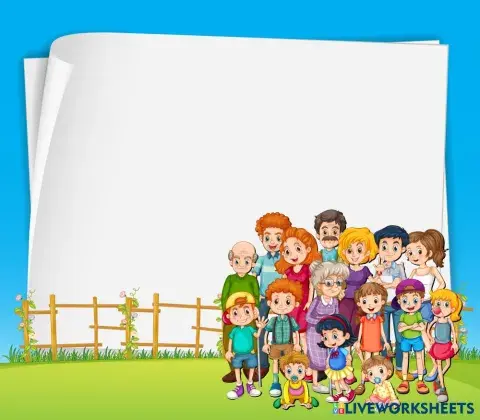
Рабочий лист для 3 класса на тему My family

Vocabulary - English Language

Страница 1

Разминка (Warm-up)🔸 Ответьте на вопросы словами Yes или No:

  1. A mother is a woman who has children.
  2. A father is a man who has no children.
  3. Brothers are boys with the same parents.
  4. Sisters are girls from different families.
  5. Grandparents have grandchildren.

Страница 2

Закрытые задания (Closed Tasks)

Задание №2. Сопоставьте членов семьи с картинками:

КартинкаЧлен семьи

👵Mother

👨Father

👦Brother

👧Sister

👴Grandfather

👵️‍💻Grandmother

Задание №3. Заполните таблицу:

Кто?Как зовут?

My motherAnn

My fatherJohn

My brotherTom

My sisterMary

Задание №4. Выберите правильный вариант:

  1. I love my _______ very much.a) dogb) familyc) car
  2. This is my __________. He works in an office.a) grandfatherb) unclec) father
  3. She helps me with homework. She’s my _______.a) grandmotherb) teacherc) sister

Задание №5. Найдите лишнее слово в каждой строке:

  1. Mother, father, house, brother
  2. Dog, cat, bird, family
  3. Car, bike, train, grandmother

Страница 3

Творческое задание (Creative Task)

Задание №6. Нарисуйте свою семью и подпишите каждого члена семьи по-английски.

Рисунок

Рефлексия (Reflection)✅ Что нового я узнал(-а)?📌 Какие трудности возникли?

Ответы (Answers)

Разминка:

  1. Yes
  2. No
  3. Yes
  4. No
  5. Yes

Задание №2:Картинки соответствуют указанным членам семьи.

Задание №3:Заполняйте правильно имена согласно образцу.

Задание №4:

  1. b) family
  2. c) father
  3. c) sister

Задание №5:

  1. House
  2. Family
  3. Grandmother

Past Simple vs Present Perfect

Practical English


  1. 1. Match the time expressions with the correct tense:

A:

• Since 2015

• Yesterday

• Just

• Last week

• Already

• Two days ago

• Ever

• In 2001


B:

1. Past Simple

2. Present Perfect


  1. 2. Fill in the blanks with the correct verb form:

1. We __________ (visit) the Louvre when we were in Paris.

2. She __________ (never / try) sushi before.

3. He __________ (finish) his homework an hour ago.

4. I __________ (just / call) you, but you didn’t answer.

5. They __________ (move) to New York in 2019.

6. She __________ (not / see) this movie yet.


  1. 3. Choose the correct option:

1. I (have seen / saw) this film twice.

2. She (wrote / has written) three books so far.

3. They (bought / have bought) a car last summer.

4. He (has lived / lived) in Rome for ten years, but now he’s in Milan.

5. We (just finished / have just finished) our project.


  1. 4. Rewrite the sentences using the other tense:

1. I have never been to Japan. → (Past Simple)

2. He bought a new phone last month. → (Present Perfect)

3. They have visited Spain several times. → (Past Simple)

4. She didn’t call me yesterday. → (Present Perfect)

5. We have known each other for five years. → (Past Simple)


  1. 5. Correct the mistakes in the sentences:

1. I have seen him yesterday. ❌

2. He has buy a new laptop. ❌

3. They lived here since 2010. ❌

4. We didn’t never go to that restaurant. ❌

5. Have you ever went to London? ❌


The future of Technology

English as a Second Language (ESL)

Technology and AI Worksheet

Nickname____________________     Number_____________

Part 1: Vocabulary Matching

Match the words on the left with the correct definitions on the right.

              Vocabulary                                                                                   Definitions


1. Robot                                                                                        A. A smart computer that can think and learn.

2. Artificial Intelligence (AI)                                                        B. A car that drives without a person.

3. Voice Assistant                                                                        C. A phone that can use the internet.

4. Smartphone                                                                             D. A machine that can do things like a human

5. Self-driving Car                                                                       E. A machine or app that listens and talks (e.g., Siri) 

6. Automation                                                                              F. Machines doing work instead of people


Part 2: Reading Comprehension

Read the short passage and answer the questions.

AI in Our Lives

AI is everywhere! Many people use AI every day. When you ask Siri or Alexa a question, you are using AI. Smartphones use AI to recognize faces and voices. Some cars can even drive themselves! AI is also helping doctors and teachers. In the future, AI will do more jobs, but some people worry it might take jobs from humans.

Questions:

What is an example of AI?


 _____________________________________________________________________

How do smartphones use AI?


 ______________________________________________________________________

What can some cars do with AI?


 ______________________________________________________________________

How can AI help people?


 ______________________________________________________________________

What is one problem people worry about with AI?


 ______________________________________________________________________

Part 3: Writing Activity

Write 3 sentences about AI in the future using "will" or "won’t."

  1.  

1. ____________________________________________________________________ 

  1.  

2. ______________________________________________________________________

  1.  

3. ______________________________________________________________________


Present Simple

English language

​​​​​​

Что такое Present Simple?

Это простое настоящее время, обозначающее действие в самом широком смысле этого слова. Одна из самых распространенных и простых форм в английском языке для описания действий.

Действия могут быть связаны с привычками, хобби, ежедневным событием вроде подъема по утрам или чем-то, что случается регулярно.


Как образуется Present Simple?

Нет ничего проще, чем поставить глагол в форму Present Simple. Для этого нужно убрать у глагола в инфинитиве частицу «to» и поставить глагол после подлежащего. Это и есть основное правило Present Simple.


Утверждение:

I / We / You / They + V

She / He / It + V + s (es)

I go to work every day — Я хожу на работу каждый день.

They usually play tennis every weekend — Они обычно играют в теннис каждые выходные.

She brings me coffee every morning — Она приносит мне кофе каждое утро.

It snows in winter — Зимой идет снег.

ВАЖНО: В Present Simple форма глагола практически всегда совпадает с изначальной. Исключение составляет третье лицо единственного числа (he / she / it) — к нему прибавляется окончание -s:

I ride — She rides

I dream — He dreams

Если глагол оканчивается на -s, -ss, -sh, -ch, -x, -o, то к нему прибавляется окончание -es

I wish — She wishes

I teach — She teaches

Если глагол оканчивается на -y, а ему предшествует согласная, то к нему прибавляется окончание -es, но -y заменяется на -i

I try — She tries

I fly — He flies

Если глагол оканчивается на -y, а ему предшествует гласная, то к нему также прибавляется окончание -s, но -y не меняется.

I play — She plays

I stay — He stays


Отрицание:

Чтобы составить отрицательное предложение — нужно поставить вспомогательный глагол между подлежащим и глаголом.

I / We / You / They + do not (don’t) + V

She / He / It + does not (doesn’t) + V

I don’t go to school every day — Я не хожу в школу каждый день

They don’t drink beer — Они не пьют пиво

She doesn’t like the weather in London — Ей не нравится погода в Лондоне

He doesn't drive the car — Он не водит машину

Отрицание также можно выразить при помощи отрицательных местоимений и наречий.

Nobody speaks Arabic — Никто не говорит по-арабски

I do nothing — Я ничего не делаю


Вопрос:

При составлении вопросительных предложений вспомогательный глагол ставится перед подлежащим и последующим глаголом. Обычно — в начало предложения.

Do + I / we / you / they + V ?

Does + she / he / it  + V ?

Do you like pizza? — Тебе нравится пицца?

Do they play football? — Они играют в футбол?

Does she learn Russian? — Она изучает русский язык?

Does he live in Spain? — Он живет в Испании?

Иногда в вопросительном предложении употребляются question words (вопросительные слова) и фразы, которые помогают задать более точный и корректный вопрос собеседнику.

К таким словам относятся: how long (как долго), why (почему), where (где) и другие. Как и в других временах, они ставятся в самом начале предложения перед вопросительной конструкцией Present Simple.

QW + do (does) + I / We / You / They / She / He / It + V ?

Where does he live in Prague? — Где он живет в Праге?

Why do you drink green tea? — Почему ты пьешь зеленый чай?

Когда в предложении с Present Simple появляется вспомогательный глагол — у основного глагола пропадает окончание -s. Считайте, что это такой своеобразный «магнит», который «перетягивает» к себе это окончание. Это касается отрицательной и вопросительной форм Present Simple.

ВАЖНО: иногда вспомогательный глагол do / does можно встретить и в утвердительных предложениях, чтобы добавить экспрессии и яркости высказыванию.

I do want to try this — Я действительно хочу это попробовать

Mary does know how to cook — Мэри действительно умеет готовить


Глагол to be в Present Simple

Глагол to be (быть) всегда является особенным и его употребление во времени Present Simple зависит от подлежащего. Он имеет 3 разных формы:


  • am (для 1-го лица единственного числа: I)
  • is (для 3-го лица единственного числа: she / he / it)
  • are (для 1-го, 2-го и 3-го лица множественного числа: we / you / they)

I am ready — Я готов

She is ready — Она готова

We are ready — Мы готовы


Когда используется Present Simple?

Present Simple используется в описании действий, которые происходят постоянно, на регулярной

основе, но не привязаны к моменту речи.

Употребление Present Simple уместно в тех случаях, когда мы хотим рассказать о нашей ежедневной рутине, достоверно известных фактах, действиях в широком смысле слова или расписании поездов.


Регулярные, повторяющиеся действия:

I often go to the bar — Я часто хожу в бар

They play music every Sunday — Они играют музыку каждое воскресенье


Действие в широком смысле слова (без привязки к моменту речи):

I live in Dublin — Я живу в Дублине.

She speaks Chinese — Она говорит по-китайски.


Факты, о которых знают все:

The Earth rotates around its axis — Земля вращается вокруг своей оси.

Moscow is the largest city in Russia — Москва самый большой город в России


Будущие действия, которые произойдут согласно расписанию:

The airplane takes off at 4.30 am — Самолет взлетит в 4.30 утра.

The train leaves at 9 pm tomorrow — Поезд отходит завтра в 9 вечера.


Рецепты и инструкции (используется вместо повелительного наклонения):

You push the red button to turn on the radio — Нажмите на красную кнопку, чтобы включить радио

First you turn left and then you go down the street — Сперва поверните налево, затем идите до конца улицы

При перечислении каких-то действий и их определенной последовательности также используется время Present Simple

You take the bus into the city center and then you take a taxi to the restaurant — Вы едете на автобусе до центра города, а затем берете такси до ресторана.

Иногда время Present Simple используется в отношении прошедшего времени. Например, в заголовках газет (указывают на факт произошедшего действия) или в рассказе о событии (когда мы говорим о ком-то и его действиях).

The bus with American tourists crashes in India — В Индии разбился автобус с американскими туристами

I met John last week. He comes to me and says: “Hello, old friend” — На прошлой неделе я встретил Джона. Он подошел ко мне и сказал: «Привет, старый друг»


Маркеры времени Present Simple

Для того, чтобы лучше сориентироваться где и когда употребляются глаголы Present Simple — обратите внимание на особые маркеры в тексте.

Такими «маячками» для Present Simple являются наречия (often, always, usually, etc.) и указатели времени (every day, in the morning, on Fridays, etc.).

She always drinks coffee in the morning — Она всегда пьет кофе по утрам

I usually wake up at 6 am — Обычно я просыпаюсь в 6 утра

They often talk about sport — Они часто говорят о спорте

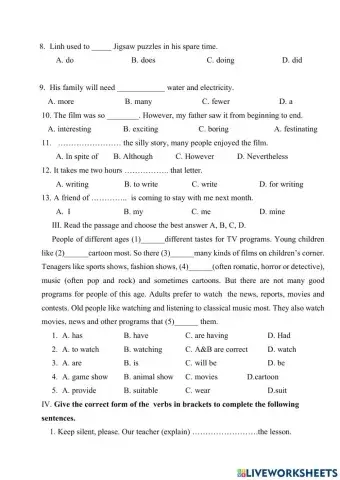
Mid-course test MIFA301 LIVE

English

GRAMMAR AND VOCABULARY TEST

I - Choose the correct answer (14 points)

1. Thomas Edison, ____________ was American, invented many things, including the light bulb.

A. which                    B. who                        C. was                         D. that

2. My MP3 player is better than __________!

A. you                         B. your                       C. yours                      D. mine

3. "What happened to the old postman?"

- "He ____________ to a new neighborhood to work".

A. has sent                  B. was send                C. was sent                 D. sent

4. This job is much ____________ than the last one!

A. hard                       B. hardest                   C. harder                    D. more hard

5. Our company is moving into a ____________ building next week.

A. larger                     B. largest                    C. more large             D. most large

6. What’s the ___________job you’ve ever had?

A. most good             B. best                        C. better                      D. good

7. Those towns ____________ you were looking at in Gaul are small.

A. who                        B. where                     C. which                     D. whom

8. The women ____________ I gave the money were glad.

A. to whom                B. to who                    C. for whom               D. for that

9. I know a boy ____________ name is John.


A. who                        B. whose                    C. whom                    D. that

10. This is the place ____________ we have tea.

A. what                       B. where                      C. which                    D. that

11. The house ____________ in the storm has now been rebuilt.

A. destroyed              B. destroying              C. which destroyed    D. was destroyed

12. The man ____________ at the blackboard is our teacher.

A. stood                     B. stands                     C. standing                 D. to stand

13. Gold ____________ in California in the nineteenth century.

A. was discovered        B. has been discovered     C. was discovere       D. they discovered

14. If I ____________ 20 years younger, I ____________ her.

A. were/would love   B. am/will love                 C. were/ loves      D. had/would love


II - Change the verbs in the brackets (10 points)

1. My bike ________________ (steal)! Call the police!

2. “The longest fish in the contest was eighteen inches long.”

- “It ________________ (catch) by Thelma Rivers.”

3. “What ____________________ (you do) when you saw the man?”, the police officer asked.

4. Do you think Curtis ___________________ (win) the car race tomorrow?

5. It’s the first time I ___________________ (get) all the answers right in a test!

6. Watch out, or you __________________ (fall) off the boat!

7. The exam ___________________ (already start) when Jimmy finally found the right room.

8. I’m tired because I ___________________ (work) since eight this morning.

9. I broke my leg when Tony and I ___________________ (practice) for the school sports day.

10. I ______________________ (travel) around the world one day.


III - Finish the following sentences without changing the meaning of the sentences printed before them. (10 points)

1. I usually get up earlier than my wife.

=> My wife __________________________________________________________________ .

2. You drink too much coffee, that’s why you can’t sleep.

=> If you ____________________________________________________________________ .

3. I’ve never played this game before.

=> This is the first time _________________________________________________________ .

4. He hides the broken cup in the drawer.

=> The broken cup ____________________________________________________________ .

5. The new words are very difficult. I have to learn them. (use “which”)

=> The new words ____________________________________________________________ .

6. Mary’s coat is more expensive than Kate’s.

=> Kate’s coat ________________________________________________________________ .

7. My mother is retired. She has decided to learn Chinese. (use “who”)

=> My mother ________________________________________________________________ .

8. I’m not good at persuading people. (use “Wish”)

=> I  ________________________________________________________________________ .

9. I missed the bus yesterday. I still went to school on time. (use “Although”) =>__________________________________________________________________________ .

10. Lucy came down with a flu last week. She didn’t go to work yesterday. (use “because”) =>__________________________________________________________________________ .


IV. Fill in the blank with one word (15 points)  and make 3 compound sentences, 3 complex sentences using the words given. (6 points)

1. Have a talent ________

2. _______ the exam(s) with flying colors

3. Be a _________ learner

4. Miss/meet the ___________

5. Get __________ in heavy traffic

6. Have a healthy and balanced _______

7. Fall _____ with

8. Strike up a _______________

9. Have a lot ______ common

10. _______ my own business

11. Have good promotion ________________

12. Get _______ shape

13. Have a heavy ___________

14. ___________ a work-life balance

15. Earn a _________ salary

Mid-course test MIFA301 LIVE

English

GRAMMAR AND VOCABULARY TEST

I - Choose the correct answer (14 points)

1. Thomas Edison, ____________ was American, invented many things, including the light bulb.

A. which                    B. who                        C. was                         D. that

2. My MP3 player is better than __________!

A. you                         B. your                       C. yours                      D. mine

3. "What happened to the old postman?"

- "He ____________ to a new neighborhood to work".

A. has sent                  B. was send                C. was sent                 D. sent

4. This job is much ____________ than the last one!

A. hard                       B. hardest                   C. harder                    D. more hard

5. Our company is moving into a ____________ building next week.

A. larger                     B. largest                    C. more large             D. most large

6. What’s the ___________job you’ve ever had?

A. most good             B. best                        C. better                      D. good

7. Those towns ____________ you were looking at in Gaul are small.

A. who                        B. where                     C. which                     D. whom

8. The women ____________ I gave the money were glad.

A. to whom                B. to who                    C. for whom               D. for that

9. I know a boy ____________ name is John.


A. who                        B. whose                    C. whom                    D. that

10. This is the place ____________ we have tea.

A. what                       B. where                      C. which                    D. that

11. The house ____________ in the storm has now been rebuilt.

A. destroyed              B. destroying              C. which destroyed    D. was destroyed

12. The man ____________ at the blackboard is our teacher.

A. stood                     B. stands                     C. standing                 D. to stand

13. Gold ____________ in California in the nineteenth century.

A. was discovered        B. has been discovered     C. was discovere       D. they discovered

14. If I ____________ 20 years younger, I ____________ her.

A. were/would love   B. am/will love                 C. were/ loves      D. had/would love


II - Change the verbs in the brackets (10 points)

1. My bike ________________ (steal)! Call the police!

2. “The longest fish in the contest was eighteen inches long.”

- “It ________________ (catch) by Thelma Rivers.”

3. “What ____________________ (you do) when you saw the man?”, the police officer asked.

4. Do you think Curtis ___________________ (win) the car race tomorrow?

5. It’s the first time I ___________________ (get) all the answers right in a test!

6. Watch out, or you __________________ (fall) off the boat!

7. The exam ___________________ (already start) when Jimmy finally found the right room.

8. I’m tired because I ___________________ (work) since eight this morning.

9. I broke my leg when Tony and I ___________________ (practice) for the school sports day.

10. I ______________________ (travel) around the world one day.


III - Finish the following sentences without changing the meaning of the sentences printed before them. (10 points)

1. I usually get up earlier than my wife.

=> My wife __________________________________________________________________ .

2. You drink too much coffee, that’s why you can’t sleep.

=> If you ____________________________________________________________________ .

3. I’ve never played this game before.

=> This is the first time _________________________________________________________ .

4. He hides the broken cup in the drawer.

=> The broken cup ____________________________________________________________ .

5. The new words are very difficult. I have to learn them. (use “which”)

=> The new words ____________________________________________________________ .

6. Mary’s coat is more expensive than Kate’s.

=> Kate’s coat ________________________________________________________________ .

7. My mother is retired. She has decided to learn Chinese. (use “who”)

=> My mother ________________________________________________________________ .

8. I’m not good at persuading people. (use “Wish”)

=> I  ________________________________________________________________________ .

9. I missed the bus yesterday. I still went to school on time. (use “Although”) =>__________________________________________________________________________ .

10. Lucy came down with a flu last week. She didn’t go to work yesterday. (use “because”) =>__________________________________________________________________________ .


IV. Fill in the blank with one word (15 points)  and make 3 compound sentences, 3 complex sentences using the words given. (6 points)

1. Have a talent ________

2. _______ the exam(s) with flying colors

3. Be a _________ learner

4. Miss/meet the ___________

5. Get __________ in heavy traffic

6. Have a healthy and balanced _______

7. Fall _____ with

8. Strike up a _______________

9. Have a lot ______ common

10. _______ my own business

11. Have good promotion ________________

12. Get _______ shape

13. Have a heavy ___________

14. ___________ a work-life balance

15. Earn a _________ salary

สร้างและปรับแต่งใบงานสำหรับทุกห้องเรียน

LiveWorksheets ทำให้คุณครู ผู้ปกครอง และผู้สอนแบบโฮมสคูล สามารถออกแบบและมอบสื่อการเรียนรู้ที่น่าสนใจได้อย่างง่ายดาย เพียงอัปโหลดไฟล์ PDF หรือเริ่มต้นสร้างใหม่ทั้งหมด คุณก็สามารถทำได้ทุกอย่าง ไม่ว่าจะเป็นใบงานคณิตศาสตร์แบบโต้ตอบ ใบงานอ่านจับใจความ ใบงานการคูณ หรือใบงานสำหรับเด็กอนุบาล ด้วยขั้นตอนเพียงไม่กี่คลิก เครื่องมือแก้ไขแบบลากและวางของเรารองรับทุกระดับชั้นและทุกวิชา ช่วยให้คุณปรับเนื้อหาให้ตรงกับแผนการสอน การบ้าน หรือแบบทดสอบ ครูสอนภาษาอังกฤษ (ESL) ยังสามารถสร้างใบงาน ESL แบบเฉพาะ เพิ่มตารางเสียงภาษาอังกฤษ หรือออกแบบกิจกรรม ESL เพื่อให้การเรียนสนุกและมีส่วนร่วมมากขึ้น สร้างกิจกรรมที่ปรับระดับได้ ตรวจอัตโนมัติ ช่วยประหยัดเวลา และสนับสนุนการเรียนรู้ของนักเรียนให้ดียิ่งขึ้น

คลังสื่อการเรียนรู้ครบวงจรสำหรับ K-12 และ ESL

เข้าถึงใบงานที่พร้อมใช้หลายพันชุด ครอบคลุมทุกวิชาในระดับ K-12 รวมถึงใบงานอนุบาล ใบงานคณิตศาสตร์ แบบฝึกการคูณ แบบฝึกอ่านจับใจความ และทรัพยากร ESL เลือกค้นหาตามชั้นเรียน วิชา หรือระดับทักษะ เพื่อให้ได้สิ่งที่คุณต้องการ ไม่ว่าจะสำหรับห้องเรียนประถม ทบทวนในระดับมัธยมต้น หรือการฝึกในระดับมัธยมปลาย ครู ESL ยังสามารถสำรวจคลังใบงาน ESL และกิจกรรมภาษาอังกฤษที่ออกแบบมาเพื่อรองรับผู้เรียนทุกระดับ เนื้อหาใหม่ถูกเพิ่มเข้ามาอย่างต่อเนื่อง LiveWorksheets จึงเป็นทรัพยากรที่ยืดหยุ่นและช่วยสร้างผลลัพธ์การเรียนรู้ที่ยั่งยืน