Sentence Structures

English as a Second Language (ESL)

1. Simple Sentence

A simple sentence contains only one independent clause (a complete thought). It has a subject and a verb, and it expresses a complete idea.

Structure:

Subject + Verb (and sometimes an object or complement)

Examples:

  1. I eat lunch every day.
    (Subject: "I", Verb: "eat")
  2. She studied for the exam.
    (Subject: "She", Verb: "studied")
  3. The dog barked loudly.
    (Subject: "The dog", Verb: "barked")

2. Compound Sentence

A compound sentence consists of two or more independent clauses joined by a coordinating conjunction (for, and, nor, but, or, yet, so), or by a semicolon.

Structure:

Independent clause + coordinating conjunction + independent clause

Examples:

  1. I wanted to go to the party, but I was too tired.
    (Two independent clauses: "I wanted to go to the party" and "I was too tired," joined by "but")
  2. She likes reading books, and he enjoys playing sports.
    (Two independent clauses: "She likes reading books" and "He enjoys playing sports," joined by "and")
  3. I am studying for my test; I will take a break later.
    (Two independent clauses joined by a semicolon)

3. Complex Sentence

A complex sentence contains one independent clause and at least one dependent clause (a clause that cannot stand alone and does not express a complete thought). Dependent clauses are connected to the independent clause by a subordinating conjunction (because, although, if, when, since, etc.).

Structure:

Independent clause + subordinating conjunction + dependent clause

Examples:

  1. I stayed home because it was raining.
    (Independent clause: "I stayed home" and dependent clause: "because it was raining")
  2. Although she was tired, she finished her homework.
    (Independent clause: "She finished her homework" and dependent clause: "although she was tired")
  3. We will go to the park if it doesn't rain.
    (Independent clause: "We will go to the park" and dependent clause: "if it doesn't rain")

4. Compound-Complex Sentence

A compound-complex sentence is a combination of both a compound sentence and a complex sentence. It contains at least two independent clauses and at least one dependent clause.

Structure:

Independent clause + coordinating conjunction + independent clause + subordinating conjunction + dependent clause

Examples:

  1. I wanted to go to the beach, but it started raining, so we stayed home.
    (Independent clauses: "I wanted to go to the beach" and "it started raining," joined by "but"; dependent clause: "so we stayed home")
  2. Although I studied hard, I didn't pass the test, and I felt disappointed.
    (Independent clauses: "I didn't pass the test" and "I felt disappointed," joined by "and"; dependent clause: "Although I studied hard")
  3. She loves reading books, and she often reads late into the night, because she finds it relaxing.
    (Independent clauses: "She loves reading books" and "She often reads late into the night," joined by "and"; dependent clause: "because she finds it relaxing")

Social Media

English as a Second Language (ESL)

The digital landscape has put increased pressure on teenagers today, and we feel it. There are so many social media channels: Facebook, Twitter, Instagram, Snapchat, Tumblr, you name it. I made a conscious decision to avoid Snapchat and Instagram because of the social pressure I saw them putting on my 14-year-old little sister. If my mum turned off the WiFi at 11pm, my sister would beg me to turn my phone into a hotspot1. She always needed to load her Snapchat stories one more time, or to reply to a message that had come in two minutes ago because she didn’t want her friend to feel ignored. If I refused, saying she could respond in the morning, I’d get the “You’re ruining my social life” speech. Even as a teenager as well, I sometimes find this craze a little baffling.

A new study has found that teenagers who engage with social media during the night could be damaging their sleep and increasing their risk of anxiety and depression. Teenagers spoke about the pressure they felt to make themselves available 24/7 and the resulting anxiety if they did not respond immediately to texts or posts. Teens are so emotionally invested in social media that a fifth of secondary school pupils will wake up at night and log on just to make sure they don’t miss out. Perhaps the worst thing about this is that teenagers need more sleep than adults do, so night-time social media use could be detrimental to their health. A lack of sleep can make teenagers tired, irritable, and depressed.

During the summer holidays, I lost my phone. And for the week that I was phoneless, it felt like a disaster. I love my phone. It gives me quick access to information and allows me to be constantly looped in with my friends, to know exactly what is going on in their lives. So when I didn’t have my phone for a week, I felt a slight sense of FOMO, or if you’re not up to speed with the lingo, fear of missing out. By the end of the week, I’d got used to not having a phone and I’d quite enjoyed the break from social media. But there was still a lingering sense of sadness at the back of my mind that there would be conversations I had missed, messages that had been sent, funny videos shared and night-time chats that I would probably never get to see.

The worst present

English as a Second Language (ESL)

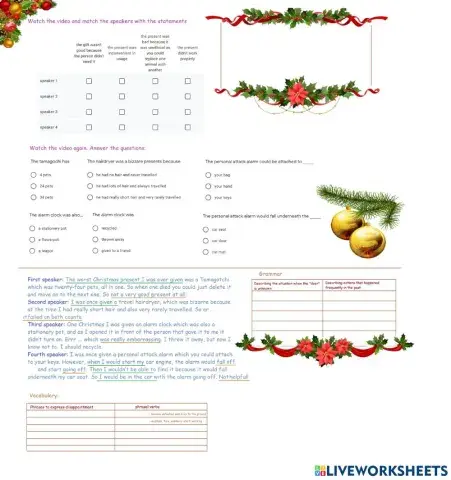
The text is taken from https://learnenglishteens.britishcouncil.org/study-break/video-zone/wor…
The first task is different from the source. The second one is the same. Some activities for deducing the meaning were added and the follow-up activity is a discussion of the worst presents using passive voice and would.

สร้างและปรับแต่งใบงานสำหรับทุกห้องเรียน

LiveWorksheets ทำให้คุณครู ผู้ปกครอง และผู้สอนแบบโฮมสคูล สามารถออกแบบและมอบสื่อการเรียนรู้ที่น่าสนใจได้อย่างง่ายดาย เพียงอัปโหลดไฟล์ PDF หรือเริ่มต้นสร้างใหม่ทั้งหมด คุณก็สามารถทำได้ทุกอย่าง ไม่ว่าจะเป็นใบงานคณิตศาสตร์แบบโต้ตอบ ใบงานอ่านจับใจความ ใบงานการคูณ หรือใบงานสำหรับเด็กอนุบาล ด้วยขั้นตอนเพียงไม่กี่คลิก เครื่องมือแก้ไขแบบลากและวางของเรารองรับทุกระดับชั้นและทุกวิชา ช่วยให้คุณปรับเนื้อหาให้ตรงกับแผนการสอน การบ้าน หรือแบบทดสอบ ครูสอนภาษาอังกฤษ (ESL) ยังสามารถสร้างใบงาน ESL แบบเฉพาะ เพิ่มตารางเสียงภาษาอังกฤษ หรือออกแบบกิจกรรม ESL เพื่อให้การเรียนสนุกและมีส่วนร่วมมากขึ้น สร้างกิจกรรมที่ปรับระดับได้ ตรวจอัตโนมัติ ช่วยประหยัดเวลา และสนับสนุนการเรียนรู้ของนักเรียนให้ดียิ่งขึ้น

คลังสื่อการเรียนรู้ครบวงจรสำหรับ K-12 และ ESL

เข้าถึงใบงานที่พร้อมใช้หลายพันชุด ครอบคลุมทุกวิชาในระดับ K-12 รวมถึงใบงานอนุบาล ใบงานคณิตศาสตร์ แบบฝึกการคูณ แบบฝึกอ่านจับใจความ และทรัพยากร ESL เลือกค้นหาตามชั้นเรียน วิชา หรือระดับทักษะ เพื่อให้ได้สิ่งที่คุณต้องการ ไม่ว่าจะสำหรับห้องเรียนประถม ทบทวนในระดับมัธยมต้น หรือการฝึกในระดับมัธยมปลาย ครู ESL ยังสามารถสำรวจคลังใบงาน ESL และกิจกรรมภาษาอังกฤษที่ออกแบบมาเพื่อรองรับผู้เรียนทุกระดับ เนื้อหาใหม่ถูกเพิ่มเข้ามาอย่างต่อเนื่อง LiveWorksheets จึงเป็นทรัพยากรที่ยืดหยุ่นและช่วยสร้างผลลัพธ์การเรียนรู้ที่ยั่งยืน