29.1 homework

Grammar - English Language

Câu 1. She ___ to school every day.
A. go
B. goes
C. is going
D. went

Câu 2. They ___ TV when I came home.
A. watch
B. watched
C. were watching
D. are watching

Câu 3. We ___ this movie before.
A. see
B. saw
C. have seen
D. will see

Câu 4. He ___ English for 5 years.
A. learns
B. learned
C. has learned
D. is learning

Câu 5. She is ___ than her sister.
A. tall
B. taller
C. tallest
D. more tall

Câu 6. This is the ___ book I’ve ever read.
A. interesting
B. more interesting
C. most interesting
D. interest

Câu 7. They ___ to Hanoi tomorrow.
A. go
B. went
C. will go
D. have gone

Câu 8. My father usually ___ up at 6 a.m.
A. get
B. gets
C. got
D. is getting

Câu 9. While she ___, the phone rang.
A. sleeps
B. slept
C. was sleeping
D. is sleeping

Câu 10. I ___ my homework yet.
A. don’t finish
B. didn’t finish
C. haven’t finished
D. won’t finish

Câu 11. This exercise is ___ than the last one.
A. easy
B. easier
C. easiest
D. more easy

Câu 12. He ___ football yesterday.
A. plays
B. played
C. is playing
D. has played

Câu 13. She ___ a letter right now.
A. writes
B. wrote
C. is writing
D. has written

Câu 14. They ___ each other since 2020.
A. know
B. knew
C. have known
D. are knowing

Câu 15. This is the ___ day of my life.
A. happy
B. happier
C. happiest
D. more happy

Câu 16. We ___ lunch when it started to rain.
A. have
B. had
C. were having
D. are having

Câu 17. She ___ speak English very well.
A. can
B. must
C. should
D. need

Câu 18. I ___ him tomorrow.
A. meet
B. met
C. will meet
D. have met

Câu 19. This house is ___ than that one.
A. big
B. bigger
C. biggest
D. more bigger

Câu 20. He ___ to music at the moment.
A. listens
B. listened
C. is listening
D. has listened

simple past tense

Writing - English Language

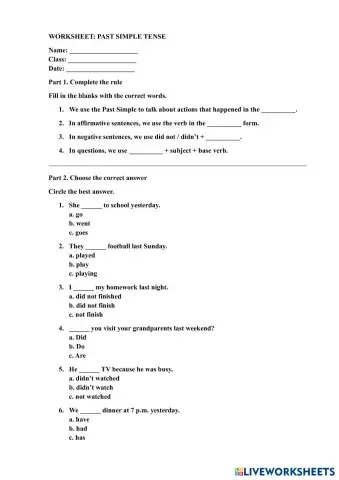
WORKSHEET: PAST SIMPLE TENSE  

Name: ____________________  
Class: ____________________  
Date: ____________________  

Part 1. Complete the rule  

Fill in the blanks with the correct words.  

     1.   We use the Past Simple to talk about actions that happened in the __________.  

    2.   In affirmative sentences, we use the verb in the __________ form.  

    3.   In negative sentences, we use did not / didn’t + __________.  

    4.   In questions, we use __________ + subject + base verb.  


Part 2. Choose the correct answer  

Circle the best answer.  

     1.   She ______ to school yesterday.  
         a. go  
         b. went  
         c. goes  

    2.   They ______ football last Sunday.  
         a. played  
         b. play  
         c. playing  

    3.   I ______ my homework last night.  
         a. did not finished  
         b. did not finish  
         c. not finish  

    4.   ______ you visit your grandparents last weekend?  
         a. Did  
         b. Do  
         c. Are  

    5.   He ______ TV because he was busy.  
         a. didn’t watched  
         b. didn’t watch  
         c. not watched  

    6.   We ______ dinner at 7 p.m. yesterday.  
         a. have  
         b. had  
         c. has  

----------------------- Page 2-----------------------

    7.   My teacher ______ me a very interesting question.  
         a. ask  
         b. asked  
         c. asking  

    8.   ______ they go to the library yesterday?  
         a. Were  
         b. Did  
         c. Do  


Part 3. Put the verbs in brackets into the Past Simple  

     1.   I __________ (watch) a movie last night.  

    2.   She __________ (go) to the supermarket yesterday.  

    3.   We __________ (study) English for the test.  

    4.   He __________ (not / come) to class last Monday.  

    5.   __________ you __________ (finish) your project yesterday?  

    6.   They __________ (see) their teacher in the hallway.  

    7.   My friends __________ (play) badminton after school.  

    8.   I __________ (not / understand) the question.  

    9.   __________ she __________ (call) you last night?  

     10. We __________ (eat) breakfast very early yesterday.  


Part 4. Change the sentences  

Rewrite the sentences into negative or question form.  

     1.   She visited her aunt last weekend.  
         → Negative: ______________________________________  

    2.   They studied in the library yesterday.  
         → Question: ______________________________________  

    3.   He cleaned his room yesterday afternoon.  
         → Negative: ______________________________________  

    4.   You watched the football match last night.  
         → Question: ______________________________________  

    5.   I finished my homework before dinner.  
         → Negative: ______________________________________  

----------------------- Page 3-----------------------

    6.   Lan went to school by bus yesterday.  
         → Question: ______________________________________  


Part 5. Find and correct the mistakes  

     1.   She didn’t went to school yesterday.  
         → ______________________________________  

    2.   Did he studied for the exam?  
         → ______________________________________  

    3.   We was very tired after class.  
         → ______________________________________  

    4.   They not play basketball last Sunday.  
         → ______________________________________  

    5.   I eated lunch at 12 o’clock.  
         → ______________________________________  

    6.   Did you went to the bookshop yesterday?  
         → ______________________________________  


Part 6. Unscramble the words  

Put the words in the correct order.  

     1.   yesterday / to / went / I / school  
         → ______________________________________  

    2.   not / she / did / coffee / drink  
         → ______________________________________  

    3.   last night / did / what / do / you / ?  
         → ______________________________________  

    4.   watched / we / a film / yesterday evening  
         → ______________________________________  

    5.   they / the test / did / pass / ?  
         → ______________________________________  


Part 7. Reading and gap-fill  

Read the passage and fill in the blanks with the correct Past Simple form of the verbs in  
brackets.  

Yesterday, Mai __________ (wake) up at 6:00 a.m. She __________ (have) breakfast with  
her family and then __________ (go) to university. In the morning, she __________  

----------------------- Page 4-----------------------

(attend) two classes. After lunch, she __________ (meet) her friends in the library. They  
__________ (study) together for two hours. In the evening, Mai __________ (return)  
home, __________ (eat) dinner, and __________ (do) her homework. She __________  
(sleep) at 10:30 p.m.  


Part 8. Speaking / Writing  

Answer the questions in full sentences.  

     1.   What did you do yesterday morning?  
         → ______________________________________  

    2.   Did you study English last night?  
         → ______________________________________  

    3.   Where did you go last weekend?  
         → ______________________________________  

    4.   What did you eat for dinner yesterday?  
         → ______________________________________  

    5.   Did you watch TV yesterday? Why / Why not?  
         → ______________________________________  
 

Writing 4a cause and effect essay

English as a Second Language (ESL)

   Paragraph 1

    1-Where did the writer illustrate the purpose of the text?

     --------------------------------------------------------------------------

    2-How did the writer introduce the topic?

     ------------------------------------------------------------------

  Paragraph 2

  1-What is the main cause (reason) of global warming?

    --------------------------------------------------------------------------

    2-How did the writer explain these reasons?

   --------------------------------------------------------------------------

     3-Did the writer use linking words? Mention them.

   --------------------------------------------------------------------------


     Paragraph 3

  1-How many negative effects (consequences) of global warming did the writer mention? What are they?

   ---------------------------------------------------

  2-What did the writer use to explain each effect?

     ------------------------------------------------------------------

  3-How did the writer link between them?

  ---------------------------------------------------------------------


  Paragraph 4

  1-How did the writer start the last paragraph?

   ------------------------------------------------------------------------------------

    2-What did the writer use at the end of the paragraph? Why?

    ------------------------------------------------------------------------------------

    3-Did the writer state his/her opinion? Why do you think?

    ------------------------------------------------------------------------------------

Tenses exercise

Exercise

Complete the sentences using the correct tense with the given verb in the parenthesis.

You should use one of these tenses: “Simple Present Tense, Simple Past Tense or Present Continuous Tense”


1. They _________ ( watch ) a movie every Friday evening.


2. Yesterday, we __________ ( visit ) our grandparents.


3. The train _________ ( depart ) from the station at 9:30 a.m. tomorrow.


4. Alex is not here now, he __________ ( play ) football with his friends.


5. Last year, we __________ ( travel ) to Spain.


6. We  _______ (visit) the museum on Saturday.


7. Our flight _______ (leave) at 6:45 p.m. on Friday.


8. The bus _______ (arrive) at our stop at 7:15 a.m. every day.


9. She (take) _______ her driving test next Wednesday.


10. Last weekend, we _________ (go) to a concert and _________ (have) a great time.


11. Right now, he __________ (prepare) dinner, so we can’t talk.


12. They often ___________ ( take ) the bus, but yesterday they ________ (drive) to work.


13. The kids _________ (play) quietly now, but earlier they _________ (make) a lot of noise.


14. Every summer, we (go / went / are going) camping, but this year we (stay / stayed / are staying) home.


15. They  _______ (leave)  for their vacation next week.


16. Last week, she __________ (buy) a new car.


17. I (see) _______ the doctor for a check-up tomorrow afternoon.


18. When she _______ (get) home, she usually ________ (make) a cup of tea.


Road not Taken

English

1. Describe how the poet/speaker acts at the end and explain why you think he acts that way.

The speaker acts with a sense of acceptance at the end, saying that his choice "has made all the difference." He reflects on his decision calmly, knowing it shaped his life. This shows he understands that life choices have lasting effects. I think he acts this way because he realizes his journey is unique to him.


2. How do the poet's thoughts affect him?

The poet’s thoughts make him reflect deeply about his life and the choices he made. He wonders how different life might have been if he had chosen the other road. This thinking brings some regret but also pride. His thoughts show he values his journey.


3. Explain why you think the poet does not choose the road that many people trod by.

The poet avoids the common path because he wants a unique experience. By choosing the less-traveled road, he believes he can have a life that stands out. This choice shows his desire to explore and be different. It also suggests he values making his own path.


 4. Explain the poet's thinking pattern throughout the poem. Does it change at the end? Explain why or why not.

The poet’s thinking is reflective and hesitant at first, as he wonders which path to take. He carefully considers each road, not wanting to miss an opportunity. At the end, he accepts his choice with some mixed feelings, showing that he’s at peace with his decision. His thinking pattern does change from uncertainty to acceptance.


5. Is the setting important to the story? How?

Yes, the setting is very important because the two roads symbolize choices in life. The fork in the woods represents a moment when the poet must make a decision. This setting highlights the theme of life’s different paths. Without this setting, the poem would lose its central meaning.


 6. What is the turning point of the story? Who/What changes as a result? How? Why?

The turning point is when the poet finally chooses one road over the other. This decision shapes his life, making him realize that choices define our journey. The poet changes by accepting his choice, understanding it’s a part of who he is now. He realizes that he cannot go back.


7. What problem does the speaker in the poem face? How does he/she solve it?

The speaker faces the problem of choosing between two paths, each leading to different futures. He solves it by picking the road less traveled, accepting that it’s his personal choice. By doing this, he takes responsibility for his life path. This decision helps him feel unique.


 8. Analyzing the poet's thinking pattern and choices, explain why you would/would not like to have him/her as a friend.

I would like to have the poet as a friend because he is thoughtful and reflective. He considers his choices deeply, which shows he values life and decisions. This quality would make him a supportive and understanding friend. I think he could give good advice.


 9. Write about what would happen if you brought the poet to school or home for a day.

If I brought the poet home, he might observe everything closely and think deeply about ordinary things. He would likely enjoy nature and quiet spaces to reflect. I think he would be a calm guest, talking about how every choice has meaning. His thoughts would make simple things feel special.


 10. Pick a stanza in which you disagreed with how the poet handled a situation and rewrite it in the way you think it should have happened.

In the second stanza, instead of hesitating, I would write, "Without a doubt, I chose the path ahead / With courage, I walked and never looked back." This version shows more confidence in choosing. It shows the poet embracing life boldly, without second thoughts.


11. What quality of the poet strikes you as a good characteristic to develop within yourself over the years? Why? Describe how the poet demonstrates this quality.

The poet’s courage to take a different path is a quality worth developing. This shows bravery in facing unknown challenges, which is important for a meaningful life. He demonstrates this quality by choosing the less-traveled road, even though it’s uncertain. This makes him unique.


 12. How would the poem be different if told through another speaker's eyes?

If another speaker told the poem, they might see the two paths differently, maybe without hesitation. They might describe the paths with different emotions, like excitement or fear. This would change the poem’s tone. The story might feel less reflective and more practical.


 13. What is the main conflict for the speaker in the poem? How does he resolve it? Do you think he resolved the conflict well or not? Explain.

The main conflict is choosing between two paths, representing different life choices. He resolves it by choosing the less-traveled road and accepting his choice. I think he resolves it well because he finds meaning in his decision. He doesn’t seem unhappy, showing he made peace with his choice.


สร้างและปรับแต่งใบงานสำหรับทุกห้องเรียน

LiveWorksheets ทำให้คุณครู ผู้ปกครอง และผู้สอนแบบโฮมสคูล สามารถออกแบบและมอบสื่อการเรียนรู้ที่น่าสนใจได้อย่างง่ายดาย เพียงอัปโหลดไฟล์ PDF หรือเริ่มต้นสร้างใหม่ทั้งหมด คุณก็สามารถทำได้ทุกอย่าง ไม่ว่าจะเป็นใบงานคณิตศาสตร์แบบโต้ตอบ ใบงานอ่านจับใจความ ใบงานการคูณ หรือใบงานสำหรับเด็กอนุบาล ด้วยขั้นตอนเพียงไม่กี่คลิก เครื่องมือแก้ไขแบบลากและวางของเรารองรับทุกระดับชั้นและทุกวิชา ช่วยให้คุณปรับเนื้อหาให้ตรงกับแผนการสอน การบ้าน หรือแบบทดสอบ ครูสอนภาษาอังกฤษ (ESL) ยังสามารถสร้างใบงาน ESL แบบเฉพาะ เพิ่มตารางเสียงภาษาอังกฤษ หรือออกแบบกิจกรรม ESL เพื่อให้การเรียนสนุกและมีส่วนร่วมมากขึ้น สร้างกิจกรรมที่ปรับระดับได้ ตรวจอัตโนมัติ ช่วยประหยัดเวลา และสนับสนุนการเรียนรู้ของนักเรียนให้ดียิ่งขึ้น

คลังสื่อการเรียนรู้ครบวงจรสำหรับ K-12 และ ESL

เข้าถึงใบงานที่พร้อมใช้หลายพันชุด ครอบคลุมทุกวิชาในระดับ K-12 รวมถึงใบงานอนุบาล ใบงานคณิตศาสตร์ แบบฝึกการคูณ แบบฝึกอ่านจับใจความ และทรัพยากร ESL เลือกค้นหาตามชั้นเรียน วิชา หรือระดับทักษะ เพื่อให้ได้สิ่งที่คุณต้องการ ไม่ว่าจะสำหรับห้องเรียนประถม ทบทวนในระดับมัธยมต้น หรือการฝึกในระดับมัธยมปลาย ครู ESL ยังสามารถสำรวจคลังใบงาน ESL และกิจกรรมภาษาอังกฤษที่ออกแบบมาเพื่อรองรับผู้เรียนทุกระดับ เนื้อหาใหม่ถูกเพิ่มเข้ามาอย่างต่อเนื่อง LiveWorksheets จึงเป็นทรัพยากรที่ยืดหยุ่นและช่วยสร้างผลลัพธ์การเรียนรู้ที่ยั่งยืน