Aglaya

  • English Language
  • 8th grade

Aglaya

Reading and Text Analysis - English Language

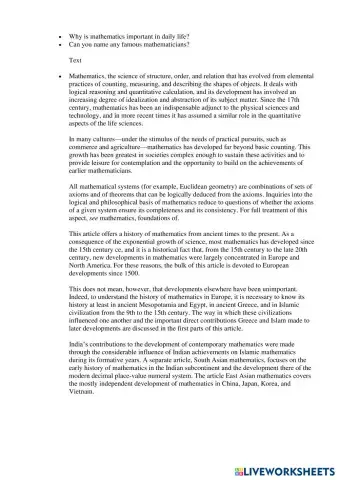
  • Why is mathematics important in daily life?
  • Can you name any famous mathematicians?
  • mathematics, the science of structure, order, and relation that has evolved from elemental practices of counting, measuring, and describing the shapes of objects. It deals with logical reasoning and quantitative calculation, and its development has involved an increasing degree of idealization and abstraction of its subject matter. Since the 17th century, mathematics has been an indispensable adjunct to the physical sciences and technology, and in more recent times it has assumed a similar role in the quantitative aspects of the life sciences.

    In many cultures—under the stimulus of the needs of practical pursuits, such as commerce and agriculture—mathematics has developed far beyond basic counting. This growth has been greatest in societies complex enough to sustain these activities and to provide leisure for contemplation and the opportunity to build on the achievements of earlier mathematicians.

    All mathematical systems (for example, Euclidean geometry) are combinations of sets of axioms and of theorems that can be logically deduced from the axioms. Inquiries into the logical and philosophical basis of mathematics reduce to questions of whether the axioms of a given system ensure its completeness and its consistency. For full treatment of this aspect, see mathematics, foundations of.

    This article offers a history of mathematics from ancient times to the present. As a consequence of the exponential growth of science, most mathematics has developed since the 15th century ce, and it is a historical fact that, from the 15th century to the late 20th century, new developments in mathematics were largely concentrated in Europe and North America. For these reasons, the bulk of this article is devoted to European developments since 1500.

    This does not mean, however, that developments elsewhere have been unimportant. Indeed, to understand the history of mathematics in Europe, it is necessary to know its history at least in ancient Mesopotamia and Egypt, in ancient Greece, and in Islamic civilization from the 9th to the 15th century. The way in which these civilizations influenced one another and the important direct contributions Greece and Islam made to later developments are discussed in the first parts of this article.

    India’s contributions to the development of contemporary mathematics were made through the considerable influence of Indian achievements on Islamic mathematics during its formative years. A separate article, South Asian mathematics, focuses on the early history of mathematics in the Indian subcontinent and the development there of the modern decimal place-value numeral system. The article East Asian mathematics covers the mostly independent development of mathematics in China, Japan, Korea, and Vietnam.

  • Match the words with their meanings.
  • structure -the process of thinking logically about something
  • reasoning-a way that parts are organized or arranged
  • quantitative-a general idea rather than a concrete object
  • abstraction-related to numbers or amounts
  • commerce-to support or keep something going
  • sustain-the activity of buying and selling goods
  • axiom-a statement that can be proved using facts and logic
  • theorem-a statement that is accepted as true without proof
  • civilization-the power to affect how someone or something develops
  • influence-an advanced human society with culture and knowledge
  • Fill in the blanks with correct words from the list:
    (structure, reasoning, commerce, influence, civilization)
  • Ancient _______ like Egypt and Greece made big progress in mathematics.
  • Logical _______ is important for solving problems.
  • Trade and _______ helped mathematics grow.
  • The _______ of India was strong in Islamic mathematics.
  • Geometry studies the _______ of shapes.
  • Choose the correct form.
  • Mathematics (has / have) been important since ancient times.
  • It (developed / has developed) far beyond basic counting.
  • Many cultures (were / have been) influenced by Greek mathematics.
  • Mathematicians (worked / have worked) for centuries to create new ideas.
  • Since the 17th century, mathematics (became / has become) a part of science.
  • Reading Comprehension

    Answer the questions:

  • What is mathematics described as in the first paragraph?
  • Why did mathematics develop in many cultures?
  • What are mathematical systems made of?
  • Where did most mathematical development occur after the 15th century?
  • Why is it important to study ancient civilizations to understand European mathematics?
  • How did India influence Islamic mathematics?

What the future holds

Vocabulary - English Language

PART 1: VOCABULARY

Exercise 1. Match the words with their definitions.

WORDS:

prediction

gadget

underwater city

robotic housemaid

mini-submarine

glass dome

traffic jam

look forward to

DEFINITIONS:

a) a small vehicle that travels under water

b) a statement about what will happen in the future

c) a small useful machine or tool, often electronic

d) a city built below the surface of the ocean

e) a robot that does cleaning and other housework

f) a round transparent roof or cover

g) a situation when vehicles are stuck and cannot move

h) to feel excited about something that will happen

Exercise 2. Complete the sentences with words from the box.

Use each word only once.

WORD BOX:

prediction, fuel, exist, creature, online school, petrol, planet, look after

Scientists think that life might __________ on other planets.

My sister studies at an __________ — she has lessons from home.

We must take care of our __________ and protect the environment.

A robot pet can __________ you when you are lonely.

Electric cars don't use __________; they use electricity instead.

No one can make a 100% accurate __________ about the future.

In the future, we may meet a strange __________ from space.

Scientists are looking for a new type of clean __________ for cars.

FUTURE SIMPLE (will + infinitive)

Use for predictions and future facts.

Exercise 3. Put the verbs in brackets into Future Simple.

I think robots __________ (do) most housework in 2050.

__________ people __________ (live) on Mars one day?

She probably __________ (not / use) paper books in the future.

We __________ (travel) in flying cars, I'm sure!

__________ you __________ (help) me with my project tomorrow?

They __________ (not / need) petrol cars because of electric vehicles.

ZERO CONDITIONAL (If + Present Simple, Present Simple)

Use for facts and general truths.

Exercise 4. Complete the sentences using Zero Conditional.

If you __________ (heat) ice, it __________ (melt).

If people __________ (not sleep) enough, they __________ (feel) tired.

Plants __________ (die) if they __________ (not get) water.

If you __________ (mix) red and blue, you __________ (get) purple.

My phone __________ (not work) if the battery __________ (be) empty.

FIRST CONDITIONAL (If + Present Simple, will + infinitive)

Use for real possibilities in the future.

Exercise 5. Complete the sentences using First Conditional.

If it __________ (rain) tomorrow, we __________ (stay) at home.

She __________ (pass) the exam if she __________ (study) hard.

If they __________ (not hurry), they __________ (miss) the bus.

I __________ (buy) a robot pet if I __________ (have) enough pocket money.

__________ you __________ (come) to the party if your friends __________ (go)?

If we __________ (protect) nature now, the planet __________ (be) healthier in the future.

Exercise 6. Zero or First Conditional? Choose the correct option.

If you freeze water, it turns / will turn into ice. (fact)

If I see Tom tomorrow, I tell / will tell him about the project. (future possibility)

If people don't recycle, the planet gets / will get more polluted. (future result)

If you heat metal, it expands / will expand. (scientific fact)

She will be / is upset if she doesn't get the job. (future possibility)

Exercise 7. Read the text and mark the statements T (True) or F (False).

                   Life in 2070: What Will Change?

Many scientists make predictions about the future. They believe that by 2070, our lives will be very different.

First, transport will change. Petrol cars will probably disappear because they pollute the planet. Instead, people will use electric cars, flying taxis, or even mini-submarines in underwater cities! Traffic jams might become a thing of the past.

Second, technology will help us at home. Robotic housemaids will do the housework: clean the rooms, cook dinner, and look after children. Some families will have robot pets that don't need food or walks but can still show affection.

Education will change too. Many students will attend online schools from their glass domes at home. They will look up information instantly and keep notes on digital devices. However, teachers will still be important as role models and sources of inspiration.

But not everything will be easy. If we don't take care of our planet now, the future will be difficult. If pollution continues, clean water and air will become expensive. That's why many young people today want to help out at home and protect the environment.

What do you think? Will the future be amazing or challenging? One thing is definite: the future is in our hands!

TRUE OR FALSE? Read the statements and write T or F. Correct the false statements.

Scientists think that petrol cars will still be popular in 2070. _____

Flying taxis and mini-submarines might be common in the future. _____

Robot pets will need the same care as real puppies. _____

All students will go to traditional schools in the future. _____

Teachers will not be necessary if students use online schools. _____

If we pollute the planet now, clean air and water will be expensive later. _____

Young people today don't care about the environment. _____

The writer believes that we can influence the future. _____

SIMPLE PAST

English as a Second Language (ESL)

1️⃣ Gap-Filling: Điền vào chỗ trống

1. She ______ (not go) to school yesterday. {did not go}
2. If he ______ (study) harder, he will pass the exam. {studies}
3. By the time we arrived, they ______ (finish) their work. {had finished}
4. Look! The baby ______ (cry). {is crying}
5. I ______ (never/see) such a beautiful sunset before. {have never seen}
2️⃣ Sentence Transformation: Viết lại câu

1. "I will call you tomorrow," she said.  
   → She said that she ______ me the next day. {would call}  

2. They built this school in 1990.  
   → This school ______ in 1990. {was built}  

3. Although it was raining, they continued playing.  
   → Despite ______, they continued playing. {the rain}  

4. He drives too fast.  
   → He should ______ more carefully. {drive}  

5. "Where do you live?" she asked me.  
   → She asked me ______ I lived. {where}  
3️⃣ Multiple Choice: Chọn đáp án đúng

1. If I ______ enough money, I would buy a new phone.  
   a) have  
   b) had @  
   c) will have  

2. The book ______ by J.K. Rowling.  
   a) writes  
   b) was written @  
   c) is writing  

3. She is used to ______ early in the morning.  
   a) wake up  
   b) waking up @  
   c) woke up  

4. I have never ______ that movie before.  
   a) see  
   b) saw  
   c) seen @  

5. He said he ______ busy at the moment.  
   a) is  
   b) was @  
   c) were  

english

english

Chapter 1: ________________________

One day, young Sherlock Holmes was staying with his aunt and uncle in Scotland. He enjoyed exploring the countryside and solving little mysteries. One evening, he saw a strange light in the distance. It looked like a fire!

Sherlock ran to the scene and found a barn burning. He noticed strange footprints around the barn and some suspicious barrels. The fire brigade arrived and put out the fire, but the barn was destroyed.

Chapter 2: ________________________

The next day, Sherlock discovered that a family who lived nearby had disappeared. They were friends of his aunt and uncle. Sherlock visited their house and found it empty. He noticed that the family had left in a hurry. He found a note saying, "Meet us at the fire storm."

Sherlock was puzzled. What was the "fire storm"? He decided to investigate further.

Chapter 3: ________________________

Sherlock followed clues that led him to a nearby forest. He found a hidden path that led to a cave. Inside the cave, he discovered the missing family! They explained that they had been hiding from dangerous men who wanted to steal their land. The men had started the fire to scare them away.

Sherlock examined the cave and found more barrels like the ones he had seen at the barn. He realized the men were using the barrels to create fires.

Chapter 4: __________________________

Sherlock came up with a plan. He told the family to stay hidden in the cave. Then, he went to the police and explained everything. The police agreed to help.

Sherlock and the police set a trap for the men. They placed empty barrels around another barn and waited. Sure enough, the men came to start another fire. But this time, the police were ready. They caught the men and arrested them.

Chapter 5: __________________________

The family was safe, thanks to Sherlock's clever thinking. The police thanked him for his help, and his aunt and uncle were very proud of him. Sherlock realized that he loved solving mysteries and decided that one day he would become a great detective.

And so, young Sherlock Holmes continued his adventures, always curious, always observant, and always ready to help those in need.


By Andrew Lane


สร้างและปรับแต่งใบงานสำหรับทุกห้องเรียน

LiveWorksheets ทำให้คุณครู ผู้ปกครอง และผู้สอนแบบโฮมสคูล สามารถออกแบบและมอบสื่อการเรียนรู้ที่น่าสนใจได้อย่างง่ายดาย เพียงอัปโหลดไฟล์ PDF หรือเริ่มต้นสร้างใหม่ทั้งหมด คุณก็สามารถทำได้ทุกอย่าง ไม่ว่าจะเป็นใบงานคณิตศาสตร์แบบโต้ตอบ ใบงานอ่านจับใจความ ใบงานการคูณ หรือใบงานสำหรับเด็กอนุบาล ด้วยขั้นตอนเพียงไม่กี่คลิก เครื่องมือแก้ไขแบบลากและวางของเรารองรับทุกระดับชั้นและทุกวิชา ช่วยให้คุณปรับเนื้อหาให้ตรงกับแผนการสอน การบ้าน หรือแบบทดสอบ ครูสอนภาษาอังกฤษ (ESL) ยังสามารถสร้างใบงาน ESL แบบเฉพาะ เพิ่มตารางเสียงภาษาอังกฤษ หรือออกแบบกิจกรรม ESL เพื่อให้การเรียนสนุกและมีส่วนร่วมมากขึ้น สร้างกิจกรรมที่ปรับระดับได้ ตรวจอัตโนมัติ ช่วยประหยัดเวลา และสนับสนุนการเรียนรู้ของนักเรียนให้ดียิ่งขึ้น

คลังสื่อการเรียนรู้ครบวงจรสำหรับ K-12 และ ESL

เข้าถึงใบงานที่พร้อมใช้หลายพันชุด ครอบคลุมทุกวิชาในระดับ K-12 รวมถึงใบงานอนุบาล ใบงานคณิตศาสตร์ แบบฝึกการคูณ แบบฝึกอ่านจับใจความ และทรัพยากร ESL เลือกค้นหาตามชั้นเรียน วิชา หรือระดับทักษะ เพื่อให้ได้สิ่งที่คุณต้องการ ไม่ว่าจะสำหรับห้องเรียนประถม ทบทวนในระดับมัธยมต้น หรือการฝึกในระดับมัธยมปลาย ครู ESL ยังสามารถสำรวจคลังใบงาน ESL และกิจกรรมภาษาอังกฤษที่ออกแบบมาเพื่อรองรับผู้เรียนทุกระดับ เนื้อหาใหม่ถูกเพิ่มเข้ามาอย่างต่อเนื่อง LiveWorksheets จึงเป็นทรัพยากรที่ยืดหยุ่นและช่วยสร้างผลลัพธ์การเรียนรู้ที่ยั่งยืน