อยากได้แบบฝึกหัดฟรีนับพัน (ไม่มีสิ่งรบกวนเลย)? Here’s how
ได้รับความนิยมมากที่สุด
Newest
Oldest
A-Z
Z-A
English as a Second Language (ESL)
Students have to classify the expressions according to their meaning and then provide new sentences with some of the vocabulary they have learnt.
Sts must match columns featuring pictures of some routines and their actual names.
Some sentence transformations to practise the grammar for the FCE
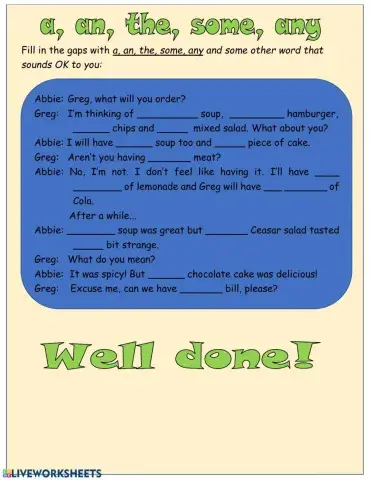
In the restaurant
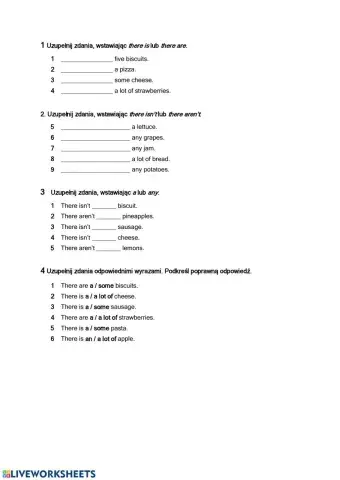
Beginners Level. Grammar: countable and uncountable nouns + a, an, some, any.
English
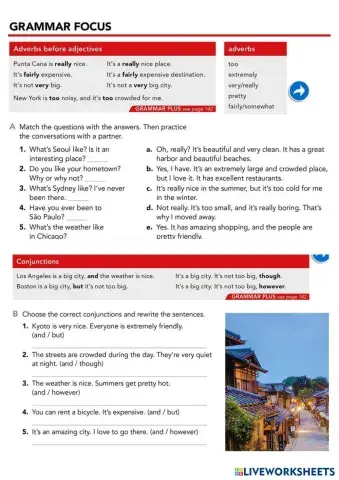
This activity is aimed to help students get familiared with some adjectives to describe places, towns, cities, and countries.
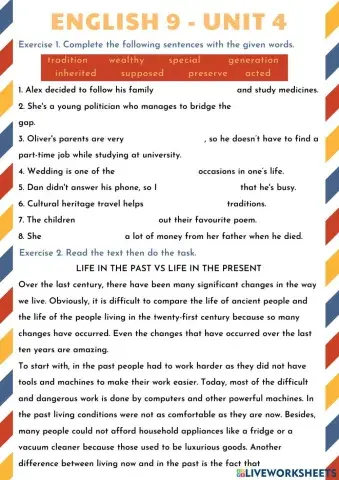
Some exercises to practice vocabulary and reading on the theme of "Life in the past".
Look at the pictures and write sentences using "there is/There are) and "Some/Any"
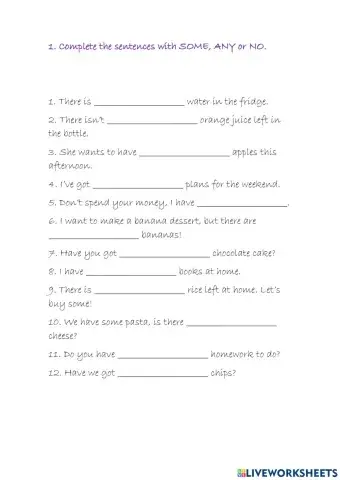
Some Any No Every Compounds
Some means of transport now you don't see the answers
writing
ALL NEARLY ALL MOST MANY ALOT OF SOME NOT MANY A FEW FEW NO ONE
There are some senteces that have been removed from the article. Choose from the sentences A-G the one which fits each gap
You will learn some useful phrases and sentences used to introduce yourself on the first day at work.
Students complete the sentences with the appropriate possessive adjectives or a/an, some and any.
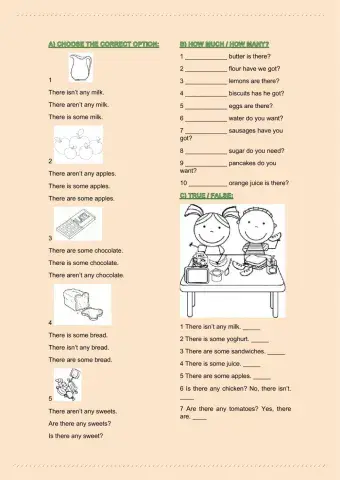
Practising the use of some, any, how much, how many.
Simple to be verb worksheet with some Minecraft pics :)
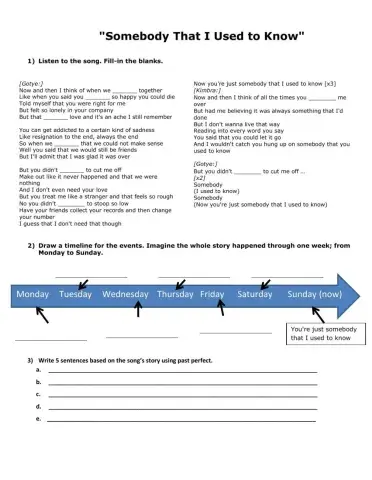
Time to practice some Past Perfect in a very funny way!
Information and communication technology (ICT)
Identify what some parts of the Excel interface do and some general questions about Excel
Unit 3 Evaluation -I like cooking- Food vocabulary Do and Does I've got some/ I haven't got any
English language
Worksheet to practice countable and uncountable nouns
Countable/uncountable - a/some/a lot of/any
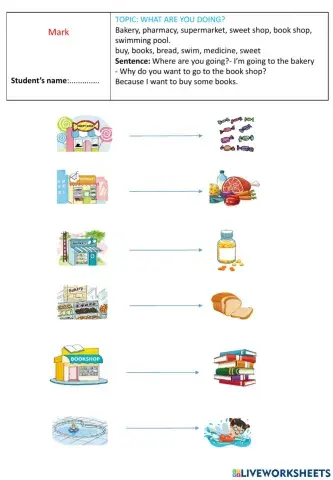
Sentence: Where are you going?- I’m going to the bakery - Why do you want to go to the book shop? Because I want to buy some books.
To review the past and past participle of some regular and irregular verbs.
Excercises related with countable and uncountable nouns. Use of some, any, much, many, a lot of, a few, a little.


 Switch to New Search Page