Listening Task

Business Communication

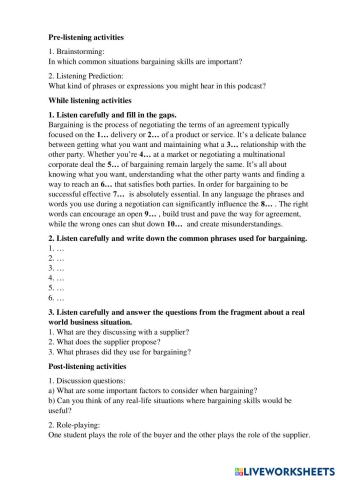
Pre-listening activities

1. Brainstorming:
In which common situations bargaining skills are important?

2. Listening Prediction:
What kind of phrases or expressions you might hear in this podcast?

While listening activities

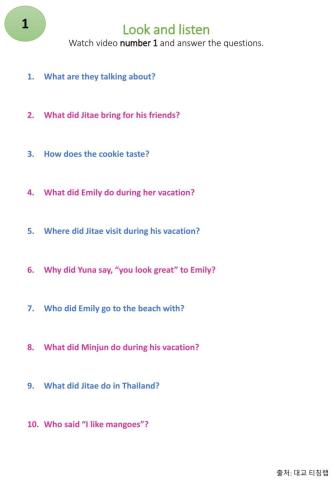
1. Listen carefully and fill in the gaps.
Bargaining is the process of negotiating the terms of an agreement typically focused on the 1… delivery or 2… of a product or service. It’s a delicate balance between getting what you want and maintaining what a 3… relationship with the other party. Whether you’re 4… at a market or negotiating a multinational corporate deal the 5… of bargaining remain largely the same. It’s all about knowing what you want, understanding what the other party wants and finding a way to reach an 6… that satisfies both parties. In order for bargaining to be successful effective 7…  is absolutely essential. In any language the phrases and words you use during a negotiation can significantly influence the 8… . The right words can encourage an open 9… , build trust and pave the way for agreement, while the wrong ones can shut down 10…  and create misunderstandings.

2. Listen carefully and write down the common phrases used for bargaining.  
1. …
2. …
3. …
4. …
5. …
6. …

3. Listen carefully and answer the questions from the fragment about a real world business situation.
1. What are they discussing with a supplier?
2. What does the supplier propose?
3. What phrases did they use for bargaining?

Post-listening activities

1. Discussion questions:
a) What are some important factors to consider when bargaining?
b) Can you think of any real-life situations where bargaining skills would be useful?

2. Role-playing:
Divide students into pairs and assign each pair a scenario similar to the one in the listening passage, such as negotiating a contract with a supplier. One student plays the role of the buyer and the other plays the role of the supplier. They use the common bargaining phrases from the listening passage to negotiate terms of the contract.

3. Writing task:
Ask students to write a dialogue between two people negotiating a deal, incorporating the common bargaining phrases from the listening passage. They can then share their dialogues with the class and discuss the effectiveness of the phrases used.


Social Media

English as a Second Language (ESL)

The digital landscape has put increased pressure on teenagers today, and we feel it. There are so many social media channels: Facebook, Twitter, Instagram, Snapchat, Tumblr, you name it. I made a conscious decision to avoid Snapchat and Instagram because of the social pressure I saw them putting on my 14-year-old little sister. If my mum turned off the WiFi at 11pm, my sister would beg me to turn my phone into a hotspot1. She always needed to load her Snapchat stories one more time, or to reply to a message that had come in two minutes ago because she didn’t want her friend to feel ignored. If I refused, saying she could respond in the morning, I’d get the “You’re ruining my social life” speech. Even as a teenager as well, I sometimes find this craze a little baffling.

A new study has found that teenagers who engage with social media during the night could be damaging their sleep and increasing their risk of anxiety and depression. Teenagers spoke about the pressure they felt to make themselves available 24/7 and the resulting anxiety if they did not respond immediately to texts or posts. Teens are so emotionally invested in social media that a fifth of secondary school pupils will wake up at night and log on just to make sure they don’t miss out. Perhaps the worst thing about this is that teenagers need more sleep than adults do, so night-time social media use could be detrimental to their health. A lack of sleep can make teenagers tired, irritable, and depressed.

During the summer holidays, I lost my phone. And for the week that I was phoneless, it felt like a disaster. I love my phone. It gives me quick access to information and allows me to be constantly looped in with my friends, to know exactly what is going on in their lives. So when I didn’t have my phone for a week, I felt a slight sense of FOMO, or if you’re not up to speed with the lingo, fear of missing out. By the end of the week, I’d got used to not having a phone and I’d quite enjoyed the break from social media. But there was still a lingering sense of sadness at the back of my mind that there would be conversations I had missed, messages that had been sent, funny videos shared and night-time chats that I would probably never get to see.

Reflexive pronoun

English Grammar

Reflective Pronouns Worksheet for Grade 5

Section 1: Theory and Rules with Example Sentences

Suggested Time: 10 minutes

What Are Reflexive Pronouns?
Reflexive pronouns are pronouns that end in “-self” or “-selves” and are used when the subject and the object of a sentence are the same person or thing. They are used to reflect the action back onto the subject.

Reflexive Pronouns:

  • Singular: myself, yourself, himself, herself, itself
  • Plural: ourselves, yourselves, themselves

When Do We Use Reflexive Pronouns?

  1. When the subject and object are the same:
    • Example: "I taught myself to play the piano."
    • Explanation: The subject "I" is the same person who is the object "myself."
  2. For emphasis (to emphasize that the subject did the action alone):
    • Example: "She cooked the entire meal herself."
    • Explanation: This emphasizes that "she" did the cooking without help.

Common Errors:

  • Incorrect: "Please give it to myself."
  • Correct: "Please give it to me."
  • Incorrect: "Himself went to the store."
  • Correct: "He went to the store by himself."

Section 2: Challenging NAPLAN-Style Questions

Suggested Time: 10 minutes

Instructions: Choose the correct reflexive pronoun to complete each sentence. Pay close attention to context and ensure the pronoun agrees with the subject.

  1. "After making the cake, Julia decorated it ______."

    • a) herself
    • b) himself
    • c) itself
    • d) themselves
  2. "The committee members decided to handle the problem ______."

    • a) themselves
    • b) itself
    • c) ourselves
    • d) himself
  3. "The robot fixed ______ after the malfunction."

    • a) himself
    • b) itself
    • c) themselves
    • d) ourselves
  4. "You must learn to rely on ______ if you want to be independent."

    • a) myself
    • b) yourselves
    • c) himself
    • d) yourself
  5. "The magician performed all the tricks ______, without any help."

    • a) itself
    • b) themselves
    • c) himself
    • d) herself

Short Answer Section: Instructions: Fill in the blank with the correct reflexive pronoun.

  1. "The cat saw ______ in the mirror and jumped back."
  2. "I taught ______ how to play the guitar by watching videos online."
  3. "The children built the treehouse all by ______."
  4. "During the test, remember to pace ______."
  5. "We enjoyed ______ at the amusement park yesterday."

Section 3: Writing Task to Practice Errors

Suggested Time: 15 minutes

Instructions: Write a short paragraph (4-5 sentences) about a time when you learned to do something by yourself. Use at least two reflexive pronouns in your paragraph.

Example Prompt: "Write about a time you learned a new skill or completed a task by yourself, such as riding a bike, cooking, or doing a school project. Describe what you did and how you felt."

Example Response: "I remember when I learned to bake cookies by myself. I followed the recipe carefully and didn’t ask for any help. I felt proud of myself when the cookies came out delicious. It was fun to bake all by myself!"

REVIEW G6-U3

Grammar - English Language

EX1: Viết các câu sau ở thể khẳng định (+), thể phủ định (-), thể nghi vấn (?) ở thì quá khứ đơn.

1.         (+) They decided to leave soon.

(-) They didn't decide to leave soon.

(?) Did they decide to leave soon?

2.         (+) ________________________________________________________________.

(-) There were not many homeless people here ten years ago.

(?) ________________________________________________________________?

3.         (+) ________________________________________________________________.

(-) _________________________________________________________________.

(?) Did Tom’s grandfather use to be a soldier?

4.         (+) My teacher started teaching here 6 years ago.

(-)_________________________________________________________________.

(?) _________________________________________________________________?

5.         (+) Jane often went to school on foot 3 years ago.

(-) _________________________________________________________________.

(?) _________________________________________________________________?

6.         (+) _________________________________________________________________.

(-) The cat didn’t want to eat yesterday.

(?) _________________________________________________________________?

7.         (+) _________________________________________________________________.

(-) __________________________________________________________________.

(?) Did the train arrive late yesterday?

8.         (+) _________________________________________________________________.

(-) There wasn’t anything left in the fridge.

(?) _________________________________________________________________?

EX2. Chia các động từ trong ngoặc ở thì quá khứ đơn.

  1. Picasso __________ (be)born in 1881.
  2. You _______(be) my inspiration when I was a boy.
  3. Neil Armstrong (be)__________ the first person to walk on the moon.
  4. Last night, I (be)___________ sick.
  5.  Last week, my mother (take) _____________ me to the zoo.
  6. Yesterday, she (be)___________ at home yesterday.
  7. Lorena and I (be)_________ in the same class when we were in secondary school.
  8. When we (arrive) _____________ at the party, there (not be) _____________ many people there.
  9. My mother (say) _____________ that she (buy) _____________ me a new dress.
  10. Last summer, my father (teach) _____________ me to drive.
  11. I (start) _____________ doing charity when I (be) _____________ a first year student.
  12. Many rich people (donate) _____________ money for this volunteer program.
  13. My friend (ring) _____________ me yesterday and (invite) _____________ me to his party.
  14. What (you/ watch) _____________ on TV last night?
  15. When my father (be) _____________ young, he (use to) ______ be the most handsome boy in the village.
  16.  _____________ (you/ go) to see the concert yesterday?
  17. My performance (not be) _____________ really good. I (not feel) _____________ happy about it
  18. Jim (spend) _____________ the whole day taking after his brother
  19. I (write) _____________ a letter to my foreign friend but he (not write) _____________ back.
  20.  _____________ (they/ be) students of our school?

EX3. Viết các câu sau ở thể khẳng định (+), thể phủ định (-), thể nghi vấn (?) ở thì hiện tại hoàn thành.

1.         (+) I have finished my homework.

(-) ________________________________________________________________.

(?) ________________________________________________________________?

2.         (+) ________________________________________________________________.

(-) My uncle hasn’t been to Singapore before.

(?) ________________________________________________________________?

3.         (+) ________________________________________________________________.

(-) ________________________________________________________________.

(?) Have they found their keys?

4.         (+) Jim has just played video games with his brother.

(-) ________________________________________________________________.

(?) ________________________________________________________________?

5.         (+) ________________________________________________________________.

(-) My grandmother hasn’t visited me since November.

(?) ________________________________________________________________?

6.         (+) ________________________________________________________________.

(-) ________________________________________________________________.

(?) Has your sister studied Medicine for 2 years?

7.         (+) It has been long since our last encounter.

(-) ________________________________________________________________.

(?) ________________________________________________________________?

8.         (+) ________________________________________________________________.

(-) We haven’t graduated yet.

(?) ________________________________________________________________?

EX4. Điền “for” hoặc “since” vào chỗ trống sao cho thích hợp.

1. I (learn)________ Japanese for 3 months.

2. May (work)_________ for a non-profit organization since he graduated.

3. Kim (unemploy)  _________ for half a year.

4. I miss my friend. I (see)________ her for  months.

5. We (live)_______ in the dorm since our first year at university.

6. Jim and Jane (know)_____each other for quite a long time.

7. The baby’s hungry. He (not eat) __________anything since the morning.

8. (you/use)________ this laptop for 4 years?

9. They(be)_________ close friends since they started college.

10. My grandmother (be)________ a vegetarian for several years.


สร้างและปรับแต่งใบงานสำหรับทุกห้องเรียน

LiveWorksheets ทำให้คุณครู ผู้ปกครอง และผู้สอนแบบโฮมสคูล สามารถออกแบบและมอบสื่อการเรียนรู้ที่น่าสนใจได้อย่างง่ายดาย เพียงอัปโหลดไฟล์ PDF หรือเริ่มต้นสร้างใหม่ทั้งหมด คุณก็สามารถทำได้ทุกอย่าง ไม่ว่าจะเป็นใบงานคณิตศาสตร์แบบโต้ตอบ ใบงานอ่านจับใจความ ใบงานการคูณ หรือใบงานสำหรับเด็กอนุบาล ด้วยขั้นตอนเพียงไม่กี่คลิก เครื่องมือแก้ไขแบบลากและวางของเรารองรับทุกระดับชั้นและทุกวิชา ช่วยให้คุณปรับเนื้อหาให้ตรงกับแผนการสอน การบ้าน หรือแบบทดสอบ ครูสอนภาษาอังกฤษ (ESL) ยังสามารถสร้างใบงาน ESL แบบเฉพาะ เพิ่มตารางเสียงภาษาอังกฤษ หรือออกแบบกิจกรรม ESL เพื่อให้การเรียนสนุกและมีส่วนร่วมมากขึ้น สร้างกิจกรรมที่ปรับระดับได้ ตรวจอัตโนมัติ ช่วยประหยัดเวลา และสนับสนุนการเรียนรู้ของนักเรียนให้ดียิ่งขึ้น

คลังสื่อการเรียนรู้ครบวงจรสำหรับ K-12 และ ESL

เข้าถึงใบงานที่พร้อมใช้หลายพันชุด ครอบคลุมทุกวิชาในระดับ K-12 รวมถึงใบงานอนุบาล ใบงานคณิตศาสตร์ แบบฝึกการคูณ แบบฝึกอ่านจับใจความ และทรัพยากร ESL เลือกค้นหาตามชั้นเรียน วิชา หรือระดับทักษะ เพื่อให้ได้สิ่งที่คุณต้องการ ไม่ว่าจะสำหรับห้องเรียนประถม ทบทวนในระดับมัธยมต้น หรือการฝึกในระดับมัธยมปลาย ครู ESL ยังสามารถสำรวจคลังใบงาน ESL และกิจกรรมภาษาอังกฤษที่ออกแบบมาเพื่อรองรับผู้เรียนทุกระดับ เนื้อหาใหม่ถูกเพิ่มเข้ามาอย่างต่อเนื่อง LiveWorksheets จึงเป็นทรัพยากรที่ยืดหยุ่นและช่วยสร้างผลลัพธ์การเรียนรู้ที่ยั่งยืน