Manh Hung

English as a Second Language (ESL)

Ukraine war: Satellite images show how hundreds of North Korean troops were likely transported to a secluded Russian port

A.


CNN —  Hundreds of North Korean troops were likely transported by sea to Russia to fight in its war against Ukraine, satellite images have revealed, according to a new analysis from a US-based think tank shared exclusively with CNN.

B.

At least two Russian naval ships are believed to have moved North Korean soldiers to a Russian military port in Dunai, in the far east, in October and November, according to researchers at the James Martin Center for Nonproliferation Studies at the Middlebury Institute of International Studies, in California.

The ship transfers were first identified by the South Korean National Intelligence Service (NIS), which said in a press release last year that some soldiers were transported via the North Korean port areas of Chongjin, Hamhung and Musudan. But the South Korean agency only offered a grainy radar image at the time.

C.

“I don’t think that the Russians or the North Koreans want these transfers caught on camera,” Sam Lair, a research associate at the Center for Nonproliferation Studies, told CNN. “The secrecy element is quite remarkable.”

Now, researchers have verified that during the same time period of the troop transfers reported by South Korea intelligence, the Russian vessels identified by the spy agency docked at Dunai port in a remote, eastern part of Russia.

D.

In North Korea, soldiers likely boarded these ships at night, making it difficult to capture evidence of the transfers, researchers said. But satellite images have revealed activities at Dunai, “where it appears the Russians have been less careful.”

For example, in one satellite image from Planet Labs, a crane can be seen extending to one of Russia’s naval landing ships, which researchers believe is the Nikolay Vilkov, at the port on October 17, and a covered cargo truck is on the dock next to it. By October 20, the crane is retracted, and it appears a transfer of soldiers is complete.

E.

Researchers could identify the Russian “Ropucha-class” and “Alligator-class” ships in the satellite images because they match with photos captured by the Japanese Defense Ministry in March 2022, when the vessels passed through Japanese waters.

Each landing ship is believed to have capacity to hold several hundred soldiers, possibly as many as 400, according to the researchers.

F.

Lair explained that Dunai is a secure military facility, making it much more conducive to under-the-radar transfers than the large, nearby port of Vladivostok, which is in an area where civilians live.

“This is an isolated place where they can do these exchanges, where people aren’t going to notice… (where) their own citizens, and folks in the intelligence community might not notice,” Lair said.

G.

An estimated 12,000 North Korean soldiers have been sent to Russia, according to Ukrainian officials and Western intelligence reports in January, which say around 4,000 of those troops have been killed or injured. Kyiv says it has captured at least two North Korean soldiers. Neither Moscow nor Pyongyang have confirmed the existence of North Korean troops on the front lines.

CNN has reached out to the Russian Ministry of Defense for comment.

H.

“The Russians seem to have been very careful to limit the exposure of the North Korean soldiers, moving them directly to military training facilities. The motive behind all the secrecy surrounding the North Koreans is uncertain, but moving some of them through Dunai would aid in that effort,” Lair wrote in his analysis.

Dunai port has previously been used to transport cargo between Russia and the North Korea since Pyongyang started aiding the invasion of Ukraine in 2023, according to the James Martin Center for Nonproliferation Studies.

Clothes and weather reading

English as a Second Language (ESL)

  1. My Clothes and the Weather


Hi! I am Jack. I am 8. I am happy today!

Today is a sunny day. I am wearing a T-shirt and shorts. I like sunny days because I can play football with my friends. When it is windy, I wear a jacket and a scarf. I don't like windy days because I can't fly my kite.

When it is snowy, I wear my coat, boots, and a sweater. I like snowy days because I can jump in the snow!

When it is cloudy, I wear jeans and a shirt. I don't like cloudy days because I can't swim in the pool.

When it is hot, I wear a dress or a skirt. I can dance and play volleyball with my friends.

When it is cold, I wear trousers and a hat. I can run outside and have fun!


No matter the weather, I love to play and have fun in my clothes!


Questions:

1. What do I wear on a sunny day?

   • a) A coat

   • b) A t-shirt and shorts

   • c) A sweater

2. Why don't I like windy days?

   • a) I can't play football

   • b) I can't fly a kite

   • c) I can't swim

3. What do I wear when it is snowy?

   • a) A dress

   • b) A coat, boots, and a sweater

   • c) Shorts and a t-shirt

4. What do I wear when it is cloudy?

   • a) A hat

   • b) Jeans and a shirt

   • c) A sweater and trousers

5. What do I do when it is hot?

   • a) I play in the snow

   • b) I dance and play volleyball

   • c) I play computer games


T/F Statements:

1. I wear a t-shirt and shorts on a sunny day. (T) (F)

2. I like windy days because I can fly a kite. (T) (F)

3. When it is snowy, I wear a coat and boots. (T) (F)

4. When it is cloudy, I wear a sweater. (T) (F)

5. When it's hot, I wear a dress or a skirt. (T) (F)


PET B1 Reading 1

English as a Second Language (ESL)

Choose the best answer for each question.

1.

Email

Dear team, remember we've moved our weekly meeting from Monday to Wednesday for this week only. This is due to staff illness.

  1. a. The weekly meeting is cancelled this week.
  2. b. The weekly meeting will be held on both Monday and Wednesday.
  3. c. Somebody is not well.

2.

Notice

Wet Floor!

Caution: Floor is wet. Please watch your step.

  1. a. The floor is wet, please go back.
  2. b. There's a step on the wet floor that needs to be watched.
  3. c. The floor is wet and you should be careful while walking.

3.

Warning

Noise Restrictions

Loud music is not permitted after 10pm. Please respect your neighbours and keep noise levels to a minimum.

  1. a. You must use headphones to listen to music.
  2. b. You can't play loud music after 10pm.
  3. c. Loud music is only allowed before 10pm if it is played through headphones.

4.

Text Message

Hey Jake, want to join us for a hike on Sunday? The weather should be nice. We're aiming to start early in the morning. Speak soon, Mark.

  1. a. Mark is inviting Jake to a hike.
  2. b. Mark is telling Jake about a hike he missed.
  3. c. The weather probably won't be great.

5.

Competition

Win a Designer Wardrobe

Enter now to win a wardrobe makeover by a top designer worth $5000! Entry is free. Participants must be aged 16 or over. Deadline for entries: January 15th.

  1. a. There is an entry fee for the competition.
  2. b. The competition is for those who want new clothes.
  3. c. The competition is open to those who want new furniture.
  4. PART 2
  5. Below, you will find descriptions of five people who want to find a book to read. And descriptions of eight books. Decide which books would be the most suitable for the people below.

    Books

    A. 'Timeless Love': A young woman from the 19th century has to navigate societal norms while pursuing her passion and finding her true love. It portrays a beautiful and heartfelt journey, painted against a historic backdrop.

    B. 'The Enigma Code': This gripping thriller tells the tale of a group of teenagers who stumble upon an ancient secret society. It's a rollercoaster ride of suspense, mystery, and daring escapades.

    C. 'Leafy Lives': An informative account of the incredibly diverse world of plants, their complex life-cycles, and how they adapt to environmental changes. Written by a renowned botanist, it brings the plant kingdom to life in the reader's mind.

    D. 'Sands of Time': This meticulously researched novel transports readers back to the time of the ancient Egyptians. A historian's delight, it intertwines factual events with a fictional narrative.

    E. 'Raging Tides': A young marine biologist investigates the deaths of whales and dolphins in South America and uncovers a global conspiracy threatening marine life. This fast-paced novel blends scientific facts with a thrilling storyline.

    F. 'Climate Call': This book delves into the complexities of global warming and its implications on the planet. It blends scientific data with personal narratives, creating a compelling argument for immediate action.

    G. 'Silent Whispers': A gripping tale of espionage set in the beautiful city of Prague during the Cold War. A young woman must balance her personal life and secret identity while trying to navigate treacherous political terrain and those that 

    H. 'Lost in the Jungle': This adventure-filled novel recounts the story of explorers lost in the Amazon rainforest. Far from civilisation, do they have what they need to survive? It's a survival tale that balances the beauty and dangers of nature.

  6.  

     
    Readers

    1. Martin is a history professor who is fascinated by ancient civilisations.

    2. Amelia is a teenager who enjoys fast-paced stories full of mystery and adventure.

    3. Carlos is a biologist, interested in how plants adapt to changing environments.

    4. Evelyn is a fan of romantic novels, particularly those with strong female leads.

    5. James is an environmental activist who is looking for an informative yet engaging read about climate change.

    Answers:

    1. Martin ______
    2. Amelia ______
    3. Carlos ______
    4. Evelyn ______
    5. James ______

  7. PART 3
  8. Read the text and then for each question, choose which of the four possible answers is best. Think also about why the other three answers are not possible.

    Safer Driving

    David Williams, a renowned driving safety expert, shares some advice on becoming a better driver. With more than three decades of experience in the field, David has extensive knowledge about safe and efficient driving. He knows more than anyone what makes a dangerous driver and what makes a safe one!

    "Driving is an important responsibility and we should always take it seriously," begins David. "We often overlook the basics. Like, for instance, regular maintenance of your vehicle is crucial. A well-functioning vehicle can greatly reduce the risk of accidents."

    He also emphasises the importance of being aware of one's surroundings while driving. "You have to keep an eye on what's happening around you - cars, pedestrians, cyclists. And remember, the road doesn't belong to you alone. You need to be aware that everyone on the road is equally important, that driver you are getting impatient with is someone's wife, or husband, or mother or son." 

    According to David, speed is a common factor in many accidents. People are often in such a hurry and the consequences can be terrible. "Sticking to the speed limit is not just about avoiding fines. It's about safety - both yours and others. Don't let impatience drive you to make poor decisions."

    David also talks about the essential role of practice. "Experience is key. The more you practice, the more comfortable you become with handling unexpected situations. New drivers especially should gain experience in different weather conditions and at different times of the day." If you want to be a better driver, keep driving and keep driving safely!

    These days, with so many distractions available to a driver in the car, it's never been so easy to take your attention off the road. As for distractions, David has a straightforward message. "Stay away from your phone and don't multitask while driving. Your full attention should be on the road."

    For David Williams, being a better driver is not about skill alone. It's about cultivating a sense of responsibility, improving awareness, practicing regularly, and most importantly, staying safe.

    341 words

    1. According to David, why is vehicle maintenance important?

  9. It saves money in the long run.
  10. It reduces the risk of accidents.
  11. It helps the vehicle last longer.
  12. It improves the vehicle's performance.
  13. 2. Why does David advise sticking to the speed limit?
  14. To avoid fines.
  15. To make poor decisions.
  16. To handle unexpected situations.
  17. 3. According to David, what should new drivers gain experience in?
  18. Repairing their vehicles.
  19. Driving at peak traffic hours.
  20. Using their phones while driving.
  21. Driving under various conditions.
  22. 4. What would David most likely say about distractions while driving?
  23. They help improve driving skills.
  24. They are a necessary part of driving.
  25. They should be minimised.
  26. They are not a major concern.
  27. 5. What would be a good introduction to this article?
  28. David Williams, an expert in car maintenance, shares his advice on how to keep your vehicle running smoothly.
  29. In this article, David Williams offers tips on how to become a faster, better car driver.
  30. David Williams, a driving safety expert, offers invaluable advice on how to become a better, safer driver.
  31. David Williams shares his personal journey from being a new driver to an experienced one. For the safety of all.

PART 4

Five sentences have been removed from the text below. For each question, choose the correct answer. There are three extra sentences which you do not need to use.

My Journey To Music

As a child, I was always surrounded by music. My grandmother had been a famous opera singer many years before although I had never heard her singing myself. My mother was a piano teacher, and our house was filled with the sounds of piano melodies from dawn till dusk. My older sister played the violin, and my father had a beautiful baritone voice. _____1_____

Every evening, after dinner, we used to gather in the living room. My mother would sit at the piano, my sister would take up her violin, and my father would stand ready to sing. _____2_____ I would sit on the floor, watching and listening, completely enchanted.

When I was six, my mother started teaching me the piano. I was an eager student, ready to embrace the musical world that was so dear to my family. _____3_____ My progress was slow at first, but I was persistent. I practised every day, improving little by little.

By the time I reached my teenage years, I had become quite proficient at the piano. _____4_____ It was not just a hobby for me anymore, but a passion. I decided then to dedicate my life to music.

Today, I am a concert pianist, travelling the world and playing at some of the most renowned concert halls. _____5_____ I often look back on those early years with gratitude, as they laid the foundation for my musical journey.

A. It was a unique family bond that I cherished.
B. That's when I truly felt a part of my family's musical world.
C. It wasn't an easy task, but it was definitely worth it.
D. But my journey wasn't without its challenges.
E. I owe it all to those evenings in our living room and the lessons with my mother.
F. Yet, I always felt a bit out of place.
G. Each note I played seemed to bring me closer to them.
H. And this is why I couldn't do it.

Answers:

1. ______
2. ______
3. ______
4. ______
5. ______


PART 5

For each question, choose which of the four possible answers fits the space best. Also think about why the other three answers are not possible.

1. He prepared the dish ___________ fresh ingredients.

  1. to
  2. with
  3. of
  4. about

2. During the lessons, the teacher often writes on the ___________.

  1. desk
  2. chair
  3. window
  4. blackboard

3. My sister loves reading historical fiction ___________.

  1. leaflets
  2. movies
  3. books
  4. covers

4. The meeting ___________ longer than expected.

  1. ended
  2. taken
  3. lasted
  4. done

5. I always ___________ to music while working.

  1. sing
  2. dance
  3. play
  4. listen

6. Seeing her friend after a long time was a(n) ___________ experience.

  1. delightful
  2. negative
  3. hard
  4. slow

PART 6

For each gap, choose ONE word which you think best completes the sentence. Look carefully at the words both before and after each space.

1. The lift is ___________ of order, we have to use the stairs.

2. He borrowed my book and promised to give it ___________ by Friday.

3. It must ___________ been very challenging to climb Mount Everest.

4. Michael began his career ___________ a photographer after his photos were discovered by a magazine editor.

5. Children often imitate people ___________ TV without understanding the consequences.

6. According to the recipe, the dessert should ___________ served chilled.

Reading Worksheet - PFlores

English as a Second Language (ESL)

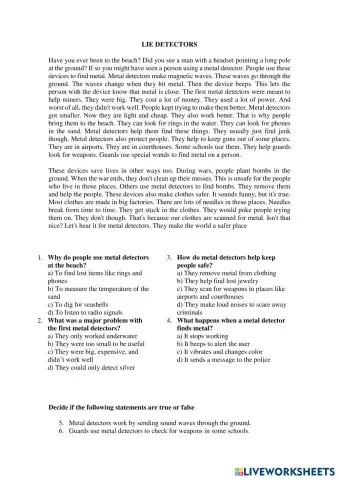
Have you ever been to the beach? Did you see a man with a headset pointing a long pole at the ground? If so you might have seen a person using a metal detector. People use these devices to find metal. Metal detectors make magnetic waves. These waves go through the ground. The waves change when they hit metal. Then the device beeps. This lets the person with the device know that metal is close. The first metal detectors were meant to help miners. They were big. They cost a lot of money. They used a lot of power. And worst of all, they didn't work well. People kept trying to make them better. Metal detectors got smaller. Now they are light and cheap. They also work better. That is why people bring them to the beach. They can look for rings in the water. They can look for phones in the sand. Metal detectors help them find these things. They usually just find junk though. Metal detectors also protect people. They help to keep guns out of some places. They are in airports. They are in courthouses. Some schools use them. They help guards look for weapons. Guards use special wands to find metal on a person.

These devices save lives in other ways too. During wars, people plant bombs in the ground. When the war ends, they don't clean up their messes. This is unsafe for the people who live in those places. Others use metal detectors to find bombs. They remove them and help the people. These devices also make clothes safer. It sounds funny, but it's true. Most clothes are made in big factories. There are lots of needles in these places. Needles break from time to time. They get stuck in the clothes. They would poke people trying them on. They don't though. That's because our clothes are scanned for metal. Isn't that nice? Let's hear it for metal detectors. They make the world a safer place

สร้างและปรับแต่งใบงานสำหรับทุกห้องเรียน

LiveWorksheets ทำให้คุณครู ผู้ปกครอง และผู้สอนแบบโฮมสคูล สามารถออกแบบและมอบสื่อการเรียนรู้ที่น่าสนใจได้อย่างง่ายดาย เพียงอัปโหลดไฟล์ PDF หรือเริ่มต้นสร้างใหม่ทั้งหมด คุณก็สามารถทำได้ทุกอย่าง ไม่ว่าจะเป็นใบงานคณิตศาสตร์แบบโต้ตอบ ใบงานอ่านจับใจความ ใบงานการคูณ หรือใบงานสำหรับเด็กอนุบาล ด้วยขั้นตอนเพียงไม่กี่คลิก เครื่องมือแก้ไขแบบลากและวางของเรารองรับทุกระดับชั้นและทุกวิชา ช่วยให้คุณปรับเนื้อหาให้ตรงกับแผนการสอน การบ้าน หรือแบบทดสอบ ครูสอนภาษาอังกฤษ (ESL) ยังสามารถสร้างใบงาน ESL แบบเฉพาะ เพิ่มตารางเสียงภาษาอังกฤษ หรือออกแบบกิจกรรม ESL เพื่อให้การเรียนสนุกและมีส่วนร่วมมากขึ้น สร้างกิจกรรมที่ปรับระดับได้ ตรวจอัตโนมัติ ช่วยประหยัดเวลา และสนับสนุนการเรียนรู้ของนักเรียนให้ดียิ่งขึ้น

คลังสื่อการเรียนรู้ครบวงจรสำหรับ K-12 และ ESL

เข้าถึงใบงานที่พร้อมใช้หลายพันชุด ครอบคลุมทุกวิชาในระดับ K-12 รวมถึงใบงานอนุบาล ใบงานคณิตศาสตร์ แบบฝึกการคูณ แบบฝึกอ่านจับใจความ และทรัพยากร ESL เลือกค้นหาตามชั้นเรียน วิชา หรือระดับทักษะ เพื่อให้ได้สิ่งที่คุณต้องการ ไม่ว่าจะสำหรับห้องเรียนประถม ทบทวนในระดับมัธยมต้น หรือการฝึกในระดับมัธยมปลาย ครู ESL ยังสามารถสำรวจคลังใบงาน ESL และกิจกรรมภาษาอังกฤษที่ออกแบบมาเพื่อรองรับผู้เรียนทุกระดับ เนื้อหาใหม่ถูกเพิ่มเข้ามาอย่างต่อเนื่อง LiveWorksheets จึงเป็นทรัพยากรที่ยืดหยุ่นและช่วยสร้างผลลัพธ์การเรียนรู้ที่ยั่งยืน