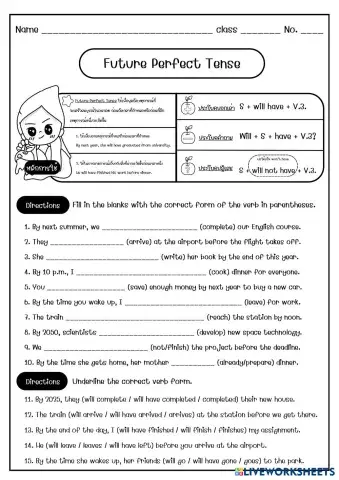
📝 Student Instruction: Future Perfect Tense
-
When do we use Future Perfect?
-
To talk about an action that will be completed before a specific time in the future.
-
By next year, I will have graduated from school.
-
To show that something will be finished before another future event.
-
She will have left by the time you arrive.
-
Form
-
Affirmative (+): Subject + will + have + past participle (V3)
-
I will have finished my homework by 8 p.m.
-
They will have built the house by next month.
-
Negative (–): Subject + will + not (won’t) + have + past participle
-
I won’t have completed the project by tomorrow.
-
She won’t have arrived by 9 o’clock.
-
Question (?): Will + subject + have + past participle
-
Will you have finished your work by 5 p.m.?
-
Will they have left before we get there?
-
Time expressions often used
-
by + time → by tomorrow, by next week, by 2025
-
before → before 6 p.m., before the meeting
-
by the time → by the time you arrive
-
Examples
-
By the time he comes, I will have cleaned the house.
-
She will have written five emails before lunch.
-
Will you have read the book by next Monday?
👉 Practice Example:
Change the verb into Future Perfect.
-
I (finish) my homework by 9 p.m. → I will have finished my homework by 9 p.m.
-
She (not complete) the project before the deadline. → She won’t have completed the project before the deadline.
-
(they / arrive) before we leave? → Will they have arrived before we leave?


 Switch to Legacy Search Page