Simple Present tense, Wh-Questions

Grammar - English Language

Part 1: Matching Wh-Questions (Section 1)

  1. Review the Visual Guide: Look at the large table of WH- QUESTIONS to remind yourself what information each word asks for (Person? Place? Reason? Quantity?).

  2. Match Them Up! Read the definitions in Section 1 (e.g., "Asking information about a reason") and write the number of the correct question word (What, Who, How, When, Why, Where) in the corresponding box.

  3. Part 2: Choose the Correct Question Word (Section 2)

    You need to be a detective here. Look closely at the answer already provided to determine what kind of information is being given.

  4. Analyze the Answer:

    • If the answer is a place (I am from China or On the classroom 401), use the word for place.

    • If the answer gives a reason (Because I have free time), use the word for reason

  5. If the answer gives a quantity (I have 3 brothers), use the word for quantity.

  6. If the answer gives a date or day (They go on Monday), use the word for time.

  7. If the answer is a thing or food (I usually eat eggs), use the word for object/thing.

  8. Complete the Question: Write the correct Wh-Question word in the empty box for the question.

  9.  

    Remember! All these questions follow the Simple Present Interrogative structure (Wh-word + Auxiliary Do/Does + Subject + Base Verb?). Pay close attention to the auxiliary verb already used in the sentence!

  10. Finished?

    When you are sure you have chosen the correct Wh-Question for each response and completed all the matching, click the button to check your answers and see your score!

    Good luck!

What the future holds

Vocabulary - English Language

PART 1: VOCABULARY

Exercise 1. Match the words with their definitions.

WORDS:

prediction

gadget

underwater city

robotic housemaid

mini-submarine

glass dome

traffic jam

look forward to

DEFINITIONS:

a) a small vehicle that travels under water

b) a statement about what will happen in the future

c) a small useful machine or tool, often electronic

d) a city built below the surface of the ocean

e) a robot that does cleaning and other housework

f) a round transparent roof or cover

g) a situation when vehicles are stuck and cannot move

h) to feel excited about something that will happen

Exercise 2. Complete the sentences with words from the box.

Use each word only once.

WORD BOX:

prediction, fuel, exist, creature, online school, petrol, planet, look after

Scientists think that life might __________ on other planets.

My sister studies at an __________ — she has lessons from home.

We must take care of our __________ and protect the environment.

A robot pet can __________ you when you are lonely.

Electric cars don't use __________; they use electricity instead.

No one can make a 100% accurate __________ about the future.

In the future, we may meet a strange __________ from space.

Scientists are looking for a new type of clean __________ for cars.

FUTURE SIMPLE (will + infinitive)

Use for predictions and future facts.

Exercise 3. Put the verbs in brackets into Future Simple.

I think robots __________ (do) most housework in 2050.

__________ people __________ (live) on Mars one day?

She probably __________ (not / use) paper books in the future.

We __________ (travel) in flying cars, I'm sure!

__________ you __________ (help) me with my project tomorrow?

They __________ (not / need) petrol cars because of electric vehicles.

ZERO CONDITIONAL (If + Present Simple, Present Simple)

Use for facts and general truths.

Exercise 4. Complete the sentences using Zero Conditional.

If you __________ (heat) ice, it __________ (melt).

If people __________ (not sleep) enough, they __________ (feel) tired.

Plants __________ (die) if they __________ (not get) water.

If you __________ (mix) red and blue, you __________ (get) purple.

My phone __________ (not work) if the battery __________ (be) empty.

FIRST CONDITIONAL (If + Present Simple, will + infinitive)

Use for real possibilities in the future.

Exercise 5. Complete the sentences using First Conditional.

If it __________ (rain) tomorrow, we __________ (stay) at home.

She __________ (pass) the exam if she __________ (study) hard.

If they __________ (not hurry), they __________ (miss) the bus.

I __________ (buy) a robot pet if I __________ (have) enough pocket money.

__________ you __________ (come) to the party if your friends __________ (go)?

If we __________ (protect) nature now, the planet __________ (be) healthier in the future.

Exercise 6. Zero or First Conditional? Choose the correct option.

If you freeze water, it turns / will turn into ice. (fact)

If I see Tom tomorrow, I tell / will tell him about the project. (future possibility)

If people don't recycle, the planet gets / will get more polluted. (future result)

If you heat metal, it expands / will expand. (scientific fact)

She will be / is upset if she doesn't get the job. (future possibility)

Exercise 7. Read the text and mark the statements T (True) or F (False).

                   Life in 2070: What Will Change?

Many scientists make predictions about the future. They believe that by 2070, our lives will be very different.

First, transport will change. Petrol cars will probably disappear because they pollute the planet. Instead, people will use electric cars, flying taxis, or even mini-submarines in underwater cities! Traffic jams might become a thing of the past.

Second, technology will help us at home. Robotic housemaids will do the housework: clean the rooms, cook dinner, and look after children. Some families will have robot pets that don't need food or walks but can still show affection.

Education will change too. Many students will attend online schools from their glass domes at home. They will look up information instantly and keep notes on digital devices. However, teachers will still be important as role models and sources of inspiration.

But not everything will be easy. If we don't take care of our planet now, the future will be difficult. If pollution continues, clean water and air will become expensive. That's why many young people today want to help out at home and protect the environment.

What do you think? Will the future be amazing or challenging? One thing is definite: the future is in our hands!

TRUE OR FALSE? Read the statements and write T or F. Correct the false statements.

Scientists think that petrol cars will still be popular in 2070. _____

Flying taxis and mini-submarines might be common in the future. _____

Robot pets will need the same care as real puppies. _____

All students will go to traditional schools in the future. _____

Teachers will not be necessary if students use online schools. _____

If we pollute the planet now, clean air and water will be expensive later. _____

Young people today don't care about the environment. _____

The writer believes that we can influence the future. _____

Interview with a celebrity

Grammar - English Language

Fill in the gap with a suitable word of the following interview. 


Instructions:
Complete the interview with the correct verb tense (Present Simple or Present Continuous) or a suitable missing word.

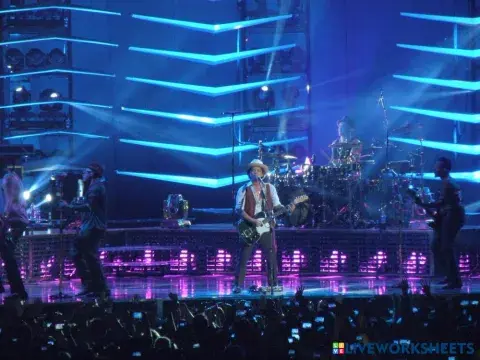
Interviewer: Hello everyone, and welcome to our show! Today we’re joined by the super talented Bruno Mars. Welcome, Bruno!
Bruno Mars: Hey! Thanks for [1] ______. I’m excited to be here.

1. Interviewer: How [2] ______ you [3] ______ today?
Bruno Mars: I’m doing great! I’m just [4] ______ after a long week in the studio.

2. Interviewer: [5] ______ you [6] ______ new songs right now?
Bruno Mars: Yes, I [7] ______. I’m working on some funky tracks with my band.

3. Interviewer: What kind of music do you usually [8] ______?
Bruno Mars: I usually make pop and funk music, but I also [9] ______ R&B.

4. Interviewer: [10] ______ you [11] ______ this year?
Bruno Mars: Not yet, but we [12] ______ a big tour for next summer.

5. Interviewer: How often do you [13] ______ with your band?
Bruno Mars: We practise almost every day when we’re preparing for a concert.

6. Interviewer: Who [14] ______ the lyrics for your songs?
Bruno Mars: I do! But sometimes I write together with my bandmates.

7. Interviewer: Do you [15] ______ any instruments?
Bruno Mars: Yes, I play the guitar, drums, and piano.

8. Interviewer: [16] ______ you [17] ______ any new instruments these days?
Bruno Mars: I’m trying to learn the trumpet — it’s harder than I [18] ______!

9. Interviewer: What’s your favourite song that you’ve [19] ______?
Bruno Mars: Probably “Treasure” — it always makes people smile.

10. Interviewer: Are you [20] ______ at any festivals this year?
Bruno Mars: Yes, I’m performing at Coachella and a few others.

11. Interviewer: What do you do when you’re not [21] ______ music?
Bruno Mars: I spend time with my family, play basketball, and watch movies.

12. Interviewer: Do you [22] ______ nervous before going on stage?
Bruno Mars: Always! But once I start singing, the nerves [23] ______.

13. Interviewer: [24] ______ you [25] ______ any love songs at the moment?
Bruno Mars: Yes, I am. Love songs are my favourite — they never get old!

14. Interviewer: How many hours a day [26] ______ you [27] ______ in the studio?
Bruno Mars: About six or seven hours. Time [28] ______ when I’m making music.

15. Interviewer: Who [29] ______ you the most as an artist?
Bruno Mars: Michael Jackson, Elvis Presley, and Prince — they’re legends.

16. Interviewer: Are you [30] ______ to collaborate with anyone soon?
Bruno Mars: Yes, I’m talking to Anderson .Paak about a new Silk Sonic project.

17. Interviewer: Do you [31] ______ travelling for concerts?
Bruno Mars: Yes, I love meeting fans all over the world.

18. Interviewer: How do you [32] ______ after a show?
Bruno Mars: I hang out with the band, eat good food, and listen to old records.

19. Interviewer: What advice [33] ______ you [34] ______ to young musicians?
Bruno Mars: Work hard, stay humble, and keep practising every day.

20. Interviewer: Thank you, Bruno, for [35] ______ us today!
Bruno Mars: Thank you! It’s been a pleasure. See you on tour!

Answer key

  1. having
  2. are
  3. doing
  4. relaxing
  5. Are
  6. recording
  7. am
  8. make
  9. love
  10. Are
  11. touring
  12. are planning
  13. practise
  14. writes
  15. play
  16. Are
  17. learning
  18. expected
  19. written
  20. performing
  21. making
  22. get
  23. disappear
  24. Are
  25. writing
  26. do
  27. work
  28. flies
  29. inspires
  30. planning
  31. enjoy
  32. relax
  33. would
  34. give
  35. joining

สร้างและปรับแต่งใบงานสำหรับทุกห้องเรียน

LiveWorksheets ทำให้คุณครู ผู้ปกครอง และผู้สอนแบบโฮมสคูล สามารถออกแบบและมอบสื่อการเรียนรู้ที่น่าสนใจได้อย่างง่ายดาย เพียงอัปโหลดไฟล์ PDF หรือเริ่มต้นสร้างใหม่ทั้งหมด คุณก็สามารถทำได้ทุกอย่าง ไม่ว่าจะเป็นใบงานคณิตศาสตร์แบบโต้ตอบ ใบงานอ่านจับใจความ ใบงานการคูณ หรือใบงานสำหรับเด็กอนุบาล ด้วยขั้นตอนเพียงไม่กี่คลิก เครื่องมือแก้ไขแบบลากและวางของเรารองรับทุกระดับชั้นและทุกวิชา ช่วยให้คุณปรับเนื้อหาให้ตรงกับแผนการสอน การบ้าน หรือแบบทดสอบ ครูสอนภาษาอังกฤษ (ESL) ยังสามารถสร้างใบงาน ESL แบบเฉพาะ เพิ่มตารางเสียงภาษาอังกฤษ หรือออกแบบกิจกรรม ESL เพื่อให้การเรียนสนุกและมีส่วนร่วมมากขึ้น สร้างกิจกรรมที่ปรับระดับได้ ตรวจอัตโนมัติ ช่วยประหยัดเวลา และสนับสนุนการเรียนรู้ของนักเรียนให้ดียิ่งขึ้น

คลังสื่อการเรียนรู้ครบวงจรสำหรับ K-12 และ ESL

เข้าถึงใบงานที่พร้อมใช้หลายพันชุด ครอบคลุมทุกวิชาในระดับ K-12 รวมถึงใบงานอนุบาล ใบงานคณิตศาสตร์ แบบฝึกการคูณ แบบฝึกอ่านจับใจความ และทรัพยากร ESL เลือกค้นหาตามชั้นเรียน วิชา หรือระดับทักษะ เพื่อให้ได้สิ่งที่คุณต้องการ ไม่ว่าจะสำหรับห้องเรียนประถม ทบทวนในระดับมัธยมต้น หรือการฝึกในระดับมัธยมปลาย ครู ESL ยังสามารถสำรวจคลังใบงาน ESL และกิจกรรมภาษาอังกฤษที่ออกแบบมาเพื่อรองรับผู้เรียนทุกระดับ เนื้อหาใหม่ถูกเพิ่มเข้ามาอย่างต่อเนื่อง LiveWorksheets จึงเป็นทรัพยากรที่ยืดหยุ่นและช่วยสร้างผลลัพธ์การเรียนรู้ที่ยั่งยืน