REVIEW

  • English Language
  • 5th grade

REVIEW

Grammar - English Language

COMPLETE


Aquí tienes una lista de ejercicios con need to / don’t need to y must / mustn’t, usando todos los pronombres. Incluyo solo ejercicios, y si quieres luego te doy las soluciones.

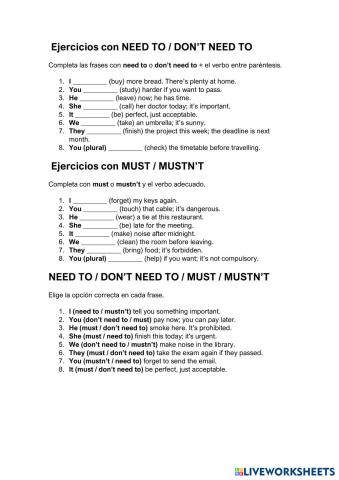
📝 Ejercicios con NEED TO / DON’T NEED TO

Completa las frases con need to o don’t need to + el verbo entre paréntesis.

  1. I __________ (buy) more bread. There’s plenty at home.

  2. You __________ (study) harder if you want to pass.

  3. He __________ (leave) now; he has time.

  4. She __________ (call) her doctor today; it’s important.

  5. It __________ (be) perfect, just acceptable.

  6. We __________ (take) an umbrella; it’s sunny.

  7. They __________ (finish) the project this week; the deadline is next month.

  8. You (plural) __________ (check) the timetable before travelling.

📝 Ejercicios con MUST / MUSTN’T

Completa con must o mustn’t y el verbo adecuado.

  1. I __________ (forget) my keys again.

  2. You __________ (touch) that cable; it’s dangerous.

  3. He __________ (wear) a tie at this restaurant.

  4. She __________ (be) late for the meeting.

  5. It __________ (make) noise after midnight.

  6. We __________ (clean) the room before leaving.

  7. They __________ (bring) food; it’s forbidden.

  8. You (plural) __________ (help) if you want; it’s not compulsory.

📝 Mezcla: NEED TO / DON’T NEED TO / MUST / MUSTN’T

Elige la opción correcta en cada frase.

  1. I (need to / mustn’t) tell you something important.

  2. You (don’t need to / must) pay now; you can pay later.

  3. He (must / don’t need to) smoke here. It’s prohibited.

  4. She (must / need to) finish this today; it's urgent.

  5. We (don’t need to / mustn’t) make noise in the library.

  6. They (must / don’t need to) take the exam again if they passed.

  7. You (mustn’t / need to) forget to send the email.

  8. It (must / don’t need to) be perfect, just acceptable.

Si quieres, te preparo también las soluciones, más ejercicios, o versiones tipo test. ¿Qué prefieres, Sara? 💬

U8 - WEATHER VOCABULARY & GRAMMAR WORKSHEET

Grammar - English Language

🔗 Activity 1: Matching

🧩 Instructions: You need to match each weather word (like “hot” or “windy”) with the correct meaning from the right column.

🧠 How to Solve It:

•             Read the weather word on the left carefully. Think about what that kind of weather looks or feels like.

•             Then read through all the definitions (A–J) on the right side.

•             Choose the letter that best explains the meaning of the word.

•             Write that letter next to the number of the word.

📌 Tip: Think about real-life examples — like how it feels when it's foggy or snowy.

________________________________________

📖 Activity 2: Reading Comprehension

📚 Instructions: Read the short story about the weather and then answer the questions.

🧠 How to Solve It:

•             Start by reading the passage slowly and carefully.

•             Underline or remember key weather words (e.g., “snowy,” “windy”).

•             Look at each question. Go back to the passage to find the part that answers it.

•             Answer using complete sentences or key words.

📌 Tip: Try reading each question before re-reading the passage so you know what to look for.

________________________________________

✏️ Activity 3: Fill in the Blanks

🖊️ Instructions: Fill in each sentence with the correct weather vocabulary word.

🧠 How to Solve It:

•             Read the full sentence to understand the meaning.

•             Think about what word fits the best: Does it describe sun, rain, cold, fog, etc.?

•             Choose the most suitable weather word from the list you learned.

📌 Tip: Think about the clue in the sentence — like “wore sunglasses” might go with “sunny.”

________________________________________

🧠 Activity 4: Multiple Choice

✅ Instructions: Choose the best answer from the options (A–D).

🧠 How to Solve It:

•             Read the question carefully.

•             Look at all the options before picking one.

•             Eliminate the ones that don’t make sense.

•             Pick the best-fitting and grammatically correct answer.

📌 Tip: Read the question and options aloud to check if they sound right.

________________________________________

🔤 Activity 5: Sentence Ordering

🧩 Instructions: Rearrange the mixed-up words to form a correct sentence.

🧠 How to Solve It:

•             Look for clues like question words (what, was) or starting words (It, The).

•             Remember how sentences are usually ordered in English:

Subject → Verb → Details (e.g., “It was sunny yesterday.”)

•             Rearrange the words until it makes a complete sentence.

📌 Tip: Say the words out loud in different orders until it sounds right.

________________________________________

🧑‍🏫 Final Tips:

•             Take your time — it’s okay to re-read or double-check your work.

•             Use your class vocabulary list or weather flashcards if you get stuck.

•             Ask yourself, “Does this make sense?” after every answer.

Draft 1

Grammar - English Language

# Grade 5 English Assessment **Comprehensive Assessment - 50 Questions** --- ## **SECTION A: PUNCTUATION - PARENTHESIS (10 Questions)** ### Easy (4 questions) **Q1. Multiple Choice** Which punctuation mark is NOT used for parenthesis? - A) Commas - B) Brackets - C) Dashes - D) Apostrophes **Answer:** D --- **Q2. True or False** This sentence uses parenthesis correctly: "My teacher Mr. Collins (who loves cricket) assigned us homework today." **Answer:** True --- **Q3. Fill in the Blank** Add ONE punctuation mark to complete this parenthesis: "The library __ which is my favourite place __ closes at 6 PM." **Answer:** Commas (accepts: commas / , ) --- **Q4. Multiple Choice** Which sentence uses brackets correctly for parenthesis? - A) The concert [it was amazing] ended late. - B) The concert (it was amazing ended late). - C) The concert it was (amazing) ended late. - D) The concert it was amazing [ended late. **Answer:** A --- ### Medium (4 questions) **Q5. Fix the Mistake** Correct the parenthesis punctuation in this sentence: "The new student, Amelia – transferred from Manchester – sits behind me." **Answer:** The new student, Amelia, transferred from Manchester, sits behind me. OR The new student – Amelia, transferred from Manchester – sits behind me. (Accept either consistent pair) --- **Q6. Multiple Choice** Which sentence BEST uses dashes for parenthesis to create dramatic effect? - A) The winner, surprisingly, was announced. - B) The winner (surprisingly) was announced. - C) The winner – surprisingly – was announced. - D) The winner "surprisingly" was announced. **Answer:** C --- **Q7. Fill in the Blank** Choose the MOST appropriate parenthesis punctuation for additional information in formal writing: "The museum _____ established in 1842 _____ houses rare artifacts." **Answer:** Brackets or ( ) (accepts: brackets, parentheses, ( )) --- **Q8. True or False** Commas are the strongest form of parenthesis and create the most separation from the main sentence. **Answer:** False --- ### Difficult (2 questions) **Q9. Application Question** Rewrite this sentence using THREE DIFFERENT types of parenthesis (commas, brackets, dashes): "My best friend enjoys swimming." Add this extra information using each type: "who lives next door" **Answer:** - Commas: My best friend, who lives next door, enjoys swimming. - Brackets: My best friend (who lives next door) enjoys swimming. - Dashes: My best friend – who lives next door – enjoys swimming. --- **Q10. Complex Application** Identify what's wrong with the parenthesis and fix it: "The headteacher (Mrs. Rahman, announced – surprisingly) that we would have extra break time." **Answer:** The headteacher, Mrs. Rahman, announced (surprisingly) that we would have extra break time. OR The headteacher – Mrs. Rahman – announced (surprisingly) that we would have extra break time. (Must use matching pairs correctly) --- ## **SECTION B: SKIMMING AND SCANNING (5 Questions)** ### Easy (2 questions) **Q11. Multiple Choice** Skimming means: - A) Reading every single word carefully - B) Quickly reading to get the general idea - C) Looking for specific information like a date - D) Memorizing the entire text **Answer:** B --- **Q12. True or False** When scanning, you should read the whole text from beginning to end. **Answer:** False --- ### Medium (2 questions) **Q13. Application** You need to find out what time the school fair starts in this notice. Should you use SKIMMING or SCANNING? **Answer:** Scanning --- **Q14. Multiple Choice** Which of these would you do when SKIMMING a story? - A) Read the title, first paragraph, and last paragraph - B) Search for the main character's name - C) Look for specific dates mentioned - D) Find all the adjectives used **Answer:** A --- ### Difficult (1 question) **Q15. Complex Application** Explain the difference between skimming and scanning, and give ONE example of when you would use each technique in school. **Ans

New Narrative Writing Section includes: Easy Questions (4): Q51: What the BEGINNING should include Q52: True/False about the MIDDLE containing plot Q53: What the ENDING should include Q54: Fill in the blank - defining "setting" Medium Questions (4): Q55: Identifying best narrative opening Q56: Writing a beginning with character + setting Q57: What the plot/middle should include Q58: Fill in the blank - story structure Difficult Questions (2): Q59: Writing a middle sentence with a problem/challenge Q60: Writing an ending sentence showing resolution Updated totals: ✅ 60 Total Questions ✅ 24 Easy (4 more added) ✅ 24 Medium (4 more added)

Should Homework Be Required Every Night?

Writing - English Language

Summary of Should Homework Be Required Every Night? Homework is a common part of school life, but opinions vary on whether it should be assigned every night. Some believe nightly homework helps students practice and learn better, while others think it may cause stress and take away family or playtime. Understanding both sides can help students and teachers find the best balance for learning and well-being. Arguments for Requiring Homework Every Night Homework reinforces what is learned in class, helping students remember and understand lessons better. It encourages responsibility and good study habits, preparing students for future school years. Nightly homework can improve time management skills by creating a routine. Some students benefit from extra practice, especially in subjects like math and reading. Homework allows parents to see what their children are learning and get involved. Arguments Against Requiring Homework Every Night Too much homework can cause stress, anxiety, and reduce free time for relaxation and hobbies. It may interfere with family time, sports, and other important activities for a balanced life. Not all students have equal support at home, making homework harder for some. Excessive homework can lead to burnout, making students dislike school or learning. Some studies suggest that homework does not always improve academic performance, especially in younger grades. Activity Structure to Explore Both Sides Students are divided into two teams: Yes (for nightly homework) and No (against nightly homework). Each team writes their name and explains their position by answering these questions: What is our side? Why do we support this side? What are the positives of this side? What are the negatives of this side? Teams start with 5 points and can lose points by arguing or speaking negatively about the opposing side. The goal is to maintain points and be able to list three points from the other side to earn a reward. After initial arguments, students swap worksheets to review and write down positives and negatives of the opposing side. A final discussion encourages understanding different viewpoints and recognizing the importance of open-mindedness. Conclusion: Key Takeaways Homework every night has both benefits and drawbacks. It can help students practice and develop important skills but may also cause stress and reduce time for other activities. Learning to see both sides of an issue helps build critical thinking and respect for different opinions. This balanced approach supports better decision-making about homework policies that work for all students.

Create and Customize Worksheets for Every Classroom

LiveWorksheets makes it easy for teachers, parents and homeschool educators to design and deliver engaging learning materials. Upload a PDF or start from scratch to create what you need: anything from interactive math worksheets to reading comprehension worksheets, multiplication worksheets, and kindergarten worksheets in just a few clicks. Our drag-and-drop editor works across all grade levels and subjects, so you can tailor content to your lesson plans, homework, or assessments. ESL teachers can also build custom ESL worksheets, add a common sound chart, or integrate ESL activities to make each class more engaging. Easily create differentiated, auto-graded activities that save valuable time and support better student learning.

A Complete Library of Learning Resources for K-12 and ESL

Access thousands of ready-to-use worksheets across K-12 subjects, including kindergarten worksheets, math worksheets, multiplication practice, reading comprehension exercises, and ESL resources. Filter by grade, subject, or skill level to find exactly what you need, whether it’s for an elementary classroom, middle school review, or high school practice. ESL teachers can explore our growing collection of ESL worksheets and English as a Second Language activities designed to support all levels of learners. With new content added regularly, LiveWorksheets is a flexible resource that helps build lasting learning outcomes.