Present Perfect Tense

Writing - English Language

📝 Student Instruction: Present Perfect Tense

  1. When do we use Present Perfect?
  • To talk about actions or experiences at an unspecified time in the past.

    • I have visited Japan.
  • To talk about actions that started in the past and continue until now.

    • She has lived here for 10 years.
  • To talk about actions that happened in the past but still have a result now.

    • He has broken his leg (he can’t walk now).
  1. Form
  • Affirmative (+): Subject + have/has + past participle (V3)

    • I have eaten breakfast.
    • She has finished her homework.
  • Negative (–): Subject + have/has + not + past participle

    • I haven’t seen that movie.
    • He hasn’t called me.
  • Question (?): Have/Has + subject + past participle

    • Have you visited London?
    • Has she done her homework?
  1. Time expressions used with Present Perfect
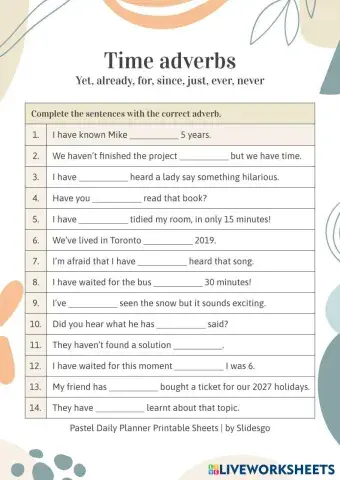
  • just → I have just finished my homework.
  • already → She has already eaten.
  • yet → Have you finished yet? / I haven’t finished yet.
  • ever → Have you ever been to Paris?
  • never → I have never seen snow.
  • for (a period of time) → for 5 years
  • since (a starting point) → since 2010
  1. Examples
  • We have studied English for three years.
  • He has never played basketball.
  • Have they arrived yet?

👉 Practice Example:
Change the verb into Present Perfect.

  1. I (see) that movie three times. → I have seen that movie three times.
  2. She (not finish) her homework yet. → She hasn’t finished her homework yet.
  3. (they / travel) to London before? → Have they traveled to London before?

TAREA 6

Research - English Language

Las anteriores imágenes muestran la detención de Nicolás Maduro.

En los grupos creados en la actividad “Think, Pair, Share” tenéis 1 minuto para decidir si estas imágenes son reales o no.


Estas imágenes son FALSAS, como ya han dicho medios como el New York Times, o RTVE.

En esta actividad vamos a aprender cómo distinguir si una noticia ha sido generada por la IA, o no.

Para ello debemos fijarnos en tres cosas

  1. La fuente: ¿Quién publica esta noticia? Es una fuente fiable?
  2. El contenido: ¿La noticia busca provocar una reacción emocional fuerte?
  3. Los detalles: ¿Hay algo que resulte extraño o incoherente?


Paso 1.

Añadid las imágenes proporcionadas en Google Lens.

Cuando las busquéis, os aparecerán las fuentes que han subido esta noticia/imágenes. Rellenad la siguiente checklist:

  • ¿La cuenta o web es oficial, verificada o conocida?
  • ¿Aparece la noticia en varios medios fiables, o solo en una cuenta de redes sociales?
  • ¿Se citan periodistas, instituciones o expertos reales?

Paso 2. 

  • Fijaos en el contenido. Completad la siguiente checklist:

  • Se usan palabras exageradas.
  • Titulares muy llamativos que no se desarrollan bien en el texto.
  • Falta de datos concretos (fechas, lugares, cifras comprobables).

Paso 3.

Ahora fijaos en las fotos.

¿Hay algo en la imagen, el vídeo o el audio que resulte extraño o incoherente?

  • Rasgos físicos raros (manos deformes, caras poco naturales).
  • Objetos que no encajan con la realidad (uniformes incorrectos, textos borrosos).
  • Vídeos o audios sin contexto claro o sin fuente original.

Paso 4.

Ahora volved a las preguntas de reflexión. ¿Ha cambiado vuestra opinión en algo?

La profesora hará sonar una canción y debéis moveros por la clase comentando vuestra opinión sobre este tema hasta que la canción acabe.

BRIGHT 10 GIỮA KỲ 1 LISTENING TEST 1

Vocabulary - English Language

TEST 1

For questions (1–5), choose the best answer (A, B or C).

Listen to a dialogue between Mark and Nancy.

1. Where does Mark go on Saturdays?

A. the mall                                        B. basketball practice                                   C. the supermarket

2. Who likes shopping for clothes?

A. Nancy                                          B. Mark                                                             C. Mark’s sister

3. Nancy doesn’t ______ .

A. do the washing-up                     B. do the laundry                                                         C. vacuum the rugs

4. What does Mark usually do in summer?

A. He goes on a picnic.                      B. He visits a museum.                                                             C. He visits his cousin.

5. What time do Mark and Nancy agree to meet?

A. 7:00                                              B. 10:00                                                             C. 11:30

Phần 2.

For questions 6 - 10

Write one word or a number or a date or a time.

You will hear a radio presenter giving some information about a music festival.

Redlands Music Festival

Starts on:

(6) …………………… August

Place:

Prospect Park, (7) …………………… Redlands

Tickets:

phone 730498 or buy from the festival (8) ……………………

Price of tickets:

(9) …………………… pounds

You can also buy:       food, T-shirts, hats and (10) …………………… at the festival.


Create and Customize Worksheets for Every Classroom

LiveWorksheets makes it easy for teachers, parents and homeschool educators to design and deliver engaging learning materials. Upload a PDF or start from scratch to create what you need: anything from interactive math worksheets to reading comprehension worksheets, multiplication worksheets, and kindergarten worksheets in just a few clicks. Our drag-and-drop editor works across all grade levels and subjects, so you can tailor content to your lesson plans, homework, or assessments. ESL teachers can also build custom ESL worksheets, add a common sound chart, or integrate ESL activities to make each class more engaging. Easily create differentiated, auto-graded activities that save valuable time and support better student learning.

A Complete Library of Learning Resources for K-12 and ESL

Access thousands of ready-to-use worksheets across K-12 subjects, including kindergarten worksheets, math worksheets, multiplication practice, reading comprehension exercises, and ESL resources. Filter by grade, subject, or skill level to find exactly what you need, whether it’s for an elementary classroom, middle school review, or high school practice. ESL teachers can explore our growing collection of ESL worksheets and English as a Second Language activities designed to support all levels of learners. With new content added regularly, LiveWorksheets is a flexible resource that helps build lasting learning outcomes.