Smartphones

English

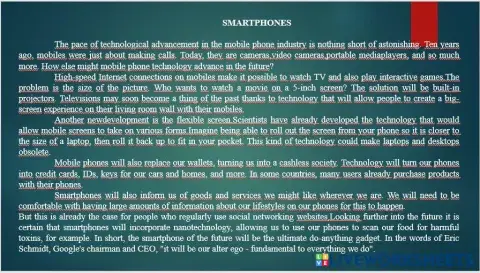
The pace of technological advancement in the mobile phone industry is nothing short of astonishing. Ten years ago, mobiles were just about making calls. Today, they are cameras,
video cameras,
portable media
players, and so much more. How else might mobile phone technology advance in the future?
High-speed Internet connections on mobiles make it possible to watch TV and also play interactive games.
The problem is the size of the picture. Who wants to watch a movie on a 5-inch screen? The solution will be built-in projectors. Televisions may soon become a thing of the past thanks to technology that will allow people to create a big-screen experience on their living room wall with their mobiles.
Another new
development is the flexible screen.
Scientists have already developed the technology that would allow mobile screens to take on various forms.
Imagine being able to roll out the screen from your phone so it is closer to the size of a laptop, then roll it back up to fit in your pocket. This kind of technology could make laptops and desktops obsolete.
Mobile phones will also replace our wallets, turning us into a cashless society. Technology will turn our phones into credit cards, IDs, keys for our cars and homes, and more. In some countries, many users already purchase products with their phones.
Smartphones will also inform us of goods and services we might like wherever we are. We will need to be comfortable with having large amounts of information about our lifestyles on our phones for this to happen.
But this is already the case for people who regularly use social networking websites.
Looking further into the future it is certain that smartphones will incorporate nanotechnology, allowing us to use our phones to scan our food for harmful toxins, for example. In short, the smartphone of the future will be the ultimate do-anything gadget. In the words of Eric Schmidt, Google's chairman and CEO, "it will be our alter ego - fundamental to everything we do".


Read the article and choose the correct option (A, B, C or D).
1 The reason people may use TVs less in the future is
A smartphones will have bigger screen displays.
B TV programmes will be made especially for smartphones.
C smartphones will be able to project images
onto walls.
D TV programmes will all be watched on PCs.
2 Smartphone screens will soon be
A unbreakable.
C expandable.
B rigid.
D exchangeable.
3 In the future, cash could become A more valuable.
B no longer necessary.
C used in only some countries.
D made of plastic.
4 In order for our phones to suggest goods and services to us, we would have to A make changes to our lifestyle.
B join a social networking site.
C provide location details.
D sacrifice some privacy.
5 The nanotechnology of the future may
A replace smartphones.
B release harmful toxins.
C be used in a number of gadgets.
D revolutionize smartphones.
5x2=10 marks

answer the questions

English as a Second Language (ESL)

1

What quality is important for a Sales Assistant to have?

a

Resourcefulness and quick thinking.

b

Responsibility and reliability.

c

Confidence and good people skills.

d

Creativity and a passion for food.

2

What characteristic is necessary for a Nurse to possess?

a

Logical thinking and problem-solving skills.

b

Knowledge and enthusiasm.

c

Responsibility and reliability.

d

Calmness and good listening skills.

3

What quality is important for a Journalist to have?

a

Flexibility and ability to work under pressure.

b

Well-organization and conscientiousness.

c

Resourcefulness and quick thinking.

d

Friendly and good with people.

4

What characteristic is necessary for a Chef to possess?

a

Patience and politeness.

b

Creativity and a passion for food.

c

Logical thinking and problem-solving skills.

d

Well-organization and conscientiousness.

5

What quality is important for a Tour Guide to have?

a

Responsiveness and ability to work long hours.

b

Knowledge and enthusiasm.

c

Flexibility and ability to work weekends and evenings.

d

Resourcefulness and quick thinking.

6

What characteristic is necessary for a Mechanic to possess?

a

Responsibility and reliability.

b

Confidence and good people skills.

c

Creativity and a passion for food.

d

Logical thinking and problem-solving skills.

7

What quality is important for a Waiter/Waitress to have?

a

Flexibility and ability to work under pressure.

b

Responsibility and reliability.

c

Confidence and good people skills.

d

Patience and politeness.

8

What characteristic is necessary for a Programmer to possess?

a

Knowledge and enthusiasm.

b

Logical thinking and problem-solving skills.

c

Resourcefulness and quick thinking.

d

Well-organization and conscientiousness.

Topics revision

Vocabulary - ESL

EXERCISE 3 – GRAMMAR

Complete the sentences.

a) Tom usually ______ (work) from Monday to Friday.

b) Last year, he ______ (change) jobs.

c) He ______ (feel) happier.

d) Next year, he ______ (study) marketing.

e) He wants ______ (have) better opportunities.


EXERCISE 4 – VOCABULARY

Choose the correct option.

a) Tom works as a __________.

b) In his free time, he likes __________ friends.

c) He works in a __________ company now.

d) He is saving money for his __________.

e) He wants to improve his job __________.


EXERCISE 5 – CONNECTORS

Complete using: usually – last year – now – because – next year


EXERCISE 6 – WRITING

Write a paragraph (40–50 words) about your work or studies, your free time and a future plan.


EXERCISE 7 – PAST SIMPLE

Complete the sentences.

a) Tom ______ (start) his new job last year.

b) He ______ (work) in a big company before.

c) He ______ (not like) his old routine.

d) He ______ (feel) happier.

e) He ______ (decide) to study marketing.


EXERCISE 8 – WAS / WERE

a) Tom ______ stressed.

b) His colleagues ______ friendly.

c) The company ______ small.

d) His weekends ______ relaxing.

e) His hours ______ long.


EXERCISE 9 – THERE WAS / THERE WERE

a) ______ many meetings.

b) ______ a lot of pressure.

c) ______ more free time.

d) ______ flexible hours.

e) ______ opportunities.


EXERCISE 10 – COMPARATIVES

Choose the correct option.

a) His new job is ______.

b) The company is ______.

c) His routine is ______.

d) His hours are ______.

e) He feels ______ now.


EXERCISE 11 – TIME EXPRESSIONS

Match:

1) last year

2) now

3) next year

4) before

5) at the moment

Crea y personaliza fichas interactivas para cada aula

LiveWorksheets facilita a profesorado, familias y personas que educan en casa el diseño y la entrega de materiales de aprendizaje atractivos. Solo tienes que subir un PDF o empezar desde cero para crear lo que necesites: desde fichas interactivas de matemáticas hasta ejercicios de comprensión lectora, fichas de multiplicación o actividades para infantil, todo en unos pocos clics. Nuestro editor de arrastrar y soltar funciona en todos los cursos y asignaturas, lo que te permite adaptar el contenido a tus programaciones, deberes o evaluaciones. Quienes enseñan inglés como segunda lengua (ESL) también pueden crear sus propias fichas, añadir cuadros de sonidos comunes o integrar actividades de ESL para hacer cada clase más participativa. Además, podrás diseñar fácilmente tareas diferenciadas y autocorregidas que ahorran tiempo y apoyan un mejor aprendizaje del alumnado.

Una biblioteca completa de recursos para K-12 y ESL

Accede a miles de fichas listas para usar en todas las asignaturas de K-12, incluidas actividades para infantil, matemáticas, práctica de multiplicación, comprensión lectora y recursos de ESL. Filtra por curso, materia o nivel de competencia para encontrar exactamente lo que necesitas, ya sea para un aula de primaria, una revisión en secundaria o actividades de práctica en bachillerato. El profesorado de ESL puede explorar nuestra colección en constante crecimiento de fichas y actividades de inglés como segunda lengua, diseñadas para apoyar a estudiantes de todos los niveles. Con nuevo contenido añadido de forma regular, LiveWorksheets es un recurso flexible que ayuda a lograr aprendizajes duraderos.