Naftali

Vocabulary - English Language

דף עבודה מורחב – חזרה למבדק באנגלית חלק א – התאמת מילים לפירוש :חברו בין המילה באנגלית למשמעות הנכונה בעברית 1. nuts a. חופשה 2. sale b. הר 3. mountain c. קבוצה 4. hospital d. אגוזים 5. team e. חתיכה בית חולים .f chocolate 6. מבצע /מכירה .g vacation 7. 8. piece h. שוקולד חלק ב – השלמת משפטים :השלימו את המשפטים בעזרת מילה מתאימה מהרשימה 1. We climbed the _______ last summer. 2. The shop has a big _______ today. 3. Please give me a _______ of cake. 4. The doctor works in a _______. 5. Our _______ won the football game. 6. I like to eat _______ when I watch TV. 7. She gave me _______ for my birthday. 8. We went on _______ to Greece. חלק ג – בחירה מרובה :בחרו את התשובה הנכונה 1. A place to buy and sell things is: a) market b) hospital c) garden 2. To put clothes on your body means: a) stand b) wear c) bring 3. The opposite of 'expensive' is: a) cheap b) special c) favorite 4. To not remember is: a) forget b) happen c) speak חלק ד – השלימו משפטים בפעלים מהרשימה מתאים פועל בחרו) grow, begin, watch, invite, teach, sleep): 1. I usually _______ TV in the evening. 2. The lesson _______ at 8:15. 3. My teacher _______ us English. 4. My parents always _______ me to family dinners. 5. Flowers _______ quickly in spring. 6. I _______ at 11 o’clock at night. חלק ה – כתיבת משפטים behind ,together ,wonderful ,sick ,strong :כתבו משפטים משלכם בעזרת המילים חלק ו – הקפת שם התואר :הקיפו את שם התואר במשפטים הבאים 1. The soup is warm and tasty. 2. We had a special day at school. 3. The test was hard but fair. 4. The park is beautiful in spring. 5. My favorite color is blue. חלק ז – תרגום מעברית לאנגלית :תרגמו את המשפטים .אני תמיד שוכח את המחברת שלי 1. .הכלב ישן בתוך הבית 2. .היא עומדת ליד החברה שלה 3. .אין לי מספיק כסף 4. .הקבוצה שלנו שיחקה נהדר 5. חלק ח – קטע קריאה קצר :קראו את הקטע וענו על השאלות Text: Last Sunday we went on a trip. The weather was sunny and warm. We climbed a mountain and had a picnic at the top. After lunch, we spent time in the garden near the river. It was a wonderful day! Questions: 1. What was the weather like? 2. Where did they have the picnic? 3. What did they do after lunch? 4. Find two adjectives in the text. 5. Translate the sentence: 'It was a wonderful day!' חלק ט – כתיבה חופשית .Vacation Favorite My :כתבו 8–10 משפטים על נושא .השתמשו בלפחות 5 מילים מהרשימה שלמדנו ☑ .הקפידו לכתוב משפטים מלאים ☑

Student Worksheet Leaflet : Marc Chagall – From Goal to Success

Reading Comprehension - English Language

Name: ____________________ 

SUCCESS

to set a goal 


to work hard


to face obstacles


to acquire new skills


to stay humble and hungry


Before Reading – Think & Discuss 

1. What do you think makes a person successful? 


2. Have you ever seen a painting with flying people, animals, or dream-like scenes? How did it make you feel? 


Reading Comprehension 

Read the biography of Marc Chagall . Then answer the questions.*


True (T) or False (F)? Correct the false sentences. 


1. Marc Chagall was born in Paris. 

   → Correction: _____________________________________ 


2. He came from a wealthy family. 

 → Correction: _____________________________________ 


3.  He stopped painting during World War II. 

 → Correction: _____________________________________ 


4.  His art often included memories of his childhood. 

 → Correction: _____________________________________ 


5. _ He only painted on canvas. 

 → Correction: _____________________________________ 


6. He painted his most famous works in Paris.

 → Correction: _____________________________________ 

7. Unfortunately, Chagall`s paintings didn`t see many exhibitions during his lifetime.

 → Correction: _____________________________________ 


Find the evidence of his success in the text. Give the details from the text 


to set a goal 

________________________________________________

to work hard

________________________________________________

to face obstacles

________________________________________________

to acquire new skills

________________________________________________

to stay humble and hungry

________________________________________________


A picture description

  • Useful vocabulary

a flying couple, a violinist, a vibrant colour palette, floating figures, distorted perspective, symbols of childhood / love / hometown, euphoria of love, soaring happiness, nostalgia for the goal, connection to roots, the artist at work, between his homeland and new life


Topics to highlight while describing

  • How does this picture reflect Chagall`s goals, dreams, obstacles etc
  • What do main figures symbolize in the picture?


Reflection 

  • Marc Chagall never gave up on his dream, even when life was hard. 
  • What is your dream or big goal? What will help you achieve it? 

Reading Worksheet - PFlores

English as a Second Language (ESL)

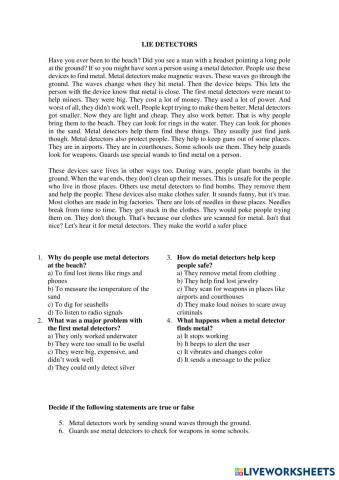
Have you ever been to the beach? Did you see a man with a headset pointing a long pole at the ground? If so you might have seen a person using a metal detector. People use these devices to find metal. Metal detectors make magnetic waves. These waves go through the ground. The waves change when they hit metal. Then the device beeps. This lets the person with the device know that metal is close. The first metal detectors were meant to help miners. They were big. They cost a lot of money. They used a lot of power. And worst of all, they didn't work well. People kept trying to make them better. Metal detectors got smaller. Now they are light and cheap. They also work better. That is why people bring them to the beach. They can look for rings in the water. They can look for phones in the sand. Metal detectors help them find these things. They usually just find junk though. Metal detectors also protect people. They help to keep guns out of some places. They are in airports. They are in courthouses. Some schools use them. They help guards look for weapons. Guards use special wands to find metal on a person.

These devices save lives in other ways too. During wars, people plant bombs in the ground. When the war ends, they don't clean up their messes. This is unsafe for the people who live in those places. Others use metal detectors to find bombs. They remove them and help the people. These devices also make clothes safer. It sounds funny, but it's true. Most clothes are made in big factories. There are lots of needles in these places. Needles break from time to time. They get stuck in the clothes. They would poke people trying them on. They don't though. That's because our clothes are scanned for metal. Isn't that nice? Let's hear it for metal detectors. They make the world a safer place

Unit 1 Grammar 02

GEP3

Talking About Past Habits and Situations

Names: ………………………………………………………….

"Used to" and "Would"

1. Explanation

🔹 "Used to"

We use "used to" to talk about:
Past habits (things we did regularly in the past but don’t do now).
Past states (situations that were true in the past but have changed).

📌 Form:

  • Positive: I used to play football every weekend.
  • Negative: I didn’t use to like coffee.
  • Question: Did you use to have long hair?

🚫 We don't use "would" for past states. I used to have long hair. (Correct). I would have long hair. (Incorrect)

🔹 "Would"

We use "would" to talk about:
Repeated past actions and habits (but NOT past states).

📌 Form:

  • Positive: When I was a child, I would visit my grandma every Sunday.
  • Negative: She wouldn’t eat vegetables when she was younger.

🚫 No question form with "would" for past habits. Use "Did you use to...?" instead.

2. Exercises

A. Complete the Conversations

Fill in the blanks using "used to," "didn't use to," "would," or "wouldn't."

  1. A: You’re so fit now! But I remember you ______________ (not/exercise) much before.
    B: Yeah, I ______________ (spend) all my weekends watching TV.
  2. A: ______________ (you/play) the piano when you were a child?
    B: Yes! I ______________ (practice) every day, but I stopped when I was 15.
  3. A: My grandpa ______________ (tell) me bedtime stories when I was little.
    B: That’s sweet! My parents ______________ (not/read) to me much, but I loved books.

B. Rewrite the Sentences

Rewrite the sentences using "used to" or "would" where possible.

  1. I often played outside with my friends after school.
    → _______________________________________
  2. She was very shy when she was younger.
    → _______________________________________
  3. My brother always helped me with my homework.
    → _______________________________________
  4. They had a small shop in our town.
    → _______________________________________

C. Past vs. Now

Look at the situations below. Write one sentence about the past and one about now using "used to" and "but now..."

  1. I hated vegetables before. Now, I eat them every day.
    → I ________________ vegetables, but now I ________________.
  2. My parents were strict. Now, they are more outgoing.
    → They ________________, but now ________________.
  3. I didn’t enjoy studying English before. Now, I love it!
    → I ________________, but now ________________.

D. Short Paragraph Exercise

Write a short paragraph (4–5 sentences) about how your life has changed. Use "used to," "didn’t use to," "would," and "wouldn’t."

Example:
"When I was a child, I used to be very shy. I wouldn’t talk much in class, and I used to feel nervous meeting new people. I used to love playing outside, and my friends and I would ride our bikes every day. Now, I’m more confident, and I love socializing."

....................................................................................................................................................................................................................................................................................................................................................................................................................................................................................................................................................................................................................................................................................................................................................................................................................................................................................................................................................................................................................................................................................................................................

Talking About Past Habits and Situations

Names: ………………………………………………………….

"Used to" and "Would"

1. Explanation

🔹 "Used to"

We use "used to" to talk about:
Past habits (things we did regularly in the past but don’t do now).
Past states (situations that were true in the past but have changed).

📌 Form:

  • Positive: I used to play football every weekend.
  • Negative: I didn’t use to like coffee.
  • Question: Did you use to have long hair?

🚫 We don't use "would" for past states. I used to have long hair. (Correct). I would have long hair. (Incorrect)

🔹 "Would"

We use "would" to talk about:
Repeated past actions and habits (but NOT past states).

📌 Form:

  • Positive: When I was a child, I would visit my grandma every Sunday.
  • Negative: She wouldn’t eat vegetables when she was younger.

🚫 No question form with "would" for past habits. Use "Did you use to...?" instead.

2. Exercises

A. Complete the Conversations

Fill in the blanks using "used to," "didn't use to," "would," or "wouldn't."

  1. A: You’re so fit now! But I remember you ______________ (not/exercise) much before.
    B: Yeah, I ______________ (spend) all my weekends watching TV.
  2. A: ______________ (you/play) the piano when you were a child?
    B: Yes! I ______________ (practice) every day, but I stopped when I was 15.
  3. A: My grandpa ______________ (tell) me bedtime stories when I was little.
    B: That’s sweet! My parents ______________ (not/read) to me much, but I loved books.

B. Rewrite the Sentences

Rewrite the sentences using "used to" or "would" where possible.

  1. I often played outside with my friends after school.
    → _______________________________________
  2. She was very shy when she was younger.
    → _______________________________________
  3. My brother always helped me with my homework.
    → _______________________________________
  4. They had a small shop in our town.
    → _______________________________________

C. Past vs. Now

Look at the situations below. Write one sentence about the past and one about now using "used to" and "but now..."

  1. I hated vegetables before. Now, I eat them every day.
    → I ________________ vegetables, but now I ________________.
  2. My parents were strict. Now, they are more outgoing.
    → They ________________, but now ________________.
  3. I didn’t enjoy studying English before. Now, I love it!
    → I ________________, but now ________________.

D. Short Paragraph Exercise

Write a short paragraph (4–5 sentences) about how your life has changed. Use "used to," "didn’t use to," "would," and "wouldn’t."

Example:
"When I was a child, I used to be very shy. I wouldn’t talk much in class, and I used to feel nervous meeting new people. I used to love playing outside, and my friends and I would ride our bikes every day. Now, I’m more confident, and I love socializing."

....................................................................................................................................................................................................................................................................................................................................................................................................................................................................................................................................................................................................................................................................................................................................................................................................................................................................................................................................................................................................................................................................................................................................


English exam

English


1): Completar espacios (Past Simple y Past Continuous)

Instrucciones: Completa las oraciones con la forma correcta del verbo entre paréntesis. Usa Past Simple o Past Continuous según corresponda. (5 puntos)

  1. While I _______ (walk) to school, it suddenly _______ (start) to rain.
  2. She _______ (not watch) TV yesterday because she _______ (study) for her exam.
  3. They _______ (play) soccer when the accident _______ (happen).
  4. What _______ you _______ (do) at 8 p.m. last night?
  5. We _______ (see) a shooting star while we _______ (sit) on the beach.

2): Opción múltiple (Future Simple - Will y Be Going To)

Instrucciones: Elige la respuesta correcta. (5 puntos)

  1. Look at those clouds! It _______ soon.
    a) will rain
    b) is going to rain
    c) rains
  2. I think John _______ be at the party tonight.
    a) will
    b) is going to
    c) is
  3. They _______ a new car next year; they’ve already saved the money.
    a) are going to buy
    b) will buy
    c) buy
  4. Don’t worry, I _______ help you with your homework.
    a) am going to
    b) will
    c) going
  5. She has decided that she _______ to university after finishing high school.
    a) will go
    b) is going
    c) is going to go

3): Transformar oraciones

Instrucciones: Reescribe las oraciones en negativo y en pregunta. (6 puntos)

  1. He was reading a book.
    • Negativo: ______________________________
    • Pregunta: ______________________________
  2. They will visit their grandparents tomorrow.
    • Negativo: ______________________________
    • Pregunta: ______________________________
  3. She cooked dinner last night.
    • Negativo: ______________________________
    • Pregunta: ______________________________

4): Ordenar oraciones

Instrucciones: Ordena las palabras para formar oraciones correctas. (4 puntos)

  1. yesterday / didn’t / homework / do / he / his
  2. the / were / doing / kids / what / at 5 p.m.?
  3. going / we / are / to / tomorrow / leave
  4. was / playing / music / she / beautiful

5): Comprensión lectora

Instrucciones: Lee el siguiente texto y responde las preguntas. (5 puntos)

Texto:
"Last summer, Emily and her family went on a trip to Spain. While they were visiting Barcelona, they saw many interesting places. One afternoon, while Emily was taking photos of the Sagrada Familia, her brother got lost. He wasn’t paying attention and walked away from the group. Luckily, a kind stranger helped him find his way back. The whole family was very relieved when they found him."

Preguntas:

  1. Where did Emily’s family go last summer?
  2. What was Emily doing when her brother got lost?
  3. Why did her brother get lost?
  4. Who helped Emily’s brother?
  5. How did the family feel when they found him?


Puntaje Total: _____ / 25


Linking words

EFL

LINKING WORDS

Exercise A: Fill in the blanks with the correct connector ( therefore, what's more, also, however, moreover, so, despite that)

1. Sarah was feeling very tired; ______, she decided to take a short nap before the meeting.

2. I enjoy playing basketball. ______, I love watching football on TV.

3. He didn't study for the exam. ______, he managed to pass it.

4. The weather was terrible. ______, we decided to go hiking.

5. She is a talented musician. ______, she speaks five languages fluently.

6. I didn't like the movie at all. ______, it was too long and boring.

7. They didn't have enough time to prepare. ______, they did their best to finish the project.


Exercise B: Choose the correct connector for each sentence.

8. I didn’t get the job offer. ______, I will keep looking for other opportunities.
a) Despite that
b) Therefore
c) However

9. He always helps others. ______, he volunteers at a local charity.
a) So
b) Moreover
c) Despite that

10. The restaurant was very expensive. ______, the food wasn’t very good.
a) Also
b) What's more
c) However

11. I wasn’t feeling well, ______ I went to work anyway.
a) Despite that
b) Therefore
c) However


Exercise C: Complete the paragraph using the appropriate connectors.

12.
I love visiting new places. ______, I always try to learn a few words in the local language before I go. This way, I can communicate with the locals more easily. I visited Paris last year. The weather was amazing, and I had a fantastic time. ______, I visited the Eiffel Tower and took lots of photos. The food was delicious, and I tried many new dishes. ______, I also visited the Louvre Museum and saw the famous Mona Lisa. ______, I would recommend going to Paris to anyone who enjoys history and culture!

We Are Particles

Science

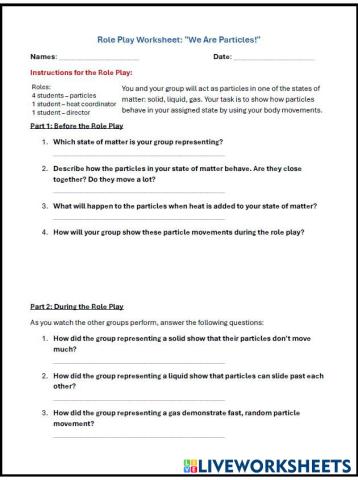
Role Play Worksheet: "We Are Particles!"

Names: _______________________                                               Date: _______________________


Roles:

4 students – particles

1 student – heat coordinator

1 student – director

Instructions for the Role Play:


You and your group will act as particles in one of the states of matter: solid, liquid, gas. Your task is to show how particles behave in your assigned state by using your body movements.

Part 1: Before the Role Play

  1. Which state of matter is your group representing?
    _________________________________________________
  2. Describe how the particles in your state of matter behave. Are they close together? Do they move a lot?
    _________________________________________________
  3. What will happen to the particles when heat is added to your state of matter?
    _________________________________________________
  4. How will your group show these particle movements during the role play?


Part 2: During the Role Play

As you watch the other groups perform, answer the following questions:

  1. How did the group representing a solid show that their particles don’t move much?
    _________________________________________________
  2. How did the group representing a liquid show that particles can slide past each other?
    _________________________________________________
  3. How did the group representing a gas demonstrate fast, random particle movement?
    _________________________________________________

Crea y personaliza fichas interactivas para cada aula

LiveWorksheets facilita a profesorado, familias y personas que educan en casa el diseño y la entrega de materiales de aprendizaje atractivos. Solo tienes que subir un PDF o empezar desde cero para crear lo que necesites: desde fichas interactivas de matemáticas hasta ejercicios de comprensión lectora, fichas de multiplicación o actividades para infantil, todo en unos pocos clics. Nuestro editor de arrastrar y soltar funciona en todos los cursos y asignaturas, lo que te permite adaptar el contenido a tus programaciones, deberes o evaluaciones. Quienes enseñan inglés como segunda lengua (ESL) también pueden crear sus propias fichas, añadir cuadros de sonidos comunes o integrar actividades de ESL para hacer cada clase más participativa. Además, podrás diseñar fácilmente tareas diferenciadas y autocorregidas que ahorran tiempo y apoyan un mejor aprendizaje del alumnado.

Una biblioteca completa de recursos para K-12 y ESL

Accede a miles de fichas listas para usar en todas las asignaturas de K-12, incluidas actividades para infantil, matemáticas, práctica de multiplicación, comprensión lectora y recursos de ESL. Filtra por curso, materia o nivel de competencia para encontrar exactamente lo que necesitas, ya sea para un aula de primaria, una revisión en secundaria o actividades de práctica en bachillerato. El profesorado de ESL puede explorar nuestra colección en constante crecimiento de fichas y actividades de inglés como segunda lengua, diseñadas para apoyar a estudiantes de todos los niveles. Con nuevo contenido añadido de forma regular, LiveWorksheets es un recurso flexible que ayuda a lograr aprendizajes duraderos.