Reading Worksheet - PFlores

English as a Second Language (ESL)

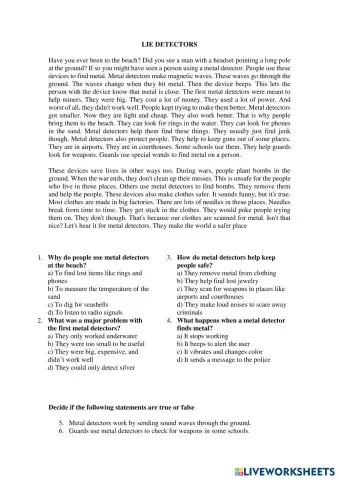
Have you ever been to the beach? Did you see a man with a headset pointing a long pole at the ground? If so you might have seen a person using a metal detector. People use these devices to find metal. Metal detectors make magnetic waves. These waves go through the ground. The waves change when they hit metal. Then the device beeps. This lets the person with the device know that metal is close. The first metal detectors were meant to help miners. They were big. They cost a lot of money. They used a lot of power. And worst of all, they didn't work well. People kept trying to make them better. Metal detectors got smaller. Now they are light and cheap. They also work better. That is why people bring them to the beach. They can look for rings in the water. They can look for phones in the sand. Metal detectors help them find these things. They usually just find junk though. Metal detectors also protect people. They help to keep guns out of some places. They are in airports. They are in courthouses. Some schools use them. They help guards look for weapons. Guards use special wands to find metal on a person.

These devices save lives in other ways too. During wars, people plant bombs in the ground. When the war ends, they don't clean up their messes. This is unsafe for the people who live in those places. Others use metal detectors to find bombs. They remove them and help the people. These devices also make clothes safer. It sounds funny, but it's true. Most clothes are made in big factories. There are lots of needles in these places. Needles break from time to time. They get stuck in the clothes. They would poke people trying them on. They don't though. That's because our clothes are scanned for metal. Isn't that nice? Let's hear it for metal detectors. They make the world a safer place

Grammar

English as a Second Language (ESL)

<html>
<head>
    <title>Exercise - Passive Voice</title>
</head>
<body>
    <h2>Exercise 1</h2>
    <p>Change the active sentences to passive.</p>
    <ol>
        <li>Waitresses and waiters serve customers. <input type="text" name="q1"></li>
        <li>The teacher is going to explain the lesson. <input type="text" name="q2"></li>
        <li>Two horses were pulling the farmer's wagon. <input type="text" name="q3"></li>
        <li>Toshi will invite Yoko to the party. <input type="text" name="q4"></li>
        <li>Alex is preparing that report. <input type="text" name="q5"></li>
        <li>Kathy had returned the book to the library. <input type="text" name="q6"></li>
        <li>Miriam has designed several public buildings. <input type="text" name="q7"></li>
        <li>His tricks won't fool me. <input type="text" name="q8"></li>
        <li>I didn't write that note. Did Jim write it? <input type="text" name="q9"></li>
        <li>Does Prof. Shapiro teach that course? No, he doesn't teach it. <input type="text" name="q10"></li>
        <li>Mrs. Andrews hasn't signed those papers yet. Has Mr. Andrews signed those papers yet? <input type="text" name="q11"></li>
    </ol>
    
    <h2>Exercise 2</h2>
    <p>Complete the sentences with the passive form of the verbs in the list. Use any appropriate tense.</p>
    <p><strong>build, divide, invent, order, surprise, cause, expect, kill, report, surround, confuse, frighten, offer, spell, wear</strong></p>
    <ol>
        <li>The electric light bulb <input type="text" name="q12"> by Thomas Edison in 1879.</li>
        <li>An island <input type="text" name="q13"> by water.</li>
        <li>The -ing form of sit <input type="text" name="q14"> with a double "t."</li>
        <li>Even though construction costs are high, a new dormitory <input type="text" name="q15"> next year.</li>
        <li>The class was too large last semester, so it <input type="text" name="q16"> into two sections.</li>
        <li>A bracelet <input type="text" name="q17"> around the wrist.</li>
        <li>The Johnsons' house burned down. According to the inspector, the fire <input type="text" name="q18"> by lightning.</li>
        <li>Al got a ticket for reckless driving. When he went to traffic court, he <input type="text" name="q19"> to pay a large fine.</li>
        <li>I read about a hunter who accidentally <input type="text" name="q20"> by another hunter.</li>
        <li>The hunter's fatal accident <input type="text" name="q21"> in the newspaper yesterday.</li>
        <li>I didn't expect Lisa to come to the meeting last night, but she was there. I <input type="text" name="q22"> to see her.</li>
        <li>Last week I <input type="text" name="q23"> a job at a local bank, but I didn't accept it.</li>
        <li>The children <input type="text" name="q24"> in the middle of the night when they heard strange noises in the house.</li>
        <li>Could you explain this math problem to me? Yesterday in class I <input type="text" name="q25"> by the teacher's explanation.</li>
        <li>A: Is the plane going to be late?</li>
        <li>B: No. It <input type="text" name="q26"> to be on time.</li>
    </ol>
</body>
</html>

Crea y personaliza fichas interactivas para cada aula

LiveWorksheets facilita a profesorado, familias y personas que educan en casa el diseño y la entrega de materiales de aprendizaje atractivos. Solo tienes que subir un PDF o empezar desde cero para crear lo que necesites: desde fichas interactivas de matemáticas hasta ejercicios de comprensión lectora, fichas de multiplicación o actividades para infantil, todo en unos pocos clics. Nuestro editor de arrastrar y soltar funciona en todos los cursos y asignaturas, lo que te permite adaptar el contenido a tus programaciones, deberes o evaluaciones. Quienes enseñan inglés como segunda lengua (ESL) también pueden crear sus propias fichas, añadir cuadros de sonidos comunes o integrar actividades de ESL para hacer cada clase más participativa. Además, podrás diseñar fácilmente tareas diferenciadas y autocorregidas que ahorran tiempo y apoyan un mejor aprendizaje del alumnado.

Una biblioteca completa de recursos para K-12 y ESL

Accede a miles de fichas listas para usar en todas las asignaturas de K-12, incluidas actividades para infantil, matemáticas, práctica de multiplicación, comprensión lectora y recursos de ESL. Filtra por curso, materia o nivel de competencia para encontrar exactamente lo que necesitas, ya sea para un aula de primaria, una revisión en secundaria o actividades de práctica en bachillerato. El profesorado de ESL puede explorar nuestra colección en constante crecimiento de fichas y actividades de inglés como segunda lengua, diseñadas para apoyar a estudiantes de todos los niveles. Con nuevo contenido añadido de forma regular, LiveWorksheets es un recurso flexible que ayuda a lograr aprendizajes duraderos.