employment

Vocabulary - ESL

🧠 A. Gap filling (1 point each)

Fill in each gap with one word only.

  1. When I was offered a higher salary, I decided to hand in my {resignation}.
  2. Many graduates nowadays struggle to find a job that matches their {qualifications}.
  3. He’s been working {for} the same company for over fifteen years.
  4. If you can’t come to work due to illness, you must provide a medical {certificate}.
  5. She’s under a lot of {pressure} to meet the deadlines this quarter.
  6. The company had to make several employees {redundant} due to the economic crisis.
  7. After years of hard work, he finally got a well-deserved {promotion}.
  8. During the interview, they asked me to talk about my previous {work} experience.

✍️ B. Translate into English (2 points each)

Translate the following sentences into English.
(Type your translation into the box below each sentence.)

  1. Firma zaoferowała jej stanowisko kierownicze po roku pracy.
    { }
  2. Jeśli chcesz wziąć kilka dni wolnego, musisz wypełnić odpowiedni formularz.
    { }
  3. Został zwolniony, ponieważ nie spełniał oczekiwań przełożonych.
    { }
  4. Otrzymała premię za wyjątkowe wyniki sprzedaży.
    { }
  5. Lubi swoją pracę, mimo że jest bardzo stresująca i wymagająca.
    { }
  6. Kiedy przechodzisz na emeryturę, możesz w końcu odpocząć od zawodowych obowiązków.
    { }
  7. On często bierze nadgodziny, żeby zarobić więcej pieniędzy.
    { }

🔗 C. Match the words to make collocations (1 point each)

Write the correct letter (a–h) next to each number.

  1. career → {b}
  2. job → {f}
  3. working → {g}
  4. annual → {d}
  5. company → {e}
  6. permanent → {a}
  7. part-time → {c}
  8. unpaid → {h}

a. contract
b. development
c. leave
d. review
e. meeting
f. position
g. experience
h. internship

🧾 D. Multiple Choice (1 point each)

Choose the correct answer (a, b, c or d).

  1. If you’re unhappy in your job, it’s best to _________ and look for something new.
    {b: resign}
  2. A person who supervises and trains young workers is called _________.
    {b: a mentor}
  3. The new project has been put _________ until next year.
    {b: on the back burner}
  4. She was praised for thinking _________ and finding an innovative solution.
    {a: outside the box}
  5. The company went _________ after years of financial problems.
    {a: in the red}
  6. If a product is selling like hotcakes, it’s _________.
    {b: very popular}
  7. He’s such a _________ person — everyone in the office likes him.
    {d: people-oriented}

💬 E. Idioms & Expressions – Gap filling (1 point each)

Complete the sentences with one of the idioms:
(in the red / have a lot on your plate / put off / crunch the numbers / take off / win-win situation)

  1. We need to {crunch the numbers} before deciding whether the project is profitable.
  2. I can’t join you this weekend — I really {have a lot on my plate} at work.
  3. Sales have really {taken off} since we launched our new website.
  4. Let’s not {put off} this decision any longer.
  5. A flexible schedule is a {win-win situation} for both the employer and employees.

Places

English as a Second Language (ESL)

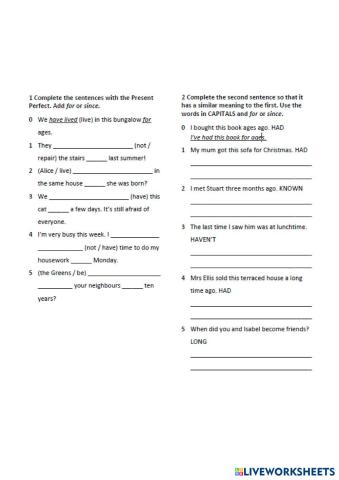
I. Fill in the blank with correct verb form to complete the dialogue below:

Anna: Hi, John! You look tired. What’s wrong?
John: Oh, I (1) ______ (not sleep) well last night.
Anna: Why? Was it because of the exam?
John: Yes, I (2) ______ (study) until midnight, and I still don’t feel ready.
Anna: Don’t worry! I’m sure you’ll do great. By the way, (3) ______ you ______ (review) the grammar rules yet?
John: Not really. I (4) ______ (focus) more on vocabulary.
Anna: Let’s review together during lunch!

II. Write a paragraph

“Describe a place you have visited and why you liked it.”
............................................................................................................................................................................................................................................................................................................................................................................................................................................................................................................................................................................................................................................................................................................................................................................................................................................................................................................................................................................

III. Choose the correct answer:

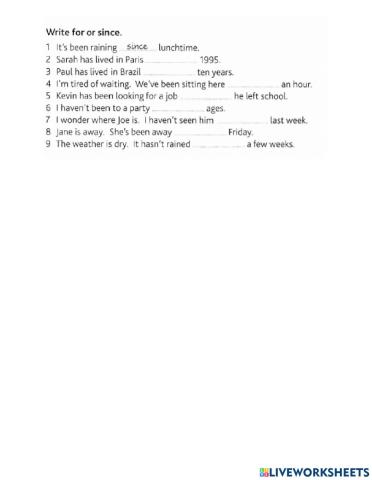
  1. I haven’t seen Sarah ______ a long time.
    a) since
    b) for
    c) ago
    d) before
  2. If I ______ enough money, I would travel around the world.
    a) have
    b) had
    c) will have
    d) has
  3. He asked me where I ______ from.
    a) am
    b) was
    c) were
    d) be

Present Perfect Tense

Writing - English Language

📝 Student Instruction: Present Perfect Tense

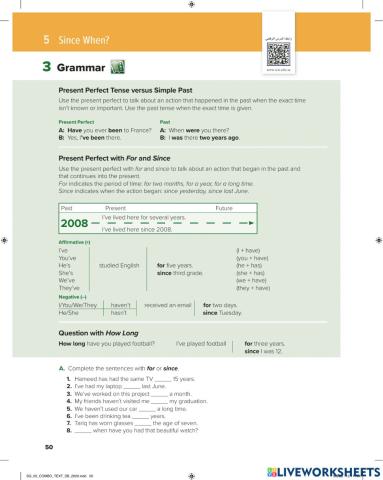
  1. When do we use Present Perfect?
  • To talk about actions or experiences at an unspecified time in the past.

    • I have visited Japan.
  • To talk about actions that started in the past and continue until now.

    • She has lived here for 10 years.
  • To talk about actions that happened in the past but still have a result now.

    • He has broken his leg (he can’t walk now).
  1. Form
  • Affirmative (+): Subject + have/has + past participle (V3)

    • I have eaten breakfast.
    • She has finished her homework.
  • Negative (–): Subject + have/has + not + past participle

    • I haven’t seen that movie.
    • He hasn’t called me.
  • Question (?): Have/Has + subject + past participle

    • Have you visited London?
    • Has she done her homework?
  1. Time expressions used with Present Perfect
  • just → I have just finished my homework.
  • already → She has already eaten.
  • yet → Have you finished yet? / I haven’t finished yet.
  • ever → Have you ever been to Paris?
  • never → I have never seen snow.
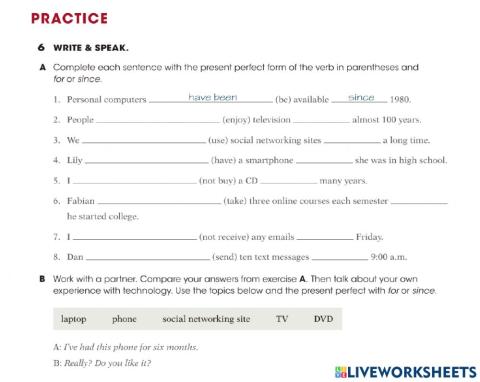
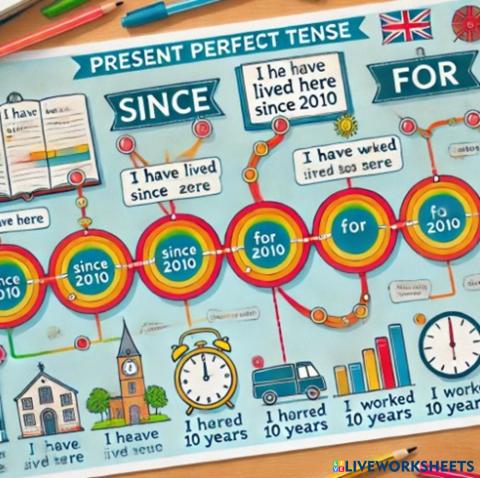
  • for (a period of time) → for 5 years
  • since (a starting point) → since 2010
  1. Examples
  • We have studied English for three years.
  • He has never played basketball.
  • Have they arrived yet?

👉 Practice Example:
Change the verb into Present Perfect.

  1. I (see) that movie three times. → I have seen that movie three times.
  2. She (not finish) her homework yet. → She hasn’t finished her homework yet.
  3. (they / travel) to London before? → Have they traveled to London before?

Crea y personaliza fichas interactivas para cada aula

LiveWorksheets facilita a profesorado, familias y personas que educan en casa el diseño y la entrega de materiales de aprendizaje atractivos. Solo tienes que subir un PDF o empezar desde cero para crear lo que necesites: desde fichas interactivas de matemáticas hasta ejercicios de comprensión lectora, fichas de multiplicación o actividades para infantil, todo en unos pocos clics. Nuestro editor de arrastrar y soltar funciona en todos los cursos y asignaturas, lo que te permite adaptar el contenido a tus programaciones, deberes o evaluaciones. Quienes enseñan inglés como segunda lengua (ESL) también pueden crear sus propias fichas, añadir cuadros de sonidos comunes o integrar actividades de ESL para hacer cada clase más participativa. Además, podrás diseñar fácilmente tareas diferenciadas y autocorregidas que ahorran tiempo y apoyan un mejor aprendizaje del alumnado.

Una biblioteca completa de recursos para K-12 y ESL

Accede a miles de fichas listas para usar en todas las asignaturas de K-12, incluidas actividades para infantil, matemáticas, práctica de multiplicación, comprensión lectora y recursos de ESL. Filtra por curso, materia o nivel de competencia para encontrar exactamente lo que necesitas, ya sea para un aula de primaria, una revisión en secundaria o actividades de práctica en bachillerato. El profesorado de ESL puede explorar nuestra colección en constante crecimiento de fichas y actividades de inglés como segunda lengua, diseñadas para apoyar a estudiantes de todos los niveles. Con nuevo contenido añadido de forma regular, LiveWorksheets es un recurso flexible que ayuda a lograr aprendizajes duraderos.