Sentence Structures

English as a Second Language (ESL)

1. Simple Sentence

A simple sentence contains only one independent clause (a complete thought). It has a subject and a verb, and it expresses a complete idea.

Structure:

Subject + Verb (and sometimes an object or complement)

Examples:

  1. I eat lunch every day.
    (Subject: "I", Verb: "eat")
  2. She studied for the exam.
    (Subject: "She", Verb: "studied")
  3. The dog barked loudly.
    (Subject: "The dog", Verb: "barked")

2. Compound Sentence

A compound sentence consists of two or more independent clauses joined by a coordinating conjunction (for, and, nor, but, or, yet, so), or by a semicolon.

Structure:

Independent clause + coordinating conjunction + independent clause

Examples:

  1. I wanted to go to the party, but I was too tired.
    (Two independent clauses: "I wanted to go to the party" and "I was too tired," joined by "but")
  2. She likes reading books, and he enjoys playing sports.
    (Two independent clauses: "She likes reading books" and "He enjoys playing sports," joined by "and")
  3. I am studying for my test; I will take a break later.
    (Two independent clauses joined by a semicolon)

3. Complex Sentence

A complex sentence contains one independent clause and at least one dependent clause (a clause that cannot stand alone and does not express a complete thought). Dependent clauses are connected to the independent clause by a subordinating conjunction (because, although, if, when, since, etc.).

Structure:

Independent clause + subordinating conjunction + dependent clause

Examples:

  1. I stayed home because it was raining.
    (Independent clause: "I stayed home" and dependent clause: "because it was raining")
  2. Although she was tired, she finished her homework.
    (Independent clause: "She finished her homework" and dependent clause: "although she was tired")
  3. We will go to the park if it doesn't rain.
    (Independent clause: "We will go to the park" and dependent clause: "if it doesn't rain")

4. Compound-Complex Sentence

A compound-complex sentence is a combination of both a compound sentence and a complex sentence. It contains at least two independent clauses and at least one dependent clause.

Structure:

Independent clause + coordinating conjunction + independent clause + subordinating conjunction + dependent clause

Examples:

  1. I wanted to go to the beach, but it started raining, so we stayed home.
    (Independent clauses: "I wanted to go to the beach" and "it started raining," joined by "but"; dependent clause: "so we stayed home")
  2. Although I studied hard, I didn't pass the test, and I felt disappointed.
    (Independent clauses: "I didn't pass the test" and "I felt disappointed," joined by "and"; dependent clause: "Although I studied hard")
  3. She loves reading books, and she often reads late into the night, because she finds it relaxing.
    (Independent clauses: "She loves reading books" and "She often reads late into the night," joined by "and"; dependent clause: "because she finds it relaxing")

A Rose for Emily | Timeline

AP Literature

Key Events in A Rose for Emily


Part 1


  • When Emily died, the whole town visited her funeral, the men visited through respectful affection, the women visited out of curiosity of what was inside of her house.
  • Alive-- Emily had been a tradition, a duty, and a care. 
  • In 1894, Colonel Sartoris sent out an edict that no negro woman should appear on the streets without an apron.
  • Colonel Sartoris made a tale saying that Miss Emily’s father had loaned money to the town, which suggested that Miss Emily would not need to pay taxes. 
  • When Jefferson's authorities ​​approached her about her taxes, she claimed that she did not have any tax. Even though Colonel Sartoris has been dead for 10 years. 


Part 2 


  • It cuts back to 30 years prior and 2 years after the death of her father, where a stench started to develop around her house.
  • The townspeople complained to the judge, and after the complaint was made, the Aldermen family met up and decided to deal with the problem themselves. Which led to them sneaking around her house in order to sprinkle lime around where the smell was.
  • The people around town started to pity Miss Emily for being left alone to herself after the death of her father, but she rejected them stating that her father was not dead. After some persuasion from the minister, she finally breaks down and admits it, after which her father would quickly be buried. The people theorized that this is due to the fact that her father drove away a lot of men who wanted to “steal” from her.


Part 3 


  • Emily begins dating Homer Barron. The townspeople are shocked to see a person of higher position dating somebody lower. Homer is seen as “unsuitable” for Emily.
  • The town starts to gossip regarding Emily’s relationship with Homer. Emily being a southern aristocrat associating herself with somebody like Homer (A Northerner of different social status) who’s seen below her status.
  • The baptist minister’s intervention in response to the gossip and concern. The town’s baptist minister sent to speak with Emily before the arrival of Emily’s cousins from Alabama. The conversation details are undisclosed.

Part 4


  • Emily isolates herself after she finds out that Homer Barron is into men, In this point of the story, Emily has become more reclusive, with her house described as decaying and the townspeople growing more curious about her life.
  • Emily had purchased arsenic, leading to people suspecting that he might harm herself with it.
  • Homer Barron’s disappearance, Homer Barron, who had been seen spending time with Emily, suddenly disappears. The townspeople assume that he left her, though his fate is still unknown.
  •  

Part 5


  • The townspeople enter Miss Emily’s house after her funeral.They explore the house and discover a locked upstairs room.
  • They find Homer’s skeleton lying in the bed, with an indentation in the pillow next to him and a long strand of Miss Emily’s gray hair.


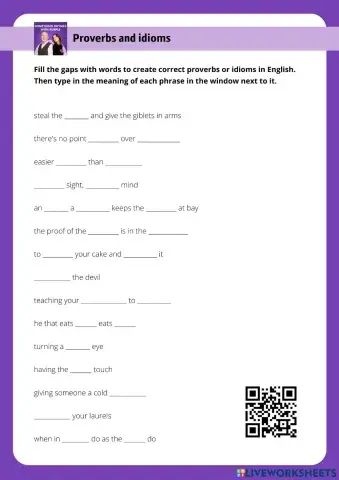
Idioms and proverbs (based on listening)

English language

Gap filling activity based on an episode of the Something Rhymes With Purple podcast (episode When in Rome Do As The Romans Do) - available here: https://lnns.co/8ojXS-Zt_ai/380 (start at 6 min 20, end at about 19 mins). I recommend setting the speed at 0.8x for better understanding. There is a short commercial break in the podcast at around 16 minutes.

Crea y personaliza fichas interactivas para cada aula

LiveWorksheets facilita a profesorado, familias y personas que educan en casa el diseño y la entrega de materiales de aprendizaje atractivos. Solo tienes que subir un PDF o empezar desde cero para crear lo que necesites: desde fichas interactivas de matemáticas hasta ejercicios de comprensión lectora, fichas de multiplicación o actividades para infantil, todo en unos pocos clics. Nuestro editor de arrastrar y soltar funciona en todos los cursos y asignaturas, lo que te permite adaptar el contenido a tus programaciones, deberes o evaluaciones. Quienes enseñan inglés como segunda lengua (ESL) también pueden crear sus propias fichas, añadir cuadros de sonidos comunes o integrar actividades de ESL para hacer cada clase más participativa. Además, podrás diseñar fácilmente tareas diferenciadas y autocorregidas que ahorran tiempo y apoyan un mejor aprendizaje del alumnado.

Una biblioteca completa de recursos para K-12 y ESL

Accede a miles de fichas listas para usar en todas las asignaturas de K-12, incluidas actividades para infantil, matemáticas, práctica de multiplicación, comprensión lectora y recursos de ESL. Filtra por curso, materia o nivel de competencia para encontrar exactamente lo que necesitas, ya sea para un aula de primaria, una revisión en secundaria o actividades de práctica en bachillerato. El profesorado de ESL puede explorar nuestra colección en constante crecimiento de fichas y actividades de inglés como segunda lengua, diseñadas para apoyar a estudiantes de todos los niveles. Con nuevo contenido añadido de forma regular, LiveWorksheets es un recurso flexible que ayuda a lograr aprendizajes duraderos.