

Instrucciones del autor
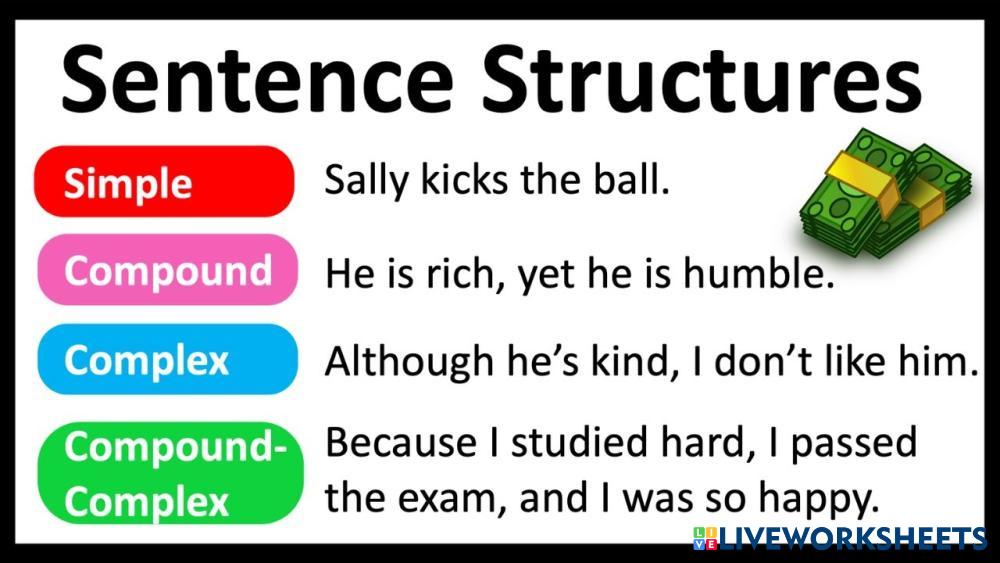
1. Simple Sentence
A simple sentence contains only one independent clause (a complete thought). It has a subject and a verb, and it expresses a complete idea.
Structure:
Subject + Verb (and sometimes an object or complement)
Examples:
-
I eat lunch every day.
(Subject: "I", Verb: "eat") -
She studied for the exam.
(Subject: "She", Verb: "studied") -
The dog barked loudly.
(Subject: "The dog", Verb: "barked")
2. Compound Sentence
A compound sentence consists of two or more independent clauses joined by a coordinating conjunction (for, and, nor, but, or, yet, so), or by a semicolon.
Structure:
Independent clause + coordinating conjunction + independent clause
Examples:
-
I wanted to go to the party, but I was too tired.
(Two independent clauses: "I wanted to go to the party" and "I was too tired," joined by "but") -
She likes reading books, and he enjoys playing sports.
(Two independent clauses: "She likes reading books" and "He enjoys playing sports," joined by "and") -
I am studying for my test; I will take a break later.
(Two independent clauses joined by a semicolon)
3. Complex Sentence
A complex sentence contains one independent clause and at least one dependent clause (a clause that cannot stand alone and does not express a complete thought). Dependent clauses are connected to the independent clause by a subordinating conjunction (because, although, if, when, since, etc.).
Structure:
Independent clause + subordinating conjunction + dependent clause
Examples:
-
I stayed home because it was raining.
(Independent clause: "I stayed home" and dependent clause: "because it was raining") -
Although she was tired, she finished her homework.
(Independent clause: "She finished her homework" and dependent clause: "although she was tired") -
We will go to the park if it doesn't rain.
(Independent clause: "We will go to the park" and dependent clause: "if it doesn't rain")
4. Compound-Complex Sentence
A compound-complex sentence is a combination of both a compound sentence and a complex sentence. It contains at least two independent clauses and at least one dependent clause.
Structure:
Independent clause + coordinating conjunction + independent clause + subordinating conjunction + dependent clause
Examples:
-
I wanted to go to the beach, but it started raining, so we stayed home.
(Independent clauses: "I wanted to go to the beach" and "it started raining," joined by "but"; dependent clause: "so we stayed home") -
Although I studied hard, I didn't pass the test, and I felt disappointed.
(Independent clauses: "I didn't pass the test" and "I felt disappointed," joined by "and"; dependent clause: "Although I studied hard") -
She loves reading books, and she often reads late into the night, because she finds it relaxing.
(Independent clauses: "She loves reading books" and "She often reads late into the night," joined by "and"; dependent clause: "because she finds it relaxing")
Sentence Structures
Instrucciones del autor
1. Simple Sentence
A simple sentence contains only one independent clause (a complete thought). It has a subject and a verb, and it expresses a complete idea.
Structure:
Subject + Verb (and sometimes an object or complement)
Examples:
-
I eat lunch every day.
(Subject: "I", Verb: "eat") -
She studied for the exam.
(Subject: "She", Verb: "studied") -
The dog barked loudly.
(Subject: "The dog", Verb: "barked")
2. Compound Sentence
A compound sentence consists of two or more independent clauses joined by a coordinating conjunction (for, and, nor, but, or, yet, so), or by a semicolon.
Structure:
Independent clause + coordinating conjunction + independent clause
Examples:
-
I wanted to go to the party, but I was too tired.
(Two independent clauses: "I wanted to go to the party" and "I was too tired," joined by "but") -
She likes reading books, and he enjoys playing sports.
(Two independent clauses: "She likes reading books" and "He enjoys playing sports," joined by "and") -
I am studying for my test; I will take a break later.
(Two independent clauses joined by a semicolon)
3. Complex Sentence
A complex sentence contains one independent clause and at least one dependent clause (a clause that cannot stand alone and does not express a complete thought). Dependent clauses are connected to the independent clause by a subordinating conjunction (because, although, if, when, since, etc.).
Structure:
Independent clause + subordinating conjunction + dependent clause
Examples:
-
I stayed home because it was raining.
(Independent clause: "I stayed home" and dependent clause: "because it was raining") -
Although she was tired, she finished her homework.
(Independent clause: "She finished her homework" and dependent clause: "although she was tired") -
We will go to the park if it doesn't rain.
(Independent clause: "We will go to the park" and dependent clause: "if it doesn't rain")
4. Compound-Complex Sentence
A compound-complex sentence is a combination of both a compound sentence and a complex sentence. It contains at least two independent clauses and at least one dependent clause.
Structure:
Independent clause + coordinating conjunction + independent clause + subordinating conjunction + dependent clause
Examples:
-
I wanted to go to the beach, but it started raining, so we stayed home.
(Independent clauses: "I wanted to go to the beach" and "it started raining," joined by "but"; dependent clause: "so we stayed home") -
Although I studied hard, I didn't pass the test, and I felt disappointed.
(Independent clauses: "I didn't pass the test" and "I felt disappointed," joined by "and"; dependent clause: "Although I studied hard") -
She loves reading books, and she often reads late into the night, because she finds it relaxing.
(Independent clauses: "She loves reading books" and "She often reads late into the night," joined by "and"; dependent clause: "because she finds it relaxing")