Reading Worksheet - PFlores

English as a Second Language (ESL)

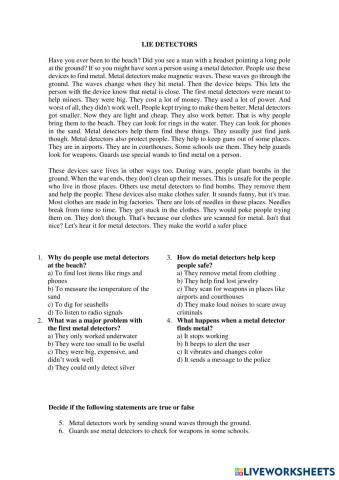
Have you ever been to the beach? Did you see a man with a headset pointing a long pole at the ground? If so you might have seen a person using a metal detector. People use these devices to find metal. Metal detectors make magnetic waves. These waves go through the ground. The waves change when they hit metal. Then the device beeps. This lets the person with the device know that metal is close. The first metal detectors were meant to help miners. They were big. They cost a lot of money. They used a lot of power. And worst of all, they didn't work well. People kept trying to make them better. Metal detectors got smaller. Now they are light and cheap. They also work better. That is why people bring them to the beach. They can look for rings in the water. They can look for phones in the sand. Metal detectors help them find these things. They usually just find junk though. Metal detectors also protect people. They help to keep guns out of some places. They are in airports. They are in courthouses. Some schools use them. They help guards look for weapons. Guards use special wands to find metal on a person.

These devices save lives in other ways too. During wars, people plant bombs in the ground. When the war ends, they don't clean up their messes. This is unsafe for the people who live in those places. Others use metal detectors to find bombs. They remove them and help the people. These devices also make clothes safer. It sounds funny, but it's true. Most clothes are made in big factories. There are lots of needles in these places. Needles break from time to time. They get stuck in the clothes. They would poke people trying them on. They don't though. That's because our clothes are scanned for metal. Isn't that nice? Let's hear it for metal detectors. They make the world a safer place

Unit 1 Grammar 02

GEP3

Talking About Past Habits and Situations

Names: ………………………………………………………….

"Used to" and "Would"

1. Explanation

🔹 "Used to"

We use "used to" to talk about:
Past habits (things we did regularly in the past but don’t do now).
Past states (situations that were true in the past but have changed).

📌 Form:

  • Positive: I used to play football every weekend.
  • Negative: I didn’t use to like coffee.
  • Question: Did you use to have long hair?

🚫 We don't use "would" for past states. I used to have long hair. (Correct). I would have long hair. (Incorrect)

🔹 "Would"

We use "would" to talk about:
Repeated past actions and habits (but NOT past states).

📌 Form:

  • Positive: When I was a child, I would visit my grandma every Sunday.
  • Negative: She wouldn’t eat vegetables when she was younger.

🚫 No question form with "would" for past habits. Use "Did you use to...?" instead.

2. Exercises

A. Complete the Conversations

Fill in the blanks using "used to," "didn't use to," "would," or "wouldn't."

  1. A: You’re so fit now! But I remember you ______________ (not/exercise) much before.
    B: Yeah, I ______________ (spend) all my weekends watching TV.
  2. A: ______________ (you/play) the piano when you were a child?
    B: Yes! I ______________ (practice) every day, but I stopped when I was 15.
  3. A: My grandpa ______________ (tell) me bedtime stories when I was little.
    B: That’s sweet! My parents ______________ (not/read) to me much, but I loved books.

B. Rewrite the Sentences

Rewrite the sentences using "used to" or "would" where possible.

  1. I often played outside with my friends after school.
    → _______________________________________
  2. She was very shy when she was younger.
    → _______________________________________
  3. My brother always helped me with my homework.
    → _______________________________________
  4. They had a small shop in our town.
    → _______________________________________

C. Past vs. Now

Look at the situations below. Write one sentence about the past and one about now using "used to" and "but now..."

  1. I hated vegetables before. Now, I eat them every day.
    → I ________________ vegetables, but now I ________________.
  2. My parents were strict. Now, they are more outgoing.
    → They ________________, but now ________________.
  3. I didn’t enjoy studying English before. Now, I love it!
    → I ________________, but now ________________.

D. Short Paragraph Exercise

Write a short paragraph (4–5 sentences) about how your life has changed. Use "used to," "didn’t use to," "would," and "wouldn’t."

Example:
"When I was a child, I used to be very shy. I wouldn’t talk much in class, and I used to feel nervous meeting new people. I used to love playing outside, and my friends and I would ride our bikes every day. Now, I’m more confident, and I love socializing."

....................................................................................................................................................................................................................................................................................................................................................................................................................................................................................................................................................................................................................................................................................................................................................................................................................................................................................................................................................................................................................................................................................................................................

Talking About Past Habits and Situations

Names: ………………………………………………………….

"Used to" and "Would"

1. Explanation

🔹 "Used to"

We use "used to" to talk about:
Past habits (things we did regularly in the past but don’t do now).
Past states (situations that were true in the past but have changed).

📌 Form:

  • Positive: I used to play football every weekend.
  • Negative: I didn’t use to like coffee.
  • Question: Did you use to have long hair?

🚫 We don't use "would" for past states. I used to have long hair. (Correct). I would have long hair. (Incorrect)

🔹 "Would"

We use "would" to talk about:
Repeated past actions and habits (but NOT past states).

📌 Form:

  • Positive: When I was a child, I would visit my grandma every Sunday.
  • Negative: She wouldn’t eat vegetables when she was younger.

🚫 No question form with "would" for past habits. Use "Did you use to...?" instead.

2. Exercises

A. Complete the Conversations

Fill in the blanks using "used to," "didn't use to," "would," or "wouldn't."

  1. A: You’re so fit now! But I remember you ______________ (not/exercise) much before.
    B: Yeah, I ______________ (spend) all my weekends watching TV.
  2. A: ______________ (you/play) the piano when you were a child?
    B: Yes! I ______________ (practice) every day, but I stopped when I was 15.
  3. A: My grandpa ______________ (tell) me bedtime stories when I was little.
    B: That’s sweet! My parents ______________ (not/read) to me much, but I loved books.

B. Rewrite the Sentences

Rewrite the sentences using "used to" or "would" where possible.

  1. I often played outside with my friends after school.
    → _______________________________________
  2. She was very shy when she was younger.
    → _______________________________________
  3. My brother always helped me with my homework.
    → _______________________________________
  4. They had a small shop in our town.
    → _______________________________________

C. Past vs. Now

Look at the situations below. Write one sentence about the past and one about now using "used to" and "but now..."

  1. I hated vegetables before. Now, I eat them every day.
    → I ________________ vegetables, but now I ________________.
  2. My parents were strict. Now, they are more outgoing.
    → They ________________, but now ________________.
  3. I didn’t enjoy studying English before. Now, I love it!
    → I ________________, but now ________________.

D. Short Paragraph Exercise

Write a short paragraph (4–5 sentences) about how your life has changed. Use "used to," "didn’t use to," "would," and "wouldn’t."

Example:
"When I was a child, I used to be very shy. I wouldn’t talk much in class, and I used to feel nervous meeting new people. I used to love playing outside, and my friends and I would ride our bikes every day. Now, I’m more confident, and I love socializing."

....................................................................................................................................................................................................................................................................................................................................................................................................................................................................................................................................................................................................................................................................................................................................................................................................................................................................................................................................................................................................................................................................................................................................


We Are Particles

Science

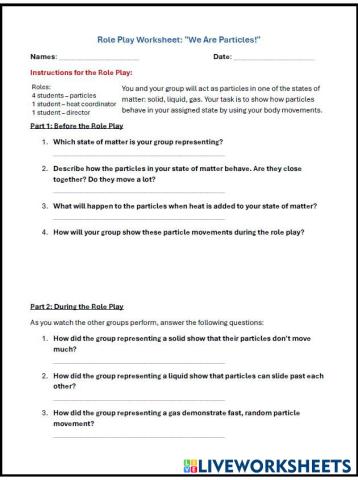
Role Play Worksheet: "We Are Particles!"

Names: _______________________                                               Date: _______________________


Roles:

4 students – particles

1 student – heat coordinator

1 student – director

Instructions for the Role Play:


You and your group will act as particles in one of the states of matter: solid, liquid, gas. Your task is to show how particles behave in your assigned state by using your body movements.

Part 1: Before the Role Play

  1. Which state of matter is your group representing?
    _________________________________________________
  2. Describe how the particles in your state of matter behave. Are they close together? Do they move a lot?
    _________________________________________________
  3. What will happen to the particles when heat is added to your state of matter?
    _________________________________________________
  4. How will your group show these particle movements during the role play?


Part 2: During the Role Play

As you watch the other groups perform, answer the following questions:

  1. How did the group representing a solid show that their particles don’t move much?
    _________________________________________________
  2. How did the group representing a liquid show that particles can slide past each other?
    _________________________________________________
  3. How did the group representing a gas demonstrate fast, random particle movement?
    _________________________________________________

Module E Vocabulary – List A Group 2

EFL-ESL

Group 2 Exercises 

General Information 

1. Fill in the English definition of each entry. 

Word Definitions approach (verb) 

can (verb) 

complicated (adjective) 

financial (adjective) 

flu (noun) 

frequent (adjective) 

past (adjective) 

personality (noun) 

personally (adverb) 

point of view (phrase) 

purpose (noun) 

seldom (adverb) 

sense (noun) 

unfortunately (adverb) 

unique (adjective) 

2. Fill in the Hebrew translation of each entry. 

Word Translation approach (verb) 

can (verb) 

complicated (adjective) 

financial (adjective) 

flu (noun) 

frequent (adjective) 

past (adjective) 

personality (noun) 

personally (adverb)

point of view (phrase) 


Word Translation 

purpose (noun) 

seldom (adverb) 

sense (noun) 

unfortunately (adverb) 

unique (adjective) 

3. Write at least one sentence with each entry. 

Word Example sentences 

approach (verb) 

can (verb) 

complicated (adjective) 

financial (adjective) 

flu (noun) 

frequent (adjective) 

past (adjective) 

personality (noun) 

personally (adverb) 

point of view (phrase) 

purpose (noun) 

seldom (adverb) 

sense (noun) 

unfortunately (adverb) 

unique (adjective) 

Reading Comprehension 

Read the following text and answer the questions following. 

In the past, Mark had a unique way of seeing the world. His personality was vibrant, and he often shared his point of view with anyone willing to listen. Personally, I found his perspectives enlightening, but others found them complicated. Mark seldom talked about his financial troubles, but everyone knew he struggled. He believed money was not the sole purpose of life, and he approached life with a deeper sense of meaning. He would frequently say, "You  can find happiness without being rich." However, unfortunately, Mark caught the flu last winter. His illness became a frequent topic of conversation among our friends. 

Despite the challenges, his approach to life remained steadfast, showing us that it's essential to stay true to oneself. 

Reading Comprehension Questions: 

1. How did Mark view the world in the past?  

a. With disdain.  

b. Indifferently.  

c. With a unique perspective.  

d. With confusion. 

2. How did the narrator feel about Mark's perspectives?  

a. They were boring.  

b. They were too easy.  

c. They were enlightening.  

d. They were too familiar. 

3. How often did Mark discuss his financial troubles?  

a. Always.  

b. Often.  

c. Rarely.  

d. Every day. 

4. What was Mark's belief regarding money?  

a. Money was the sole purpose of life.  

b. Money brought happiness.  

c. You couldn't be happy without money.  

d. You can find happiness without being rich.


5. What illness did Mark contract last winter?  

a. A cold.  

b. Pneumonia.  

c. Flu.  

d. COVID-19. 

6. After getting sick, what became a common topic among friends?  a. Mark's financial issues.  

b. Mark's unique perspectives.  

c. Mark's flu.  

d. Mark's past. 

7. What remained consistent about Mark despite his challenges?  a. His financial status.  

b. His complaints about money.  

c. His approach to life.  

d. His disdain for others. 

8. How did others find Mark's perspectives?  

a. Enlightening.  

b. Confusing.  

c. Complicated.  

d. Boring. 

9. What does the narrator personally feel about Mark's perspectives?  a. They are too familiar.  

b. They are enlightening.  

c. They are too complicated.  

d. They are common. 

10. What does Mark believe is not the sole purpose of life?  a. Fame.  

b. Achievements.  

c. Money.  

d. Happiness. 

Question 11: Give the text a title and explain your answer.


Matching Definitions 

Match 3 words to their definitions: 

Question 1:  

1. approach (verb) 

2. can (verb) a. To come near or closer to something or someone.  

3. complicated (adjective) b. Difficult to understand or analyse.  

4. financial (adjective) c. Related to money. 

5. flu (noun) 

6. frequent (adjective) 

Question 2:  

1. personality (noun) 

2. personally (adverb) a. A person's individual character or traits.  3. point of view (phrase) b. From a time before now.  

4. past (adjective) c. An individual's perspective or opinion. 5. purpose (noun) 

6. seldom (adverb) 

Question 3:  

1. sense (noun) 

2. unfortunately (adverb) a. One of a kind; not like any other.  

3. unique (adjective) b. A feeling or understanding about something.  

4. approach (verb) c. Illness that affects the nose, throat, and lungs. 

5. flu (noun) 

6. past (adjective) 

Question 4: 

1. financial (adjective) 

2. frequent (adjective) a. Happening often.  

3. complicated (adjective) b. The reason for which something is done.  4. purpose (noun) c. To be able to do something. 

5. sense (noun) 

6. can (verb) 

Question 5: Match 3 words to their definitions:  

1. personally (adverb) 

2. point of view (phrase) a. In one's own opinion.  

3. seldom (adverb) b. Not often; rarely.  

4. unique (adjective) c. In a way that is sad or disappointing. 

5. unfortunately (adverb) 

6. personality (noun)


Fill-In 

Fill in the sentences with the words from the word-group. 

1. Her vibrant ________ makes her popular among her peers. 

2. _______, the event had to be postponed due to rain. 

3. This math problem seems very ________. 

4. Each person's fingerprint is ________. 

5. We ________ see them these days as they've moved to another city. 

6. The primary ________ of the event is to raise funds for charity. 

7. The museum displayed artifacts from the ________ century. 

8. From my ________, the situation seems very different. 

9. Many people get the ________ vaccine during winter. 

10. The scientist will ________ the mysterious island tomorrow. 

11. Before making a big purchase, you should review your ______ situation. 

12. The ________ visits to the library made her more knowledgeable. 

13. I don't think I ________ do it without some extra help. 

14. I have a strong ________ that something good is about to happen. 

15. ________, I think that's the best decision. 


The Cask of Amontillado

English

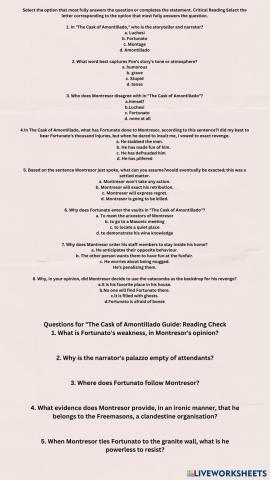
Select the option that most fully answers the question or completes the statement. Critical Reading Select the letter corresponding to the option that most fully answers the question.

1. In "The Cask of Amontillado," who is the storyteller and narrator?
a.Luchesi
b. Fortunato
c. Montage
d. Amontillado

2. What word best captures Poe's story's tone or atmosphere?
a. humorous
b. grave
c. Stupid
d. tense

3. Who does Montresor disagree with in "The Cask of Amontillado"?
a.himself
b.Luchesi
c. Fortunato
d. none at all

4.In "The Cask of Amontillado," what has Fortunato done to Montresor, according to this sentence?I did my best to bear Fortunato's thousand injuries, but when he dared to insult me, I vowed to exact revenge.
a. He stabbed the man.
b. He has made fun of him.
c. He has defrauded him.
d. He has pilfered


5. Based on the sentence Montresor just spoke, what can you assume?would eventually be exacted; this was a settled matter.
a. Montresor won't take any action.
b. Montresor will exact his retribution.
c. Montresor will express regret.
d. Montresor is going to be killed.

6. Why does Fortunato enter the vaults in "The Cask of Amontillado"?
a. To meet the ancestors of Montresor
b. to go to a Masonic meeting
c. to locate a quiet place
d. to demonstrate his wine knowledge

7. Why does Montresor order his staff members to stay inside his home?
He anticipates their opposite behaviour.
b. The other person wants them to have fun at the funfair.
c. He worries about being mugged.
He's penalising them.

8. Why, in your opinion, did Montresor decide to use the catacombs as the backdrop for his revenge?
a.It is his favorite place in his house.
b.No one will find Fortunato there.
c.It is filled with ghosts.
d.Fortunato is afraid of bones


Questions for "The Cask of Amontillado" Guide: Reading Check

1. What is Fortunato's weakness, in Montresor's opinion?

2. Why is the narrator's palazzo empty of attendants?

3. Where does Fortunato follow Montresor?

4. What evidence does Montresor provide, in an ironic manner, that he belongs to the Freemasons, a clandestine organisation?

5. When Montresor ties Fortunato to the granite wall, what is he powerless to resist?


Conversation Colegio Italiano 1

English Conversation

Student A:
Hi, Sarah! How’s it going?

Student B:
Hey, Mark! I’m good, thanks. How about you?

Student A:
I’m doing well! So, any plans for the weekend?

Student B:
Actually, yes! I’m going to the new park with my family on Saturday. We’ll have a picnic and maybe play some games. What about you?

Student A:
That sounds fun! I’ve heard the park is really nice. I don’t have anything planned yet, but I was thinking about going to the movies. There’s a new action movie out that I want to see.

Student B:
Oh, I love action movies! What’s the name of the movie?

Student A:
It’s called "The Last Escape". Have you heard of it?

Student B:
Yeah, I saw the trailer! It looks really exciting. Maybe I’ll join you if you don’t mind.

Student A:
Of course! That would be great. Let’s go on Sunday then. What time works for you?

Student B:
Sunday sounds perfect! How about 4 p.m.? We can grab some snacks before the movie.

Student A:
4 p.m. is fine with me. And yes, popcorn and drinks are a must! Should we meet at the mall?

Student B:
Sure! I’ll see you there. By the way, have you finished the homework for English class?

Student A:
I did, but I found it a bit difficult. The grammar exercises were tricky. How about you?

Student B:
Same here. I wasn’t sure about the past perfect tense part. Maybe we can review it together before the movie?

Student A:
Good idea! Let’s meet a bit earlier and go over it.

Student B:
Sounds like a plan! See you on Sunday then!

Student A:
See you! Have a great time at the park!


Crea y personaliza fichas interactivas para cada aula

LiveWorksheets facilita a profesorado, familias y personas que educan en casa el diseño y la entrega de materiales de aprendizaje atractivos. Solo tienes que subir un PDF o empezar desde cero para crear lo que necesites: desde fichas interactivas de matemáticas hasta ejercicios de comprensión lectora, fichas de multiplicación o actividades para infantil, todo en unos pocos clics. Nuestro editor de arrastrar y soltar funciona en todos los cursos y asignaturas, lo que te permite adaptar el contenido a tus programaciones, deberes o evaluaciones. Quienes enseñan inglés como segunda lengua (ESL) también pueden crear sus propias fichas, añadir cuadros de sonidos comunes o integrar actividades de ESL para hacer cada clase más participativa. Además, podrás diseñar fácilmente tareas diferenciadas y autocorregidas que ahorran tiempo y apoyan un mejor aprendizaje del alumnado.

Una biblioteca completa de recursos para K-12 y ESL

Accede a miles de fichas listas para usar en todas las asignaturas de K-12, incluidas actividades para infantil, matemáticas, práctica de multiplicación, comprensión lectora y recursos de ESL. Filtra por curso, materia o nivel de competencia para encontrar exactamente lo que necesitas, ya sea para un aula de primaria, una revisión en secundaria o actividades de práctica en bachillerato. El profesorado de ESL puede explorar nuestra colección en constante crecimiento de fichas y actividades de inglés como segunda lengua, diseñadas para apoyar a estudiantes de todos los niveles. Con nuevo contenido añadido de forma regular, LiveWorksheets es un recurso flexible que ayuda a lograr aprendizajes duraderos.