Present Simple Tense

Vocabulary - English Language


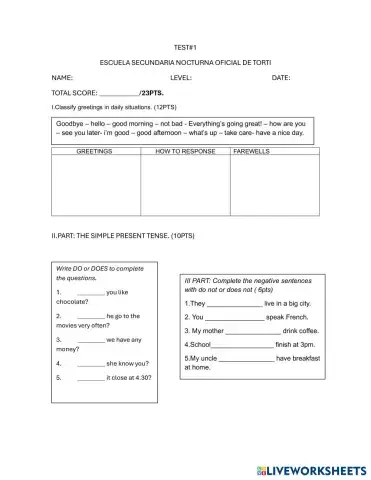
📘 PRESENT SIMPLE TENSE – STUDY GUIDE

1. 📌 What is Present Simple?

The present simple tense is used to talk about:

  • Daily routines → I go to school every day.

  • General facts → The sun rises in the east.

  • Habits → She drinks coffee every morning.

  • Schedules → The class starts at 7 a.m.

2. Structure

 Affirmative (Positive)

  • S + V (base form)

  • S + V-s/es (he/she/it)

Example:

  • I play football.

  • She plays football.

Negative

  • S + do not (don’t) + V

  • S + does not (doesn’t) + V

Examples:

  • I don’t like coffee.

  • He doesn’t like coffee.

 Questions

  • Do + S + V?

  • Does + S + V?

 Examples:

  • Do you like music?

  • Does she like music?

 Short Answers

  • Yes, I do. / No, I don’t.

  • Yes, he does. / No, he doesn’t.

3.  Verb Rules (IMPORTANT)

 Add -s / -es with he/she/it:

VerbForm

playplays

gogoes

watchwatches

studystudies

 Rules:

  • Add -s → play → plays

  • Add -es (verbs ending in ch, sh, s, x, o) → watch → watches

  • Change y → ies → study → studies

4.  Time Expressions

Common words used with present simple:

  • always

  • usually

  • often

  • sometimes

  • rarely

  • never

  • every day/week/month

  • on Mondays

 Example:

  • I always wake up early.

  • She often studies at night.

5. Adverbs of Frequency (Position)

 Before main verb:

  • I usually go to school early.

 After “to be”:

  • She is always happy.

6.  Common Mistakes

❌ He go to school.
✅ He goes to school.

❌ She don’t like pizza.
✅ She doesn’t like pizza.

❌ Does she likes music?
✅ Does she like music?

7. ✏️ Practice Exercises

Exercise 1: Fill in the blanks

  1. She ______ (play) tennis.

  2. They ______ (not/go) to school on Sunday.

  3. ______ you like coffee?

  4. He ______ (watch) TV every night.

Exercise 2: Rewrite

  1. She likes milk. (negative)

  2. They go to school. (question)

  3. He plays football. (question)

8. 🎯 Quick Summary

  • Use for habits, facts, routines

  • Add -s/es for he/she/it

  • Use do/does for questions & negatives


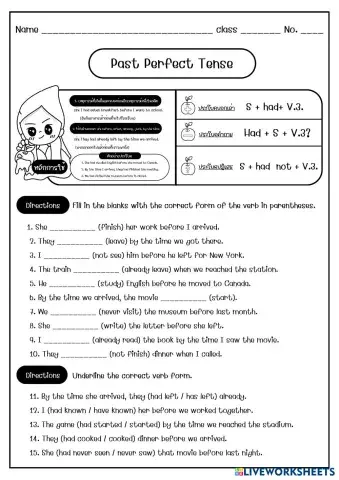
Present Perfect Tense

Writing - English Language

📝 Student Instruction: Present Perfect Tense

  1. When do we use Present Perfect?
  • To talk about actions or experiences at an unspecified time in the past.

    • I have visited Japan.
  • To talk about actions that started in the past and continue until now.

    • She has lived here for 10 years.
  • To talk about actions that happened in the past but still have a result now.

    • He has broken his leg (he can’t walk now).
  1. Form
  • Affirmative (+): Subject + have/has + past participle (V3)

    • I have eaten breakfast.
    • She has finished her homework.
  • Negative (–): Subject + have/has + not + past participle

    • I haven’t seen that movie.
    • He hasn’t called me.
  • Question (?): Have/Has + subject + past participle

    • Have you visited London?
    • Has she done her homework?
  1. Time expressions used with Present Perfect
  • just → I have just finished my homework.
  • already → She has already eaten.
  • yet → Have you finished yet? / I haven’t finished yet.
  • ever → Have you ever been to Paris?
  • never → I have never seen snow.
  • for (a period of time) → for 5 years
  • since (a starting point) → since 2010
  1. Examples
  • We have studied English for three years.
  • He has never played basketball.
  • Have they arrived yet?

👉 Practice Example:
Change the verb into Present Perfect.

  1. I (see) that movie three times. → I have seen that movie three times.
  2. She (not finish) her homework yet. → She hasn’t finished her homework yet.
  3. (they / travel) to London before? → Have they traveled to London before?

TAREA 6

Research - English Language

Las anteriores imágenes muestran la detención de Nicolás Maduro.

En los grupos creados en la actividad “Think, Pair, Share” tenéis 1 minuto para decidir si estas imágenes son reales o no.


Estas imágenes son FALSAS, como ya han dicho medios como el New York Times, o RTVE.

En esta actividad vamos a aprender cómo distinguir si una noticia ha sido generada por la IA, o no.

Para ello debemos fijarnos en tres cosas

  1. La fuente: ¿Quién publica esta noticia? Es una fuente fiable?
  2. El contenido: ¿La noticia busca provocar una reacción emocional fuerte?
  3. Los detalles: ¿Hay algo que resulte extraño o incoherente?


Paso 1.

Añadid las imágenes proporcionadas en Google Lens.

Cuando las busquéis, os aparecerán las fuentes que han subido esta noticia/imágenes. Rellenad la siguiente checklist:

  • ¿La cuenta o web es oficial, verificada o conocida?
  • ¿Aparece la noticia en varios medios fiables, o solo en una cuenta de redes sociales?
  • ¿Se citan periodistas, instituciones o expertos reales?

Paso 2. 

  • Fijaos en el contenido. Completad la siguiente checklist:

  • Se usan palabras exageradas.
  • Titulares muy llamativos que no se desarrollan bien en el texto.
  • Falta de datos concretos (fechas, lugares, cifras comprobables).

Paso 3.

Ahora fijaos en las fotos.

¿Hay algo en la imagen, el vídeo o el audio que resulte extraño o incoherente?

  • Rasgos físicos raros (manos deformes, caras poco naturales).
  • Objetos que no encajan con la realidad (uniformes incorrectos, textos borrosos).
  • Vídeos o audios sin contexto claro o sin fuente original.

Paso 4.

Ahora volved a las preguntas de reflexión. ¿Ha cambiado vuestra opinión en algo?

La profesora hará sonar una canción y debéis moveros por la clase comentando vuestra opinión sobre este tema hasta que la canción acabe.

NARRATIVE TEXT FABLE

Reading Comprehension - English Language

WORKSHEET – NARRATIVE TEXT (FABLE)
READING & ANALYZING

Name: _________________________

Class: _________________________

Date: _________________________

---

A. LET'S READ!

Read the fable below carefully. (Bacalah fabel berikut dengan saksama.)

---

The Rabbit and the Turtle

Once upon a time, there was a rabbit. He was very proud of himself because he could run very fast. He often laughed at other animals because they walked slowly. One day, the rabbit met a turtle. The turtle walked very, very slowly.

"Hey, Turtle! You are so slow!" said the rabbit, laughing.

The turtle felt angry but he stayed calm. "Why don't we have a race, Rabbit? Let's see who is faster," said the turtle.

The rabbit laughed even harder. "You? Race with me? That's funny! But okay, let's race."

The race began. The rabbit ran very fast and left the turtle far behind. The rabbit thought, "The turtle is so slow. I have plenty of time. I can take a nap." So the rabbit slept under a big tree.

Meanwhile, the turtle kept walking. He did not stop. He walked slowly but step by step, he got closer to the finish line.

When the rabbit woke up, he ran as fast as he could. But it was too late. The turtle had already crossed the finish line. The turtle won the race.

The rabbit felt very ashamed. He said, "I'm sorry, Turtle. I laughed at you. Now I understand that being fast is not everything."

The turtle smiled and said, "It's okay, Rabbit. Slow and steady wins the race."

Moral value: Don't underestimate others. Keep trying and never give up.

B. ANSWER THESE QUESTIONS! (Jawab pertanyaan berikut.)

1. Characters (Tokoh)
- Who are the characters in this story?
  Answer: _________________________________

- Which animal is proud and likes to laugh at others?
  Answer: _________________________________

- Which animal is slow but patient and never gives up?
  Answer: _________________________________

---

**2. Character Traits (Sifat Tokoh)**
Match the animal with their character. (Pasangkan hewan dengan sifatnya.)

| Animal | Trait (Sifat) |
|--------|----------------|
| Rabbit | ................ (patient / arrogant) |
| Turtle | ................ (slow but persistent / lazy) |

---

**3. Plot – Beginning (Orientation)**
- Where did the story happen?
  Answer: _________________________________

- What did the rabbit do at the beginning of the story?
  Answer: _________________________________

---

**4. Plot – Middle (Complication)**
- What challenge did the turtle give to the rabbit?
  Answer: _________________________________

- Why did the rabbit take a nap during the race?
  Answer: _________________________________

---

**5. Plot – End (Resolution)**
- Who won the race in the end?
  Answer: _________________________________

- How did the rabbit feel after losing?
  Answer: _________________________________

- What did the rabbit say to the turtle?
  Answer: _________________________________

---

**6. Moral Lesson (Pesan Moral)**
- What is the moral value of this story? Write in your own words.
  Answer: _________________________________

- Have you ever felt as arrogant as the rabbit? Or as patient as the turtle? Explain briefly.
  Answer: _________________________________

---

## C. LET'S ANALYZE THE STRUCTURE!

Fill in the table below. (Isilah tabel di bawah ini.)

| **Structure** | **Part of the story (write from the text)** |
|---------------|-----------------------------------------------|
| **Orientation** (Introduction of characters, time, place) | |
| **Complication** (Problem appears) | |
| **Resolution** (Problem solved) | |
| **Moral Value** (Lesson learned) | |

---

D. VOCABULARY CORNER (Kosakata Baru)

Find the meaning of these words from the story! (Cari arti kata-kata berikut dari cerita.)

| Word | Meaning (in Indonesian) |
|----------|-----------------------------|
| proud |  |
| laughed at |  |
| race |  |
| ashamed |  |
| underestimate |  |
| persistent |  |

---

E. DRAW & DESCRIBE! (Gambar & Ceritakan!)

Draw your favorite character from the story (Rabbit or Turtle). Then write one sentence to describe the character.

Draw here:

```
[                  ]
[                  ]
[                  ]
```

Description (one sentence):
_________________________________

---

F. REFLECTION (Refleksi)

Answer with your honest feeling. (Jawab dengan jujur.)

- Was this story easy or difficult to understand?
  Answer: _________________________________

- Which part of the worksheet was the most fun?
  Answer: _________________________________

- What new thing did you learn today?
  Answer: _________________________________

---


Crea y personaliza fichas interactivas para cada aula

LiveWorksheets facilita a profesorado, familias y personas que educan en casa el diseño y la entrega de materiales de aprendizaje atractivos. Solo tienes que subir un PDF o empezar desde cero para crear lo que necesites: desde fichas interactivas de matemáticas hasta ejercicios de comprensión lectora, fichas de multiplicación o actividades para infantil, todo en unos pocos clics. Nuestro editor de arrastrar y soltar funciona en todos los cursos y asignaturas, lo que te permite adaptar el contenido a tus programaciones, deberes o evaluaciones. Quienes enseñan inglés como segunda lengua (ESL) también pueden crear sus propias fichas, añadir cuadros de sonidos comunes o integrar actividades de ESL para hacer cada clase más participativa. Además, podrás diseñar fácilmente tareas diferenciadas y autocorregidas que ahorran tiempo y apoyan un mejor aprendizaje del alumnado.

Una biblioteca completa de recursos para K-12 y ESL

Accede a miles de fichas listas para usar en todas las asignaturas de K-12, incluidas actividades para infantil, matemáticas, práctica de multiplicación, comprensión lectora y recursos de ESL. Filtra por curso, materia o nivel de competencia para encontrar exactamente lo que necesitas, ya sea para un aula de primaria, una revisión en secundaria o actividades de práctica en bachillerato. El profesorado de ESL puede explorar nuestra colección en constante crecimiento de fichas y actividades de inglés como segunda lengua, diseñadas para apoyar a estudiantes de todos los niveles. Con nuevo contenido añadido de forma regular, LiveWorksheets es un recurso flexible que ayuda a lograr aprendizajes duraderos.