

How to Teach Comparatives and Superlatives
You've probably heard a student say, “This is more better!”, and you knew exactly what they meant, even if the grammar wasn’t quite there yet. Comparative and superlative adjectives are essential tools that help students describe the world around them with clarity. Understanding how these forms develop and when to introduce them allows us to support students more intentionally as their language skills grow.
In this article, I’ll break down the progression of comparatives and superlatives, their common stumbling blocks, and how they connect to language standards across grade levels.
1. What are Comparatives & Superlatives
Comparative and superlative adjectives help learners express relationships, such as bigger, smaller, more interesting, and the best. They allow people to compare ideas, evaluate information, and reflect on choices in everyday life.
We naturally notice differences and make comparisons in language, but intentional instruction can help them recognize patterns and use these forms more accurately.
At the introductory stage, the goal is not immediate mastery but meaningful exposure, providing opportunities to see and apply these language forms in context.
2. When and How Students Begin Learning Comparatives
Formal instruction in comparatives often starts with short adjectives (one syllable):
- big → bigger
- fast → faster
They learn that comparative adjectives answer the question, “Which one is more ___?” and compare two nouns.
Typical Progression:
- Recognizing adjectives in sentences
- Adding –er to form comparatives
- Learning spelling changes (big → bigger, happy → happier)
- Introducing “more” for longer adjectives (more careful)
Misconceptions to Watch For:
- Adding “more” + “–er” (“more faster”)
- Using comparatives with three items
- Forgetting to compare two things clearly
Consider using real-life scenarios: comparing two books, two shapes, two sports,anything relevant to the student.
3. Introducing Superlatives
Superlatives typically appear after students feel confident with comparatives. These forms help students describe the “most” or “least” within groups of three or more.
Examples:
- tall → tallest
- interesting → most interesting
Students begin using superlatives naturally in narrative writing (“the biggest dragon,” “the smallest planet”), making this a great place to reinforce grammar in context.
Common Misunderstandings:
- Using superlatives for comparisons of two
- Overgeneralizing spelling rules (nice → nicest, but good → best)
- Irregular forms (good → better → best, bad → worse → worst)
Classroom tip: Ask students to create “Top 3” lists,favorite foods, strongest superheroes, fastest animals,to practice superlatives playfully.
4. Complex Patterns: “More,” “Most,” and Irregular Forms
Students refine their understanding and move beyond simple –er/–est endings. They learn when to use more/most, how to handle two-syllable adjectives, and how irregular forms work.
Examples:
- careful → more careful → most careful
- far → farther/further → farthest/furthest
This is also the stage where students begin writing more analytically,comparing themes, characters, text structures, and informational data. Comparative and superlative adjectives naturally support academic writing.
Practical classroom approach:
Have students sort adjectives into categories:
- Add –er/–est
- Use more/most
- Irregular (better/best, worse/worst)
This visual processing improves retention.
5. Applying Comparatives & Superlatives Across Content Areas
Comparatives and superlatives don’t live only in ELA. They naturally weave into science, math, and social studies.
Examples across subjects:
- Math: Comparing fractions (“1/2 is larger than 1/3”)
- Science: Comparing planets, animals, temperatures
- Social Studies: Comparing time periods or historic leaders
- Writing: Evaluating characters or arguments
Students strengthen this skill when they see relationships across disciplines, not just in grammar exercises.
Encourage teachers to integrate comparison language into warm-ups, exit tickets, and content-area note-taking.
Comparative & Superlative Worksheet Practice:
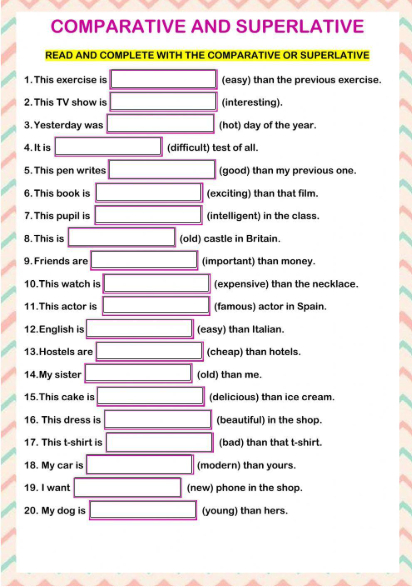
Check out the worksheet attached above that aligns well with skill development. It reinforces:
- Forming comparatives and superlatives (–er/–est and more/most)
- Applying them in sentence context
- Recognizing irregular forms
- Practicing both comprehension and production
This type of worksheet works well as guided practice after instruction, a center activity, homework reinforcement, or an informal assessment of mastery.
The sentences vary in difficulty, making it easy to see who understands the rules and who may need additional support with patterns or irregular forms.
Conclusion
Comparatives and superlatives are tools for clearer thinking and communication. Understanding how students learn these structures helps us scaffold instruction more effectively, anticipate misconceptions, and integrate them naturally into writing and content learning.
When we approach this topic with progression in mind, from simple adjectives to complex structures, students develop confidence not only in grammar but in expressing relationships across all subjects.
Thoughtful planning, abundant examples, and consistent practice give students the language they need to compare, contrast, analyze, and describe the world around them.