Shapes Matching Activity

English


Shapes Matching Activity


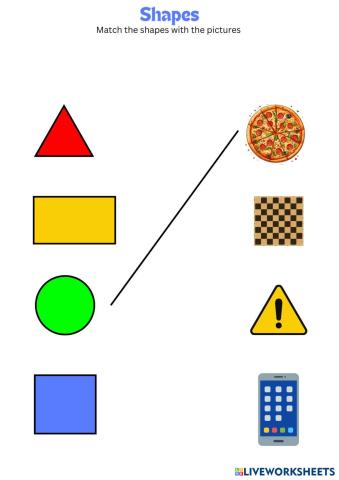
This worksheet is designed to introduce and reinforce the recognition of basic geometric shapes through real-life object associations. It supports early learners in building foundational geometry knowledge by identifying shapes and connecting them with familiar items. This is particularly useful for preschool, kindergarten, and early elementary students.


Objective:

Students will:

  • Identify and name basic geometric shapes: triangle, rectangle, circle, and square.
  • Match each shape with a real-world object that has the same shape.
  • Develop visual recognition skills, shape vocabulary, and critical thinking.


Instructions:

  • On the left side, there are four basic shapes:

    1. Triangle (red)
    2. Rectangle (yellow)
    3. Circle (green)
    4. Square (blue)
  • On the right side, there are four real-world images:

    1. A pizza (round shape)
    2. A chessboard (square shape)
    3. A warning sign (triangle shape)
    4. A smartphone (rectangular shape)
  •  
  • Students are instructed to match each shape on the left with the corresponding object on the right. This can be done by drawing lines.


Example:

  1. CirclePizza

    • The pizza is circular in shape.


Skills Developed:

  • Shape recognition: Identify and name common geometric shapes.
  • Real-world application: Understand how shapes appear in everyday life.
  • Vocabulary enhancement: Learn and use shape-related terminology.
  • Fine motor skills: Practice drawing lines or interacting with digital tools.
  • Cognitive skills: Strengthen observation and logical matching abilities.


Educational Use:

  • Can be used in classroom settings, homeschooling, or online learning platforms.
  • Suitable for individual practice, group activities, or teacher-led instruction.
  • Can serve as an assessment tool for understanding shape recognition.
  • Useful as a warm-up activity, part of a geometry lesson, or during math centers.

Grammar

English as a Second Language (ESL)

<html>
<head>
    <title>Exercise - Passive Voice</title>
</head>
<body>
    <h2>Exercise 1</h2>
    <p>Change the active sentences to passive.</p>
    <ol>
        <li>Waitresses and waiters serve customers. <input type="text" name="q1"></li>
        <li>The teacher is going to explain the lesson. <input type="text" name="q2"></li>
        <li>Two horses were pulling the farmer's wagon. <input type="text" name="q3"></li>
        <li>Toshi will invite Yoko to the party. <input type="text" name="q4"></li>
        <li>Alex is preparing that report. <input type="text" name="q5"></li>
        <li>Kathy had returned the book to the library. <input type="text" name="q6"></li>
        <li>Miriam has designed several public buildings. <input type="text" name="q7"></li>
        <li>His tricks won't fool me. <input type="text" name="q8"></li>
        <li>I didn't write that note. Did Jim write it? <input type="text" name="q9"></li>
        <li>Does Prof. Shapiro teach that course? No, he doesn't teach it. <input type="text" name="q10"></li>
        <li>Mrs. Andrews hasn't signed those papers yet. Has Mr. Andrews signed those papers yet? <input type="text" name="q11"></li>
    </ol>
    
    <h2>Exercise 2</h2>
    <p>Complete the sentences with the passive form of the verbs in the list. Use any appropriate tense.</p>
    <p><strong>build, divide, invent, order, surprise, cause, expect, kill, report, surround, confuse, frighten, offer, spell, wear</strong></p>
    <ol>
        <li>The electric light bulb <input type="text" name="q12"> by Thomas Edison in 1879.</li>
        <li>An island <input type="text" name="q13"> by water.</li>
        <li>The -ing form of sit <input type="text" name="q14"> with a double "t."</li>
        <li>Even though construction costs are high, a new dormitory <input type="text" name="q15"> next year.</li>
        <li>The class was too large last semester, so it <input type="text" name="q16"> into two sections.</li>
        <li>A bracelet <input type="text" name="q17"> around the wrist.</li>
        <li>The Johnsons' house burned down. According to the inspector, the fire <input type="text" name="q18"> by lightning.</li>
        <li>Al got a ticket for reckless driving. When he went to traffic court, he <input type="text" name="q19"> to pay a large fine.</li>
        <li>I read about a hunter who accidentally <input type="text" name="q20"> by another hunter.</li>
        <li>The hunter's fatal accident <input type="text" name="q21"> in the newspaper yesterday.</li>
        <li>I didn't expect Lisa to come to the meeting last night, but she was there. I <input type="text" name="q22"> to see her.</li>
        <li>Last week I <input type="text" name="q23"> a job at a local bank, but I didn't accept it.</li>
        <li>The children <input type="text" name="q24"> in the middle of the night when they heard strange noises in the house.</li>
        <li>Could you explain this math problem to me? Yesterday in class I <input type="text" name="q25"> by the teacher's explanation.</li>
        <li>A: Is the plane going to be late?</li>
        <li>B: No. It <input type="text" name="q26"> to be on time.</li>
    </ol>
</body>
</html>

Descriptive Text

English as a Foreign Language (EFL)

The Borobudur Temple

Borobudur is a Buddhist temple built by the Syallendra Dynasty in the 9th century. It is located at Magelang, Central Java. The temple is famous all around the world. For hundreds of years, it had been buried under volcanic ash and vegetation, until its discovery in the 1800s.

Influenced by Indian Gupta architecture, Borobudur Temple stands on a hill-like construction with eight stone terraces. The first five are square, surrounded by walls with Buddhist reliefs. The upper three are round. Each of these terraces has bell-shaped stupas.

A large stupa crowns the entire edifice at the centre of the top circle. Passages and stairways stretch out 4.8 km to the peak. Borobudur Temple's architecture is similar to that of the temples at Angkor, Cambodia. They form mountain-like structures that symbolise the structure of the universe.

Borobudur Temple, rededicated as a national monument in 1983, is a treasure for the nation.

(Pathway to English for Grade X)

  1. What does the text tell you about?
  2. Who might be interested in reading this text?
  3. Mention adjectives that you find in the text.
  4. When was Borobudur temple built?
  5. What does Borobudur temple symbolize?


The Giant Glass Slipper Building of Taiwan


The Giant Glass Slipper building is a unique building built on the coastal area in Chiayi Taiwan with a height of 16 meters (55 feet) and a width of about 10 meters (36 feet). This shiny blue building was made of 320 tinted glass panels and costed around US$686,000. It was completed on 10 January 2016 and was officially opened on 23 July 2016.

There was no special architect for the building. This was purely the creation of the local government officials. This building is used as a wedding venue. The Slipper building qualified for The Guinness high heel shoe-shaped structure.

Inspired by the fairy tale "Cinderella and her glass slippers”, the purpose of building The Giant Glass Slipper is to develop tourism in Taiwan. This building only serves couples who are getting married. They want to make the building a blissful romantic venue. This unique building is expected to attract many tourists not only domestic but also all over the world so that it will increase the country's income.


  1. What inspired the design of the building?
  2. What is the function of the building?
  3. What ‘Certificate of Appreciation’ is the building awarded for?
  4. When was the building officially opened?
  5. What was the building made of?

Create and Customize Worksheets for Every Classroom

LiveWorksheets makes it easy for teachers, parents and homeschool educators to design and deliver engaging learning materials. Upload a PDF or start from scratch to create what you need: anything from interactive math worksheets to reading comprehension worksheets, multiplication worksheets, and kindergarten worksheets in just a few clicks. Our drag-and-drop editor works across all grade levels and subjects, so you can tailor content to your lesson plans, homework, or assessments. ESL teachers can also build custom ESL worksheets, add a common sound chart, or integrate ESL activities to make each class more engaging. Easily create differentiated, auto-graded activities that save valuable time and support better student learning.

A Complete Library of Learning Resources for K-12 and ESL

Access thousands of ready-to-use worksheets across K-12 subjects, including kindergarten worksheets, math worksheets, multiplication practice, reading comprehension exercises, and ESL resources. Filter by grade, subject, or skill level to find exactly what you need, whether it’s for an elementary classroom, middle school review, or high school practice. ESL teachers can explore our growing collection of ESL worksheets and English as a Second Language activities designed to support all levels of learners. With new content added regularly, LiveWorksheets is a flexible resource that helps build lasting learning outcomes.