Jarosława Pełszyk

Vocabulary - Language Arts

1. Co powiesz, gdy twój lot jest opóźniony i chcesz zapytać o czas odlotu?
a) How is the weather today?
b) Excuse me, when does the flight leave?
c) Can I sit here?

2. Jak poprosisz w hotelu o dodatkowy ręcznik?
a) Where is the supermarket?
b) Can I open the window?
c) Can I have an extra towel, please?

3. Co powiesz w restauracji, gdy chcesz zapytać, czy danie jest wegetariańskie?
a) I don’t eat at school.
b) Do you like vegetables?
c) Is this dish vegetarian?

4. Jak zapytasz w aptece o lekarstwo na ból głowy?
a) Can you help me with my homework?
b) Do you have medicine for a headache?
c) Do you sell magazines here?

5. Co powiesz, gdy zgubiłeś paszport?
a) I need a new notebook.
b) I am afraid of dogs.
c) I can’t find my passport.

6. Jak zapytasz o najbliższy bankomat?
a) Can I use your computer?
b) Excuse me, where is the nearest ATM?
c) Do you like maths?

7. Co powiesz, gdy chcesz zapłacić oddzielnie w restauracji?
a) I want to sit outside.
b) Where are the toilets?
c) Can we pay separately, please?

8. Jak poprosisz w sklepie o inny rozmiar butów?
a) How much is this T-shirt?
b) Do you have these shoes in a different size?
c) Can you speak slower, please?

9. Co powiesz, gdy nie rozumiesz rozmówcy?
a) It’s very hot today.
b) Please close the door.
c) Sorry, I don’t understand.

10. Jak zapytasz o przystanek metra?
a) Do you like trains?
b) Excuse me, where is the nearest underground station?
c) Can you draw a map?

11. Co powiesz, gdy chcesz sprawdzić godzinę odjazdu pociągu do Paryża?
a) What time does the train to Paris leave?
b) Do you have tickets for the concert?
c) Where do you usually eat?

12. Jak poprosisz w hotelu o budzenie na rano?
a) Can I have a wake-up call at 7 a.m., please?
b) Can I have the bill, please?
c) What’s your favourite sport?

13. Co powiesz, gdy chcesz wymienić pieniądze?
a) I don’t have enough time.
b) Do you like shopping?
c) Where can I change money?

14. Jak zapytasz o bezpłatne Wi-Fi w hotelu?
a) Is there a swimming pool?
b) Can I buy a ticket here?
c) Do you have free Wi-Fi?

15. Co powiesz, gdy chcesz zamówić taksówkę na rano?
a) Can you order a taxi for me at 8 a.m.?
b) Can I sit near the window?
c) What’s the time now?

16. Jak poprosisz o polecenie dobrej restauracji?
a) Where is the school?
b) Do you like this restaurant?
c) Can you recommend a good restaurant nearby?

17. Co powiesz, gdy chcesz kupić bilet w dwie strony?
a) I’d like a return ticket, please.
b) Can I have a coffee, please?
c) I want a one-way street.

18. Jak zapytasz o godzinę otwarcia muzeum?
a) Do you like history?
b) How much is the ticket?
c) What time does the museum open?

19. Co powiesz, gdy chcesz zapytać o najbliższą aptekę?
a) Can I have some water?
b) Excuse me, where is the nearest pharmacy?
c) Where are my keys?

20. Jak poprosisz o pomoc, gdy nie możesz znaleźć hotelu?
a) Can you help me with my bag?
b) Excuse me, can you help me find my hotel?
c) I like this city very much.


Rewrite the following sentences without changing their original meanings.

Writing - Language Arts

1. I am interested in learning English. 

=> I like _________________________________________________

2. Lan likes using the computer best in her free time

=> Lan's favorite

3. I am interested in going camping with my close friends.

=> I fancy

4. Mr. Pike is a big fan of water polo.

=> Mr. Pike is fond

5. It is not a problem to me whether I have to pick her up to the cinema or not.

=> I don’t mind

6. John cannot bear listening to such kind of noisy music.

=> John dislikes

7. Watching historical films is very interesting to my younger brother.

=> My younger brother enjoys

8. She cannot bear talking with him about what he likes.

=> She hates

9. The thing that I hate most is motor racing, and I will never do it in my life.

=> I detest

10. It is really interesting for him to talk with his music teacher about jazz.

=> He fancies

11. He uses all his free time to look after his garden.

=> He spends

12. Making crafts or collecting things like stamps and coins are very interesting.

=> It’s very

13. We usually visit museums when we have leisure time.

=> We enjoy

14. I don’t like to get up early and prepare breakfast in the cold winter days.

=> I hate

15. It took us 30 minutes to rehearse the song.

=> We spent

16. It took Tom one hour to travel to his hometown last week.

=> Tom spent

17. It took him 30 minutes to watch the play.

=> He spent

18. He likes swimming and sunbathing.

=> He is interested

19. It took her nearly an hour to do the crossword.

=> She spent

20. My teacher enjoys listening to folk songs in her free time as this helps her to reduce stress.

=> My teacher likes

21. Jane likes skateboarding although this has hurt her leg and arm some times.         

=> Jane fancies

22. My aunt really loves surfing the Internet. She can even do it all day without being tired at all.

=> My aunt adores

23. Ngoc dislikes doing any sports or exercises, so her health is not good enough to study.

=> Ngoc doesn’t like

24. Some of my friends fancy making crafts. They often save money for some craft kits.

=> Some of my friends enjoy

25. Cindy is extremely interested in taking care of her pets. She doesn’t mind doing it every day.

=> Cindy adores ______________________________________________________________________

January

Grammar - Language Arts

Часть 1. Найди своего друга! (Глагол TO BE)

Задание: Вставь правильную форму глагола am, is, are.

  1. I ______ a student.

  2. My friend ______ at the park now.

  3. We ______ from Russia.

  4. The cat ______ sleeping on the sofa.

  5. ______ you happy today?

  6. My parents ______ at work. They ______ not at home.

  7. It ______ cold and windy outside.

Часть 2. Обычно vs Сейчас (Present Simple vs Present Continuous)

Задание: Распредели слова-подсказки в правильную колонку.

Слова: now, every day, at the moment, on Mondays, usually, right now, often, today, always, Look!

Present Simple (обычные действия)Present Continuous (действие сейчас)

1. _________________1. _________________

2. _________________2. _________________

3. _________________3. _________________

4. _________________4. _________________

5. _________________

ЧАСТЬ 3. ГРАММАТИЧЕСКАЯ ТРЕНИРОВКА (Работа с глаголами)

Задание 3.1. Поставь глагол в нужную форму.
Выбери: Present Simple (V/Vs) или Present Continuous (am/is/are + Ving)

  1. My sister __________ (to read) books every evening.

  2. Be quiet, please! The baby __________ (to sleep).

  3. They __________ (to play) tennis every weekend.

  4. Look at Tom! He __________ (to ride) a new bike.

  5. I __________ (to drink) tea for breakfast every day.

  6. We __________ (to cook) dinner right now. The kitchen smells great!

Задание 3.2. Собери предложение.
Расставь слова в правильном порядке, чтобы получилось грамотное предложение. Не забудь про форму глагола!

  1. (usually / to school / I / walk) → ____________________________________________.

  2. (is / a letter / writing / now / She) → ________________________________________.

  3. (listen / We / to music / often) → ____________________________________________.

  4. (not / am / I / TV / watching / at the moment) → _______________________________.

  5. (your brother / Does / play / chess /?) → _____________________________________?

Часть 4. Что не так? (Исправь ошибки)

Задание: В каждом предложении есть одна грамматическая ошибка. Найди и исправь её.

  1. She am reading a book. → _________________________

  2. He play football every Tuesday. → _________________________

  3. They is swimming in the pool. → _________________________

  4. We usually watches TV in the evening. → _________________________

  5. I is not hungry right now. → _________________________

  6. Listen! The birds sings. → _________________________

Часть 5. Твоё творческое задание «Мой день»

Задание: Напиши небольшой рассказ (6-8 предложений) о СЕГОДНЯШНЕМ ДНЕ. Используй все три темы!

  • To be — чтобы описать, где ты, какое у тебя настроение.

  • Present Simple — чтобы рассказать о том, что ты делаешь обычно.

  • Present Continuous — чтобы рассказать, что происходит прямо сейчас или в эти каникулы.

Слова-помощники: today, now, usually, but, and, because (потому что).

Пример начала:
«Hello! My name is ______. Today I am at home. The weather is sunny. I usually help my mom on holidays, but today I am relaxing. Right now, I am doing this worksheet. My dog is sleeping near me...»

Present Simple vs Present Continuous

Grammar - Language Arts

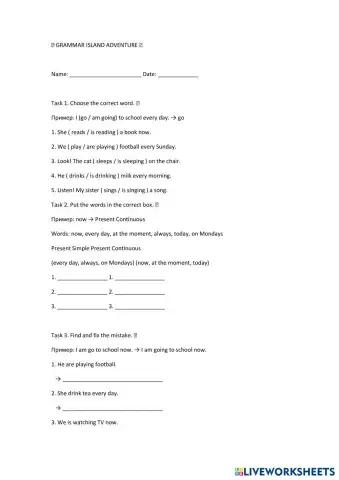
🌴 GRAMMAR ISLAND ADVENTURE 🌴


Name: _______________________ Date: _____________


Task 1. Choose the correct word. 🔍

Пример: I (go / am going) to school every day. → go

1. She ( reads / is reading ) a book now.

2. We ( play / are playing ) football every Sunday.

3. Look! The cat ( sleeps / is sleeping ) on the chair.

4. He ( drinks / is drinking ) milk every morning.

5. Listen! My sister ( sings / is singing ) a song.

Task 2. Put the words in the correct box. 📦

Пример: now → Present Continuous

Words: now, every day, at the moment, always, today, on Mondays

Present Simple Present Continuous

(every day, always, on Mondays) (now, at the moment, today)

1. ________________ 1. ________________

2. ________________ 2. ________________

3. ________________ 3. ________________


Task 3. Find and fix the mistake. ✏️

Пример: I am go to school now. → I am going to school now.

1. He are playing football.

   → ________________________________

2. She drink tea every day.

   → ________________________________

3. We is watching TV now.

   → ________________________________

4. They goes to the park on Sundays.

   → ________________________________


Task 4. Choose the right answer. ✅

1. My brother _______ a comic now.

   · A) reads

   · B) is reading

2. I _______ to music every evening.

   · A) listen

   · B) am listening

3. The girls _______ in the pool at the moment.

   · A) swim

   · B) are swimming

4. _______ he _______ his homework every day?

   · A) Do / do

   · B) Does / do

🎉 GREAT JOB! YOU ARE A GRAMMAR HERO! 🎉

Clothes and weather reading

English as a Second Language (ESL)

  1. My Clothes and the Weather


Hi! I am Jack. I am 8. I am happy today!

Today is a sunny day. I am wearing a T-shirt and shorts. I like sunny days because I can play football with my friends. When it is windy, I wear a jacket and a scarf. I don't like windy days because I can't fly my kite.

When it is snowy, I wear my coat, boots, and a sweater. I like snowy days because I can jump in the snow!

When it is cloudy, I wear jeans and a shirt. I don't like cloudy days because I can't swim in the pool.

When it is hot, I wear a dress or a skirt. I can dance and play volleyball with my friends.

When it is cold, I wear trousers and a hat. I can run outside and have fun!


No matter the weather, I love to play and have fun in my clothes!


Questions:

1. What do I wear on a sunny day?

   • a) A coat

   • b) A t-shirt and shorts

   • c) A sweater

2. Why don't I like windy days?

   • a) I can't play football

   • b) I can't fly a kite

   • c) I can't swim

3. What do I wear when it is snowy?

   • a) A dress

   • b) A coat, boots, and a sweater

   • c) Shorts and a t-shirt

4. What do I wear when it is cloudy?

   • a) A hat

   • b) Jeans and a shirt

   • c) A sweater and trousers

5. What do I do when it is hot?

   • a) I play in the snow

   • b) I dance and play volleyball

   • c) I play computer games


T/F Statements:

1. I wear a t-shirt and shorts on a sunny day. (T) (F)

2. I like windy days because I can fly a kite. (T) (F)

3. When it is snowy, I wear a coat and boots. (T) (F)

4. When it is cloudy, I wear a sweater. (T) (F)

5. When it's hot, I wear a dress or a skirt. (T) (F)


Physical Activity

Physical Education (PE)

5 Amazing facts about Women in Sports

1. Although women were technically permitted to participate in many sports, relatively few did until the late 19th century, when women's sport history is considered to start. Back then, although horseback riding, archery, golf, tennis, skiing and skating were practiced among women in the upper social class, there was often disapproval of women who played sport.

2. The first Olympic games in the modern era, in 1896, were not open to women. The first time for female athletes to participate in the Olympic games was in 1900. Only 12 female athletes participated out of the 1066 athletes from 19 countries. They competed in only golf and tennis. In the 3rd St. Louis Olympics, archery was the only women's event. In the 4th London Olympics, archery, figure skating and tennis became women's events, and diving, swimming and tennis in the 5th Stockholm Olympics.

 3. There are a few sports where men and women compete together: in mixed events or in truly mixed sports. Sports that operate in mixed events are badminton, luge, tennis and ice skating. In badminton, men and women compete as a male/female duo; in luge they compete by teams with equal numbers of men and women; in tennis, men and women compete as a male/female team in mixed doubles matches; and in ice skating male/female pairs compete together performing a dance on the ice.

 4. Sports where men and women compete against each other regardless of sex, as the physical differences between them are considered to not have any effect on the outcome of the competition, are equestrian, in which the attributes required to win are just to be an able rider, and sailing, but only in one particular class, the Nacre 17.

 5. Women that have broken boundaries in sports! African American sprinter Wilma Rudolph was the first  woman to win three gold medals in a single Olympics. Despite the loss of strength in her left leg, caused by polio, she became the fastest woman in the world at the 1960 Olympics. Former World No. 1 Billie Jean King is regarded as one of the greatest women's tennis players of all time. She won 39 Grand Slam titles, including 12 in singles, 16 in women's doubles, and 11 in mixed doubles. 


1. When did women's participation in sports significantly increase?

A) 18th century
B) Late 19th century
C) Early 20th century
D) Mid-20th century


2. In which year did female athletes first participate in the Olympic Games?

A) 1896
B) 1900
C) 1904
D) 1912


3. Which of the following sports allows men and women to compete against each other regardless of sex?

A) Badminton and Ice Skating
B) Equestrian and Sailing
C) Tennis and Luge
D) Golf and Archery


4. Who was the first woman to win three gold medals in a single Olympics?

A) Serena Williams
B) Billie Jean King
C) Wilma Rudolph
D) Nadia Comaneci


Choose the answer correct if TRUE or FALSE 


5. Women were allowed to compete in the first modern Olympic Games in 1896.


6. In mixed doubles tennis, men and women compete together as a team.


7. Wilma Rudolph won three gold medals at the 1964 Olympics.


Match the sport with how men and women compete:

  1. Badminton           Mixed-gender pairs compete in doubles matches
  2. Equestrian            Men and women compete directly against each other
  3. Tennis                    Men and women compete as a male/female team in mixed doubles

Create and Customize Worksheets for Every Classroom

LiveWorksheets makes it easy for teachers, parents and homeschool educators to design and deliver engaging learning materials. Upload a PDF or start from scratch to create what you need: anything from interactive math worksheets to reading comprehension worksheets, multiplication worksheets, and kindergarten worksheets in just a few clicks. Our drag-and-drop editor works across all grade levels and subjects, so you can tailor content to your lesson plans, homework, or assessments. ESL teachers can also build custom ESL worksheets, add a common sound chart, or integrate ESL activities to make each class more engaging. Easily create differentiated, auto-graded activities that save valuable time and support better student learning.

A Complete Library of Learning Resources for K-12 and ESL

Access thousands of ready-to-use worksheets across K-12 subjects, including kindergarten worksheets, math worksheets, multiplication practice, reading comprehension exercises, and ESL resources. Filter by grade, subject, or skill level to find exactly what you need, whether it’s for an elementary classroom, middle school review, or high school practice. ESL teachers can explore our growing collection of ESL worksheets and English as a Second Language activities designed to support all levels of learners. With new content added regularly, LiveWorksheets is a flexible resource that helps build lasting learning outcomes.