Module E Vocabulary – List A Group 2

EFL-ESL

Group 2 Exercises 

General Information 

1. Fill in the English definition of each entry. 

Word Definitions approach (verb) 

can (verb) 

complicated (adjective) 

financial (adjective) 

flu (noun) 

frequent (adjective) 

past (adjective) 

personality (noun) 

personally (adverb) 

point of view (phrase) 

purpose (noun) 

seldom (adverb) 

sense (noun) 

unfortunately (adverb) 

unique (adjective) 

2. Fill in the Hebrew translation of each entry. 

Word Translation approach (verb) 

can (verb) 

complicated (adjective) 

financial (adjective) 

flu (noun) 

frequent (adjective) 

past (adjective) 

personality (noun) 

personally (adverb)

point of view (phrase) 


Word Translation 

purpose (noun) 

seldom (adverb) 

sense (noun) 

unfortunately (adverb) 

unique (adjective) 

3. Write at least one sentence with each entry. 

Word Example sentences 

approach (verb) 

can (verb) 

complicated (adjective) 

financial (adjective) 

flu (noun) 

frequent (adjective) 

past (adjective) 

personality (noun) 

personally (adverb) 

point of view (phrase) 

purpose (noun) 

seldom (adverb) 

sense (noun) 

unfortunately (adverb) 

unique (adjective) 

Reading Comprehension 

Read the following text and answer the questions following. 

In the past, Mark had a unique way of seeing the world. His personality was vibrant, and he often shared his point of view with anyone willing to listen. Personally, I found his perspectives enlightening, but others found them complicated. Mark seldom talked about his financial troubles, but everyone knew he struggled. He believed money was not the sole purpose of life, and he approached life with a deeper sense of meaning. He would frequently say, "You  can find happiness without being rich." However, unfortunately, Mark caught the flu last winter. His illness became a frequent topic of conversation among our friends. 

Despite the challenges, his approach to life remained steadfast, showing us that it's essential to stay true to oneself. 

Reading Comprehension Questions: 

1. How did Mark view the world in the past?  

a. With disdain.  

b. Indifferently.  

c. With a unique perspective.  

d. With confusion. 

2. How did the narrator feel about Mark's perspectives?  

a. They were boring.  

b. They were too easy.  

c. They were enlightening.  

d. They were too familiar. 

3. How often did Mark discuss his financial troubles?  

a. Always.  

b. Often.  

c. Rarely.  

d. Every day. 

4. What was Mark's belief regarding money?  

a. Money was the sole purpose of life.  

b. Money brought happiness.  

c. You couldn't be happy without money.  

d. You can find happiness without being rich.


5. What illness did Mark contract last winter?  

a. A cold.  

b. Pneumonia.  

c. Flu.  

d. COVID-19. 

6. After getting sick, what became a common topic among friends?  a. Mark's financial issues.  

b. Mark's unique perspectives.  

c. Mark's flu.  

d. Mark's past. 

7. What remained consistent about Mark despite his challenges?  a. His financial status.  

b. His complaints about money.  

c. His approach to life.  

d. His disdain for others. 

8. How did others find Mark's perspectives?  

a. Enlightening.  

b. Confusing.  

c. Complicated.  

d. Boring. 

9. What does the narrator personally feel about Mark's perspectives?  a. They are too familiar.  

b. They are enlightening.  

c. They are too complicated.  

d. They are common. 

10. What does Mark believe is not the sole purpose of life?  a. Fame.  

b. Achievements.  

c. Money.  

d. Happiness. 

Question 11: Give the text a title and explain your answer.


Matching Definitions 

Match 3 words to their definitions: 

Question 1:  

1. approach (verb) 

2. can (verb) a. To come near or closer to something or someone.  

3. complicated (adjective) b. Difficult to understand or analyse.  

4. financial (adjective) c. Related to money. 

5. flu (noun) 

6. frequent (adjective) 

Question 2:  

1. personality (noun) 

2. personally (adverb) a. A person's individual character or traits.  3. point of view (phrase) b. From a time before now.  

4. past (adjective) c. An individual's perspective or opinion. 5. purpose (noun) 

6. seldom (adverb) 

Question 3:  

1. sense (noun) 

2. unfortunately (adverb) a. One of a kind; not like any other.  

3. unique (adjective) b. A feeling or understanding about something.  

4. approach (verb) c. Illness that affects the nose, throat, and lungs. 

5. flu (noun) 

6. past (adjective) 

Question 4: 

1. financial (adjective) 

2. frequent (adjective) a. Happening often.  

3. complicated (adjective) b. The reason for which something is done.  4. purpose (noun) c. To be able to do something. 

5. sense (noun) 

6. can (verb) 

Question 5: Match 3 words to their definitions:  

1. personally (adverb) 

2. point of view (phrase) a. In one's own opinion.  

3. seldom (adverb) b. Not often; rarely.  

4. unique (adjective) c. In a way that is sad or disappointing. 

5. unfortunately (adverb) 

6. personality (noun)


Fill-In 

Fill in the sentences with the words from the word-group. 

1. Her vibrant ________ makes her popular among her peers. 

2. _______, the event had to be postponed due to rain. 

3. This math problem seems very ________. 

4. Each person's fingerprint is ________. 

5. We ________ see them these days as they've moved to another city. 

6. The primary ________ of the event is to raise funds for charity. 

7. The museum displayed artifacts from the ________ century. 

8. From my ________, the situation seems very different. 

9. Many people get the ________ vaccine during winter. 

10. The scientist will ________ the mysterious island tomorrow. 

11. Before making a big purchase, you should review your ______ situation. 

12. The ________ visits to the library made her more knowledgeable. 

13. I don't think I ________ do it without some extra help. 

14. I have a strong ________ that something good is about to happen. 

15. ________, I think that's the best decision. 


Reading Test: Black Friday

English as a Foreign Language

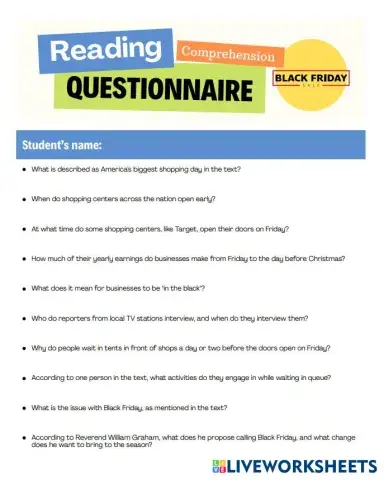
The day after Thanksgiving has become America’s biggest shopping day. Closed all day on Thursday, shopping centres all across the nation open early on Friday. Some of them open at 12:01 Friday morning, while others open at 4 a.m. Some “sleepyhead“ shopping centres, like Target this year, don’t open their doors on Friday until 6 a.m. From Friday to the day before Christmas, this is the season when businesses make nearly 25 per cent of what they earn in a year. This season puts many businesses “in the black”, that is, they make the money they need for the year.

Reporters from local TV stations interview people who sleep in tents in front of the shops a day or two before the doors open on Friday. These people patiently wait in queue to get products that are 50 per cent cheaper or more.

“Oh, we have fun,” said one of the persons queuing. “We sometimes bring games to play, we watch TV and order lots of pizza, and we often meet interesting people. And, most important of all, we save a lot!” The problem, of course, is that only a very small number of products have big reductions in their prices. Apart from a few big discounts, each shop has other things that are reduced from 10 to 50 per cent, saving shoppers from $10 to $400 per item, and so Americans want to go shopping.

Not all Americans enjoy shopping. Reverend William Graham wants to change Black Friday’s name. “We want to call it Remember Jesus Friday. People should start the season with the right attitude. Christmas has become a Season of Shopping. We want to make it a Season of Giving. And we don’t mean giving material things. We mean giving your back, your mind, and your hands. Help an old lady clean up her house. Teach a kid how to read. Visit sick people in the hospital or in nursing homes. Give food to the Red Cross. Celebrate Christmas by remembering Jesus and forgetting Santa Claus.”

Create and Customize Worksheets for Every Classroom

LiveWorksheets makes it easy for teachers, parents and homeschool educators to design and deliver engaging learning materials. Upload a PDF or start from scratch to create what you need: anything from interactive math worksheets to reading comprehension worksheets, multiplication worksheets, and kindergarten worksheets in just a few clicks. Our drag-and-drop editor works across all grade levels and subjects, so you can tailor content to your lesson plans, homework, or assessments. ESL teachers can also build custom ESL worksheets, add a common sound chart, or integrate ESL activities to make each class more engaging. Easily create differentiated, auto-graded activities that save valuable time and support better student learning.

A Complete Library of Learning Resources for K-12 and ESL

Access thousands of ready-to-use worksheets across K-12 subjects, including kindergarten worksheets, math worksheets, multiplication practice, reading comprehension exercises, and ESL resources. Filter by grade, subject, or skill level to find exactly what you need, whether it’s for an elementary classroom, middle school review, or high school practice. ESL teachers can explore our growing collection of ESL worksheets and English as a Second Language activities designed to support all levels of learners. With new content added regularly, LiveWorksheets is a flexible resource that helps build lasting learning outcomes.