Revision for Mid-term I examination

Vocabulary - ESL

Task 1. Complete the sentences with correct words. 

  1. Lisa doesn’t mind speaking in public because she is very ____________
  2. Diane always tell everyone what to do because she is very ____________
  3. Grace is very ____________ because he always makes me laugh.
  4. Tia doesn’t often joke or smile because she is very ____________
  5. I am interested ____________ playing games because it helps me relax.
  6. I am excited ____________ attending the Coldplay concert tomorrow.
  7. I am bad ____________ Maths because I don’t like working with numbers.
  8. I am bored ____________ studying all day because it is so tiring.

Task 3: Complete the passage with given words.

Passage 1:  accent   complaint   excuse   explanation   greeting   interrupted   out loud   repeated   translation. 

My family and I were looking forward to eating at this restaurant but the menu was in the local language and we couldn’t understand it. We asked the waiter for a menu with an English (1) ____________ but he didn’t have one. He tried to give us an (2)  ____________of each item on the menu but it was taking him ages and his (3)  ____________ was hard for us to understand, so it didn’t help. My dad (4)  ____________ him and said we’d be OK. I tried to read some of the meals (5)  ____________ to see if that helped but it didn’t. In the end, we made an (6)  ____________ about not feeling well and left.

Passage 2:  back down   out (x3)   up (x2)   with

All of our smartphones and tablets have a built-in digital assistant these days. You press a button, ask a question and the assistant finds (1)  ____________the answer for you. One day, our digital assistant will end (2)  ____________ organising all aspects of our lives.She’ll carry (3)  ____________boring chores for us, such as ordering the weekly shopping.She’ll help us get (4)  ____________ home if we’re lost.
If the car breaks (5)  ____________, she’ll call a mechanic and ask them to come and fix it.
In fact, any problem we have, our assistant will deal (6)  ____________ it by calling someone who can help.We might even find that our assistant is happy to call up our partner and break (7)  ____________ with them for us!I’m not sure that’s true, but the biggest problem will be how dependent we are on the assistant. We won’t know what to do when our phone runs (8)  ____________ of battery!

Task 2. Complete the sentences with the correct form of the verbs in brackets.

1. They (visit)____________ Paris next month. They (plan) ____________for this trip for a whole month.

2. Jack (play)____________ a video game when his brother (enter)____________ the room without any permission.

3. She (walk)____________ to school yesterday because there (be) no bus. 

4. A: I (be)____________ so hungry, mom.

    B: I (make)____________ some sandwiches.

5. Be careful. The cooker is still very hot. You (burn)____________ yourself.

6. I hate (play)____________ chess with my brother because he (always/win).

7. A: I want to tell you a secret.

    B: Okay. I (not tell)____________ anyone.

8. He likes acting. He (be) ____________an actor in the future.

9. (You/play)____________ football at 3 o’clock yesterday?

10. John (listen)____________ to music while his parents (watch) TV news.

11. Yesterday, Lisa (made)____________ a pizza. First, she (mold) ____________the bun then she (put)____________ it into the oven.

12.  I (note like)____________ (go)____________ to the museum because I am not interested in (look)____________ at old things.

13. Watch out! It (rain)____________. You should stay at home.

14. A: Hey Mark! What (you/do)____________ when you finish your final exam?

    B: You (not believe)____________ it but I (visit)____________ the UK for the first time in my life.

    A: Really! That’s so nice. I am sure you (love) ____________it.

    B: I think so. My family and I (stay)____________ in a hotel near Swiss Alps.

15. Tom (never/late)____________ for school because he (always/wake)____________ up early.

16. Ella doesn’t like (speak) ____________in front of other people because she is very shy.

17. Cathay (usually/have)____________ burger for her lunch but today she (have) a salad.

18. I (have)____________ dinner now so please call me later. 

19. Don’t eat that cake. It (smell)____________ terrible.

20. What (this symbol/mean)____________?

21. My brother (have)____________ two cats and one dog at home.

22. He (look)____________ happy in his new job because he (believe)____________ his choice.

23. (Eat)____________ too much sugar can cause tooth decay.

24. (Listen)____________ to music is the most interesting hobby.

25. Last night, Sue (water)____________ the flower when it (start)____________ to rain.


Present Simple

English language

​​​​​​

Что такое Present Simple?

Это простое настоящее время, обозначающее действие в самом широком смысле этого слова. Одна из самых распространенных и простых форм в английском языке для описания действий.

Действия могут быть связаны с привычками, хобби, ежедневным событием вроде подъема по утрам или чем-то, что случается регулярно.


Как образуется Present Simple?

Нет ничего проще, чем поставить глагол в форму Present Simple. Для этого нужно убрать у глагола в инфинитиве частицу «to» и поставить глагол после подлежащего. Это и есть основное правило Present Simple.


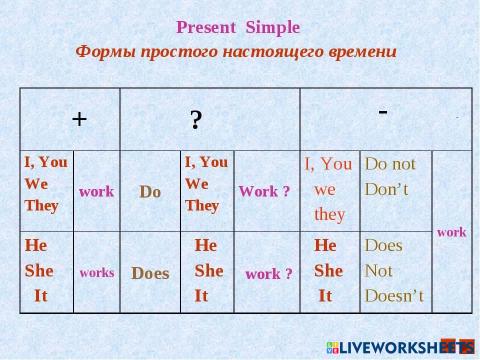
Утверждение:

I / We / You / They + V

She / He / It + V + s (es)

I go to work every day — Я хожу на работу каждый день.

They usually play tennis every weekend — Они обычно играют в теннис каждые выходные.

She brings me coffee every morning — Она приносит мне кофе каждое утро.

It snows in winter — Зимой идет снег.

ВАЖНО: В Present Simple форма глагола практически всегда совпадает с изначальной. Исключение составляет третье лицо единственного числа (he / she / it) — к нему прибавляется окончание -s:

I ride — She rides

I dream — He dreams

Если глагол оканчивается на -s, -ss, -sh, -ch, -x, -o, то к нему прибавляется окончание -es

I wish — She wishes

I teach — She teaches

Если глагол оканчивается на -y, а ему предшествует согласная, то к нему прибавляется окончание -es, но -y заменяется на -i

I try — She tries

I fly — He flies

Если глагол оканчивается на -y, а ему предшествует гласная, то к нему также прибавляется окончание -s, но -y не меняется.

I play — She plays

I stay — He stays


Отрицание:

Чтобы составить отрицательное предложение — нужно поставить вспомогательный глагол между подлежащим и глаголом.

I / We / You / They + do not (don’t) + V

She / He / It + does not (doesn’t) + V

I don’t go to school every day — Я не хожу в школу каждый день

They don’t drink beer — Они не пьют пиво

She doesn’t like the weather in London — Ей не нравится погода в Лондоне

He doesn't drive the car — Он не водит машину

Отрицание также можно выразить при помощи отрицательных местоимений и наречий.

Nobody speaks Arabic — Никто не говорит по-арабски

I do nothing — Я ничего не делаю


Вопрос:

При составлении вопросительных предложений вспомогательный глагол ставится перед подлежащим и последующим глаголом. Обычно — в начало предложения.

Do + I / we / you / they + V ?

Does + she / he / it  + V ?

Do you like pizza? — Тебе нравится пицца?

Do they play football? — Они играют в футбол?

Does she learn Russian? — Она изучает русский язык?

Does he live in Spain? — Он живет в Испании?

Иногда в вопросительном предложении употребляются question words (вопросительные слова) и фразы, которые помогают задать более точный и корректный вопрос собеседнику.

К таким словам относятся: how long (как долго), why (почему), where (где) и другие. Как и в других временах, они ставятся в самом начале предложения перед вопросительной конструкцией Present Simple.

QW + do (does) + I / We / You / They / She / He / It + V ?

Where does he live in Prague? — Где он живет в Праге?

Why do you drink green tea? — Почему ты пьешь зеленый чай?

Когда в предложении с Present Simple появляется вспомогательный глагол — у основного глагола пропадает окончание -s. Считайте, что это такой своеобразный «магнит», который «перетягивает» к себе это окончание. Это касается отрицательной и вопросительной форм Present Simple.

ВАЖНО: иногда вспомогательный глагол do / does можно встретить и в утвердительных предложениях, чтобы добавить экспрессии и яркости высказыванию.

I do want to try this — Я действительно хочу это попробовать

Mary does know how to cook — Мэри действительно умеет готовить


Глагол to be в Present Simple

Глагол to be (быть) всегда является особенным и его употребление во времени Present Simple зависит от подлежащего. Он имеет 3 разных формы:


  • am (для 1-го лица единственного числа: I)
  • is (для 3-го лица единственного числа: she / he / it)
  • are (для 1-го, 2-го и 3-го лица множественного числа: we / you / they)

I am ready — Я готов

She is ready — Она готова

We are ready — Мы готовы


Когда используется Present Simple?

Present Simple используется в описании действий, которые происходят постоянно, на регулярной

основе, но не привязаны к моменту речи.

Употребление Present Simple уместно в тех случаях, когда мы хотим рассказать о нашей ежедневной рутине, достоверно известных фактах, действиях в широком смысле слова или расписании поездов.


Регулярные, повторяющиеся действия:

I often go to the bar — Я часто хожу в бар

They play music every Sunday — Они играют музыку каждое воскресенье


Действие в широком смысле слова (без привязки к моменту речи):

I live in Dublin — Я живу в Дублине.

She speaks Chinese — Она говорит по-китайски.


Факты, о которых знают все:

The Earth rotates around its axis — Земля вращается вокруг своей оси.

Moscow is the largest city in Russia — Москва самый большой город в России


Будущие действия, которые произойдут согласно расписанию:

The airplane takes off at 4.30 am — Самолет взлетит в 4.30 утра.

The train leaves at 9 pm tomorrow — Поезд отходит завтра в 9 вечера.


Рецепты и инструкции (используется вместо повелительного наклонения):

You push the red button to turn on the radio — Нажмите на красную кнопку, чтобы включить радио

First you turn left and then you go down the street — Сперва поверните налево, затем идите до конца улицы

При перечислении каких-то действий и их определенной последовательности также используется время Present Simple

You take the bus into the city center and then you take a taxi to the restaurant — Вы едете на автобусе до центра города, а затем берете такси до ресторана.

Иногда время Present Simple используется в отношении прошедшего времени. Например, в заголовках газет (указывают на факт произошедшего действия) или в рассказе о событии (когда мы говорим о ком-то и его действиях).

The bus with American tourists crashes in India — В Индии разбился автобус с американскими туристами

I met John last week. He comes to me and says: “Hello, old friend” — На прошлой неделе я встретил Джона. Он подошел ко мне и сказал: «Привет, старый друг»


Маркеры времени Present Simple

Для того, чтобы лучше сориентироваться где и когда употребляются глаголы Present Simple — обратите внимание на особые маркеры в тексте.

Такими «маячками» для Present Simple являются наречия (often, always, usually, etc.) и указатели времени (every day, in the morning, on Fridays, etc.).

She always drinks coffee in the morning — Она всегда пьет кофе по утрам

I usually wake up at 6 am — Обычно я просыпаюсь в 6 утра

They often talk about sport — Они часто говорят о спорте

Grammar Assessment Types of Sentences

English

  1. I. Join the given simple sentences to form compound or complex sentences.   Use the conjunctions in the parentheses (6 points).


  1. 1. The student did not cheat on the exam. It was the wrong thing to do. (for)
  2. ________________________________________________________________________________________
  3. ________________________________________________________________________________________
  4. 2. I don’t like to eat mushrooms. I like them as a pizza topping. (even though
  5. ________________________________________________________________________________________
  6. ________________________________________________________________________________________
  7. 3. I left my house early. I arrived late to school. (yet)
  1. ________________________________________________________________________________________
  2. ________________________________________________________________________________________
  1. 4.  Alice played the piano. Joe played the violin. (while)
  1. ________________________________________________________________________________________
  2. ________________________________________________________________________________________
  1. 5. Mom made lunch. Dad helped with washing the dishes. (and)
  1. ________________________________________________________________________________________
  2. ________________________________________________________________________________________


  1. 6. I had to go to the dentist. My back tooth started to hurt. (because)
  1. ________________________________________________________________________________________
  2. ________________________________________________________________________________________


  1. II. Correct the mistakes in each of the following sentences. Look for missing conjunctions and punctuation marks. (6 points).


  1. 1. He read a book he watched a movie.

     _________________________________________________________


  1. 2. The cat chased the mouse but it couldn’t catch it.

     _________________________________________________________


  1. 3. Sara wanted to go to the mall her friends wanted to go the movies.

     _________________________________________________________


  1. 4. I can play video games because, I finished my homework.

     _________________________________________________________


  1. 5. My favorite subject is science and I love conducting experiments.

     _________________________________________________________


  1. 6. Although she was tired she kept working on her project.

     _________________________________________________________

Create and Customize Worksheets for Every Classroom

LiveWorksheets makes it easy for teachers, parents and homeschool educators to design and deliver engaging learning materials. Upload a PDF or start from scratch to create what you need: anything from interactive math worksheets to reading comprehension worksheets, multiplication worksheets, and kindergarten worksheets in just a few clicks. Our drag-and-drop editor works across all grade levels and subjects, so you can tailor content to your lesson plans, homework, or assessments. ESL teachers can also build custom ESL worksheets, add a common sound chart, or integrate ESL activities to make each class more engaging. Easily create differentiated, auto-graded activities that save valuable time and support better student learning.

A Complete Library of Learning Resources for K-12 and ESL

Access thousands of ready-to-use worksheets across K-12 subjects, including kindergarten worksheets, math worksheets, multiplication practice, reading comprehension exercises, and ESL resources. Filter by grade, subject, or skill level to find exactly what you need, whether it’s for an elementary classroom, middle school review, or high school practice. ESL teachers can explore our growing collection of ESL worksheets and English as a Second Language activities designed to support all levels of learners. With new content added regularly, LiveWorksheets is a flexible resource that helps build lasting learning outcomes.