Mid-course test MIFA301 LIVE

English

GRAMMAR AND VOCABULARY TEST

I - Choose the correct answer (14 points)

1. Thomas Edison, ____________ was American, invented many things, including the light bulb.

A. which                    B. who                        C. was                         D. that

2. My MP3 player is better than __________!

A. you                         B. your                       C. yours                      D. mine

3. "What happened to the old postman?"

- "He ____________ to a new neighborhood to work".

A. has sent                  B. was send                C. was sent                 D. sent

4. This job is much ____________ than the last one!

A. hard                       B. hardest                   C. harder                    D. more hard

5. Our company is moving into a ____________ building next week.

A. larger                     B. largest                    C. more large             D. most large

6. What’s the ___________job you’ve ever had?

A. most good             B. best                        C. better                      D. good

7. Those towns ____________ you were looking at in Gaul are small.

A. who                        B. where                     C. which                     D. whom

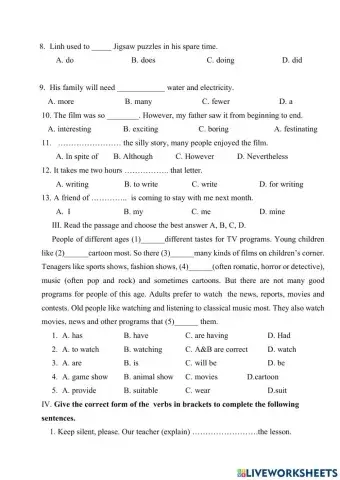
8. The women ____________ I gave the money were glad.

A. to whom                B. to who                    C. for whom               D. for that

9. I know a boy ____________ name is John.


A. who                        B. whose                    C. whom                    D. that

10. This is the place ____________ we have tea.

A. what                       B. where                      C. which                    D. that

11. The house ____________ in the storm has now been rebuilt.

A. destroyed              B. destroying              C. which destroyed    D. was destroyed

12. The man ____________ at the blackboard is our teacher.

A. stood                     B. stands                     C. standing                 D. to stand

13. Gold ____________ in California in the nineteenth century.

A. was discovered        B. has been discovered     C. was discovere       D. they discovered

14. If I ____________ 20 years younger, I ____________ her.

A. were/would love   B. am/will love                 C. were/ loves      D. had/would love


II - Change the verbs in the brackets (10 points)

1. My bike ________________ (steal)! Call the police!

2. “The longest fish in the contest was eighteen inches long.”

- “It ________________ (catch) by Thelma Rivers.”

3. “What ____________________ (you do) when you saw the man?”, the police officer asked.

4. Do you think Curtis ___________________ (win) the car race tomorrow?

5. It’s the first time I ___________________ (get) all the answers right in a test!

6. Watch out, or you __________________ (fall) off the boat!

7. The exam ___________________ (already start) when Jimmy finally found the right room.

8. I’m tired because I ___________________ (work) since eight this morning.

9. I broke my leg when Tony and I ___________________ (practice) for the school sports day.

10. I ______________________ (travel) around the world one day.


III - Finish the following sentences without changing the meaning of the sentences printed before them. (10 points)

1. I usually get up earlier than my wife.

=> My wife __________________________________________________________________ .

2. You drink too much coffee, that’s why you can’t sleep.

=> If you ____________________________________________________________________ .

3. I’ve never played this game before.

=> This is the first time _________________________________________________________ .

4. He hides the broken cup in the drawer.

=> The broken cup ____________________________________________________________ .

5. The new words are very difficult. I have to learn them. (use “which”)

=> The new words ____________________________________________________________ .

6. Mary’s coat is more expensive than Kate’s.

=> Kate’s coat ________________________________________________________________ .

7. My mother is retired. She has decided to learn Chinese. (use “who”)

=> My mother ________________________________________________________________ .

8. I’m not good at persuading people. (use “Wish”)

=> I  ________________________________________________________________________ .

9. I missed the bus yesterday. I still went to school on time. (use “Although”) =>__________________________________________________________________________ .

10. Lucy came down with a flu last week. She didn’t go to work yesterday. (use “because”) =>__________________________________________________________________________ .


IV. Fill in the blank with one word (15 points)  and make 3 compound sentences, 3 complex sentences using the words given. (6 points)

1. Have a talent ________

2. _______ the exam(s) with flying colors

3. Be a _________ learner

4. Miss/meet the ___________

5. Get __________ in heavy traffic

6. Have a healthy and balanced _______

7. Fall _____ with

8. Strike up a _______________

9. Have a lot ______ common

10. _______ my own business

11. Have good promotion ________________

12. Get _______ shape

13. Have a heavy ___________

14. ___________ a work-life balance

15. Earn a _________ salary

Reflexive pronoun

English Grammar

Reflective Pronouns Worksheet for Grade 5

Section 1: Theory and Rules with Example Sentences

Suggested Time: 10 minutes

What Are Reflexive Pronouns?
Reflexive pronouns are pronouns that end in “-self” or “-selves” and are used when the subject and the object of a sentence are the same person or thing. They are used to reflect the action back onto the subject.

Reflexive Pronouns:

  • Singular: myself, yourself, himself, herself, itself
  • Plural: ourselves, yourselves, themselves

When Do We Use Reflexive Pronouns?

  1. When the subject and object are the same:
    • Example: "I taught myself to play the piano."
    • Explanation: The subject "I" is the same person who is the object "myself."
  2. For emphasis (to emphasize that the subject did the action alone):
    • Example: "She cooked the entire meal herself."
    • Explanation: This emphasizes that "she" did the cooking without help.

Common Errors:

  • Incorrect: "Please give it to myself."
  • Correct: "Please give it to me."
  • Incorrect: "Himself went to the store."
  • Correct: "He went to the store by himself."

Section 2: Challenging NAPLAN-Style Questions

Suggested Time: 10 minutes

Instructions: Choose the correct reflexive pronoun to complete each sentence. Pay close attention to context and ensure the pronoun agrees with the subject.

  1. "After making the cake, Julia decorated it ______."

    • a) herself
    • b) himself
    • c) itself
    • d) themselves
  2. "The committee members decided to handle the problem ______."

    • a) themselves
    • b) itself
    • c) ourselves
    • d) himself
  3. "The robot fixed ______ after the malfunction."

    • a) himself
    • b) itself
    • c) themselves
    • d) ourselves
  4. "You must learn to rely on ______ if you want to be independent."

    • a) myself
    • b) yourselves
    • c) himself
    • d) yourself
  5. "The magician performed all the tricks ______, without any help."

    • a) itself
    • b) themselves
    • c) himself
    • d) herself

Short Answer Section: Instructions: Fill in the blank with the correct reflexive pronoun.

  1. "The cat saw ______ in the mirror and jumped back."
  2. "I taught ______ how to play the guitar by watching videos online."
  3. "The children built the treehouse all by ______."
  4. "During the test, remember to pace ______."
  5. "We enjoyed ______ at the amusement park yesterday."

Section 3: Writing Task to Practice Errors

Suggested Time: 15 minutes

Instructions: Write a short paragraph (4-5 sentences) about a time when you learned to do something by yourself. Use at least two reflexive pronouns in your paragraph.

Example Prompt: "Write about a time you learned a new skill or completed a task by yourself, such as riding a bike, cooking, or doing a school project. Describe what you did and how you felt."

Example Response: "I remember when I learned to bake cookies by myself. I followed the recipe carefully and didn’t ask for any help. I felt proud of myself when the cookies came out delicious. It was fun to bake all by myself!"

REVIEW G6-U3

Grammar - English Language

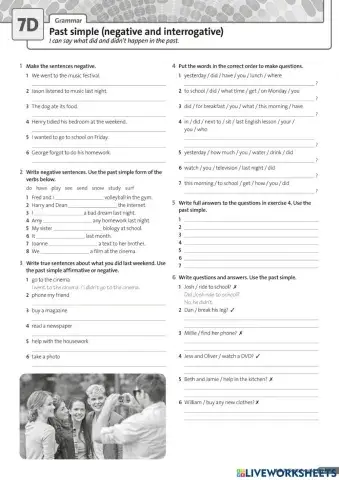
EX1: Viết các câu sau ở thể khẳng định (+), thể phủ định (-), thể nghi vấn (?) ở thì quá khứ đơn.

1.         (+) They decided to leave soon.

(-) They didn't decide to leave soon.

(?) Did they decide to leave soon?

2.         (+) ________________________________________________________________.

(-) There were not many homeless people here ten years ago.

(?) ________________________________________________________________?

3.         (+) ________________________________________________________________.

(-) _________________________________________________________________.

(?) Did Tom’s grandfather use to be a soldier?

4.         (+) My teacher started teaching here 6 years ago.

(-)_________________________________________________________________.

(?) _________________________________________________________________?

5.         (+) Jane often went to school on foot 3 years ago.

(-) _________________________________________________________________.

(?) _________________________________________________________________?

6.         (+) _________________________________________________________________.

(-) The cat didn’t want to eat yesterday.

(?) _________________________________________________________________?

7.         (+) _________________________________________________________________.

(-) __________________________________________________________________.

(?) Did the train arrive late yesterday?

8.         (+) _________________________________________________________________.

(-) There wasn’t anything left in the fridge.

(?) _________________________________________________________________?

EX2. Chia các động từ trong ngoặc ở thì quá khứ đơn.

  1. Picasso __________ (be)born in 1881.
  2. You _______(be) my inspiration when I was a boy.
  3. Neil Armstrong (be)__________ the first person to walk on the moon.
  4. Last night, I (be)___________ sick.
  5.  Last week, my mother (take) _____________ me to the zoo.
  6. Yesterday, she (be)___________ at home yesterday.
  7. Lorena and I (be)_________ in the same class when we were in secondary school.
  8. When we (arrive) _____________ at the party, there (not be) _____________ many people there.
  9. My mother (say) _____________ that she (buy) _____________ me a new dress.
  10. Last summer, my father (teach) _____________ me to drive.
  11. I (start) _____________ doing charity when I (be) _____________ a first year student.
  12. Many rich people (donate) _____________ money for this volunteer program.
  13. My friend (ring) _____________ me yesterday and (invite) _____________ me to his party.
  14. What (you/ watch) _____________ on TV last night?
  15. When my father (be) _____________ young, he (use to) ______ be the most handsome boy in the village.
  16.  _____________ (you/ go) to see the concert yesterday?
  17. My performance (not be) _____________ really good. I (not feel) _____________ happy about it
  18. Jim (spend) _____________ the whole day taking after his brother
  19. I (write) _____________ a letter to my foreign friend but he (not write) _____________ back.
  20.  _____________ (they/ be) students of our school?

EX3. Viết các câu sau ở thể khẳng định (+), thể phủ định (-), thể nghi vấn (?) ở thì hiện tại hoàn thành.

1.         (+) I have finished my homework.

(-) ________________________________________________________________.

(?) ________________________________________________________________?

2.         (+) ________________________________________________________________.

(-) My uncle hasn’t been to Singapore before.

(?) ________________________________________________________________?

3.         (+) ________________________________________________________________.

(-) ________________________________________________________________.

(?) Have they found their keys?

4.         (+) Jim has just played video games with his brother.

(-) ________________________________________________________________.

(?) ________________________________________________________________?

5.         (+) ________________________________________________________________.

(-) My grandmother hasn’t visited me since November.

(?) ________________________________________________________________?

6.         (+) ________________________________________________________________.

(-) ________________________________________________________________.

(?) Has your sister studied Medicine for 2 years?

7.         (+) It has been long since our last encounter.

(-) ________________________________________________________________.

(?) ________________________________________________________________?

8.         (+) ________________________________________________________________.

(-) We haven’t graduated yet.

(?) ________________________________________________________________?

EX4. Điền “for” hoặc “since” vào chỗ trống sao cho thích hợp.

1. I (learn)________ Japanese for 3 months.

2. May (work)_________ for a non-profit organization since he graduated.

3. Kim (unemploy)  _________ for half a year.

4. I miss my friend. I (see)________ her for  months.

5. We (live)_______ in the dorm since our first year at university.

6. Jim and Jane (know)_____each other for quite a long time.

7. The baby’s hungry. He (not eat) __________anything since the morning.

8. (you/use)________ this laptop for 4 years?

9. They(be)_________ close friends since they started college.

10. My grandmother (be)________ a vegetarian for several years.


CAE REVISION COMPLETE UNITS 1+2

English as a Second Language (ESL)

COMPLETE ADVANCED UNITS 1+2

Exercise 1: Underline the correct options to complete the sentences.

  1. 1. After waiting in line for hours, we finally had / ate / would eat / were eating something small. By then, we were very hungry.
  2. 2. Alicia still hadn’t found / wasn’t finding / didn’t use to find / didn’t find a job when I last spoke to her.
  3. 3. By the time we arrived, most of the dessert already went / had already gone / would go / was already going. Only a few pieces were left.
  4. 4. Aaron wouldn’t leave / hadn’t left / didn’t use to leave / didn’t leave until red finished his homework.
  5. 5. As soon as we were collecting / collected / had collected / would collect our bags, we hurried to find our friends.
  6. 6. Claudia is learning / has been learning / has learned / learned guitar since the start of term. She is really enjoying it.
  7. 7. Are you finishing / Did you finish / Had you finished / Have you finished making the decorations yet? People will be here soon.
  8. 8. When Ben got home today, he had gone out / went out / would go out / was going out to join his friends at the park.
  9. 9. We didn’t live / wouldn’t live / hadn’t lived / didn’t use to live in our town for very long before the new library was built.
  10. 10 I wouldn’t see / haven’t seen / didn’t see / wasn’t seeing Rafael in a while. Do you think he has moved?


Exercise 2: Complete the sentences with the correct form of the verb in brackets.


  1. 1. When my brother and I were younger, we often ________ to our cousin’s farm in the summer. (go)
  2. 2. Our history teacher said she ________ the violin in an orchestra when she was younger. (play)
  3. 3. I ________ spicy food, but now I eat it regularly. (like)
  4. 4. My father ________ in a coffee shop when he met my mother. (work)
  1. 5. When Luis lived in Argentina, he often ________ dinner around 10:00 pm. (eat)
  2. 6. I ________ in a big city when I was younger. It’s quite different from where I live

    now. (live)

  3. 7. A: ________ a snack when Natalia called? (have)

    B: No, we had already finished.

  4. 8. A: ________ cartoons on Sunday mornings when you were little? (watch)

    B: No, we didn’t have cable TV.

  5. 9. Nina ________ in this bookstore during her summer break when she was in college.

    (work)

  6. When Maia had tests, she ________ stressed easily. (feel)

Exercise 3: Underline the correct options in the text.


Last year, I (1) was going / had gone / went / used to go on a school trip to Rome. I (2) would go / was going / used to go / went on holiday to Italy with my family as a child, but I (3) hadn’t gone / wasn’t going / didn’t go / wouldn’t go in many years, so I felt very excited. We (4) all used to study / had all been studying / have all studied / would all study Italian that semester, so we (5) were looking / used to look / had looked / would look forward to practising speaking with locals. I had a funny experience when I (6) would buy / was buying / used to buy / had bought a pizza slice. The vendor began speaking to me in English, and I felt confused because I thought he (7) was speaking / used to speak / has spoken / would speak only Italian. Eventually, I explained I was from the UK. He said he (8) would see / had been seeing / was seeing / had seen me with a group of English students and thought I was with them. In the end, he (9) had spoken / spoke / was speaking / would speak to me in Italian. I felt quite proud that I (10) had managed / would manage / was managing / had been managing to order food in Italian – finally!


Exercise 4: Complete


Last year, she decided to __________ in marketing to improve her career prospects. During the conference, the CEO was invited to __________ to an audience of 500. If you’re unhappy with the service, don’t hesitate to __________ to the manager.
I have to __________ later, so please remind me to charge my phone.

My goal this year is to __________ at an international company with opportunities for growth.
After several setbacks, he finally decided to __________ and switch to a more fulfilling job.

On weekends, I usually __________ to buy groceries and household essentials. Before I leave for vacation, I want to __________ to my travel plans to make everything perfect.
To fund her education, Sarah was given __________ through a scholarship program. Since she was already in the city, she decided to __________ and get a few things she needed.


Exercise 5: Complete the sentences with the correct words from the box.


Choose the correct words from the box to complete the sentences.

Box: conscientious, considerate, hilarious, imaginative, insensitive, naïve, protective, supportive, thoughtful, well-organised

  1.  
  2. 1. My friend Mark recommended a new comedy show, so I watched it last night. It was absolutely __________. I couldn’t stop laughing.
  3. 2. Ella felt uncomfortable with the TV host’s comments about people’s looks. She thought they were quite __________.
  4. 3. Thanks so much for the card and gift! It was a really __________ gesture.
  5. 4. Annie is very __________ of her little brother. She always makes sure he’s safe and

    checks on him after school.

  6. 5. Leo is probably the most __________ student in our class. He studies outside class

    hours and plans to apply for a top university scholarship.

  7. 6. One of my favorite authors writes sci-fi novels with very creative storylines. Her plots

    are always so __________, and I often wonder how she dreams up her ideas.

  8. 7. My cousin Max disliked school and wanted to train as a chef when he was 16.

    Fortunately, his parents were __________ and helped him find the right culinary

    program.

  9. 8. Final-year students need to be very __________ if they want to succeed. They need to

    track their study hours and keep a calendar for all assignments.

  10. 9. When I first entered the job market, I was a little __________. I thought my degree

    alone would guarantee a job quickly, but that wasn’t the case.

  11. 10. My parents taught me to be __________ of other people’s feelings. When I have

    friends over, I make sure we aren’t too noisy so as not to disturb the neighbors.

Exercise 6: Underline the correct options to complete the sentences.

Select the best option to complete each sentence.

  1. 1. I __________ with Sofia at the grocery store. She was on her lunch break from her new job.

    1. a) hit it off
    2. b) bumped into
    3. c) fell out with
    4. d) headed off
  2. 2. I need someone to water my plants while I’m away. I thought of asking Rob, but I’ve been __________ by him in the past. I need someone more dependable.

     a) let down

  1. b) bumped into
  2. c) taken to
  3. d) wound up

3. Since the shops are closed now, we’ll have to __________ milk until tomorrow.
 a) do without

  1. b) settle down
  2. c) turn up
  3. d) take to
  1. 4. My new roommate and I really __________. We both love books, and we have similar interests.

    1. a) hit it off
    2. b) fell out
    3. c) settled down
    4. d) fell apart
  2. 5. When Aaron retires, he hopes to __________ in a small, quiet village.
  3.  a) settle down
  4.  b) catch up
  5.  c) head off
  6. d) dwell on
  7. 6. Chris quickly __________ skiing. I think it’s because he already enjoyed snowboarding.

    a) took to
    b) wound up

  8. c) turned up
  9. d) fell apart
  10. 7. Layla blames her headaches on the stress she’s feeling from her exams. She __________ it to all the studying she’s doing.

    1. a) puts it down
    2. b) gets in the way
    3. c) does without
    4. d) took to
  11. 8. Ever since they __________ over a year ago, Leo and Isabel haven’t spoken. I really wish they would make up.

    a) wound up

  1. b) fell out
  2. c) hit it off
  3. d) caught up

9. Working hard is essential, but don’t let it __________ spending time with family.

  1. a) wind up
  2. b) get in the way of
  3. c) fall apart
  4. d) dwell on

10. It’s normal to feel let down when plans don’t work out, but it’s important not to __________ it. There are other opportunities ahead.

  1. a) fall apart
  2. b) fall out
  3. c) dwell on
  4. d) wind up

Social Media

English as a Second Language (ESL)

The digital landscape has put increased pressure on teenagers today, and we feel it. There are so many social media channels: Facebook, Twitter, Instagram, Snapchat, Tumblr, you name it. I made a conscious decision to avoid Snapchat and Instagram because of the social pressure I saw them putting on my 14-year-old little sister. If my mum turned off the WiFi at 11pm, my sister would beg me to turn my phone into a hotspot1. She always needed to load her Snapchat stories one more time, or to reply to a message that had come in two minutes ago because she didn’t want her friend to feel ignored. If I refused, saying she could respond in the morning, I’d get the “You’re ruining my social life” speech. Even as a teenager as well, I sometimes find this craze a little baffling.

A new study has found that teenagers who engage with social media during the night could be damaging their sleep and increasing their risk of anxiety and depression. Teenagers spoke about the pressure they felt to make themselves available 24/7 and the resulting anxiety if they did not respond immediately to texts or posts. Teens are so emotionally invested in social media that a fifth of secondary school pupils will wake up at night and log on just to make sure they don’t miss out. Perhaps the worst thing about this is that teenagers need more sleep than adults do, so night-time social media use could be detrimental to their health. A lack of sleep can make teenagers tired, irritable, and depressed.

During the summer holidays, I lost my phone. And for the week that I was phoneless, it felt like a disaster. I love my phone. It gives me quick access to information and allows me to be constantly looped in with my friends, to know exactly what is going on in their lives. So when I didn’t have my phone for a week, I felt a slight sense of FOMO, or if you’re not up to speed with the lingo, fear of missing out. By the end of the week, I’d got used to not having a phone and I’d quite enjoyed the break from social media. But there was still a lingering sense of sadness at the back of my mind that there would be conversations I had missed, messages that had been sent, funny videos shared and night-time chats that I would probably never get to see.

The last Sunday

English

The Last Saturday


Last Saturday, Emily and her friends went to the amusement park. They arrived early in the morning because they wanted to enjoy the whole day there. Emily tried the big roller coaster, and it was very exciting, but also a little scary. Her friend, Jake, didn't like the roller coaster, so he waited for her near the food stalls. After the ride, they all ate hot dogs and drank lemonade. Later, they played games to win prizes, but only Emily won a small teddy bear. At the end of the day, they watched a firework show. They were very tired but happy. It was a fun day.


Vocabulario

  1. Amusement park – parque de diversiones
  2. Roller coaster – montaña rusa
  3. Exciting – emocionante
  4. Scary – aterrador/a
  5. Food stalls – puestos de comida
  6. Hot dog – perro caliente
  7. Lemonade – limonada
  8. Teddy bear – oso de peluche
  9. Firework show – espectáculo de fuegos artificiales

Preguntas de Comprensión

  1. 1. Where did Emily and her friends go last Saturday?
  2. 2. What time of day did they arrive at the amusement park?
  3. 3. What ride did Emily try?
  4. 4. Who didn’t like the roller coaster?
  5. 5. What did they eat after the ride?
  6. 6. What did they drink with their hot dogs?
  7. 7. Who won a prize at the amusement park games?
  8. 8. What kind of prize did Emily win?
  9. 9. What did they watch at the end of the day?
  10. 10. How did Emily and her friends feel at the end of the day?


Complete the sentences using verbs into brackets (simple past tense):


  1. 1. Emily and her friends _____ (go) to the amusement park last Saturday.
  2. 2. They _____ (arrive) early in the morning.
  3. 3. Emily _____ (try) the big roller coaster.
  4. 4. Her friend Jake _____ (not like) the roller coaster.
  5. 5. At the end of the day, they _____ (watch) a firework show.

Create and Customize Worksheets for Every Classroom

LiveWorksheets makes it easy for teachers, parents and homeschool educators to design and deliver engaging learning materials. Upload a PDF or start from scratch to create what you need: anything from interactive math worksheets to reading comprehension worksheets, multiplication worksheets, and kindergarten worksheets in just a few clicks. Our drag-and-drop editor works across all grade levels and subjects, so you can tailor content to your lesson plans, homework, or assessments. ESL teachers can also build custom ESL worksheets, add a common sound chart, or integrate ESL activities to make each class more engaging. Easily create differentiated, auto-graded activities that save valuable time and support better student learning.

A Complete Library of Learning Resources for K-12 and ESL

Access thousands of ready-to-use worksheets across K-12 subjects, including kindergarten worksheets, math worksheets, multiplication practice, reading comprehension exercises, and ESL resources. Filter by grade, subject, or skill level to find exactly what you need, whether it’s for an elementary classroom, middle school review, or high school practice. ESL teachers can explore our growing collection of ESL worksheets and English as a Second Language activities designed to support all levels of learners. With new content added regularly, LiveWorksheets is a flexible resource that helps build lasting learning outcomes.