Colors Matching Activity

English


Colors Matching Activity


This interactive worksheet is designed to help young learners recognize and match colors to commonly known objects or items based on their real-world colors. It is ideal for early learners, particularly preschoolers, kindergarten students, or early elementary students, as part of a color recognition and visual association lesson.


Objective:

Students will:

  • Identify and name basic colors.
  • Match each color to the corresponding object that naturally represents that color.
  • Enhance visual perception, color vocabulary, and fine motor skills through drag-and-drop or line drawing activities.


Instructions:

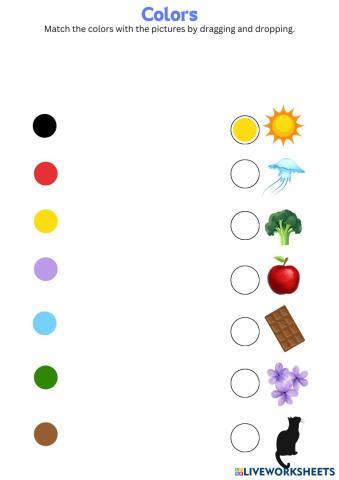
  • On the left side, there are seven color circles (Black, Red, Yellow, Purple, Light Blue, Green, Brown).
  • On the right side, there are seven images of familiar objects and creatures.
  • Each object is associated with one of the colors provided.
  • Students are instructed to match the colors with the pictures by either dragging and dropping the color circles to the corresponding image or by drawing a line from the color to the picture.


Example:

  1. YellowSun

    • Yellow is represented by the bright yellow sun.


Skills Developed:

  • Color recognition: Learn and identify primary and secondary colors.
  • Visual discrimination: Understand the association between objects and their typical colors.
  • Vocabulary building: Reinforce color and object names.
  • Motor skills: Practice coordination by drawing lines or dragging/dropping.
  • Critical thinking: Make connections between abstract colors and real-life objects.


Educational Use:

  • Can be used for individual practice, group work, or teacher-guided activities.
  • Excellent for review sessions, color-themed lessons, or as a diagnostic tool to assess color knowledge.
  • Can be printed for hands-on activities or used in digital formats for interactive learning.

Beginning Sounds

English


Beginning Sounds


This educational worksheet is designed to help young learners develop phonemic awareness by focusing on beginning sounds in words. It is suitable for early childhood education, particularly for preschoolers, kindergarteners, or early elementary students who are learning to identify the initial letter sounds of common words and objects.


Objective:

Students will:

  • Identify the beginning sound of each word represented by a picture.
  • Match each picture to the corresponding uppercase letter that represents the first sound in the picture’s name.


Instructions:

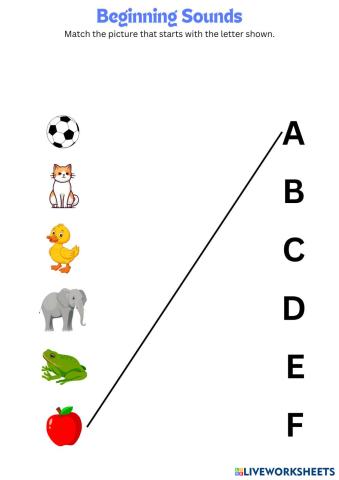
  • Learners are provided with six images of familiar objects or animals arranged vertically on the left side of the worksheet.
  • On the right side, there are six uppercase letters (A, B, C, D, E, F) listed in order.
  • Students are instructed to match each image to the correct letter by drawing a line or mentally connecting the image with the letter that corresponds to the beginning sound of the object shown.

Example:

  1. Apple – Beginning sound: A (match with letter A)


Skills Developed:

  • Phonemic awareness: Recognizing and isolating beginning sounds in words.
  • Letter recognition: Identifying uppercase letters and connecting them with their corresponding sounds.
  • Vocabulary building: Learning and reinforcing the names of everyday animals and objects.
  • Fine motor skills (if printed and completed by drawing lines).


Educational Use:

  • This worksheet can be used as a classroom activity, homework assignment, or part of a phonics lesson.
  • It is ideal for individual, pair, or small group work, and can also serve as an assessment tool for teachers to evaluate a child's understanding of beginning sounds.

Shapes Matching Activity

English


Shapes Matching Activity


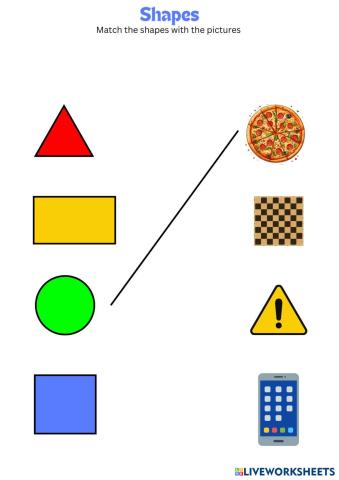
This worksheet is designed to introduce and reinforce the recognition of basic geometric shapes through real-life object associations. It supports early learners in building foundational geometry knowledge by identifying shapes and connecting them with familiar items. This is particularly useful for preschool, kindergarten, and early elementary students.


Objective:

Students will:

  • Identify and name basic geometric shapes: triangle, rectangle, circle, and square.
  • Match each shape with a real-world object that has the same shape.
  • Develop visual recognition skills, shape vocabulary, and critical thinking.


Instructions:

  • On the left side, there are four basic shapes:

    1. Triangle (red)
    2. Rectangle (yellow)
    3. Circle (green)
    4. Square (blue)
  • On the right side, there are four real-world images:

    1. A pizza (round shape)
    2. A chessboard (square shape)
    3. A warning sign (triangle shape)
    4. A smartphone (rectangular shape)
  •  
  • Students are instructed to match each shape on the left with the corresponding object on the right. This can be done by drawing lines.


Example:

  1. CirclePizza

    • The pizza is circular in shape.


Skills Developed:

  • Shape recognition: Identify and name common geometric shapes.
  • Real-world application: Understand how shapes appear in everyday life.
  • Vocabulary enhancement: Learn and use shape-related terminology.
  • Fine motor skills: Practice drawing lines or interacting with digital tools.
  • Cognitive skills: Strengthen observation and logical matching abilities.


Educational Use:

  • Can be used in classroom settings, homeschooling, or online learning platforms.
  • Suitable for individual practice, group activities, or teacher-led instruction.
  • Can serve as an assessment tool for understanding shape recognition.
  • Useful as a warm-up activity, part of a geometry lesson, or during math centers.

Create and Customize Worksheets for Every Classroom

LiveWorksheets makes it easy for teachers, parents and homeschool educators to design and deliver engaging learning materials. Upload a PDF or start from scratch to create what you need: anything from interactive math worksheets to reading comprehension worksheets, multiplication worksheets, and kindergarten worksheets in just a few clicks. Our drag-and-drop editor works across all grade levels and subjects, so you can tailor content to your lesson plans, homework, or assessments. ESL teachers can also build custom ESL worksheets, add a common sound chart, or integrate ESL activities to make each class more engaging. Easily create differentiated, auto-graded activities that save valuable time and support better student learning.

A Complete Library of Learning Resources for K-12 and ESL

Access thousands of ready-to-use worksheets across K-12 subjects, including kindergarten worksheets, math worksheets, multiplication practice, reading comprehension exercises, and ESL resources. Filter by grade, subject, or skill level to find exactly what you need, whether it’s for an elementary classroom, middle school review, or high school practice. ESL teachers can explore our growing collection of ESL worksheets and English as a Second Language activities designed to support all levels of learners. With new content added regularly, LiveWorksheets is a flexible resource that helps build lasting learning outcomes.