How to Become a DJ: 10 Tips to Start DJing in 2025

English as a Second Language (ESL)

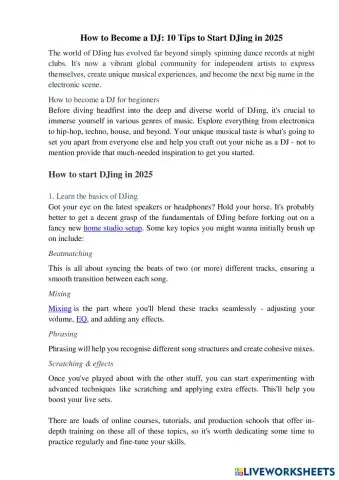
How to Become a DJ: 10 Tips to Start DJing in 2025

The world of DJing has evolved far beyond simply spinning dance records at night clubs. It's now a vibrant global community for independent artists to express themselves, create unique musical experiences, and become the next big name in the electronic scene.

How to become a DJ for beginners

Before diving headfirst into the deep and diverse world of DJing, it's crucial to immerse yourself in various genres of music. Explore everything from electronica to hip-hop, techno, house, and beyond. Your unique musical taste is what's going to set you apart from everyone else and help you craft out your niche as a DJ - not to mention provide that much-needed inspiration to get you started.

How to start DJing in 2025

1. Learn the basics of DJing

Got your eye on the latest speakers or headphones? Hold your horse. It's probably better to get a decent grasp of the fundamentals of DJing before forking out on a fancy new home studio setup. Some key topics you might wanna initially brush up on include:

Beatmatching

This is all about syncing the beats of two (or more) different tracks, ensuring a smooth transition between each song.

Mixing

Mixing is the part where you'll blend these tracks seamlessly - adjusting your volume, EQ, and adding any effects.

Phrasing

Phrasing will help you recognise different song structures and create cohesive mixes.

Scratching & effects

Once you've played about with the other stuff, you can start experimenting with advanced techniques like scratching and applying extra effects. This'll help you boost your live sets.

There are loads of online courses, tutorials, and production schools that offer in-depth training on these all of these topics, so it's worth dedicating some time to practice regularly and fine-tune your skills.

2. Invest in the right equipment

Basics ticked off. Now you need to pick out the right equipment. 

While professional setups can be expensive, there are loads of budget-friendly options for beginners. Consider purchasing a DJ controller, headphones, and a laptop loaded with DJ software. It might be pricey, but quality equipment is essential for honing your skills and creating top-notch mixes.

But this doesn't necessarily mean splashing out on the most expensive options. Northern Irish Producer & DJ, The Cyclist, has these tips for starting out and developing your skills:

“Start experimenting and learning the tools. There are so many free versions of everything to get started. Try searching for ‘free VSTs’ and go from there.”

3. Build your music library

Your DJ career ultimately hinges on the quality of music you play and how well it goes down with your crowd. To cover your own back during potentially tricky sets, you’ll want to build up a diverse and extensive music library. This will include a mix of tracks that resonate with your style and also the preferences of your target audience. 

Explore electronic music platforms like Beatport, buy sample packs from stores like Splice, and consider subscribing to DJ record pools for access to a wide selection of music.

4. Define your sound

Just as bands and solo artists need to nurture their own specific sound, DJs need to carve out their particular style and decide on the sound that they're going to build their career around.

Use other artists you're a fan of as reference and start playing about with certain sounds or samples that you like. This is the start of your journey so be experimental!

“Writing loops/beats/riffs is great fun and a place to start, but you need to finish tracks. Work on arranging these into a full track format - use other tracks as reference and for ideas on improving your production and arrangement.” - The Cyclist

5. Create your brand and identity

As an independent DJ, your brand is everything. Develop a unique name, logo, and visual style that reflects your personality and musical style. Your music branding should be consistent across all your promotional materials, from social media profiles to event flyers.

Once you’ve established your brand, you’ll be able to get a better understanding of your following and lean further into producing the sounds you're becoming associated with.


Take Fred Again.. as an example. His brand of honest and personal social media marketing lead to him selling out global tours as well as headlining Glastonbury and Coachella in 2023. A lot of the hype built up around Fred's came from his branding, a simple '..' - which was used across his merch and discography as well as used to tease appearances online and get more people chatting about him.

A large-scale example, but good branding strategy which you can apply to your own music.


Concepts and comments Units 1 and 2

English

Exercise 1: Vocabulary Matching

Instructions: Match the vocabulary words with their correct definitions.

  1. Hogan
  2. Artifacts
  3. Amateur
  4. Graffiti
  5. Impartiality
  6. Porcelain
  7. Ceremony
  8. Peacekeeping
  9. Torture
  10. Tapestries

Definitions: a. A traditional Navajo house. b. Objects made by humans, typically of cultural or historical interest. c. Non-professional; doing something for fun, not as a job. d. Words or drawings scratched or painted on a wall. e. Fairness; not favoring one side over another. f. A fine, white ceramic material. g. A ritual or formal event. h. The maintenance of peace by an international military force. i. Cruel treatment or punishment. j. Artworks made of cloth, often used as wall hangings.

Exercise 2: Fill in the Blanks

Instructions: Fill in the blanks with the appropriate vocabulary words from the list.

  1. The ______ is a traditional Navajo house where sand paintings are often made.
  2. Archeologists study ______ to learn about past cultures.
  3. The cave paintings were discovered by three ______ explorers.
  4. ______ is often considered vandalism rather than art.
  5. Amnesty International is known for its ______ in handling human rights cases.
  6. ______ is a highly valued type of ceramic material.
  7. The healing ______ is an important part of Navajo culture.
  8. The United Nations is involved in ______ missions around the world.
  9. Amnesty International campaigns against ______.
  10. Early permanent sand paintings were actually ______ woven by Hosteen Klah.

Vocabulary List: Hogan, artifacts, amateur, graffiti, impartiality, porcelain, ceremony, peacekeeping, torture, tapestries

Exercise 3: Synonyms and Antonyms

Instructions: Identify the synonyms and antonyms for the given vocabulary words.

  1. Adapt
    • Synonym: ______
    • Antonym: ______
  2. Controversy
    • Synonym: ______
    • Antonym: ______
  3. Preserved
    • Synonym: ______
    • Antonym: ______
  4. Humanitarian
    • Synonym: ______
    • Antonym: ______
  5. Campaign
    • Synonym: ______
    • Antonym: ______

Exercise 4: Sentence Creation

Instructions: Create sentences using the following vocabulary words. Each student should create three sentences and then share them with each other.

  1. Hogan
  2. Artifacts
  3. Amateur
  4. Graffiti
  5. Impartiality
  6. Porcelain
  7. Ceremony
  8. Peacekeeping
  9. Torture
  10. Tapestries

Exercise 5: Vocabulary Quiz (Kahoot)

Instructions: Create a Kahoot quiz with the following multiple-choice questions. Each question should have four options, with one correct answer.

  1. What is a hogan?
    • A) A type of food
    • B) A traditional Navajo house
    • C) A musical instrument
    • D) A type of clothing
  2. What does 'artifacts' refer to?
    • A) Natural objects
    • B) Human-made objects of historical interest
    • C) Modern technology
    • D) Fictional items
  3. What does 'amateur' mean?
    • A) Professional
    • B) Expert
    • C) Non-professional
    • D) Skilled
  4. What is 'graffiti'?
    • A) Sculptures
    • B) Paintings on canvas
    • C) Words or drawings scratched or painted on a wall
    • D) Digital art
  5. What does 'impartiality' mean?
    • A) Bias
    • B) Fairness
    • C) Prejudice
    • D) Favoritism
  6. What is 'porcelain'?
    • A) A type of metal
    • B) A fine, white ceramic material
    • C) A kind of fabric
    • D) A type of wood
  7. What is a 'ceremony'?
    • A) A casual meeting
    • B) A ritual or formal event
    • C) A spontaneous gathering
    • D) An informal party
  8. What is 'peacekeeping'?
    • A) Starting conflicts
    • B) The maintenance of peace by an international military force
    • C) Ignoring disputes
    • D) Promoting violence
  9. What does 'torture' mean?
    • A) Kindness
    • B) Cruel treatment or punishment
    • C) Comfort
    • D) Healing
  10. What are 'tapestries'?
    • A) Paintings on paper
    • B) Artworks made of cloth, often used as wall hangings
    • C) Sculptures made of stone
    • D) Digital prints

Exercise 6: Word Association

Instructions: For each vocabulary word, write down three words that you associate with it. Share your associations with your partner and discuss why you chose those words.

  1. Hogan
  2. Artifacts
  3. Amateur
  4. Graffiti
  5. Impartiality
  6. Porcelain
  7. Ceremony
  8. Peacekeeping
  9. Torture

Tapestries

Create and Customize Worksheets for Every Classroom

LiveWorksheets makes it easy for teachers, parents and homeschool educators to design and deliver engaging learning materials. Upload a PDF or start from scratch to create what you need: anything from interactive math worksheets to reading comprehension worksheets, multiplication worksheets, and kindergarten worksheets in just a few clicks. Our drag-and-drop editor works across all grade levels and subjects, so you can tailor content to your lesson plans, homework, or assessments. ESL teachers can also build custom ESL worksheets, add a common sound chart, or integrate ESL activities to make each class more engaging. Easily create differentiated, auto-graded activities that save valuable time and support better student learning.

A Complete Library of Learning Resources for K-12 and ESL

Access thousands of ready-to-use worksheets across K-12 subjects, including kindergarten worksheets, math worksheets, multiplication practice, reading comprehension exercises, and ESL resources. Filter by grade, subject, or skill level to find exactly what you need, whether it’s for an elementary classroom, middle school review, or high school practice. ESL teachers can explore our growing collection of ESL worksheets and English as a Second Language activities designed to support all levels of learners. With new content added regularly, LiveWorksheets is a flexible resource that helps build lasting learning outcomes.