What the future holds

Vocabulary - English Language

PART 1: VOCABULARY

Exercise 1. Match the words with their definitions.

WORDS:

prediction

gadget

underwater city

robotic housemaid

mini-submarine

glass dome

traffic jam

look forward to

DEFINITIONS:

a) a small vehicle that travels under water

b) a statement about what will happen in the future

c) a small useful machine or tool, often electronic

d) a city built below the surface of the ocean

e) a robot that does cleaning and other housework

f) a round transparent roof or cover

g) a situation when vehicles are stuck and cannot move

h) to feel excited about something that will happen

Exercise 2. Complete the sentences with words from the box.

Use each word only once.

WORD BOX:

prediction, fuel, exist, creature, online school, petrol, planet, look after

Scientists think that life might __________ on other planets.

My sister studies at an __________ — she has lessons from home.

We must take care of our __________ and protect the environment.

A robot pet can __________ you when you are lonely.

Electric cars don't use __________; they use electricity instead.

No one can make a 100% accurate __________ about the future.

In the future, we may meet a strange __________ from space.

Scientists are looking for a new type of clean __________ for cars.

FUTURE SIMPLE (will + infinitive)

Use for predictions and future facts.

Exercise 3. Put the verbs in brackets into Future Simple.

I think robots __________ (do) most housework in 2050.

__________ people __________ (live) on Mars one day?

She probably __________ (not / use) paper books in the future.

We __________ (travel) in flying cars, I'm sure!

__________ you __________ (help) me with my project tomorrow?

They __________ (not / need) petrol cars because of electric vehicles.

ZERO CONDITIONAL (If + Present Simple, Present Simple)

Use for facts and general truths.

Exercise 4. Complete the sentences using Zero Conditional.

If you __________ (heat) ice, it __________ (melt).

If people __________ (not sleep) enough, they __________ (feel) tired.

Plants __________ (die) if they __________ (not get) water.

If you __________ (mix) red and blue, you __________ (get) purple.

My phone __________ (not work) if the battery __________ (be) empty.

FIRST CONDITIONAL (If + Present Simple, will + infinitive)

Use for real possibilities in the future.

Exercise 5. Complete the sentences using First Conditional.

If it __________ (rain) tomorrow, we __________ (stay) at home.

She __________ (pass) the exam if she __________ (study) hard.

If they __________ (not hurry), they __________ (miss) the bus.

I __________ (buy) a robot pet if I __________ (have) enough pocket money.

__________ you __________ (come) to the party if your friends __________ (go)?

If we __________ (protect) nature now, the planet __________ (be) healthier in the future.

Exercise 6. Zero or First Conditional? Choose the correct option.

If you freeze water, it turns / will turn into ice. (fact)

If I see Tom tomorrow, I tell / will tell him about the project. (future possibility)

If people don't recycle, the planet gets / will get more polluted. (future result)

If you heat metal, it expands / will expand. (scientific fact)

She will be / is upset if she doesn't get the job. (future possibility)

Exercise 7. Read the text and mark the statements T (True) or F (False).

                   Life in 2070: What Will Change?

Many scientists make predictions about the future. They believe that by 2070, our lives will be very different.

First, transport will change. Petrol cars will probably disappear because they pollute the planet. Instead, people will use electric cars, flying taxis, or even mini-submarines in underwater cities! Traffic jams might become a thing of the past.

Second, technology will help us at home. Robotic housemaids will do the housework: clean the rooms, cook dinner, and look after children. Some families will have robot pets that don't need food or walks but can still show affection.

Education will change too. Many students will attend online schools from their glass domes at home. They will look up information instantly and keep notes on digital devices. However, teachers will still be important as role models and sources of inspiration.

But not everything will be easy. If we don't take care of our planet now, the future will be difficult. If pollution continues, clean water and air will become expensive. That's why many young people today want to help out at home and protect the environment.

What do you think? Will the future be amazing or challenging? One thing is definite: the future is in our hands!

TRUE OR FALSE? Read the statements and write T or F. Correct the false statements.

Scientists think that petrol cars will still be popular in 2070. _____

Flying taxis and mini-submarines might be common in the future. _____

Robot pets will need the same care as real puppies. _____

All students will go to traditional schools in the future. _____

Teachers will not be necessary if students use online schools. _____

If we pollute the planet now, clean air and water will be expensive later. _____

Young people today don't care about the environment. _____

The writer believes that we can influence the future. _____

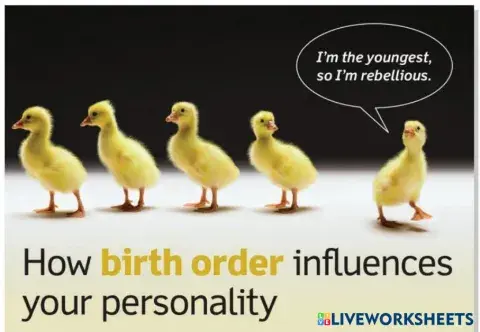
How birth order influences your personality

Reading - ESL

THE OLDEST CHILD

Firstborn children often have to look after their younger brothers and sisters, so they're usually sensible and responsible as adults.

They also tend to be ambitious, and they make good leaders. On the negative side, oldest children can be insecure and anxious. This is because -1-H. when the second child was born, they lost some of their parents' attention, and maybe they felt rejected

THE MIDDLE CHILD

Middle children are more relaxed than the oldest children, probably because -2- C. their parents were more relaxed themselves by the time the second child arrived. They're usually very sociable - the kind

of people who get on with everybody. They are also usually sensitive to what other people need, because -3-A. they grew up between older and younger brothers and sisters. For the same reason, they're often quite good at sorting out arguments, and they're always sympathetic to the ones on the losing side, or in general, to people who are having problems. On the other hand, middle children can sometimes be unambitious, and they can lack direction in life.

THE YOUNGEST CHILD

Youngest children are often very outgoing and charming. This is the way they try to get the attention of both their parents and their older brothers and sisters. They are often more rebellious, and this is probably because

-4-B. it's easier for them to break the rules - by the time they were born, their parents were more relaxed about discipline. They can also be immature and disorganized, and they often depend too much on other people, because -5-E. they have always been the baby of the family.

THE ONLY CHILD

Only children usually do very well at school, because they have a lot of contact with adults. They get a lot of love and attention from their parents, so they're typically self-confident. They're also independent, as they spend so much time by themselves. And because -6-F. they spend a lot of time with adults, they're often very organized. Only children can sometimes be spoilt, because -7-D. they are given everything they ask for by their parents. They can also be quite selfish and get impatient, especially when things go wrong. This is because -8-G. they've never had to sort out problems with other brothers and sisters.

Reading Comprehension - The Golestan Palace in Tehran

Reading Comprehension

Reading Comprehension - The Golestan Palace in Tehran


Resources:

UNESCO “Nomination of Golestan Palace For Inscription on the world heritage list”


Disclaimer:

I’m neither a native speaker of English nor a professional educationalist. I’m just a simple person whose native tongue is Arabic. I’m trying to make a positive impact on this world, and I believe that passing knowledge to them young minds coming after us is one way to do that. If you have any suggestions regarding the content of this worksheet, please don’t hesitate to reach out to me at Skype: [email protected]. Please remember that I’d always be pleased to hear from you all!!


Call to donate:

Hi there!! If you are reading this, then you probably are either a learner or having a career in the educational sector. In each case, you mostly are having enough to deal with in your own life. Please remember that you are free to print this worksheet and distribute it in the way you find suitable and promoting to learners. Yet, if you have a suggestion regarding modifying part or all of it, then I’d be really pleased to hear from you first so that we can help as many learners as possible. I know this is not the perfect place to ask this, but if you think that you can donate to help me produce more worksheets similar to this one, then please reach out to me at my Skype account: [email protected] so I can send you my credit card number or see how you can do that some other possible ways. Thanks in advance!!

Create and Customize Worksheets for Every Classroom

LiveWorksheets makes it easy for teachers, parents and homeschool educators to design and deliver engaging learning materials. Upload a PDF or start from scratch to create what you need: anything from interactive math worksheets to reading comprehension worksheets, multiplication worksheets, and kindergarten worksheets in just a few clicks. Our drag-and-drop editor works across all grade levels and subjects, so you can tailor content to your lesson plans, homework, or assessments. ESL teachers can also build custom ESL worksheets, add a common sound chart, or integrate ESL activities to make each class more engaging. Easily create differentiated, auto-graded activities that save valuable time and support better student learning.

A Complete Library of Learning Resources for K-12 and ESL

Access thousands of ready-to-use worksheets across K-12 subjects, including kindergarten worksheets, math worksheets, multiplication practice, reading comprehension exercises, and ESL resources. Filter by grade, subject, or skill level to find exactly what you need, whether it’s for an elementary classroom, middle school review, or high school practice. ESL teachers can explore our growing collection of ESL worksheets and English as a Second Language activities designed to support all levels of learners. With new content added regularly, LiveWorksheets is a flexible resource that helps build lasting learning outcomes.