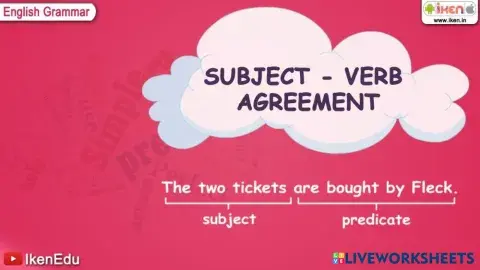
Subject-Predicate Agreement

English as a Second Language (ESL)

1.Everyone is here but nothing is being done.

2. If either of you takes a vacation now I shall be asked to finish this work.

3. Neither of these books is very new.

4. Every man and woman is eligible to vote.

5. Each student and teacher has a computer.

6. It was the dogs which awakened me.

7. It is grades that worry him.

8. The woman together with her two sons is arriving soon.

9. His answer in addition to his written tests shows that he deserves an excellent mark.

10. A strong wind along with rain and hail has been following us all the way.

11. The tutor as well as his pupils is going to have a rest in July.

12. Everyone except him was glad to make friends with foreign students.

13. One of the students was especially good at imitating birds' voices.

14. A red Honda and a blue Ford are parked outside.

15. Both a tiger and an elephant were in the Zoo.

16. Each dog and cat is vaccinated.

17. Both are going to attend the University.

18. Only a few have recognized her after her long absence.

19.Your sunglasses are very modern but your trousers aren't.

20. Your thanks are enough to forget the quarrel.

21. Environs of my native village are beautiful.

22. That pair of pants is not new.

23. A word of thanks is enough.

24. Neither the students nor the teacher is allowed to smoke here.

25. Either the teacher or the students have your book.

26. The New York Times is a good newspaper.

27. "Star Wars" war a good movie.

28. The Lords is one of the Houses of the British Parliament.

29. The Netherlands is a country situated below the sea level.

30. The Seyshells do not produce oil.

31. The Balkans are composed of sedimentary strata.

32. A number of students were missing from yesterday's classes.

33. The number of European students at the University is small.

34. Two weeks is enough time to have a vacation.

35. Five hundred dollars is required as a minimum payment.

36. Ten extra pounds is a lot to lose in a week.

37. 20 gallons of gasoline costs a lot of money.

38. The three years between 1991 and 1994 were the hardest for the state.

39. Mathematics is a difficult subject.

40. Acoustics are excellent in this hall.

41. The news was very good.

42. Measles is not a serious illness, nor is mumps.

43. Draughts is one of my favourite games, and so is dominoes.

44. The ironworks is just outside the town.

45. The class has its final tests on Friday.

46. The class are working on their individual projects.

47. The police are everywhere and they are searching for the criminals.

48. The jury are in their seats.

49. That species is rare.

50. Those species are common.

51. That deer is young and playful.

52. Deer live in Belarusian forests.

53. Where is the money? It is on the table.

54. Your advice is always good. I gladly follow it.

55. French is a Roman language.

56. The French are romantic.

57. The radius of the circle is two inches.

58. None of the stolen money has been found.

59. None of the students have finished the exam yet.

60. No example is relevant to this case.

61. No examples are relevant.

61. The majority believes that our life will change for the better.

62. The majority of the students believe that they will have a wonderful time during their vacation.

63. The flock of birds is circling overhead.

64. A school of fish is being attacked by sharks.

65. There are one or two things you should remember.

66. The students one after another are flooding into the assembly hall.

67. Who is to answer for all these mistakes?

68. To finish school well, to enter the University, to be a good specialist was the desire of Mike.

69. The small and the big house are both very ancient.

70. The small and big houses are both very beautiful.

71. Many a student attends the Central library.

72. Two and three is five.

73. His soul and body was in her hands.

Sleep later! 2025

English as a Second Language (ESL)

The "Aludj máskor!" ("Sleep Later!") competition is an exciting 24-hour event held annually in Gyöngyös, Hungary. This year, it will take place on April 5th and 6th, 2025. The event brings together high school students from various schools to participate in a series of challenges that test their creativity, physical endurance, and teamwork.​

Event Organization and Programs

Teams, typically consisting of 25 to 40 students, gather at the Dr. Fejes András Sports Hall for the competition. The event kicks off with an opening ceremony, followed by a variety of activities designed to keep participants engaged and awake throughout the 24 hours. These activities include sports tournaments, such as basketball and soccer matches, creative workshops where teams design posters or perform skits, and quiz competitions that challenge their knowledge on various topics.​

Fair Play Cup

A highlight of the competition is the awarding of the Fair Play Cup, which recognizes the team that demonstrates the best sportsmanship and ethical behavior during the event. For example, in a previous competition, the team from Károly Róbert High School received the Fair Play Cup for their respectful conduct and willingness to assist other teams throughout the challenges.​

Participant Experience

We spoke with Anna Kovács, a student from Berze Nagy János High School, who participated in last year's event. She shared her experience: "The 'Aludj máskor!' competition was unforgettable. We faced various challenges that pushed our limits, but the camaraderie and support from teammates made it enjoyable. Winning wasn't our main goal; building friendships and creating memories were the best rewards."​

The "Aludj máskor!" competition continues to be a cherished event in Gyöngyös, promoting unity, resilience, and the spirit of fair play among students.

Grammar points

English Grammar

  • Present Simple Tense

    • Structure: Subject + base verb (s/es for he/she/it)
    • Example: "I work in an office." / "She goes to school every day."
  • Present Continuous Tense

    • Structure: Subject + am/are/is + verb-ing
    • Example: "I am studying right now." / "They are playing football."
  • Past Simple Tense

    • Structure: Subject + past form of verb
    • Example: "She visited the museum yesterday." / "I watched a movie last night."
  • Past Continuous Tense

    • Structure: Subject + was/were + verb-ing
    • Example: "I was reading when the phone rang." / "They were sleeping at 10 PM."
  • Future Simple Tense (will)

    • Structure: Subject + will + base verb
    • Example: "I will call you tomorrow." / "They will come to the party."
  • Future with "going to"

    • Structure: Subject + am/are/is + going to + base verb
    • Example: "I’m going to visit my grandparents." / "He is going to study abroad."
  • Present Perfect Simple

    • Structure: Subject + have/has + past participle
    • Example: "I have finished my homework." / "She has lived in this city for five years."
  • Comparatives and Superlatives

    • Comparatives: Subject + verb + adjective + -er / more + adjective (for longer adjectives)
      • Example: "This book is cheaper than that one." / "She is more intelligent than him."
    • Superlatives: The + adjective + -est / most + adjective (for longer adjectives)
      • Example: "This is the tallest building." / "He is the most hardworking person."
  • There is/There are

    • Structure: There + is/are + noun
    • Example: "There is a book on the table." / "There are many people in the park."
  • Can (ability and permission)

    • Structure: Subject + can + base verb
    • Example: "I can swim." / "Can I go to the bathroom?"
  • Some and Any

    • Some: Used in positive statements, offers, and requests.
      • Example: "I have some friends." / "Would you like some tea?"
    • Any: Used in negative statements and questions.
      • Example: "I don’t have any money." / "Do you have any pens?"
  • First Conditional

    • Structure: If + present simple, will + base verb
    • Example: "If it rains, I will stay at home." / "If I see her, I will say hello."
  • Second Conditional

    • Structure: If + past simple, would + base verb
    • Example: "If I were rich, I would travel the world." / "If she studied more, she would pass the exam."
  • Prepositions of Place and Time

    • Examples: "in," "on," "at"
    • "The book is on the table." / "We have a meeting at 3 PM." / "I live in New York."
  • Questions with Wh- words

    • Examples: "What," "Where," "When," "Why," "How"
    • "What is your name?" / "Where do you live?" / "How are you?"

Past simple- Past continous contrast

Reading Comprehension - English Language

 A)Put the three parts of each sentence in the correct order.

  1. ________________________________________________________

 Marta was cleaning the living room/ the murder happened/ when
 

  1. ________________________________________________________

when/ Lucy was drinking coffee/ she saw someone running
 

  1. _______________________________________________________

 he was attacked/  Mr. Black was walking home/  when
 

  1. _______________________________________________________

when/ Tom was entering to the bank/ he heard a scream 

  1. _________________________________________________________

when/ the police arrived/ the neighbour was coming to his house 

B) Complete the sentence with the correct form of the verb. Choose the correct option.

  1. Lucy ___ (drink) coffee when she ___ (see) someone running.
     

    • a) was drinking / saw
       
    • b) drank / sees
       
    • c) was drank / seeing
       
  2. Mr. Black ___ (arrive) home at 8 p.m., but Marta ___ (clean) the living room.
     

    • a) arrived / was cleaning
       
    • b) was arriving / cleaned
       
    • c) arrive / was clean
       
  3. The police ___ (find) the handkerchief while Marta ___ (stand) up.
     

    • a) found / was standing
       
    • b) find / stood
       
    • c) was finding / stands
       
  4. Tom ___ (work) at the bank when the crime ___ (happen).
     

    • a) was working / happened
       
    • b) worked / was happening
       
    • c) is working / happen
       
  5. Marta ___ (wipe) her hands with a handkerchief when it ___ (fall).
     

    • a) was wiping / fell
       
    • b) wiped / fall
       
    • c) was wiped / falling
       

Create and Customize Worksheets for Every Classroom

LiveWorksheets makes it easy for teachers, parents and homeschool educators to design and deliver engaging learning materials. Upload a PDF or start from scratch to create what you need: anything from interactive math worksheets to reading comprehension worksheets, multiplication worksheets, and kindergarten worksheets in just a few clicks. Our drag-and-drop editor works across all grade levels and subjects, so you can tailor content to your lesson plans, homework, or assessments. ESL teachers can also build custom ESL worksheets, add a common sound chart, or integrate ESL activities to make each class more engaging. Easily create differentiated, auto-graded activities that save valuable time and support better student learning.

A Complete Library of Learning Resources for K-12 and ESL

Access thousands of ready-to-use worksheets across K-12 subjects, including kindergarten worksheets, math worksheets, multiplication practice, reading comprehension exercises, and ESL resources. Filter by grade, subject, or skill level to find exactly what you need, whether it’s for an elementary classroom, middle school review, or high school practice. ESL teachers can explore our growing collection of ESL worksheets and English as a Second Language activities designed to support all levels of learners. With new content added regularly, LiveWorksheets is a flexible resource that helps build lasting learning outcomes.