Manh Hung

English as a Second Language (ESL)

Ukraine war: Satellite images show how hundreds of North Korean troops were likely transported to a secluded Russian port

A.


CNN —  Hundreds of North Korean troops were likely transported by sea to Russia to fight in its war against Ukraine, satellite images have revealed, according to a new analysis from a US-based think tank shared exclusively with CNN.

B.

At least two Russian naval ships are believed to have moved North Korean soldiers to a Russian military port in Dunai, in the far east, in October and November, according to researchers at the James Martin Center for Nonproliferation Studies at the Middlebury Institute of International Studies, in California.

The ship transfers were first identified by the South Korean National Intelligence Service (NIS), which said in a press release last year that some soldiers were transported via the North Korean port areas of Chongjin, Hamhung and Musudan. But the South Korean agency only offered a grainy radar image at the time.

C.

“I don’t think that the Russians or the North Koreans want these transfers caught on camera,” Sam Lair, a research associate at the Center for Nonproliferation Studies, told CNN. “The secrecy element is quite remarkable.”

Now, researchers have verified that during the same time period of the troop transfers reported by South Korea intelligence, the Russian vessels identified by the spy agency docked at Dunai port in a remote, eastern part of Russia.

D.

In North Korea, soldiers likely boarded these ships at night, making it difficult to capture evidence of the transfers, researchers said. But satellite images have revealed activities at Dunai, “where it appears the Russians have been less careful.”

For example, in one satellite image from Planet Labs, a crane can be seen extending to one of Russia’s naval landing ships, which researchers believe is the Nikolay Vilkov, at the port on October 17, and a covered cargo truck is on the dock next to it. By October 20, the crane is retracted, and it appears a transfer of soldiers is complete.

E.

Researchers could identify the Russian “Ropucha-class” and “Alligator-class” ships in the satellite images because they match with photos captured by the Japanese Defense Ministry in March 2022, when the vessels passed through Japanese waters.

Each landing ship is believed to have capacity to hold several hundred soldiers, possibly as many as 400, according to the researchers.

F.

Lair explained that Dunai is a secure military facility, making it much more conducive to under-the-radar transfers than the large, nearby port of Vladivostok, which is in an area where civilians live.

“This is an isolated place where they can do these exchanges, where people aren’t going to notice… (where) their own citizens, and folks in the intelligence community might not notice,” Lair said.

G.

An estimated 12,000 North Korean soldiers have been sent to Russia, according to Ukrainian officials and Western intelligence reports in January, which say around 4,000 of those troops have been killed or injured. Kyiv says it has captured at least two North Korean soldiers. Neither Moscow nor Pyongyang have confirmed the existence of North Korean troops on the front lines.

CNN has reached out to the Russian Ministry of Defense for comment.

H.

“The Russians seem to have been very careful to limit the exposure of the North Korean soldiers, moving them directly to military training facilities. The motive behind all the secrecy surrounding the North Koreans is uncertain, but moving some of them through Dunai would aid in that effort,” Lair wrote in his analysis.

Dunai port has previously been used to transport cargo between Russia and the North Korea since Pyongyang started aiding the invasion of Ukraine in 2023, according to the James Martin Center for Nonproliferation Studies.

Reading

English

                                                                                 The Earth

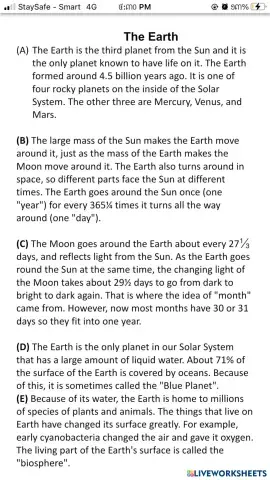
  1. The Earth is the third planet from the Sun and it is the only planet known to have life on it. The Earth formed around 4.5 billion years ago. It is one of four rocky planets on the inside of the Solar System. The other three are Mercury, Venus, and Mars.


(B) The large mass of the Sun makes the Earth move around it, just as the mass of the Earth makes the Moon move around it. The Earth also turns around in space, so different parts face the Sun at different times. The Earth goes around the Sun once (one "year") for every 365¼ times it turns all the way around (one "day").


(C) The Moon goes around the Earth about every 27⅓ days, and reflects light from the Sun. As the Earth goes round the Sun at the same time, the changing light of the Moon takes about 29½ days to go from dark to bright to dark again. That is where the idea of "month" came from. However, now most months have 30 or 31 days so they fit into one year.


(D) The Earth is the only planet in our Solar System that has a large amount of liquid water. About 71% of the surface of the Earth is covered by oceans. Because of this, it is sometimes called the "Blue Planet".

(E) Because of its water, the Earth is home to millions of species of plants and animals. The things that live on Earth have changed its surface greatly. For example, early cyanobacteria changed the air and gave it oxygen. The living part of the Earth's surface is called the "biosphere".


(F) The Earth is part of the eight planets and many thousands of small bodies that move around the Sun as its Solar System. The Solar System is moving through the Orion Arm of the Milky Way Galaxy now, and will be for about the next 10,000 years.

(G) The Earth is generally 150,000,000 kilometers or 93,000,000 miles away from the Sun (this distance is named an "Astronomical Unit"). The Earth moves along its way at an average speed of about 30 km or 19 mi a second. The Earth turns all the way around about 365¼ times in the time it takes for the Earth to go all the way around the Sun. To make up this extra bit of a day every year, an additional day is used every four years. This is named a "leap year".


(H) The Moon goes around the Earth at an average distance of 400,000 kilometers (250,000 mi). It is locked to Earth, so that it always has the same half facing the Earth; the other half is called the "dark side of the Moon". It takes about 27⅓ days for the Moon to go all the way around the Earth but, because the Earth is moving around the Sun at the same time, it takes about 29½ days for the Moon to go from dark to bright to dark again. This is where the word "month" came from, even though most months now have 30 or 31 days.


Questions 1–8

Reading Passage 1 has eight paragraphs A-H. Which paragraph contains the following information?  Write the correct letter, A–H, in boxes 1–8 on your answer sheet.

1. Earth’s natural satellite  ____
2. Distance between Earth and Sun  ____
3. General information about Earth  ____
4. The Solar System  ____
5. Length of most moths  ____
6. Another name for Earth  ____
7. The living part of the Earth's surface  ____
8. The movements of Earth around the Sun ____

Questions 9-13

Complete the sentences below.

Choose NO MORE THAN THREE WORDS from the text for each answer.

Write your answers in boxes 9-13 on your answer sheet.

9. Apart from Earth, other rocky planets in our Solar Systems are Venus, Mars and ____________ 

10. Moon ____________ from the Sun on Earth.

11. There are millions of ___________ of plants and animals that inhabit Earth.

12. Now the Solar System is travelling through ______________.

13. The dark side of the Moon is the side, which _____________ faces Earth.


additions and subtraction

Maths

Addition and Subtraction Quiz

Question 1

Sarah has 45 apples. She gives 12 apples to her friend and then buys 8 more apples. How many apples does Sarah have now?

  • A)41
  • B)39
  • C)33
  • D)45

Correct Answer: A) 41

Difficulty: Medium

Question 2

On a number line, if you start at -3 and move 7 units to the right, where do you end up?

  • A)4
  • B)5
  • C)3
  • D)2

Correct Answer: D) 4

Difficulty: Medium

Question 3

John had xx dollars. He spent $15 on a book and $10 on lunch. If he has $25 left, how much money did he have initially?

  • A)$50
  • B)$40
  • C)$60
  • D)$55

Correct Answer: C) $60

Difficulty: Medium

Question 4

On a number line, if you start at 10 and move 15 units to the left, where do you end up?

  • A)-5
  • B)-3
  • C)-4
  • D)-2

Correct Answer: A) -5

Difficulty: Medium

Question 5

Emily has 120 candies. She gives 30 candies to her brother and 25 candies to her sister. How many candies does she have left?

  • A)65
  • B)70
  • C)75
  • D)85

Correct Answer: C) 65

Difficulty: Medium

Question 6

On a number line, if you start at 5 and move 9 units to the left, where do you end up?

  • A)-4
  • B)-3
  • C)-2
  • D)-1

Correct Answer: B) -4

Difficulty: Medium

Question 7

A store had 200 shirts. They sold 75 shirts on Monday and 50 shirts on Tuesday. How many shirts are left in the store?

  • A)75
  • B)85
  • C)95
  • D)100

Correct Answer: C) 75

Difficulty: Medium

Question 8

On a number line, if you start at -7 and move 12 units to the right, where do you end up?

  • A)5
  • B)4
  • C)3
  • D)2

Correct Answer: D) 5

Difficulty: Medium

Question 9

Tom has 150 marbles. He loses 20 marbles and then finds 10 more. How many marbles does Tom have now?

  • A)140
  • B)130
  • C)135
  • D)145

Correct Answer: D) 140

Difficulty: Medium

Question 10

On a number line, if you start at 0 and move 20 units to the left, where do you end up?

  • A)-20
  • B)-15
  • C)-10
  • D)-5

Correct Answer: A) -20

Difficulty: Medium

Create and Customize Worksheets for Every Classroom

LiveWorksheets makes it easy for teachers, parents and homeschool educators to design and deliver engaging learning materials. Upload a PDF or start from scratch to create what you need: anything from interactive math worksheets to reading comprehension worksheets, multiplication worksheets, and kindergarten worksheets in just a few clicks. Our drag-and-drop editor works across all grade levels and subjects, so you can tailor content to your lesson plans, homework, or assessments. ESL teachers can also build custom ESL worksheets, add a common sound chart, or integrate ESL activities to make each class more engaging. Easily create differentiated, auto-graded activities that save valuable time and support better student learning.

A Complete Library of Learning Resources for K-12 and ESL

Access thousands of ready-to-use worksheets across K-12 subjects, including kindergarten worksheets, math worksheets, multiplication practice, reading comprehension exercises, and ESL resources. Filter by grade, subject, or skill level to find exactly what you need, whether it’s for an elementary classroom, middle school review, or high school practice. ESL teachers can explore our growing collection of ESL worksheets and English as a Second Language activities designed to support all levels of learners. With new content added regularly, LiveWorksheets is a flexible resource that helps build lasting learning outcomes.