Tour of London

English as a foreign language

Tour guide: Good aft­ern­oon lad­ies and gen­tle­men and _ _ _ _ _ _ _ | _ _ | this _ _ _ _ _ _ _ _ _ | _ _ _ _ | of Lon­don by bus. 
My name’s Greg and I’m your _ _ _ _ _  this aft­ern­oon on our tour of London. As you can see, we’re on an _ _ _ _ | _ _ _ | bus, so you can see all the _ _ _ _ _ _ _ _ _ _ _ from your seat and you don’t need to _ _ _ _ anywhere. And ple­ase _ _ _ _ _ | _ _ _ _ _| about the rain, I’m sure it’ll stop soon. A-a-and ple­ase ask any que­sti­ons at any time. 
Tourist 1: I have a question. 
Tour guide: Yes? 
Tourist 1: Do you have extra umbrellas? I mean if it rains a lot. 
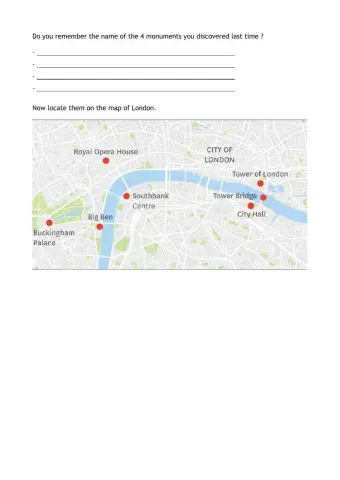
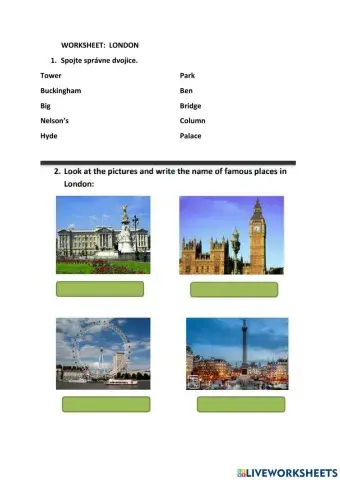
Tour guide: Err, no, we don’t have any extra umbrellas, but don’t worry, I’m sure the rain will stop soon. Right, OK, so where are we going on our_ _ _ _ _ _ _ _ _ | _ _ _ _? Well, the tour _ _ _ _ _ 2 hours and we are going to visit all the fam­ous sites. First, we’ll see Mad­ame Tussauds, the _ _ _ _ _ _ with wax mod­els of fam­ous peo­ple and celebrities, then we’ll _ _ _ _ _ | _ _ _ _ _  the most fam­ous _ _ _ _ _ _ _ _ | _ _ _ _ _ _  in the world, Oxf­ord Street. After that we’ll see the fam­ous _ _ _ _ _ Big Ben and The Hou­ses of Parliament. As we drive along the river you’ll see the pop­ula­r attraction, the Lon­don Eye, from which you can see the _ _ _ _ _ | _ _ _ _  on a sunny day. Then we’ll see Tower Bri­dge and the fam­ous Tower of Lon­don bef­ore _ _ _ _ _ _ _ _ at Buc­kin­gha­m Palace, just in time for a _ _ _  of _ _ _ with the Queen. 
Tourist 2: Is that inc­lud­ed in the tour? A cup of tea with the Queen? 
Tour guide: Err, well, no not exactly, but there’s a lov­ely _ _ _ _ near the _ _ _ _ _ _ where you can get a cup of tea. 
(Sound of a storm right overhead, loud thu­nde­r and very heavy downpour) 
Tourist 1: I have ano­the­r question. 
Tour guide: Yes?
Tourist 1: Can we have our money back? We’re _ _ _ _ _ _ _ | _ _ _ the bus. 
Tour guide: Err, well, you see... Quick! Run! Eve­ryo­ne off the bus! …

BLO Reading 2 Ex 2

IELTS Reading

The man who invented synthetic dyes


William Henry Perkin was born on March 12, 1838, in London, England. As a boy, Perkin’s curiosity prompted early interests in the arts, sciences. photography, and engineering. But it was a chance stumbling upon a run-down, yet functional, laboratory in his late grandfather's home that solidified the young man`s enthusiasm for chemistry.

As a student at the City of London School, Perkin became immersed in the study of chemistry. His talent and devotion to the subject were perceived by his teacher, Thomas Hall, who encouraged him to attend a series of lectures given by the eminent scientist Michael Faraday at the Royal Institution. Those speeches tired the young chemist`s enthusiasm further, and he later went on to attend the Royal College of Chemistry, which he succeeded in entering in 1853, at the age of 15.

At the time of Perkin’s enrollment, the Royal College of Chemistry was headed by the noted German chemist August Wilhelm Hofmann. Perkin’s scientific gifts soon caught Hofmann’s attention and within two years, he became Hofmann’s youngest assistant. Not long after that, Perkin made the scientific breakthrough that would bring him both fame and fortune.

At the time, quinine was the only viable medical treatment for malaria. The drug is derived from the bark of the cinchona tree, native to South America and by 1856 demand for the drug was surpassing the available supply. Thus, when Hofmann made some passing comments about the desirability of a synthetic substitute for quinine, it was unsurprising that his star pupil was moved to take up the challenge.

During his vacation in 1856, Perkin spent his time in the laboratory on the top floor of his family's house. He was attempting to manufacture quinine from aniline, an inexpensive and readily available coal tar waste product. Despite his best efforts, however, he did not end up with quinine. Instead, he produced a mysterious dark sludge. Luckily, Perkin’s scientific training and nature prompted him to investigate the substance further. Incorporating potassium dichromate and alcohol into the aniline at various stages of the experimental process, he finally produced a deep purple solution. And, proving the truth of the famous scientist Louis Pasteur's words 'chance favors only the prepared mind'. Perkin saw the potential of his unexpected find.


phân biệt tính trạng vị trí enough và tính từ thêm đuôi ED, ING

English

1. Check your work…..

==a. carefully                              b. careful

c. carefulness                               d. care                               

2. I know them…..

a. good                                       ==b. well

c. best                                         d. better

3. She sometimes goes to school …..

a. laterly                                     b. lately

c. later                                        ==d. late

4. Jane is … because her job is …..

a. tired/tired                                 ==b. tired/tiring

c. tiring/tired                               d. tiring/tiring

5.  He has lived in London for some years so he speaks …..

a. fluently English                                 b. English fluent

c. fluent English                                             ==d. English fluently

6. "How does Amy like her new school?"

"Fine. And she's doing_____ in her courses"

a. extreme good                                    ==b. extremely well

c. extremely good                                 d. extreme well

7. "Your son seems to be an excellent skier"

"They say he's_____ for his age".

==a. surprisingly competent                            b. surprising competent

c. competently surprising                                d. surprising competently

8. "The students all went to the circus yesterday".

"I heard it was really_____".

a. amused                                                      ==b. amusing

c. amuse                                                       d. amusingly

9. "I was_____ that Jan couldn't come to the party".

"Her boss made her work overtime"

==a. disappointing                                         b. disappointedly

c. disappoint                                         d. disappointed

10. "I can’t believe that Jim is marrying the vice-president's daughter".

"That they would get married is_____".

a. surprised                                          b. surprising

==c. surprisingly                                            d. surprise

11 . My brother is_________to drive a car.

==A. Old enough

B. Enough old

12. I don’t think you are ___________ to lift this table.

==A. Strong enough

B. Enough strong

13. Mike doesn’t have __________ to meet her.

A. Time enough

==B. Enough time

14. He is __________ to eat 10 apples.

==A. Hungry enough

B. Enough hungry

15. Is your cake _____________?

==A. Sweet enough

B. Enough sweet

16. Helen doesn’t have_____________to buy a new phone

==A. enough money

B. money enough

17.  She isn’t _____________to carry this bag

A. enough strong

==B. strong enough

18. Bill isn’t _____________to understand what I say

==A. intelligent enough

B. enough intelligent

19. She lost the match simply because she didn’t play

==A. well enough

B. enough well

20. Even if you use a green house, it will never be_____________to grow bananas in this climate

==A. warm enough

B enough warm

21. We went to the cinema but the film was really

A. bored

==B. boring

22. It’s an___________book

A. amazed

==B. amazing

23. The direction he gave us were really___________

A. confused

==B. confusing

24. I felt___________after running a marathon

==A. exhausted

B. exhausting

25. I was___________to see my best friend at the party

==A. surprised

B. surprising

26. The challenging puzzle was___________and required careful thought to solve

==A. puzzling

B. puzzled

27. You should take a rest. You look really___________

==A. tired

B. tiring

28. The journey was___________. Twenty hours by train made us___________

A. bored/exhausted

B. boring/exhausting

==C. boring/exhausted

D. bored/exhausting

29. Don’t show my baby photos to others, Mum! It’s so___________!

==A. embarrassing

B. embarrased

30. She got really___________ yesterday because someone threw rubbish in front of her house

==A. annoyed

B. annoying


Present Perfect Tense

Writing - English Language

📝 Student Instruction: Present Perfect Tense

  1. When do we use Present Perfect?
  • To talk about actions or experiences at an unspecified time in the past.

    • I have visited Japan.
  • To talk about actions that started in the past and continue until now.

    • She has lived here for 10 years.
  • To talk about actions that happened in the past but still have a result now.

    • He has broken his leg (he can’t walk now).
  1. Form
  • Affirmative (+): Subject + have/has + past participle (V3)

    • I have eaten breakfast.
    • She has finished her homework.
  • Negative (–): Subject + have/has + not + past participle

    • I haven’t seen that movie.
    • He hasn’t called me.
  • Question (?): Have/Has + subject + past participle

    • Have you visited London?
    • Has she done her homework?
  1. Time expressions used with Present Perfect
  • just → I have just finished my homework.
  • already → She has already eaten.
  • yet → Have you finished yet? / I haven’t finished yet.
  • ever → Have you ever been to Paris?
  • never → I have never seen snow.
  • for (a period of time) → for 5 years
  • since (a starting point) → since 2010
  1. Examples
  • We have studied English for three years.
  • He has never played basketball.
  • Have they arrived yet?

👉 Practice Example:
Change the verb into Present Perfect.

  1. I (see) that movie three times. → I have seen that movie three times.
  2. She (not finish) her homework yet. → She hasn’t finished her homework yet.
  3. (they / travel) to London before? → Have they traveled to London before?

Create and Customize Worksheets for Every Classroom

LiveWorksheets makes it easy for teachers, parents and homeschool educators to design and deliver engaging learning materials. Upload a PDF or start from scratch to create what you need: anything from interactive math worksheets to reading comprehension worksheets, multiplication worksheets, and kindergarten worksheets in just a few clicks. Our drag-and-drop editor works across all grade levels and subjects, so you can tailor content to your lesson plans, homework, or assessments. ESL teachers can also build custom ESL worksheets, add a common sound chart, or integrate ESL activities to make each class more engaging. Easily create differentiated, auto-graded activities that save valuable time and support better student learning.

A Complete Library of Learning Resources for K-12 and ESL

Access thousands of ready-to-use worksheets across K-12 subjects, including kindergarten worksheets, math worksheets, multiplication practice, reading comprehension exercises, and ESL resources. Filter by grade, subject, or skill level to find exactly what you need, whether it’s for an elementary classroom, middle school review, or high school practice. ESL teachers can explore our growing collection of ESL worksheets and English as a Second Language activities designed to support all levels of learners. With new content added regularly, LiveWorksheets is a flexible resource that helps build lasting learning outcomes.