Articles

Articles and their usage

🔹 Types of Articles

  1. Indefinite Articles:

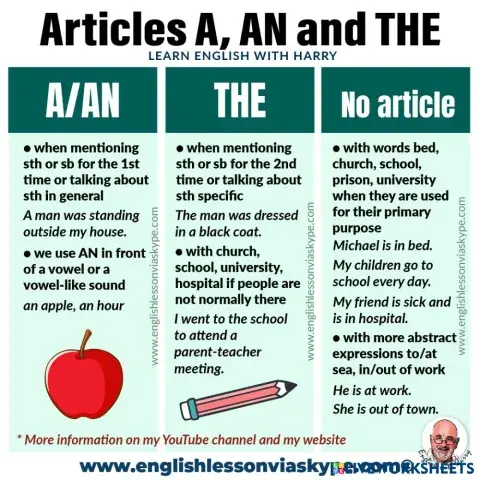
    • "a" – used before words that begin with a consonant sound.

      • Example: a cat, a book, a university (sounds like you-niversity).
    • "an" – used before words that begin with a vowel sound.

      • Example: an apple, an hour, an honest man.
  2. Definite Article:

    • "the" – used to refer to a specific noun that is known to the reader or listener.

      • Example: the sun, the car you bought, the book on the table.

🔹 When to Use "a" or "an"

  • First mention:
    Use "a" or "an" when mentioning something for the first time.

    • I saw a movie last night.
    • She brought an umbrella.
  • One of many:
    Used when it’s not a specific one of its kind.

    • He wants to buy a car. (Not any specific car)

🔹 When to Use "the"

  • Specific noun (already mentioned or known):

    • I saw a dog. The dog was very friendly.
  • Unique things:

    • the sun, the moon, the earth
  • Superlatives and ordinals:

    • the best day, the first time
  • Things mentioned earlier:

    • I bought a pen and a notebook. The notebook is red.
  • Places (specific ones):

    • the Eiffel Tower, the Pacific Ocean, the UK

🔹 When Not to Use Any Article (Zero Article)

  • Plural nouns or uncountable nouns when speaking generally:

    • Cats are cute.
    • Information is valuable.
  • Names of countries (usually):

    • France, Japan (but the Netherlands, the United States)
  • Meals, months, and days:

    • We eat lunch at noon.
    • She was born in May.
    • School starts on Monday.

🔹 Tricky Situations

  • Abbreviations: Use based on pronunciation, not spelling.

    • an MBA (pronounced em-bee-ay)
    • a UFO (pronounced you-eff-oh)
  • Adjectives before nouns: Use article based on the sound of the adjective.

    • an interesting idea
    • a unique concept (sounds like you-nique)

Future Plans (Going to)

English as a Second Language (ESL)

Exercise 1: Fill in the blanks


Complete the sentences using “going to” and the correct verb.

  • I __________ (visit) my grandmother this weekend.
  • She __________ (buy) a new phone tomorrow.
  • We __________ (watch) a movie tonight.
  • They __________ (travel) to Spain next summer.
  • He __________ (start) a new job next Monday.

Exercise 2: Match the questions with the correct answers.


Draw a line or match the correct responses.


Questions

1. What are you going to do this evening?

2. Are you going to visit your parents this weekend?

3. Where are you going to go on holiday?

4. Is she going to buy a new car?

5. What are they going to eat for dinner?


Answers

a) I’m going to study for my exam.

b) No, I’m going to stay at home.

c) We’re going to the beach.

d) Yes, she’s going to buy a red one.

e) They’re going to have pizza.


Exercise 3: Plan your weekend!


Write three sentences about your weekend plans using "going to". Example: I am going to visit my friend on Saturday.


1. _______________________________________________________

2. _______________________________________________________

3. _______________________________________________________


Exercise 4: Speaking practice (Breakout rooms)


Work with a partner. Ask and answer questions about your future plans. Take turns answering. Use full sentences!

  • What are you going to do this weekend?
  • Are you going to visit your family?
  • Where are you going to go on holiday?

PET B1 Reading 1

English as a Second Language (ESL)

Choose the best answer for each question.

1.

Email

Dear team, remember we've moved our weekly meeting from Monday to Wednesday for this week only. This is due to staff illness.

  1. a. The weekly meeting is cancelled this week.
  2. b. The weekly meeting will be held on both Monday and Wednesday.
  3. c. Somebody is not well.

2.

Notice

Wet Floor!

Caution: Floor is wet. Please watch your step.

  1. a. The floor is wet, please go back.
  2. b. There's a step on the wet floor that needs to be watched.
  3. c. The floor is wet and you should be careful while walking.

3.

Warning

Noise Restrictions

Loud music is not permitted after 10pm. Please respect your neighbours and keep noise levels to a minimum.

  1. a. You must use headphones to listen to music.
  2. b. You can't play loud music after 10pm.
  3. c. Loud music is only allowed before 10pm if it is played through headphones.

4.

Text Message

Hey Jake, want to join us for a hike on Sunday? The weather should be nice. We're aiming to start early in the morning. Speak soon, Mark.

  1. a. Mark is inviting Jake to a hike.
  2. b. Mark is telling Jake about a hike he missed.
  3. c. The weather probably won't be great.

5.

Competition

Win a Designer Wardrobe

Enter now to win a wardrobe makeover by a top designer worth $5000! Entry is free. Participants must be aged 16 or over. Deadline for entries: January 15th.

  1. a. There is an entry fee for the competition.
  2. b. The competition is for those who want new clothes.
  3. c. The competition is open to those who want new furniture.
  4. PART 2
  5. Below, you will find descriptions of five people who want to find a book to read. And descriptions of eight books. Decide which books would be the most suitable for the people below.

    Books

    A. 'Timeless Love': A young woman from the 19th century has to navigate societal norms while pursuing her passion and finding her true love. It portrays a beautiful and heartfelt journey, painted against a historic backdrop.

    B. 'The Enigma Code': This gripping thriller tells the tale of a group of teenagers who stumble upon an ancient secret society. It's a rollercoaster ride of suspense, mystery, and daring escapades.

    C. 'Leafy Lives': An informative account of the incredibly diverse world of plants, their complex life-cycles, and how they adapt to environmental changes. Written by a renowned botanist, it brings the plant kingdom to life in the reader's mind.

    D. 'Sands of Time': This meticulously researched novel transports readers back to the time of the ancient Egyptians. A historian's delight, it intertwines factual events with a fictional narrative.

    E. 'Raging Tides': A young marine biologist investigates the deaths of whales and dolphins in South America and uncovers a global conspiracy threatening marine life. This fast-paced novel blends scientific facts with a thrilling storyline.

    F. 'Climate Call': This book delves into the complexities of global warming and its implications on the planet. It blends scientific data with personal narratives, creating a compelling argument for immediate action.

    G. 'Silent Whispers': A gripping tale of espionage set in the beautiful city of Prague during the Cold War. A young woman must balance her personal life and secret identity while trying to navigate treacherous political terrain and those that 

    H. 'Lost in the Jungle': This adventure-filled novel recounts the story of explorers lost in the Amazon rainforest. Far from civilisation, do they have what they need to survive? It's a survival tale that balances the beauty and dangers of nature.

  6.  

     
    Readers

    1. Martin is a history professor who is fascinated by ancient civilisations.

    2. Amelia is a teenager who enjoys fast-paced stories full of mystery and adventure.

    3. Carlos is a biologist, interested in how plants adapt to changing environments.

    4. Evelyn is a fan of romantic novels, particularly those with strong female leads.

    5. James is an environmental activist who is looking for an informative yet engaging read about climate change.

    Answers:

    1. Martin ______
    2. Amelia ______
    3. Carlos ______
    4. Evelyn ______
    5. James ______

  7. PART 3
  8. Read the text and then for each question, choose which of the four possible answers is best. Think also about why the other three answers are not possible.

    Safer Driving

    David Williams, a renowned driving safety expert, shares some advice on becoming a better driver. With more than three decades of experience in the field, David has extensive knowledge about safe and efficient driving. He knows more than anyone what makes a dangerous driver and what makes a safe one!

    "Driving is an important responsibility and we should always take it seriously," begins David. "We often overlook the basics. Like, for instance, regular maintenance of your vehicle is crucial. A well-functioning vehicle can greatly reduce the risk of accidents."

    He also emphasises the importance of being aware of one's surroundings while driving. "You have to keep an eye on what's happening around you - cars, pedestrians, cyclists. And remember, the road doesn't belong to you alone. You need to be aware that everyone on the road is equally important, that driver you are getting impatient with is someone's wife, or husband, or mother or son." 

    According to David, speed is a common factor in many accidents. People are often in such a hurry and the consequences can be terrible. "Sticking to the speed limit is not just about avoiding fines. It's about safety - both yours and others. Don't let impatience drive you to make poor decisions."

    David also talks about the essential role of practice. "Experience is key. The more you practice, the more comfortable you become with handling unexpected situations. New drivers especially should gain experience in different weather conditions and at different times of the day." If you want to be a better driver, keep driving and keep driving safely!

    These days, with so many distractions available to a driver in the car, it's never been so easy to take your attention off the road. As for distractions, David has a straightforward message. "Stay away from your phone and don't multitask while driving. Your full attention should be on the road."

    For David Williams, being a better driver is not about skill alone. It's about cultivating a sense of responsibility, improving awareness, practicing regularly, and most importantly, staying safe.

    341 words

    1. According to David, why is vehicle maintenance important?

  9. It saves money in the long run.
  10. It reduces the risk of accidents.
  11. It helps the vehicle last longer.
  12. It improves the vehicle's performance.
  13. 2. Why does David advise sticking to the speed limit?
  14. To avoid fines.
  15. To make poor decisions.
  16. To handle unexpected situations.
  17. 3. According to David, what should new drivers gain experience in?
  18. Repairing their vehicles.
  19. Driving at peak traffic hours.
  20. Using their phones while driving.
  21. Driving under various conditions.
  22. 4. What would David most likely say about distractions while driving?
  23. They help improve driving skills.
  24. They are a necessary part of driving.
  25. They should be minimised.
  26. They are not a major concern.
  27. 5. What would be a good introduction to this article?
  28. David Williams, an expert in car maintenance, shares his advice on how to keep your vehicle running smoothly.
  29. In this article, David Williams offers tips on how to become a faster, better car driver.
  30. David Williams, a driving safety expert, offers invaluable advice on how to become a better, safer driver.
  31. David Williams shares his personal journey from being a new driver to an experienced one. For the safety of all.

PART 4

Five sentences have been removed from the text below. For each question, choose the correct answer. There are three extra sentences which you do not need to use.

My Journey To Music

As a child, I was always surrounded by music. My grandmother had been a famous opera singer many years before although I had never heard her singing myself. My mother was a piano teacher, and our house was filled with the sounds of piano melodies from dawn till dusk. My older sister played the violin, and my father had a beautiful baritone voice. _____1_____

Every evening, after dinner, we used to gather in the living room. My mother would sit at the piano, my sister would take up her violin, and my father would stand ready to sing. _____2_____ I would sit on the floor, watching and listening, completely enchanted.

When I was six, my mother started teaching me the piano. I was an eager student, ready to embrace the musical world that was so dear to my family. _____3_____ My progress was slow at first, but I was persistent. I practised every day, improving little by little.

By the time I reached my teenage years, I had become quite proficient at the piano. _____4_____ It was not just a hobby for me anymore, but a passion. I decided then to dedicate my life to music.

Today, I am a concert pianist, travelling the world and playing at some of the most renowned concert halls. _____5_____ I often look back on those early years with gratitude, as they laid the foundation for my musical journey.

A. It was a unique family bond that I cherished.
B. That's when I truly felt a part of my family's musical world.
C. It wasn't an easy task, but it was definitely worth it.
D. But my journey wasn't without its challenges.
E. I owe it all to those evenings in our living room and the lessons with my mother.
F. Yet, I always felt a bit out of place.
G. Each note I played seemed to bring me closer to them.
H. And this is why I couldn't do it.

Answers:

1. ______
2. ______
3. ______
4. ______
5. ______


PART 5

For each question, choose which of the four possible answers fits the space best. Also think about why the other three answers are not possible.

1. He prepared the dish ___________ fresh ingredients.

  1. to
  2. with
  3. of
  4. about

2. During the lessons, the teacher often writes on the ___________.

  1. desk
  2. chair
  3. window
  4. blackboard

3. My sister loves reading historical fiction ___________.

  1. leaflets
  2. movies
  3. books
  4. covers

4. The meeting ___________ longer than expected.

  1. ended
  2. taken
  3. lasted
  4. done

5. I always ___________ to music while working.

  1. sing
  2. dance
  3. play
  4. listen

6. Seeing her friend after a long time was a(n) ___________ experience.

  1. delightful
  2. negative
  3. hard
  4. slow

PART 6

For each gap, choose ONE word which you think best completes the sentence. Look carefully at the words both before and after each space.

1. The lift is ___________ of order, we have to use the stairs.

2. He borrowed my book and promised to give it ___________ by Friday.

3. It must ___________ been very challenging to climb Mount Everest.

4. Michael began his career ___________ a photographer after his photos were discovered by a magazine editor.

5. Children often imitate people ___________ TV without understanding the consequences.

6. According to the recipe, the dessert should ___________ served chilled.

Erther

Basic English

A. LISTENING SMART START 4 – TERM 1 I. Listen and circle. Question 1. A Question 2. B C A Question 3. B C A II. Listen and choose the correct answer. Question 1. A. Yes, I’d love to B B. Yes, you can Question 2. A. They’re kangaroos Question 3. A. It’s sunny and cool Question 4. A. It’s pizza Question 5. A. He’s shopping B. Kangaroos can jump B. I like warm weather B. Yes, I can C C. I like the winter C. I like kangaroos C. It’s spring. C. Yes, please B. He likes hopping C. He can hop B. VOCABULARY AND READING Question 2. Question 3. I. Look and complete. Question 1. pu_ _ le II. Choose the correct answer fr_ _ zing Question 1. What can your dad do? - ____________ A. He’s doing gymnastics B. He can do gymnastics C. Yes, he can f_ _ther D. He likes doing gymnastics Question 2. Ben and his friends can ______table tennis well. A. make B. have C. do Question 3. Bring your ________ because it’s rainy A. raincoat B. coat Question 4. Can your mother ______ a car? A. drive B. to drive Question 5. I can draw, _____ I can’t dance. A. because B. at C. dress C. to driving C. with Question 6. My mom would like to go ______ a walk A. for B. at Question 7. My grandpa ______ television A. is watching B. is watch Question 8. What’s this? - _______ A. It’s a zebra’ B. It’s zebras C. in C. are watch C. They’re a zebra Question 9. What do you like ______ when it’s hot? A. can do B. doing C. to doing Question 10. What _____ these? – They’re snakes. A. are B. am D. play D. sunglasses D. driving D. but D. with D. can watching D. They’re zebras D. do C. is D. can III. Read and match A. It’s warm 1. What ‘s your favorite season? 2. What’s the weather like today? B. No, thanks 3. What’s his brother doing? C. It’s summer 4. Would you like to eat snacks? D. He’s eating snacks IV. Choose the underlined part that needs correcting Question 1. What can his grandma doing? – She can play chess A B C D Question 2. Would you like playing video games? – Yes, I’d love to A B C D Question 3. Bring your cap because it’s hot and rainy outside. A B C Question 4. What is he doing? – He is watch TV. A V. Read and fill. B C D D This is a picture of the zoo. This is a _______(1). It’s big and gray. It’s swimming . That’s an elephant. It’s very big. It’s _______(2) leaves now. Look over there. _______(3) are dolphins. They have _______(4) to help them swim well. They can _______(5) in the water. I love animals jump – fins – Those – eating – These – hippo C. WRITING Unscramble the sentences, 1. fur/ yellow/ and/ have/ Lions/ tail/ a long/ ___________________________________________________________________________ 2. watcing/ Is/ Lucy/ TV?/ eating/ and/ snacks/ ___________________________________________________________________________

Revision 1

English

REVISION 1 (U1-3)


PART 1: GRAMMAR

Identify the error (A, B, C or D) in each sentence and write the correct words/ phrases

Example:  What’s (A) his (B) name ? - His (C) name are (D) Alan

                    ANS: D-is

  1. Is this (A) a (B) orange or a (C) lemon? - It is a (D) lemon.
  2. Their son, James, is (A) an (B) mechanical engineer for a (C) company in (D) France.
  3. Anna Miller and Tom Brown are (A) my friends (B). Them (C) are from (D) England.
  4. My (A) boyfriend is (B) very funny, so people love (C) he (D) a lot.
  5. Our teacher is (A) Selena and she (B) is very kind (C) to we (D).
  6. Pamela and I am (A) Canadian, now we (B) live in a (C) small town in Spain (D).
  7. My car’s parents (A) is not very (B) expensive. It (A) is only 1000 dollars D).
  8. Lara’s (A) children are (B) in they (C) room upstairs in her house.
  9. Nancy is (A) from England (B). She (C) husband is a (D) doctor.

10. There isn’t (A) any books on (B) your desk but there are two English books (C) under it (D).
11. There are (A) two bookshelfs (B) with a lot of technical books and (C) a big table in (D) my room.

12. My (A) boyfriend is (B) very funny, so people love (C) he (D) a lot.
13. Look at that (A) screwdrivers over (B) there. They (C) are new but (D) very expensive.

14. The keys (A) are between the lamp or (B) some papers on the desk but the hammer is (C) under it (D).

15. Lee’s factory is (A) quite small. There are (B) a manager (C) and five workers (D).

16. I study (A) at Hanoi University of Industry. There are (B) 45 student (C) in my class (D).

17. What (A) is the language (B) in your (C) country? – We speak America (D).

18. I is (A) from Spain (B). I am not (C) from Germany (D).

19. Are (A) there an (B) English book (C) in the schoolbag on (D) the chair?

20. Mary is (A) a student (B). She goes (C) to school with she (D) friend by motorbike.


PART 2: VOCABULARY

Complete each sentence with a suitable word/ phrase. The first letter is given.

Example:  Sorry I’m late, may I c_ _ _ in please?

Answer: come

21. First, let’s do the h _ _ _ _ _ _ _ on page 25 together and check your answer with a partner.

22. I’m sorry, can you speak more s_ _ _ _ _?. I can’t understand what you say.

23. Can you write the answers on the b _ _ _ _  please?. You will get one point for a correct answer  

24. I have a little b _ _ _ _ _ _. He is very naughty but lovely. My parents love him a lot.

25. My g _ _ _ _ _ _ _ _ _ _ is eighty years old but he still remembers everything about his school days.

26. My mother is my father’s w _ _ _. She is the person I love the most in my family.

27. I have two c _ _ _ _ _ _ _, a son and a daughter. The son is five and the daughter is seven.

28. Alice is from the United States. She is A _ _ _ _ _ _ _. She has a boyfriend from Australia.

29. There are four members in my f_ _ _ _ _: my father, my mother, my sister and me. 

30. My parents use an e-_ _ _ _ _ _ to read news on the internet when they are at home.

31. Mary is married, her h _ _ _ _ _ _ is an engineer. He works for an automobile factory.

32. My s_ _ _ _ _ _ _ often go to the school library to study. They are very interested in learning at this university.

33. Duncan is English. He is from _ _ _ _ _ _. He learns with many students from different countries.

34. There are a lot of s_ _ _ _ _ _ in the living room. Put books on them.

35. I can’t find my u_ _ _ _ _ _ _ to go out. It is raining outside.

36. I carry my books to school in my b_ _ _ _ _ _ _. I usually put it on my bed when I come home.

37. The man cuts his wood stick with a s_ _. He often keeps it together with the hammer in the box.

38. Don’t sit on that c_ _ _ _. Its leg is broken. I need to fix it with some screws.

39. She has a l_ _ _ _ _ c_ _ _ to keep her laptop safe. It is on the table behind the lamp.

40. I can’t hear it from here. The room is so noisy. Can you r_ _ _ _ _ that?

phân biệt tính trạng vị trí enough và tính từ thêm đuôi ED, ING

English

1. Check your work…..

==a. carefully                              b. careful

c. carefulness                               d. care                               

2. I know them…..

a. good                                       ==b. well

c. best                                         d. better

3. She sometimes goes to school …..

a. laterly                                     b. lately

c. later                                        ==d. late

4. Jane is … because her job is …..

a. tired/tired                                 ==b. tired/tiring

c. tiring/tired                               d. tiring/tiring

5.  He has lived in London for some years so he speaks …..

a. fluently English                                 b. English fluent

c. fluent English                                             ==d. English fluently

6. "How does Amy like her new school?"

"Fine. And she's doing_____ in her courses"

a. extreme good                                    ==b. extremely well

c. extremely good                                 d. extreme well

7. "Your son seems to be an excellent skier"

"They say he's_____ for his age".

==a. surprisingly competent                            b. surprising competent

c. competently surprising                                d. surprising competently

8. "The students all went to the circus yesterday".

"I heard it was really_____".

a. amused                                                      ==b. amusing

c. amuse                                                       d. amusingly

9. "I was_____ that Jan couldn't come to the party".

"Her boss made her work overtime"

==a. disappointing                                         b. disappointedly

c. disappoint                                         d. disappointed

10. "I can’t believe that Jim is marrying the vice-president's daughter".

"That they would get married is_____".

a. surprised                                          b. surprising

==c. surprisingly                                            d. surprise

11 . My brother is_________to drive a car.

==A. Old enough

B. Enough old

12. I don’t think you are ___________ to lift this table.

==A. Strong enough

B. Enough strong

13. Mike doesn’t have __________ to meet her.

A. Time enough

==B. Enough time

14. He is __________ to eat 10 apples.

==A. Hungry enough

B. Enough hungry

15. Is your cake _____________?

==A. Sweet enough

B. Enough sweet

16. Helen doesn’t have_____________to buy a new phone

==A. enough money

B. money enough

17.  She isn’t _____________to carry this bag

A. enough strong

==B. strong enough

18. Bill isn’t _____________to understand what I say

==A. intelligent enough

B. enough intelligent

19. She lost the match simply because she didn’t play

==A. well enough

B. enough well

20. Even if you use a green house, it will never be_____________to grow bananas in this climate

==A. warm enough

B enough warm

21. We went to the cinema but the film was really

A. bored

==B. boring

22. It’s an___________book

A. amazed

==B. amazing

23. The direction he gave us were really___________

A. confused

==B. confusing

24. I felt___________after running a marathon

==A. exhausted

B. exhausting

25. I was___________to see my best friend at the party

==A. surprised

B. surprising

26. The challenging puzzle was___________and required careful thought to solve

==A. puzzling

B. puzzled

27. You should take a rest. You look really___________

==A. tired

B. tiring

28. The journey was___________. Twenty hours by train made us___________

A. bored/exhausted

B. boring/exhausting

==C. boring/exhausted

D. bored/exhausting

29. Don’t show my baby photos to others, Mum! It’s so___________!

==A. embarrassing

B. embarrased

30. She got really___________ yesterday because someone threw rubbish in front of her house

==A. annoyed

B. annoying


Travel and Transport

Reading and Text Analysis - English Language

Reading Task

Text (example):
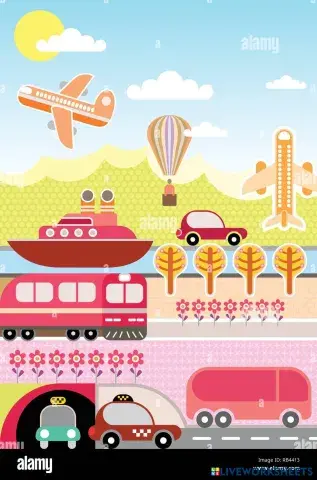
“Travel has always been important for people. In the past, people traveled by horse, on foot, or by simple boats. Today, we can travel by car, train, plane, or even by underground metro. Modern transport is faster and more comfortable, but it also causes traffic jams and pollution. Many people now think about eco-friendly travel, such as cycling, walking, or using electric vehicles.”


Text Analysis Tasks
    1.    Comprehension Questions
    •    How did people travel in the past?
    •    What are the advantages of modern transport?
    •    What problems does modern transport create?
    •    What are some eco-friendly ways to travel?
    2.    True or False
    •    In the past, people traveled by airplane.
    •    Modern transport is faster and more comfortable.
    •    Transport does not cause any problems.
    •    Cycling is an eco-friendly way to travel.
    3.    Vocabulary Work
    •    Find words in the text that mean:
a) very old ( → past )
b) not harmful to the environment ( → eco-friendly )
c) faster and easier to use ( → comfortable )
d) situation when many cars stop moving ( → traffic jam )
    4.    Discussion / Critical Thinking
    •    Which transport do you use most often and why?
    •    What are the advantages and disadvantages of cars?
    •    How can we make transport more eco-friendly in the future?
    5.    Writing Extension
    •    Write a short paragraph about your last trip. Which transport did you use? Was it comfortable or difficult?

Create and Customize Worksheets for Every Classroom

LiveWorksheets makes it easy for teachers, parents and homeschool educators to design and deliver engaging learning materials. Upload a PDF or start from scratch to create what you need: anything from interactive math worksheets to reading comprehension worksheets, multiplication worksheets, and kindergarten worksheets in just a few clicks. Our drag-and-drop editor works across all grade levels and subjects, so you can tailor content to your lesson plans, homework, or assessments. ESL teachers can also build custom ESL worksheets, add a common sound chart, or integrate ESL activities to make each class more engaging. Easily create differentiated, auto-graded activities that save valuable time and support better student learning.

A Complete Library of Learning Resources for K-12 and ESL

Access thousands of ready-to-use worksheets across K-12 subjects, including kindergarten worksheets, math worksheets, multiplication practice, reading comprehension exercises, and ESL resources. Filter by grade, subject, or skill level to find exactly what you need, whether it’s for an elementary classroom, middle school review, or high school practice. ESL teachers can explore our growing collection of ESL worksheets and English as a Second Language activities designed to support all levels of learners. With new content added regularly, LiveWorksheets is a flexible resource that helps build lasting learning outcomes.