Alicia Lauro

English as a Second Language (ESL)

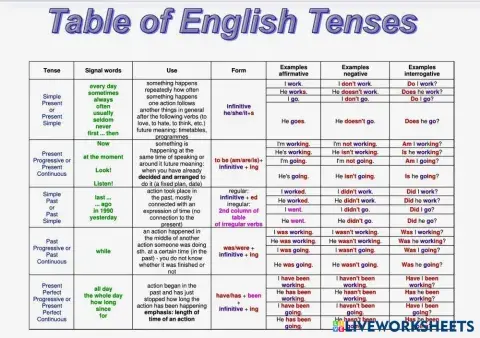
Travel Worksheet: Past Continuous Tense for Describing Interrupted Actions

Name: _______________________

Date: _______________________


Instructions: Complete the exercises below using the past continuous tense to describe interrupted actions in the past. Part 1: Fill in the Blanks Complete the sentences using the past continuous tense of the verbs in parentheses.


1. While I ______________ (explore) the city, it ______________ (start) to rain.

2. We ______________ (take) a guided tour when the bus ______________ (break) down.

3. She ______________ (take) pictures of the monuments while her friends ______________ (shop) nearby.

4. They ______________ (enjoy) their dinner at the restaurant when the power ______________ (go) out.

5. He ______________ (relax) on the beach when someone ______________ (steal) his bag.


Part 2: Choose the Correct Option Select the correct verb form to complete each sentence.


1. We were having lunch when the tour guide __________ (was arriving / arrived).

2. She __________ (was looking / looked) at the map while they were waiting for the train.

3. The children __________ (were playing / played) at the park when it started to rain.

4. I __________ (was walking / walked) around the city center when I met an old friend.

5. They __________ (were booking / booked) their tickets when the website crashed.


Part 3: Rewrite the Sentences Rewrite the following sentences using the past continuous to show interrupted actions.


1. I visited the museum. I met some interesting people. o While I __________, I __________.

2. She was eating lunch. Her phone rang. o While she __________, __________.

3. They were hiking in the mountains. It started to snow. o While they __________, __________.

4. We were watching a movie. The fire alarm went off. o While we __________, __________.

5. He was reading a book. His friend called him. o While he __________, __________.


Part 4: Travel Story Write a short travel story (about 5-6 sentences) describing a situation where one action was interrupted by another. Use the past continuous tense in your story.


Part 5: Check Your Understanding Answer these questions about the past continuous tense.

1. When do we use the past continuous tense? o To describe actions that __________.

2. How do we form the past continuous tense? o We use __________ + __________ + __________.

3. Give an example sentence using the past continuous tense to describe an interrupted action.


Answer Key (for teacher reference): Part 1: 1. was exploring, started 2. were taking, broke 3. was taking, were shopping 4. were enjoying, went 5. was relaxing, stole Part 2: 1. arrived 2. was looking 3. were playing 4. was walking 5. were booking Part 3: 1. I was visiting the museum when I met some interesting people. 2. While she was eating lunch, her phone rang. 3. While they were hiking in the mountains, it started to snow. 4. While we were watching a movie, the fire alarm went off. 5. While he was reading a book, his friend called him. Part 4: (Students’ answers will vary. Ensure the past continuous is used correctly.) Part 5: 1. To describe actions that were in progress when another action occurred. 2. was/were + verb + -ing 3. Example: While I was exploring the city, I bumped into an old friend.

Ecosystem

Science

Answer the following questions 


1. Which of the following best describes adaptation?

   a) The process by which organisms change over time

   b) The process of developing new species

   c) The process of migration to different habitats

   d) The process of hibernation during winter


2. What is the main purpose of adaptation in living organisms?

   a) To increase their lifespan

   b) To prevent diseases

   c) To survive and reproduce in their environment

   d) To communicate with other organisms


3. Which of the following is an example of a structural adaptation?

   a) The ability of a chameleon to change its skin color

   b) The migration of birds during winter

   c) The hibernation of bears during the cold season

   d) The ability of a shark to detect electrical signals


4. Which of the following is an example of a behavioral adaptation?

   a) The long neck of a giraffe

   b) The camouflage of a chameleon

   c) The migration of monarch butterflies

   d) The sharp claws of a tiger


5. How does camouflage help an organism survive?

   a) It helps the organism find food more easily

   b) It helps the organism attract a mate

   c) It helps the organism hide from predators or prey

   d) It helps the organism communicate with others


6. Which of the following is an example of a plant adaptation?

   a) The ability of a cactus to store water

   b) The ability of a butterfly to fly long distances

   c) The ability of a squirrel to climb trees

   d) The ability of a snake to shed its skin


7. What is mimicry as an adaptation?

   a) The ability of an organism to produce toxins

   b) The ability of an organism to imitate the appearance of another organism

   c) The ability of an organism to run at high speeds

   d) The ability of an organism to change its body coloration


8. Which of the following is an example of a physiological adaptation?

   a) The ability of a bird to build a nest

   b) The ability of a fish to breathe underwater

   c) The ability of a plant to photosynthesize

   d) The ability of a mammal to change its fur color


9. How do organisms with adaptations have an advantage over those without?

   a) They can live longer lives

   b) They can reproduce more offspring

   c) They can communicate with other organisms more effectively

   d) They can survive and thrive in their environment


10. Which of the following is NOT an example of an adaptation?

    a) A polar bear's thick fur to keep it warm in the Arctic

    b) A cheetah's speed to catch its prey

    c) A peacock's colorful feathers to attract a mate

    d) A dog's ability to perform tricks for treats


11. What is an ecosystem?

   a) A group of organisms living together in a habitat

   b) The study of rocks and minerals in a given area

   c) The process of converting sunlight into food energy

   d) The interaction between predators and prey


12. What are the components of an ecosystem?

   a) Rocks and minerals

   b) Producers, consumers, and decomposers

   c) Sunlight and water

   d) Oxygen and carbon dioxide


13. What are producers in an ecosystem?

   a) Organisms that consume other organisms for energy

   b) Organisms that produce their own food through photosynthesis

   c) Organisms that break down dead organic matter

   d) Organisms that decompose waste materials


14. Which of the following is an example of a consumer in an ecosystem?

   a) Grass

   b) Rabbit

   c) Tree

   d) Fungus


15. What is the role of decomposers in an ecosystem?

   a) They break down dead organisms and recycle nutrients

   b) They produce food through photosynthesis

   c) They are the top predators in the ecosystem

   d) They help plants grow by providing them with nutrients


16. What is the primary source of energy in most ecosystems?

   a) Rocks and minerals

   b) Sunlight

   c) Oxygen

   d) Water


17. How do consumers obtain energy in an ecosystem?

   a) They produce their own food through photosynthesis

   b) They consume other organisms

   c) They break down dead organic matter

   d) They absorb nutrients from the soil


18. Which of the following is an example of a decomposer in an ecosystem?

   a) Lion

   b) Grasshopper

   c) Mushroom

   d) Algae


19. What is the main difference between producers and consumers in an ecosystem?

   a) Producers produce their own food, while consumers consume other organisms for energy

   b) Producers are carnivores, while consumers are herbivores

   c) Producers are microscopic, while consumers are macroscopic

   d) Producers live in water, while consumers live on land


20. How are energy and nutrients transferred in an ecosystem?

    a) Energy flows from producers to consumers, while nutrients flow from consumers to producers

    b) Energy and nutrients flow from producers to consumers

    c) Energy and nutrients flow from consumers to producers

    d) Energy and nutrients flow randomly within the ecosystem


21. What is a food chain?

   a) A group of organisms living together in a habitat

   b) The study of rocks and minerals in a given area

   c) The process of converting sunlight into food energy

   d) The sequence of organisms where one organism eats another organism to obtain energy


22. What do arrows represent in a food chain?

   a) The direction of energy flow

   b) The movement of organisms

   c) The relationship between producers and consumers

   d) The process of photosynthesis


23. What is a food web?

   a) A single line of organisms that shows the flow of energy

   b) A diagram representing the interconnected food chains in an ecosystem

   c) A process where organisms convert food into energy

   d) The interaction between predators and prey


24. How are food chains and food webs different?

   a) Food chains show more complex interactions than food webs

   b) Food webs focus on energy flow, while food chains focus on species interactions

   c) Food chains are more accurate representations of ecosystems than food webs

   d) Food webs are linear, while food chains are interconnected


25. What is the primary source of energy in a food chain or web?

   a) Sunlight

   b) Producers

   c) Decomposers

   d) Consumers


26. What is the role of decomposers in energy flow within an ecosystem?

   a) They consume primary consumers for energy

   b) They produce food through photosynthesis

   c) They break down dead organisms and release nutrients back into the ecosystem

   d) They are the top predators in the food chain


27. How does energy flow in a food chain or web?

   a) Energy flows from consumers to producers

   b) Energy flows from decomposers to consumers

   c) Energy flows from producers to consumers

   d) Energy flows from predators to prey


28. What happens to the amount of energy as you move up the food chain or web?

   a) The amount of energy decreases

   b) The amount of energy increases

   c) The amount of energy stays the same

   d) The amount of energy fluctuates


29. What are trophic levels in a food chain or web?

   a) The different types of habitats within an ecosystem

   b) The different reproductive strategies of organisms

   c) The positions that organisms occupy in the energy pyramid

   d) The various biomes found in a specific region


30. How do disruptions in one part of a food chain or web affect the entire ecosystem?

    a) Disruptions only affect the organisms directly involved

    b) Disruptions lead to increased biodiversity within the ecosystem

    c) Disruptions can cause imbalances and negatively impact other organisms

    d) Disruptions have minimal impact on the overall functioning of the ecosystem

A Rose for Emily | Timeline

AP Literature

Key Events in A Rose for Emily


Part 1


  • When Emily died, the whole town visited her funeral, the men visited through respectful affection, the women visited out of curiosity of what was inside of her house.
  • Alive-- Emily had been a tradition, a duty, and a care. 
  • In 1894, Colonel Sartoris sent out an edict that no negro woman should appear on the streets without an apron.
  • Colonel Sartoris made a tale saying that Miss Emily’s father had loaned money to the town, which suggested that Miss Emily would not need to pay taxes. 
  • When Jefferson's authorities ​​approached her about her taxes, she claimed that she did not have any tax. Even though Colonel Sartoris has been dead for 10 years. 


Part 2 


  • It cuts back to 30 years prior and 2 years after the death of her father, where a stench started to develop around her house.
  • The townspeople complained to the judge, and after the complaint was made, the Aldermen family met up and decided to deal with the problem themselves. Which led to them sneaking around her house in order to sprinkle lime around where the smell was.
  • The people around town started to pity Miss Emily for being left alone to herself after the death of her father, but she rejected them stating that her father was not dead. After some persuasion from the minister, she finally breaks down and admits it, after which her father would quickly be buried. The people theorized that this is due to the fact that her father drove away a lot of men who wanted to “steal” from her.


Part 3 


  • Emily begins dating Homer Barron. The townspeople are shocked to see a person of higher position dating somebody lower. Homer is seen as “unsuitable” for Emily.
  • The town starts to gossip regarding Emily’s relationship with Homer. Emily being a southern aristocrat associating herself with somebody like Homer (A Northerner of different social status) who’s seen below her status.
  • The baptist minister’s intervention in response to the gossip and concern. The town’s baptist minister sent to speak with Emily before the arrival of Emily’s cousins from Alabama. The conversation details are undisclosed.

Part 4


  • Emily isolates herself after she finds out that Homer Barron is into men, In this point of the story, Emily has become more reclusive, with her house described as decaying and the townspeople growing more curious about her life.
  • Emily had purchased arsenic, leading to people suspecting that he might harm herself with it.
  • Homer Barron’s disappearance, Homer Barron, who had been seen spending time with Emily, suddenly disappears. The townspeople assume that he left her, though his fate is still unknown.
  •  

Part 5


  • The townspeople enter Miss Emily’s house after her funeral.They explore the house and discover a locked upstairs room.
  • They find Homer’s skeleton lying in the bed, with an indentation in the pillow next to him and a long strand of Miss Emily’s gray hair.


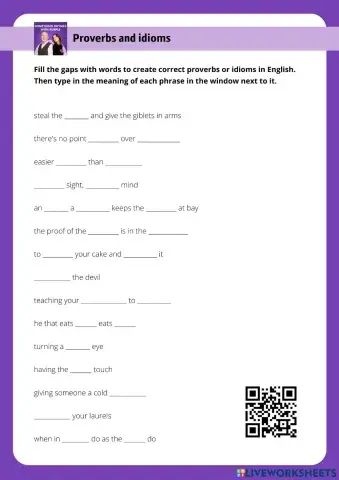
Idioms and proverbs (based on listening)

English language

Gap filling activity based on an episode of the Something Rhymes With Purple podcast (episode When in Rome Do As The Romans Do) - available here: https://lnns.co/8ojXS-Zt_ai/380 (start at 6 min 20, end at about 19 mins). I recommend setting the speed at 0.8x for better understanding. There is a short commercial break in the podcast at around 16 minutes.

Create and Customize Worksheets for Every Classroom

LiveWorksheets makes it easy for teachers, parents and homeschool educators to design and deliver engaging learning materials. Upload a PDF or start from scratch to create what you need: anything from interactive math worksheets to reading comprehension worksheets, multiplication worksheets, and kindergarten worksheets in just a few clicks. Our drag-and-drop editor works across all grade levels and subjects, so you can tailor content to your lesson plans, homework, or assessments. ESL teachers can also build custom ESL worksheets, add a common sound chart, or integrate ESL activities to make each class more engaging. Easily create differentiated, auto-graded activities that save valuable time and support better student learning.

A Complete Library of Learning Resources for K-12 and ESL

Access thousands of ready-to-use worksheets across K-12 subjects, including kindergarten worksheets, math worksheets, multiplication practice, reading comprehension exercises, and ESL resources. Filter by grade, subject, or skill level to find exactly what you need, whether it’s for an elementary classroom, middle school review, or high school practice. ESL teachers can explore our growing collection of ESL worksheets and English as a Second Language activities designed to support all levels of learners. With new content added regularly, LiveWorksheets is a flexible resource that helps build lasting learning outcomes.