A Rose for Emily | Timeline

AP Literature

Key Events in A Rose for Emily


Part 1


  • When Emily died, the whole town visited her funeral, the men visited through respectful affection, the women visited out of curiosity of what was inside of her house.
  • Alive-- Emily had been a tradition, a duty, and a care. 
  • In 1894, Colonel Sartoris sent out an edict that no negro woman should appear on the streets without an apron.
  • Colonel Sartoris made a tale saying that Miss Emily’s father had loaned money to the town, which suggested that Miss Emily would not need to pay taxes. 
  • When Jefferson's authorities ​​approached her about her taxes, she claimed that she did not have any tax. Even though Colonel Sartoris has been dead for 10 years. 


Part 2 


  • It cuts back to 30 years prior and 2 years after the death of her father, where a stench started to develop around her house.
  • The townspeople complained to the judge, and after the complaint was made, the Aldermen family met up and decided to deal with the problem themselves. Which led to them sneaking around her house in order to sprinkle lime around where the smell was.
  • The people around town started to pity Miss Emily for being left alone to herself after the death of her father, but she rejected them stating that her father was not dead. After some persuasion from the minister, she finally breaks down and admits it, after which her father would quickly be buried. The people theorized that this is due to the fact that her father drove away a lot of men who wanted to “steal” from her.


Part 3 


  • Emily begins dating Homer Barron. The townspeople are shocked to see a person of higher position dating somebody lower. Homer is seen as “unsuitable” for Emily.
  • The town starts to gossip regarding Emily’s relationship with Homer. Emily being a southern aristocrat associating herself with somebody like Homer (A Northerner of different social status) who’s seen below her status.
  • The baptist minister’s intervention in response to the gossip and concern. The town’s baptist minister sent to speak with Emily before the arrival of Emily’s cousins from Alabama. The conversation details are undisclosed.

Part 4


  • Emily isolates herself after she finds out that Homer Barron is into men, In this point of the story, Emily has become more reclusive, with her house described as decaying and the townspeople growing more curious about her life.
  • Emily had purchased arsenic, leading to people suspecting that he might harm herself with it.
  • Homer Barron’s disappearance, Homer Barron, who had been seen spending time with Emily, suddenly disappears. The townspeople assume that he left her, though his fate is still unknown.
  •  

Part 5


  • The townspeople enter Miss Emily’s house after her funeral.They explore the house and discover a locked upstairs room.
  • They find Homer’s skeleton lying in the bed, with an indentation in the pillow next to him and a long strand of Miss Emily’s gray hair.


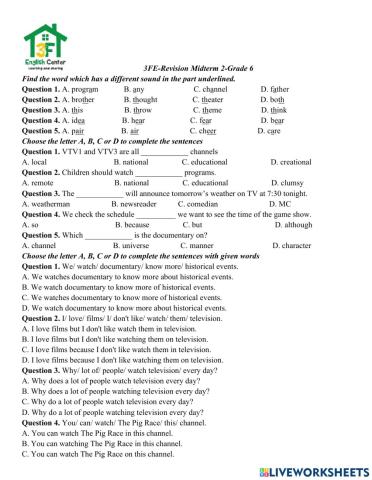
3FE-G6-Midterm2

English as a Second Language (ESL)

Choose the letter A, B, C or D to complete the sentences with given words
Question 1. We/ watch/ documentary/ know more/ historical events.
A. We watches documentary to know more about historical events.
B. We watch documentary to know more of historical events.
C. We watches documentary to know more of historical events.
D. We watch documentary to know more about historical events.
Question 2. I/ love/ films/ I/ don't like/ watch/ them/ television.
A. I love films but I don't like watch them in television.
B. I love films but I don't like watching them on television.
C. I love films because I don't like watch them in television.
D. I love films because I don't like watching them on television.
Question 3. Why/ lot of/ people/ watch television/ every day?
A. Why does a lot of people watch television every day?
B. Why does a lot of people watching television every day?
C. Why do a lot of people watch television every day?
D. Why do a lot of people watching television every day?
Question 4. You/ can/ watch/ The Pig Race/ this/ channel.
A. You can watch The Pig Race in this channel.
B. You can watching The Pig Race in this channel.
C. You can watch The Pig Race on this channel.
D. You can watching The Pig Race on this channel.
Question 5. Television/ a tool/ gain/ education/ information.
A. Television is a tool to gain education and information.
B. Television is a tool gaining education and information.
C. Television are a tool to gain education and information.
D. Television are a tool gaining education and information.
Rearrange the sentences to make meaningful sentences
Question 6. on/ The/ is/ at 20:00/ Saturday/ program/ on.
A. The program is on at 20:00 on Saturday.
B. The program is at 20:00 on Saturday on.
C. The program on is at 20:00 on Saturday.
D. The program on is on at 20:00 Saturday.
Question 7. in/ I’m/ game shows/ interested/ watching.
A. I’m watching in interested game shows.
B. I’m game shows interested watching in.
C. I’m interested in watching game shows.
D. I’m in watching interested game shows.
Question 8. favorite/ TV/ comedy/ My/ is/ program.
A. My favorite TV program is comedy.
B. My favorite TV program comedy is.
C. My favorite comedy TV program is.
D. My favorite comedy is TV program.
Question 9. time/ is/ TV/ a/ waste/ Watching/ of
A. Watching TV is a time waste of.
B. Watching time is a waste of TV.
C. Watching TV is time of a waste.
D. Watching TV is a waste of time.
Question 10. watch/ you/ How often/ TV/ do?
A. How often watch do you TV?
B. How often do you watch TV?
C. How often you do watch TV?
D. How often TV do you watch?
Choose the best answer
Question 11. He is a good football player.
A. He can’t play football
B. He isn’t good at football.
C. He love playing football.
D. He plays football well.
Question 12. My brother is a fast runner.
A. My brother runs fast.
B. My brother runs fastly.
C. My brother ran fast.
D. My brother ran fastly.
Question 13. I do judo every Tuesday and Thursday.
A. I do judo three times a week.
B. I do judo once a week.
C. I do judo twice a week.
D. I do judo four times a week.
Question 14. I like watching sports more than playing sports.
A. I prefer watching sports to playing sports.
B. I enjoy playing sports.
C. My favorite sports is tennis.
D. The most interesting sports is tennis.
Question 15. Helen's favorite sport is table tennis.
A. Helen hates playing table tennis.
B. Helen hates playing sports table tennis.
C. Helen enjoys playing table tennis.
D. Helen enjoys playing sports table tennis.
Question 16. Did you fly to Los Angeles?
A. Did you went to Los Angeles on foot?
B. Did you go to Los Angeles by plane?
C. Did you go to Los Angeles on foot?
D. Did you went to Los Angeles by plane?
Question 17. The world has seven continents.
A. There are seven continents in the world.
B. Seven continents have the world.
C. There is the world in seven continents.
D. The world there is seven continents.
Question 18. Africa is large. Asia is larger.
A. Asia is largest than Africa.
B. Africa is larger than Asia.
C. Asia is larger than Africa.
D. Africa is largest than Asia.
Question 19. Mr. and Mrs. Black have a son, John.
A. John is Mr. and Mrs. Black’s son.
B. John is Mr. and Mrs. Black’s father.
C. John is Mr. and Mrs. Black’s mother.
D. John is Mr. and Mrs. Black’s parents.
Question 20. Mr. Peter drives to Amsterdam every month.
A. Mr. Peter goes to Amsterdam by plane every month.
B. Mr. Peter goes to Amsterdam by horse every month.
C. Mr. Peter goes to Amsterdam by car every month.
D. Mr. Peter goes to Amsterdam by bike every month.
Choose the letter A, B, C or D to complete the sentences with given words
Question 21. Students/ do/ lot of/ outdoor/ activity.
A. Students do a lot of outdoor activities.
B. Students does a lot of outdoor activities.
C. Students doing a lot of outdoor activities.
D. Students did a lot of outdoor activities.
Question 22. I/ more/ interested/ go swimming/ my sister.
A. I more interested at going swimming than my sister.
B. I’m more interested at going swimming than my sister.
C. I more interested in going swimming than my sister.
D. I’m more interested in going swimming than my sister.
Question 23. In/ first half/ the match/ our team/ score/ goal.
A. In the first half of the match, our team score a goal.
B. In the first half of the match, our team scored a goal.
C. In the first half on the match, our team scored a goal.
D. In the first half on the match, our team score a goal.
Question 24. The first/ sport competition/ held/ Greece/ 776 B.C.
A. The first sport competition is held in Greece in 776 B.C.
B. The first sport competition was held in Greece in 776 B.C.
C. The first sport competition is held on Greece in 776 B.C.
D. The first sport competition was held on Greece in 776 B.C.
Question 25. Playing/ volleyball/ interesting.
A. Playing volleyball are interesting.
B. Playing the volleyball is interesting.
C. Playing volleyball is interesting.
D. Playing the volleyball are interesting.
Choose the letter A, B, C or D to complete the sentences with given words
Question 26. been to/ is/ What/ destination/ exciting/ you/ have/ the most?
A. What destination you is the most exiting have been to?
B. What is the most exiting destination you have been to?
C. What you have been to is the most exiting destination?
D. What is the most you have been to exiting destination?
Question 27. Malaysia’s/ its/ Kuala Lumpur/ and/ is/ largest city/ capital.
A. Kuala Lumpur is Malaysia's capital and its largest city.
B. Malaysia's Kuala Lumpur is capital and its largest city.
C. Kuala Lumpur is its largest city Malaysia's capital and.
D. Kuala Lumpur is Malaysia's its largest capital and city.
Question 28. seeing/ I/ London/ London Eye/ in/ enjoy/ the.
A. I enjoy seeing the London Eye in London.
B. I enjoy London seeing the London Eye in.
C. I enjoy seeing in London the London Eye.
D. I enjoy the London Eye seeing in London.
Question 29. Singapore/ located/ Southeast Asia.
A. Singapore is located in Southeast Asia.
B. Singapore was located in Southeast Asia.
C. Singapore is located on Southeast Asia.
D. Singapore was located on Southeast Asia.
Question 30. It’s/ fantastic/ spend/ a day/ New York.
A. It’s fantastic to spend a day in New York.
B. It’s fantastic spending a day in New York.
C. It’s fantastic to spend a day at New York.
D. It’s fantastic spending a day at New York.

Math Unit 3 Review

Math

🎨 Shapes and Sides

  1. 🧐 Sorting Shapes by Sides

    • Question: Greg was sorting shapes into groups by the number of sides. He made a group of shapes that had more than three sides. Which of the following shapes CANNOT be part of this group?

      • A. ▲ (Triangle)
      • B. □ (Square)
      • C. ⬟ (Pentagon)
      • D. ⭐ (Octagon)
  2. 🛏️ Flat Surfaces on Shapes

    • Question: Which TWO shapes have only 2 flat sides?

      • A. 🏢 (Cube)
      • B. 🌆 (Cylinder)
      • C. ⬤ (Sphere)
      • D. 💨 (Cone)
  3. 🔀 Combining Shapes

    • Question: What two shapes can be joined without overlap to form this square?

      • A. ▲ + ▲ (Two triangles)
      • B. ▲ + ⬤ (Triangle and circle)
      • C. □ + ▭ (Square and rectangle)
  4. 🔨 Building Figures

    • Question: Which figures can be made by putting the shapes together? Choose TWO.

      • A. 🌆 + 🏢 (Cylinder and cube)
      • B. 💨 + 🏠 (Cone and rectangular prism)
      • C. 🏢 + 🏠 (Cube and rectangular prism)
  5. □ Squares Have 4 Sides

    • Question: All of these shapes are squares. Which of these is true?

      • A. All squares are 🔶 (yellow).
      • B. All squares have 4 sides.
      • C. All squares are the same size.

🔢 Patterns and Numbers

  1. ➕ Counting Patterns

    • Question: What comes next in the sequence 29, 28, 27, 26, ___?

      • A. 24
      • B. 25
      • C. 23
  2. 💃 Swings Pattern

    • Question: Sarah and her friend Jelicia are on the 8th and 9th swings. Continuing the pattern, what colors are their swings?

      • A. 🟢, 🟢 (Green, Green)
      • B. 🟢, 🍊 (Green, Orange)
      • C. 🍊, 🟢 (Orange, Green)
  3. 🥜 Sharing Cookie Cake

    • Question: Some friends want to share a cookie cake. How much will each friend get if they divide it equally? Choose TWO ways.

      • A. ½ (One-half)
      • B. ¼ (One-quarter)
      • C. ⅓ (One-third)

🧍 Word Problems

  1. 🍬 Candy Problem

    • Samson went to the candy store. He bought 16 pieces of candy. He eats 2 pieces on his way home and 2 more before dinner. Later, he eats 2 more pieces before going to bed. How many pieces of candy does he have left?

      • A. 14
      • B. 10
      • C. 8
  2. 🔺 Tally Chart

    • Andrea drew squares and ovals on her paper. After she was done, she created a tally chart to see how many of each shape she drew. How many more ovals did Andrea draw than squares?

🔠 Fractions and Sharing

  1. 🔷 Equal Shares

    • Look at the squares below. One square is divided into fourths, and the other into halves. Which sentence is true?

      • A. All the shares are the same size.
      • B. Only the shares on the left are the same size.
      • C. The shares on the right are smaller.

🎨 Favorite Shapes

  1. 📊 Chart Problem

    • Mr. Carter asked his class what their favorite shapes were and recorded the choices. Use the chart to answer: Which shape was chosen the MOST?

      • A. ▲ (Triangle)
      • B. 🌆 (Cylinder)
      • C. 🏢 (Cube)

📚 Study Tips:

  • Review the names and properties of shapes (number of sides, flat surfaces).
  • Practice recognizing patterns in numbers and colors.
  • Work on basic addition and subtraction for word problems.
  • Understand how to divide items into equal shares (½, ¼).
  • Remember to read each question carefully before answering!


Create and Customize Worksheets for Every Classroom

LiveWorksheets makes it easy for teachers, parents and homeschool educators to design and deliver engaging learning materials. Upload a PDF or start from scratch to create what you need: anything from interactive math worksheets to reading comprehension worksheets, multiplication worksheets, and kindergarten worksheets in just a few clicks. Our drag-and-drop editor works across all grade levels and subjects, so you can tailor content to your lesson plans, homework, or assessments. ESL teachers can also build custom ESL worksheets, add a common sound chart, or integrate ESL activities to make each class more engaging. Easily create differentiated, auto-graded activities that save valuable time and support better student learning.

A Complete Library of Learning Resources for K-12 and ESL

Access thousands of ready-to-use worksheets across K-12 subjects, including kindergarten worksheets, math worksheets, multiplication practice, reading comprehension exercises, and ESL resources. Filter by grade, subject, or skill level to find exactly what you need, whether it’s for an elementary classroom, middle school review, or high school practice. ESL teachers can explore our growing collection of ESL worksheets and English as a Second Language activities designed to support all levels of learners. With new content added regularly, LiveWorksheets is a flexible resource that helps build lasting learning outcomes.