Listening Task

Business Communication

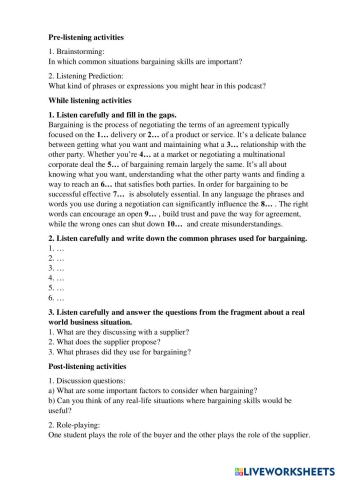
Pre-listening activities

1. Brainstorming:
In which common situations bargaining skills are important?

2. Listening Prediction:
What kind of phrases or expressions you might hear in this podcast?

While listening activities

1. Listen carefully and fill in the gaps.
Bargaining is the process of negotiating the terms of an agreement typically focused on the 1… delivery or 2… of a product or service. It’s a delicate balance between getting what you want and maintaining what a 3… relationship with the other party. Whether you’re 4… at a market or negotiating a multinational corporate deal the 5… of bargaining remain largely the same. It’s all about knowing what you want, understanding what the other party wants and finding a way to reach an 6… that satisfies both parties. In order for bargaining to be successful effective 7…  is absolutely essential. In any language the phrases and words you use during a negotiation can significantly influence the 8… . The right words can encourage an open 9… , build trust and pave the way for agreement, while the wrong ones can shut down 10…  and create misunderstandings.

2. Listen carefully and write down the common phrases used for bargaining.  
1. …
2. …
3. …
4. …
5. …
6. …

3. Listen carefully and answer the questions from the fragment about a real world business situation.
1. What are they discussing with a supplier?
2. What does the supplier propose?
3. What phrases did they use for bargaining?

Post-listening activities

1. Discussion questions:
a) What are some important factors to consider when bargaining?
b) Can you think of any real-life situations where bargaining skills would be useful?

2. Role-playing:
Divide students into pairs and assign each pair a scenario similar to the one in the listening passage, such as negotiating a contract with a supplier. One student plays the role of the buyer and the other plays the role of the supplier. They use the common bargaining phrases from the listening passage to negotiate terms of the contract.

3. Writing task:
Ask students to write a dialogue between two people negotiating a deal, incorporating the common bargaining phrases from the listening passage. They can then share their dialogues with the class and discuss the effectiveness of the phrases used.


Social Media

English as a Second Language (ESL)

The digital landscape has put increased pressure on teenagers today, and we feel it. There are so many social media channels: Facebook, Twitter, Instagram, Snapchat, Tumblr, you name it. I made a conscious decision to avoid Snapchat and Instagram because of the social pressure I saw them putting on my 14-year-old little sister. If my mum turned off the WiFi at 11pm, my sister would beg me to turn my phone into a hotspot1. She always needed to load her Snapchat stories one more time, or to reply to a message that had come in two minutes ago because she didn’t want her friend to feel ignored. If I refused, saying she could respond in the morning, I’d get the “You’re ruining my social life” speech. Even as a teenager as well, I sometimes find this craze a little baffling.

A new study has found that teenagers who engage with social media during the night could be damaging their sleep and increasing their risk of anxiety and depression. Teenagers spoke about the pressure they felt to make themselves available 24/7 and the resulting anxiety if they did not respond immediately to texts or posts. Teens are so emotionally invested in social media that a fifth of secondary school pupils will wake up at night and log on just to make sure they don’t miss out. Perhaps the worst thing about this is that teenagers need more sleep than adults do, so night-time social media use could be detrimental to their health. A lack of sleep can make teenagers tired, irritable, and depressed.

During the summer holidays, I lost my phone. And for the week that I was phoneless, it felt like a disaster. I love my phone. It gives me quick access to information and allows me to be constantly looped in with my friends, to know exactly what is going on in their lives. So when I didn’t have my phone for a week, I felt a slight sense of FOMO, or if you’re not up to speed with the lingo, fear of missing out. By the end of the week, I’d got used to not having a phone and I’d quite enjoyed the break from social media. But there was still a lingering sense of sadness at the back of my mind that there would be conversations I had missed, messages that had been sent, funny videos shared and night-time chats that I would probably never get to see.

CALT - SA2001 - LANGUAGE FOCUS (Trần Minh Triết)

English language

LANGUAGE FOCUS

Pronunciation

Listen and repeat.

/sl/

slave

sleep

slim

/sm/

small

smell

smart

Practise reading aloud this dialogue.

A: Is Snowy at home? Snowy Smith?

B: He is sleeping. Go away.

A: Sleeping? Where?

B: In there. Why do you smile?

A: Perhaps Snowy is in there. But he is not asleep.

B: I swear he is sleeping.

A: When Snowy sleeps, he snores but he looks sweet.


Grammar 1

Exercise 1. Choose the suitable italicised words to complete the following sentences. 

1. To who/whom it may concern.

2. It was a service for which/that I was grateful.

3. The success of a shared holiday depends on who/whom you share it with.

4. Do you like the person who/whom sits next to you?

5. Midway through the second half, Manchester United scored their third goal, at that/ which point Leeds United save up completely.

6. There is one person to whom/who I owe more than I can say.

7. It was the kind of accident for which/that nobody was really to blame.


Grammar 2

Exercise 2. Combine the following sentences, using preposition + whom or which. 

1. The man was very kind. I talked to him yesterday.

2. The man works in the hospital. I told you about him.

3. The woman teaches me English. I am telling you about her.

4. The movie is fantastic. They are talking about it.

5. The picture was beautiful. She was looking at it.

6. I'll give you the address. You should write to it.


Grammar 3

Exercise 3Complete the following sentences, using whowhomwhich or that.

1. Jack is the one ______ I miss most.

2. It was a kind of computer with ______I was not familiar.

3. Do you get on with the person ______ lives next door?

4. I must thank the man from ______ I got the present.

5. It is an event ______ I would rather not forget.

6. The meeting to ______ I went was interesting.

7. The person ______ did it was never caught.

8. That's the woman to ______ Jim used to be married.


Create and Customize Worksheets for Every Classroom

LiveWorksheets makes it easy for teachers, parents and homeschool educators to design and deliver engaging learning materials. Upload a PDF or start from scratch to create what you need: anything from interactive math worksheets to reading comprehension worksheets, multiplication worksheets, and kindergarten worksheets in just a few clicks. Our drag-and-drop editor works across all grade levels and subjects, so you can tailor content to your lesson plans, homework, or assessments. ESL teachers can also build custom ESL worksheets, add a common sound chart, or integrate ESL activities to make each class more engaging. Easily create differentiated, auto-graded activities that save valuable time and support better student learning.

A Complete Library of Learning Resources for K-12 and ESL

Access thousands of ready-to-use worksheets across K-12 subjects, including kindergarten worksheets, math worksheets, multiplication practice, reading comprehension exercises, and ESL resources. Filter by grade, subject, or skill level to find exactly what you need, whether it’s for an elementary classroom, middle school review, or high school practice. ESL teachers can explore our growing collection of ESL worksheets and English as a Second Language activities designed to support all levels of learners. With new content added regularly, LiveWorksheets is a flexible resource that helps build lasting learning outcomes.