CALT - SA2001 - Language Focus (Nguyễn Thị Minh Huyền)

English language

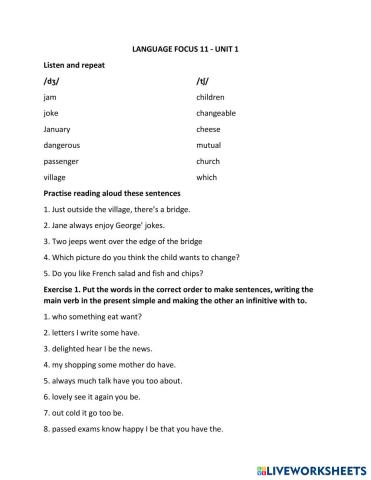
LANGUAGE FOCUS 11 - UNIT 1

Listen and repeat

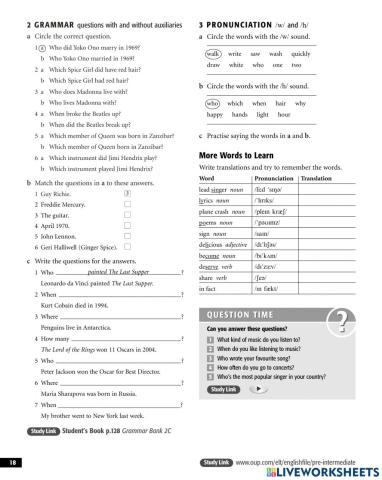
/dʒ/

jam

joke

January

dangerous

passenger

village

/tʃ/

children

changeable

cheese

mutual

church

which

Practise reading aloud these sentences

1. Just outside the village, there’s a bridge.

2. Jane always enjoy George’ jokes.

3. Two jeeps went over the edge of the bridge

4. Which picture do you think the child wants to change?

5. Do you like French salad and fish and chips?

Exercise 1. Put the words in the correct order to make sentences, writing the main verb in the present simple and making the other an infinitive with to.

1. who something eat want?

2. letters I write some have.

3. delighted hear I be the news.

4. my shopping some mother do have.

5. always much talk have you too about.

6. lovely see it again you be.

7. out cold it go too be.

8. passed exams know happy I be that you have the.

Exercise 2. Rewrite the sentences, using the words given in brackets.

1. They Slot out of the car. (The police watched)

2. They allowed him to write a letter to his wife. (They let)

3. They talked in the next room. (I heard)

4. The customs officer told him to open the briefcase. (The customs officer made)

5. The cat jumped through the window. (The boy saw)

6. Maybe the company will ask him to pay some extra money. (Do you think the company will make)

7. The animal moved towards me. I felt it. (I felt)

8. She wants to go for a picnic. (Do you think her parents will let)


Media

English language

STUDENTS THINK FAKE NEWS IS FACT AND ARE USING IT IN THEIR SCHOOLWORK, SAY TEACHERS

Teachers are frustrated that students can’t accept that some stories on social networks are false, while experts suggest that students need better education about online dangers. Students believe that fake news is a fact, and are repeating it in lessons and using it in written work, teachers have warned. More than a third of teachers say their students have used false information that they found online, according to a survey by a teacher’s union.

The union’s general secretary Chris Keates said that the information was "worrying" and it showed that internet companies have a lot of power to influence people’s opinions, especially young people. International education experts are becoming more worried about the situation and say that teachers will need to teach children how to spot fake news. Others were frustrated that students didn’t believe that news they had seen on Facebook and other social media sites was not true, even when the problem was explained to them. One teacher said that students often thought that fake news sites were real, and also that anything that President Donald Trump said was a fact. Last week, German officials said they would give fines of up to 50 million euro to social networks if they didn’t take down illegal fake news posts. The new law would give social networks 24 hours to delete or block the content and seven days to concentrate on more complicated cases. Commenting on the results of the survey, Ms. Keates said that she was worried about the trend, particularly because many young people have never known a world without internet, and are less able to judge whether information that they read online is real or fake. She added that: "It is important for children and young people to be made aware that not everything they see and read online is real."

She said that teachers are trying to help educate students about using false information, but added that it was important for internet providers and websites to take responsibility for any material that is available, and also to deal with people who misuse their services. Last month, Andreas Schleicher, the director of education and skills at OECD (The Organization of Economic co-operation and Development) said that in the modern age, being able to tell the difference between what is real and what is fake is a critical skill. He added that: "This is something that we believe schools can do something about."

Adapted from the Independent by Rachel Pells, April 12th, 2017

Create and Customize Worksheets for Every Classroom

LiveWorksheets makes it easy for teachers, parents and homeschool educators to design and deliver engaging learning materials. Upload a PDF or start from scratch to create what you need: anything from interactive math worksheets to reading comprehension worksheets, multiplication worksheets, and kindergarten worksheets in just a few clicks. Our drag-and-drop editor works across all grade levels and subjects, so you can tailor content to your lesson plans, homework, or assessments. ESL teachers can also build custom ESL worksheets, add a common sound chart, or integrate ESL activities to make each class more engaging. Easily create differentiated, auto-graded activities that save valuable time and support better student learning.

A Complete Library of Learning Resources for K-12 and ESL

Access thousands of ready-to-use worksheets across K-12 subjects, including kindergarten worksheets, math worksheets, multiplication practice, reading comprehension exercises, and ESL resources. Filter by grade, subject, or skill level to find exactly what you need, whether it’s for an elementary classroom, middle school review, or high school practice. ESL teachers can explore our growing collection of ESL worksheets and English as a Second Language activities designed to support all levels of learners. With new content added regularly, LiveWorksheets is a flexible resource that helps build lasting learning outcomes.