Fill in the gaps

English as a Second Language (ESL)

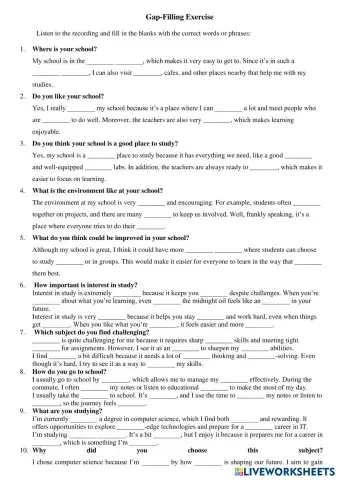
  1. Where is your school?
    My school is in the ________ ________, which makes it very easy to get to. Since it’s in such a ________ ________, I can also visit ________, cafes, and other places nearby that help me with my studies.
  2. Do you like your school?
    Yes, I really ________ my school because it’s a place where I can ________ a lot and meet people who are ________ to do well. Moreover, the teachers are also very ________, which makes learning enjoyable.
  3. Do you think your school is a good place to study?
    Yes, my school is a ________ place to study because it has everything we need, like a good ________ and well-equipped ________ labs. In addition, the teachers are always ready to ________, which makes it easier to focus on learning.
  4. What is the environment like at your school?
    The environment at my school is very ________ and encouraging. For example, students often ________ together on projects, and there are many ________ to keep us involved. Well, frankly speaking, it’s a place where everyone tries to do their ________.
  5. What do you think could be improved in your school?
    Although my school is great, I think it could have more ________ ________ where students can choose to study ________ or in groups. This would make it easier for everyone to learn in the way that ________ them best.
  6.  How important is interest in study?
    Interest in study is extremely ________ because it keeps you ________ despite challenges. When you’re ________ about what you’re learning, even ________ the midnight oil feels like an ________ in your future.
    Interest in study is very ________ because it helps you stay ________ and work hard, even when things get ________. When you like what you’re ________, it feels easier and more ________.
  7.  Which subject do you find challenging?
    ________ is quite challenging for me because it requires sharp ________ skills and meeting tight ________ for assignments. However, I see it as an ________ to sharpen my ________ abilities.
    I find ________ a bit difficult because it needs a lot of ________ thinking and ________-solving. Even though it’s hard, I try to see it as a way to ________ my skills.
  8. How do you go to school?
    I usually go to school by ________, which allows me to manage my ________ effectively. During the commute, I often ________ my notes or listen to educational ________ to make the most of my day.
    I usually take the ________ to school. It’s ________, and I use the time to ________ my notes or listen to ________, so the journey feels ________.
  9. What are you studying?
    I’m currently ________ a degree in computer science, which I find both ________ and rewarding. It offers opportunities to explore ________-edge technologies and prepare for a ________ career in IT.
    I’m studying ________ ________. It’s a bit ________, but I enjoy it because it prepares me for a career in ________, which is something I’m ________.
  10. Why did you choose this subject?
    I chose computer science because I’m ________ by how ________ is shaping our future. I aim to gain ________ in this field and use it to climb the ________ ladder.
    Well, I chose computer science because I’m really ________ in ________ and how it is ________ the world. I want to learn more about it and use this ________ to build my ________ career.

11.            What do you like most about your studies?

……………..is the balance between theoretical knowledge and practical application. For instance, during lab sessions, I gain hands-on …………………..which helps me sharpen my skills and stay ………………..

I like that my studies include both …………. and practice. For example, we have lab sessions where I can ………………. what I’ve learned. This makes studying more interesting and ……………….

     12.            Are you more interested in theoretical or practical subjects? Why?

I prefer …………… subjects because they allow me to gain hands-on experience and ………………….. real-world scenarios. This approach not only sharpens my skills but also builds my …………………. for future challenges.

I prefer practical subjects because I like to apply what I’ve learned in real situations. It makes learning more fun and gives me …………………… I can use in the future.

     13.            Do you find your studies difficult? Why or why not?

Sometimes, the workload can be…………………., especially when I have to meet tight deadlines. However, I stay motivated by setting ……………….. and managing my schedule effectively.

Sometimes my studies are a bit hard, especially when I have a lot of assignments or……………….. But I try to manage my time well and stay ………………….. which helps me deal with the workload.

14.  How do you usually prepare for exams?

I prepare for exams by ………………..a study schedule that helps me balance my workload. I also collaborate with classmates for group discussions and …………………. past papers to improve my understanding.

I prepare for exams by making a study plan so I can manage my time well. I also study with my classmates and practice past papers to …………………. my understanding of the topics.

15.  Do you prefer studying alone or with others? Why?

I prefer a mix of both. Studying alone helps me focus and ……………… my time effectively, while group study sessions are engaging and help me explore ………………….. perspectives.

I like both. When I study alone, I can ………………. better, but studying with others helps me learn from different ………………… and understand things more clearly

16.  What are your future plans after finishing your studies?

After completing my studies, I plan to ……………….. a career in software engineering. My ultimate goal is to climb the career ladder by gaining expertise in my field and making a meaningful impact in a reputable company.

After I …………….. my studies, I plan to work as a software engineer. I want to keep learning and improving my skills so I can build a ……………..career and contribute to interesting projects

  1.  
  2.  
  3.  


Present Simple

English language

​​​​​​

Что такое Present Simple?

Это простое настоящее время, обозначающее действие в самом широком смысле этого слова. Одна из самых распространенных и простых форм в английском языке для описания действий.

Действия могут быть связаны с привычками, хобби, ежедневным событием вроде подъема по утрам или чем-то, что случается регулярно.


Как образуется Present Simple?

Нет ничего проще, чем поставить глагол в форму Present Simple. Для этого нужно убрать у глагола в инфинитиве частицу «to» и поставить глагол после подлежащего. Это и есть основное правило Present Simple.


Утверждение:

I / We / You / They + V

She / He / It + V + s (es)

I go to work every day — Я хожу на работу каждый день.

They usually play tennis every weekend — Они обычно играют в теннис каждые выходные.

She brings me coffee every morning — Она приносит мне кофе каждое утро.

It snows in winter — Зимой идет снег.

ВАЖНО: В Present Simple форма глагола практически всегда совпадает с изначальной. Исключение составляет третье лицо единственного числа (he / she / it) — к нему прибавляется окончание -s:

I ride — She rides

I dream — He dreams

Если глагол оканчивается на -s, -ss, -sh, -ch, -x, -o, то к нему прибавляется окончание -es

I wish — She wishes

I teach — She teaches

Если глагол оканчивается на -y, а ему предшествует согласная, то к нему прибавляется окончание -es, но -y заменяется на -i

I try — She tries

I fly — He flies

Если глагол оканчивается на -y, а ему предшествует гласная, то к нему также прибавляется окончание -s, но -y не меняется.

I play — She plays

I stay — He stays


Отрицание:

Чтобы составить отрицательное предложение — нужно поставить вспомогательный глагол между подлежащим и глаголом.

I / We / You / They + do not (don’t) + V

She / He / It + does not (doesn’t) + V

I don’t go to school every day — Я не хожу в школу каждый день

They don’t drink beer — Они не пьют пиво

She doesn’t like the weather in London — Ей не нравится погода в Лондоне

He doesn't drive the car — Он не водит машину

Отрицание также можно выразить при помощи отрицательных местоимений и наречий.

Nobody speaks Arabic — Никто не говорит по-арабски

I do nothing — Я ничего не делаю


Вопрос:

При составлении вопросительных предложений вспомогательный глагол ставится перед подлежащим и последующим глаголом. Обычно — в начало предложения.

Do + I / we / you / they + V ?

Does + she / he / it  + V ?

Do you like pizza? — Тебе нравится пицца?

Do they play football? — Они играют в футбол?

Does she learn Russian? — Она изучает русский язык?

Does he live in Spain? — Он живет в Испании?

Иногда в вопросительном предложении употребляются question words (вопросительные слова) и фразы, которые помогают задать более точный и корректный вопрос собеседнику.

К таким словам относятся: how long (как долго), why (почему), where (где) и другие. Как и в других временах, они ставятся в самом начале предложения перед вопросительной конструкцией Present Simple.

QW + do (does) + I / We / You / They / She / He / It + V ?

Where does he live in Prague? — Где он живет в Праге?

Why do you drink green tea? — Почему ты пьешь зеленый чай?

Когда в предложении с Present Simple появляется вспомогательный глагол — у основного глагола пропадает окончание -s. Считайте, что это такой своеобразный «магнит», который «перетягивает» к себе это окончание. Это касается отрицательной и вопросительной форм Present Simple.

ВАЖНО: иногда вспомогательный глагол do / does можно встретить и в утвердительных предложениях, чтобы добавить экспрессии и яркости высказыванию.

I do want to try this — Я действительно хочу это попробовать

Mary does know how to cook — Мэри действительно умеет готовить


Глагол to be в Present Simple

Глагол to be (быть) всегда является особенным и его употребление во времени Present Simple зависит от подлежащего. Он имеет 3 разных формы:


  • am (для 1-го лица единственного числа: I)
  • is (для 3-го лица единственного числа: she / he / it)
  • are (для 1-го, 2-го и 3-го лица множественного числа: we / you / they)

I am ready — Я готов

She is ready — Она готова

We are ready — Мы готовы


Когда используется Present Simple?

Present Simple используется в описании действий, которые происходят постоянно, на регулярной

основе, но не привязаны к моменту речи.

Употребление Present Simple уместно в тех случаях, когда мы хотим рассказать о нашей ежедневной рутине, достоверно известных фактах, действиях в широком смысле слова или расписании поездов.


Регулярные, повторяющиеся действия:

I often go to the bar — Я часто хожу в бар

They play music every Sunday — Они играют музыку каждое воскресенье


Действие в широком смысле слова (без привязки к моменту речи):

I live in Dublin — Я живу в Дублине.

She speaks Chinese — Она говорит по-китайски.


Факты, о которых знают все:

The Earth rotates around its axis — Земля вращается вокруг своей оси.

Moscow is the largest city in Russia — Москва самый большой город в России


Будущие действия, которые произойдут согласно расписанию:

The airplane takes off at 4.30 am — Самолет взлетит в 4.30 утра.

The train leaves at 9 pm tomorrow — Поезд отходит завтра в 9 вечера.


Рецепты и инструкции (используется вместо повелительного наклонения):

You push the red button to turn on the radio — Нажмите на красную кнопку, чтобы включить радио

First you turn left and then you go down the street — Сперва поверните налево, затем идите до конца улицы

При перечислении каких-то действий и их определенной последовательности также используется время Present Simple

You take the bus into the city center and then you take a taxi to the restaurant — Вы едете на автобусе до центра города, а затем берете такси до ресторана.

Иногда время Present Simple используется в отношении прошедшего времени. Например, в заголовках газет (указывают на факт произошедшего действия) или в рассказе о событии (когда мы говорим о ком-то и его действиях).

The bus with American tourists crashes in India — В Индии разбился автобус с американскими туристами

I met John last week. He comes to me and says: “Hello, old friend” — На прошлой неделе я встретил Джона. Он подошел ко мне и сказал: «Привет, старый друг»


Маркеры времени Present Simple

Для того, чтобы лучше сориентироваться где и когда употребляются глаголы Present Simple — обратите внимание на особые маркеры в тексте.

Такими «маячками» для Present Simple являются наречия (often, always, usually, etc.) и указатели времени (every day, in the morning, on Fridays, etc.).

She always drinks coffee in the morning — Она всегда пьет кофе по утрам

I usually wake up at 6 am — Обычно я просыпаюсь в 6 утра

They often talk about sport — Они часто говорят о спорте

"The Adventures of Tom Sawyer" Comprehension Quiz Chapters 1-3

English


1. Who does Tom Sawyer live with?

  • A) His parents
  • B) His aunt
  • C) His grandparents
  • D) His teacher

2. What punishment does Aunt Polly give Tom?

  • A) He has to paint the fence
  • B) He has to wash the dishes
  • C) He has to clean the house
  • D) He has to study for hours

3. Why does Tom not want to paint the fence?

  • A) He thinks it is too hard
  • B) He thinks it is boring
  • C) He is afraid of making a mistake
  • D) He does not have the paint

4. How does Tom get other boys to paint the fence for him?

  • A) He promises to give them candy
  • B) He says painting is fun
  • C) He offers to help them with school
  • D) He pays them

5. What do the boys give Tom for letting them paint the fence?

  • A) Their toys
  • B) Their money
  • C) Their books
  • D) Their food

6. Who is Becky Thatcher?

  • A) Tom’s sister
  • B) Tom’s best friend
  • C) A girl Tom likes
  • D) Tom’s teacher

7. Where does Tom first see Becky?

  • A) At school
  • B) In the park
  • C) At church
  • D) Near his house

8. How does Tom feel when he sees Becky?

  • A) Happy
  • B) Excited
  • C) Nervous
  • D) Angry

9. What does Tom do with the medicine Aunt Polly gives him?

  • A) He drinks it quickly
  • B) He gives it to the cat
  • C) He spills it on the floor
  • D) He hides it in his room

10. Why does Aunt Polly sometimes feel bad about punishing Tom?

  • A) She does not think he deserves it
  • B) She loves him and wants him to be happy
  • C) She thinks he will run away
  • D) She does not know how to punish him

11. Why do Tom and the boys want to run away?

  • A) They want to play pirates
  • B) They are afraid of Aunt Polly
  • C) They want to live on their own
  • D) They are bored at home

12. Where do the boys plan to go when they run away?

  • A) To the mountains
  • B) Across the river
  • C) To the forest
  • D) To another town

13. Who joins Tom in his plan to run away?

  • A) Sid and Joe
  • B) Huck and Joe
  • C) Becky and Huck
  • D) Sid and Becky

14. What do the boys take with them for their adventure?

  • A) Toys and books
  • B) Food and fishing rods
  • C) Treasure maps
  • D) Blankets and clothes

15. How do the boys feel about their plan to run away?

  • A) Excited and happy
  • B) Scared and nervous
  • C) Angry and sad
  • D) Confused and unsure

สร้างและปรับแต่งใบงานสำหรับทุกห้องเรียน

LiveWorksheets ทำให้คุณครู ผู้ปกครอง และผู้สอนแบบโฮมสคูล สามารถออกแบบและมอบสื่อการเรียนรู้ที่น่าสนใจได้อย่างง่ายดาย เพียงอัปโหลดไฟล์ PDF หรือเริ่มต้นสร้างใหม่ทั้งหมด คุณก็สามารถทำได้ทุกอย่าง ไม่ว่าจะเป็นใบงานคณิตศาสตร์แบบโต้ตอบ ใบงานอ่านจับใจความ ใบงานการคูณ หรือใบงานสำหรับเด็กอนุบาล ด้วยขั้นตอนเพียงไม่กี่คลิก เครื่องมือแก้ไขแบบลากและวางของเรารองรับทุกระดับชั้นและทุกวิชา ช่วยให้คุณปรับเนื้อหาให้ตรงกับแผนการสอน การบ้าน หรือแบบทดสอบ ครูสอนภาษาอังกฤษ (ESL) ยังสามารถสร้างใบงาน ESL แบบเฉพาะ เพิ่มตารางเสียงภาษาอังกฤษ หรือออกแบบกิจกรรม ESL เพื่อให้การเรียนสนุกและมีส่วนร่วมมากขึ้น สร้างกิจกรรมที่ปรับระดับได้ ตรวจอัตโนมัติ ช่วยประหยัดเวลา และสนับสนุนการเรียนรู้ของนักเรียนให้ดียิ่งขึ้น

คลังสื่อการเรียนรู้ครบวงจรสำหรับ K-12 และ ESL

เข้าถึงใบงานที่พร้อมใช้หลายพันชุด ครอบคลุมทุกวิชาในระดับ K-12 รวมถึงใบงานอนุบาล ใบงานคณิตศาสตร์ แบบฝึกการคูณ แบบฝึกอ่านจับใจความ และทรัพยากร ESL เลือกค้นหาตามชั้นเรียน วิชา หรือระดับทักษะ เพื่อให้ได้สิ่งที่คุณต้องการ ไม่ว่าจะสำหรับห้องเรียนประถม ทบทวนในระดับมัธยมต้น หรือการฝึกในระดับมัธยมปลาย ครู ESL ยังสามารถสำรวจคลังใบงาน ESL และกิจกรรมภาษาอังกฤษที่ออกแบบมาเพื่อรองรับผู้เรียนทุกระดับ เนื้อหาใหม่ถูกเพิ่มเข้ามาอย่างต่อเนื่อง LiveWorksheets จึงเป็นทรัพยากรที่ยืดหยุ่นและช่วยสร้างผลลัพธ์การเรียนรู้ที่ยั่งยืน