Revision for Mid-term I examination

Vocabulary - ESL

Task 1. Complete the sentences with correct words. 

  1. Lisa doesn’t mind speaking in public because she is very ____________
  2. Diane always tell everyone what to do because she is very ____________
  3. Grace is very ____________ because he always makes me laugh.
  4. Tia doesn’t often joke or smile because she is very ____________
  5. I am interested ____________ playing games because it helps me relax.
  6. I am excited ____________ attending the Coldplay concert tomorrow.
  7. I am bad ____________ Maths because I don’t like working with numbers.
  8. I am bored ____________ studying all day because it is so tiring.

Task 3: Complete the passage with given words.

Passage 1:  accent   complaint   excuse   explanation   greeting   interrupted   out loud   repeated   translation. 

My family and I were looking forward to eating at this restaurant but the menu was in the local language and we couldn’t understand it. We asked the waiter for a menu with an English (1) ____________ but he didn’t have one. He tried to give us an (2)  ____________of each item on the menu but it was taking him ages and his (3)  ____________ was hard for us to understand, so it didn’t help. My dad (4)  ____________ him and said we’d be OK. I tried to read some of the meals (5)  ____________ to see if that helped but it didn’t. In the end, we made an (6)  ____________ about not feeling well and left.

Passage 2:  back down   out (x3)   up (x2)   with

All of our smartphones and tablets have a built-in digital assistant these days. You press a button, ask a question and the assistant finds (1)  ____________the answer for you. One day, our digital assistant will end (2)  ____________ organising all aspects of our lives.She’ll carry (3)  ____________boring chores for us, such as ordering the weekly shopping.She’ll help us get (4)  ____________ home if we’re lost.
If the car breaks (5)  ____________, she’ll call a mechanic and ask them to come and fix it.
In fact, any problem we have, our assistant will deal (6)  ____________ it by calling someone who can help.We might even find that our assistant is happy to call up our partner and break (7)  ____________ with them for us!I’m not sure that’s true, but the biggest problem will be how dependent we are on the assistant. We won’t know what to do when our phone runs (8)  ____________ of battery!

Task 2. Complete the sentences with the correct form of the verbs in brackets.

1. They (visit)____________ Paris next month. They (plan) ____________for this trip for a whole month.

2. Jack (play)____________ a video game when his brother (enter)____________ the room without any permission.

3. She (walk)____________ to school yesterday because there (be) no bus. 

4. A: I (be)____________ so hungry, mom.

    B: I (make)____________ some sandwiches.

5. Be careful. The cooker is still very hot. You (burn)____________ yourself.

6. I hate (play)____________ chess with my brother because he (always/win).

7. A: I want to tell you a secret.

    B: Okay. I (not tell)____________ anyone.

8. He likes acting. He (be) ____________an actor in the future.

9. (You/play)____________ football at 3 o’clock yesterday?

10. John (listen)____________ to music while his parents (watch) TV news.

11. Yesterday, Lisa (made)____________ a pizza. First, she (mold) ____________the bun then she (put)____________ it into the oven.

12.  I (note like)____________ (go)____________ to the museum because I am not interested in (look)____________ at old things.

13. Watch out! It (rain)____________. You should stay at home.

14. A: Hey Mark! What (you/do)____________ when you finish your final exam?

    B: You (not believe)____________ it but I (visit)____________ the UK for the first time in my life.

    A: Really! That’s so nice. I am sure you (love) ____________it.

    B: I think so. My family and I (stay)____________ in a hotel near Swiss Alps.

15. Tom (never/late)____________ for school because he (always/wake)____________ up early.

16. Ella doesn’t like (speak) ____________in front of other people because she is very shy.

17. Cathay (usually/have)____________ burger for her lunch but today she (have) a salad.

18. I (have)____________ dinner now so please call me later. 

19. Don’t eat that cake. It (smell)____________ terrible.

20. What (this symbol/mean)____________?

21. My brother (have)____________ two cats and one dog at home.

22. He (look)____________ happy in his new job because he (believe)____________ his choice.

23. (Eat)____________ too much sugar can cause tooth decay.

24. (Listen)____________ to music is the most interesting hobby.

25. Last night, Sue (water)____________ the flower when it (start)____________ to rain.


Reading Worksheet - PFlores

English as a Second Language (ESL)

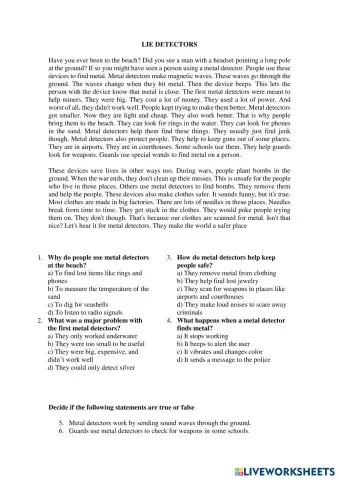
Have you ever been to the beach? Did you see a man with a headset pointing a long pole at the ground? If so you might have seen a person using a metal detector. People use these devices to find metal. Metal detectors make magnetic waves. These waves go through the ground. The waves change when they hit metal. Then the device beeps. This lets the person with the device know that metal is close. The first metal detectors were meant to help miners. They were big. They cost a lot of money. They used a lot of power. And worst of all, they didn't work well. People kept trying to make them better. Metal detectors got smaller. Now they are light and cheap. They also work better. That is why people bring them to the beach. They can look for rings in the water. They can look for phones in the sand. Metal detectors help them find these things. They usually just find junk though. Metal detectors also protect people. They help to keep guns out of some places. They are in airports. They are in courthouses. Some schools use them. They help guards look for weapons. Guards use special wands to find metal on a person.

These devices save lives in other ways too. During wars, people plant bombs in the ground. When the war ends, they don't clean up their messes. This is unsafe for the people who live in those places. Others use metal detectors to find bombs. They remove them and help the people. These devices also make clothes safer. It sounds funny, but it's true. Most clothes are made in big factories. There are lots of needles in these places. Needles break from time to time. They get stuck in the clothes. They would poke people trying them on. They don't though. That's because our clothes are scanned for metal. Isn't that nice? Let's hear it for metal detectors. They make the world a safer place

Unit 1 Grammar 02

GEP3

Talking About Past Habits and Situations

Names: ………………………………………………………….

"Used to" and "Would"

1. Explanation

🔹 "Used to"

We use "used to" to talk about:
Past habits (things we did regularly in the past but don’t do now).
Past states (situations that were true in the past but have changed).

📌 Form:

  • Positive: I used to play football every weekend.
  • Negative: I didn’t use to like coffee.
  • Question: Did you use to have long hair?

🚫 We don't use "would" for past states. I used to have long hair. (Correct). I would have long hair. (Incorrect)

🔹 "Would"

We use "would" to talk about:
Repeated past actions and habits (but NOT past states).

📌 Form:

  • Positive: When I was a child, I would visit my grandma every Sunday.
  • Negative: She wouldn’t eat vegetables when she was younger.

🚫 No question form with "would" for past habits. Use "Did you use to...?" instead.

2. Exercises

A. Complete the Conversations

Fill in the blanks using "used to," "didn't use to," "would," or "wouldn't."

  1. A: You’re so fit now! But I remember you ______________ (not/exercise) much before.
    B: Yeah, I ______________ (spend) all my weekends watching TV.
  2. A: ______________ (you/play) the piano when you were a child?
    B: Yes! I ______________ (practice) every day, but I stopped when I was 15.
  3. A: My grandpa ______________ (tell) me bedtime stories when I was little.
    B: That’s sweet! My parents ______________ (not/read) to me much, but I loved books.

B. Rewrite the Sentences

Rewrite the sentences using "used to" or "would" where possible.

  1. I often played outside with my friends after school.
    → _______________________________________
  2. She was very shy when she was younger.
    → _______________________________________
  3. My brother always helped me with my homework.
    → _______________________________________
  4. They had a small shop in our town.
    → _______________________________________

C. Past vs. Now

Look at the situations below. Write one sentence about the past and one about now using "used to" and "but now..."

  1. I hated vegetables before. Now, I eat them every day.
    → I ________________ vegetables, but now I ________________.
  2. My parents were strict. Now, they are more outgoing.
    → They ________________, but now ________________.
  3. I didn’t enjoy studying English before. Now, I love it!
    → I ________________, but now ________________.

D. Short Paragraph Exercise

Write a short paragraph (4–5 sentences) about how your life has changed. Use "used to," "didn’t use to," "would," and "wouldn’t."

Example:
"When I was a child, I used to be very shy. I wouldn’t talk much in class, and I used to feel nervous meeting new people. I used to love playing outside, and my friends and I would ride our bikes every day. Now, I’m more confident, and I love socializing."

....................................................................................................................................................................................................................................................................................................................................................................................................................................................................................................................................................................................................................................................................................................................................................................................................................................................................................................................................................................................................................................................................................................................................

Talking About Past Habits and Situations

Names: ………………………………………………………….

"Used to" and "Would"

1. Explanation

🔹 "Used to"

We use "used to" to talk about:
Past habits (things we did regularly in the past but don’t do now).
Past states (situations that were true in the past but have changed).

📌 Form:

  • Positive: I used to play football every weekend.
  • Negative: I didn’t use to like coffee.
  • Question: Did you use to have long hair?

🚫 We don't use "would" for past states. I used to have long hair. (Correct). I would have long hair. (Incorrect)

🔹 "Would"

We use "would" to talk about:
Repeated past actions and habits (but NOT past states).

📌 Form:

  • Positive: When I was a child, I would visit my grandma every Sunday.
  • Negative: She wouldn’t eat vegetables when she was younger.

🚫 No question form with "would" for past habits. Use "Did you use to...?" instead.

2. Exercises

A. Complete the Conversations

Fill in the blanks using "used to," "didn't use to," "would," or "wouldn't."

  1. A: You’re so fit now! But I remember you ______________ (not/exercise) much before.
    B: Yeah, I ______________ (spend) all my weekends watching TV.
  2. A: ______________ (you/play) the piano when you were a child?
    B: Yes! I ______________ (practice) every day, but I stopped when I was 15.
  3. A: My grandpa ______________ (tell) me bedtime stories when I was little.
    B: That’s sweet! My parents ______________ (not/read) to me much, but I loved books.

B. Rewrite the Sentences

Rewrite the sentences using "used to" or "would" where possible.

  1. I often played outside with my friends after school.
    → _______________________________________
  2. She was very shy when she was younger.
    → _______________________________________
  3. My brother always helped me with my homework.
    → _______________________________________
  4. They had a small shop in our town.
    → _______________________________________

C. Past vs. Now

Look at the situations below. Write one sentence about the past and one about now using "used to" and "but now..."

  1. I hated vegetables before. Now, I eat them every day.
    → I ________________ vegetables, but now I ________________.
  2. My parents were strict. Now, they are more outgoing.
    → They ________________, but now ________________.
  3. I didn’t enjoy studying English before. Now, I love it!
    → I ________________, but now ________________.

D. Short Paragraph Exercise

Write a short paragraph (4–5 sentences) about how your life has changed. Use "used to," "didn’t use to," "would," and "wouldn’t."

Example:
"When I was a child, I used to be very shy. I wouldn’t talk much in class, and I used to feel nervous meeting new people. I used to love playing outside, and my friends and I would ride our bikes every day. Now, I’m more confident, and I love socializing."

....................................................................................................................................................................................................................................................................................................................................................................................................................................................................................................................................................................................................................................................................................................................................................................................................................................................................................................................................................................................................................................................................................................................................


English exam

English


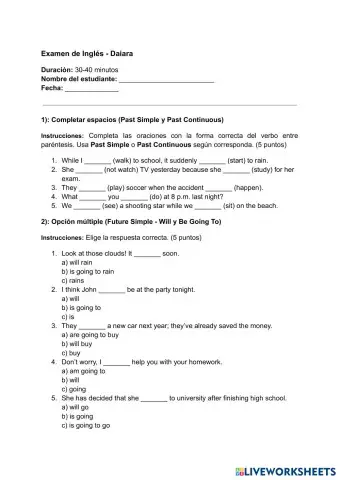
1): Completar espacios (Past Simple y Past Continuous)

Instrucciones: Completa las oraciones con la forma correcta del verbo entre paréntesis. Usa Past Simple o Past Continuous según corresponda. (5 puntos)

  1. While I _______ (walk) to school, it suddenly _______ (start) to rain.
  2. She _______ (not watch) TV yesterday because she _______ (study) for her exam.
  3. They _______ (play) soccer when the accident _______ (happen).
  4. What _______ you _______ (do) at 8 p.m. last night?
  5. We _______ (see) a shooting star while we _______ (sit) on the beach.

2): Opción múltiple (Future Simple - Will y Be Going To)

Instrucciones: Elige la respuesta correcta. (5 puntos)

  1. Look at those clouds! It _______ soon.
    a) will rain
    b) is going to rain
    c) rains
  2. I think John _______ be at the party tonight.
    a) will
    b) is going to
    c) is
  3. They _______ a new car next year; they’ve already saved the money.
    a) are going to buy
    b) will buy
    c) buy
  4. Don’t worry, I _______ help you with your homework.
    a) am going to
    b) will
    c) going
  5. She has decided that she _______ to university after finishing high school.
    a) will go
    b) is going
    c) is going to go

3): Transformar oraciones

Instrucciones: Reescribe las oraciones en negativo y en pregunta. (6 puntos)

  1. He was reading a book.
    • Negativo: ______________________________
    • Pregunta: ______________________________
  2. They will visit their grandparents tomorrow.
    • Negativo: ______________________________
    • Pregunta: ______________________________
  3. She cooked dinner last night.
    • Negativo: ______________________________
    • Pregunta: ______________________________

4): Ordenar oraciones

Instrucciones: Ordena las palabras para formar oraciones correctas. (4 puntos)

  1. yesterday / didn’t / homework / do / he / his
  2. the / were / doing / kids / what / at 5 p.m.?
  3. going / we / are / to / tomorrow / leave
  4. was / playing / music / she / beautiful

5): Comprensión lectora

Instrucciones: Lee el siguiente texto y responde las preguntas. (5 puntos)

Texto:
"Last summer, Emily and her family went on a trip to Spain. While they were visiting Barcelona, they saw many interesting places. One afternoon, while Emily was taking photos of the Sagrada Familia, her brother got lost. He wasn’t paying attention and walked away from the group. Luckily, a kind stranger helped him find his way back. The whole family was very relieved when they found him."

Preguntas:

  1. Where did Emily’s family go last summer?
  2. What was Emily doing when her brother got lost?
  3. Why did her brother get lost?
  4. Who helped Emily’s brother?
  5. How did the family feel when they found him?


Puntaje Total: _____ / 25


Linking words

EFL

LINKING WORDS

Exercise A: Fill in the blanks with the correct connector ( therefore, what's more, also, however, moreover, so, despite that)

1. Sarah was feeling very tired; ______, she decided to take a short nap before the meeting.

2. I enjoy playing basketball. ______, I love watching football on TV.

3. He didn't study for the exam. ______, he managed to pass it.

4. The weather was terrible. ______, we decided to go hiking.

5. She is a talented musician. ______, she speaks five languages fluently.

6. I didn't like the movie at all. ______, it was too long and boring.

7. They didn't have enough time to prepare. ______, they did their best to finish the project.


Exercise B: Choose the correct connector for each sentence.

8. I didn’t get the job offer. ______, I will keep looking for other opportunities.
a) Despite that
b) Therefore
c) However

9. He always helps others. ______, he volunteers at a local charity.
a) So
b) Moreover
c) Despite that

10. The restaurant was very expensive. ______, the food wasn’t very good.
a) Also
b) What's more
c) However

11. I wasn’t feeling well, ______ I went to work anyway.
a) Despite that
b) Therefore
c) However


Exercise C: Complete the paragraph using the appropriate connectors.

12.
I love visiting new places. ______, I always try to learn a few words in the local language before I go. This way, I can communicate with the locals more easily. I visited Paris last year. The weather was amazing, and I had a fantastic time. ______, I visited the Eiffel Tower and took lots of photos. The food was delicious, and I tried many new dishes. ______, I also visited the Louvre Museum and saw the famous Mona Lisa. ______, I would recommend going to Paris to anyone who enjoys history and culture!

Mandailing-Task

English for Young Learners

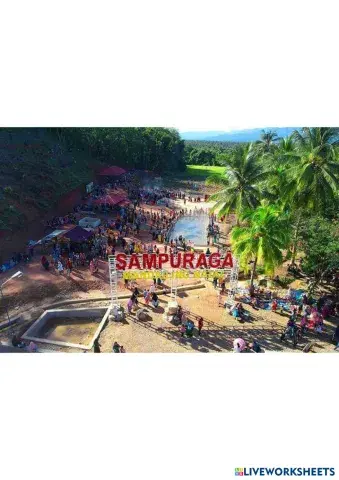
The moon shines down on the land of a remote village in Padang Bolak. The sound of howling coyotes was carried by the night breeze. Sampuraga looked up at the moon with an uneasy feeling.

His landlord's words three days ago made it difficult for him to close his eyes. “Still not sure, Raga?” asked Tondi, who faithfully accompanied Sampuraga. “I'm capable of migrating, what's the harm in just walking a long way?” replied Sampuraga.

Tondi sighed for a moment before speaking again, “But Raga, what about...” Before Tondi could continue, a woman with a frail body and bleached hair appeared from behind the door.

“Umak...” called Sampuraga. “Nape modom ho, amang? (Haven't you slept yet, son?)” asked the old woman approaching Sampuraga.

“Ahadei, amang?” she continued. Hearing the question, Sampuraga looked down.

“I cooked holat with your favorite pakkat but you didn't eat it. You have been sleeping late for the past three days. Tell me about it with Umak,” said the old woman. “Raga wants to migrate Umak,” said Sampuraga.

The request made Mrs. Sampuraga's blood boil, “Do you want to leave Umak?” Raga revealed his heart. “Raga wants to change our fate by going to Mandailing. Giot pasonang Umak do au so ke au marantau (I want to please my mother that's why I'm going overseas)” Sampuraga explained.


“Saotik peindaadong hu bayangkanmarsarak dot hu (Not even a little bit I imagine amang inda can hu pasonang ho (I apologize for not being able to make you happy),” said Mrs. Sampuraga softly. “Umak...” Sampuraga replied no less softly.

Sampuraga immediately knelt before his mother. “Thank you Umak! Raga promised to come back after he succeeded,” Sampuraga promised his mother. Tondi, who witnessed the emotional event in front of him, could not hold back his tears.

For days Sampuraga walked with Tondi through the wilderness and various villages. They finally arrived at a place called Pidoli, Mandailing. Sampuraga was mesmerized after seeing the prosperity and well-being in the Pidoli region.

“Raga, look!” pointed Tondi at a crowd. “Try approaching the merchant,” he continued. Raga took Tondi's advice by introducing himself and expressing his desire to work for the merchant.

The merchant granted Sampuraga's request. Thanks to the tenacity and honesty always taught by his mother, Sampuraga won the trust of his employer. After a long time, Sampuraga was asked to become the merchant's son-in-law.

“Since the beginning of our meeting, I have always believed that you are a diligent and good young man. I have never met a young man as good as you, would you like to be my son-in-law?” asked the master expressing his wish. “I would gladly marry your daughter,” Sampuraga said happily. “Soon I will be very rich!” said Sampuraga. Tondi, who heard this, was stunned because he caught the arrogant tone of his words.

The news of Sampuraga's marriage to a noble princess quickly spread throughout the country, including his mother who was unsure of the truth. She traveled step by step to reach the land of Pidoli in Mandailing.

Upon arriving in the land of Pidoli, the old woman was greeted by the sound of gondang sambilan, indicating a festive occasion. She was surprised to see a young man she recognized sitting side by side with a beautiful princess.

Sampuraga's mother broke through the front row of the crowd and shouted her son's name. “That's Umak's voice...” whispered Tondi, who was accompanying Sampuraga. “Ah, no way!” argued Sampuraga when he heard a familiar voice.

“Sampuraga, it's me, your umak, son!” exclaimed his mother. Tondi repeatedly reassured Sampuraga but Sampuraga was suddenly embarrassed and angry. “You ugly old woman! How dare you. My Umak has been dead for a long time!” said Sampuraga.

“How dare you Sampuraga! How dare you disown your umak,” his mother hissed. “Bow down Raga! Ro ma ho mangido maaf selagi mangolu umakmu (Come you son apologize while your mother lives),” ordered Tondi. However, Sampuraga called the guards to chase his mother away.

After leaving the party with tears in her eyes, Sampuraga's mother prayed, “God, if the young man is really Sampuraga then teach him a lesson. For the greatest sin is to disobey one's parents.”

The sky seemed to change suddenly until lightning struck each other. Rain fell heavily followed by the sound of thunder. All the invitees including Sampuraga and his wife tried to run for their lives. Unfortunately, the place sank in no time.

Sampuraga's party venue turned into a pool of extremely hot water. The locals believed that everything was the incarnation of Sampuraga's wedding party that was cursed. The local people then named the place as “Kolam Sampuraga”.

สร้างและปรับแต่งใบงานสำหรับทุกห้องเรียน

LiveWorksheets ทำให้คุณครู ผู้ปกครอง และผู้สอนแบบโฮมสคูล สามารถออกแบบและมอบสื่อการเรียนรู้ที่น่าสนใจได้อย่างง่ายดาย เพียงอัปโหลดไฟล์ PDF หรือเริ่มต้นสร้างใหม่ทั้งหมด คุณก็สามารถทำได้ทุกอย่าง ไม่ว่าจะเป็นใบงานคณิตศาสตร์แบบโต้ตอบ ใบงานอ่านจับใจความ ใบงานการคูณ หรือใบงานสำหรับเด็กอนุบาล ด้วยขั้นตอนเพียงไม่กี่คลิก เครื่องมือแก้ไขแบบลากและวางของเรารองรับทุกระดับชั้นและทุกวิชา ช่วยให้คุณปรับเนื้อหาให้ตรงกับแผนการสอน การบ้าน หรือแบบทดสอบ ครูสอนภาษาอังกฤษ (ESL) ยังสามารถสร้างใบงาน ESL แบบเฉพาะ เพิ่มตารางเสียงภาษาอังกฤษ หรือออกแบบกิจกรรม ESL เพื่อให้การเรียนสนุกและมีส่วนร่วมมากขึ้น สร้างกิจกรรมที่ปรับระดับได้ ตรวจอัตโนมัติ ช่วยประหยัดเวลา และสนับสนุนการเรียนรู้ของนักเรียนให้ดียิ่งขึ้น

คลังสื่อการเรียนรู้ครบวงจรสำหรับ K-12 และ ESL

เข้าถึงใบงานที่พร้อมใช้หลายพันชุด ครอบคลุมทุกวิชาในระดับ K-12 รวมถึงใบงานอนุบาล ใบงานคณิตศาสตร์ แบบฝึกการคูณ แบบฝึกอ่านจับใจความ และทรัพยากร ESL เลือกค้นหาตามชั้นเรียน วิชา หรือระดับทักษะ เพื่อให้ได้สิ่งที่คุณต้องการ ไม่ว่าจะสำหรับห้องเรียนประถม ทบทวนในระดับมัธยมต้น หรือการฝึกในระดับมัธยมปลาย ครู ESL ยังสามารถสำรวจคลังใบงาน ESL และกิจกรรมภาษาอังกฤษที่ออกแบบมาเพื่อรองรับผู้เรียนทุกระดับ เนื้อหาใหม่ถูกเพิ่มเข้ามาอย่างต่อเนื่อง LiveWorksheets จึงเป็นทรัพยากรที่ยืดหยุ่นและช่วยสร้างผลลัพธ์การเรียนรู้ที่ยั่งยืน