Smartphones

English

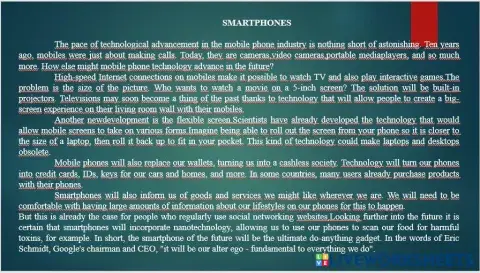
The pace of technological advancement in the mobile phone industry is nothing short of astonishing. Ten years ago, mobiles were just about making calls. Today, they are cameras,
video cameras,
portable media
players, and so much more. How else might mobile phone technology advance in the future?
High-speed Internet connections on mobiles make it possible to watch TV and also play interactive games.
The problem is the size of the picture. Who wants to watch a movie on a 5-inch screen? The solution will be built-in projectors. Televisions may soon become a thing of the past thanks to technology that will allow people to create a big-screen experience on their living room wall with their mobiles.
Another new
development is the flexible screen.
Scientists have already developed the technology that would allow mobile screens to take on various forms.
Imagine being able to roll out the screen from your phone so it is closer to the size of a laptop, then roll it back up to fit in your pocket. This kind of technology could make laptops and desktops obsolete.
Mobile phones will also replace our wallets, turning us into a cashless society. Technology will turn our phones into credit cards, IDs, keys for our cars and homes, and more. In some countries, many users already purchase products with their phones.
Smartphones will also inform us of goods and services we might like wherever we are. We will need to be comfortable with having large amounts of information about our lifestyles on our phones for this to happen.
But this is already the case for people who regularly use social networking websites.
Looking further into the future it is certain that smartphones will incorporate nanotechnology, allowing us to use our phones to scan our food for harmful toxins, for example. In short, the smartphone of the future will be the ultimate do-anything gadget. In the words of Eric Schmidt, Google's chairman and CEO, "it will be our alter ego - fundamental to everything we do".


Read the article and choose the correct option (A, B, C or D).
1 The reason people may use TVs less in the future is
A smartphones will have bigger screen displays.
B TV programmes will be made especially for smartphones.
C smartphones will be able to project images
onto walls.
D TV programmes will all be watched on PCs.
2 Smartphone screens will soon be
A unbreakable.
C expandable.
B rigid.
D exchangeable.
3 In the future, cash could become A more valuable.
B no longer necessary.
C used in only some countries.
D made of plastic.
4 In order for our phones to suggest goods and services to us, we would have to A make changes to our lifestyle.
B join a social networking site.
C provide location details.
D sacrifice some privacy.
5 The nanotechnology of the future may
A replace smartphones.
B release harmful toxins.
C be used in a number of gadgets.
D revolutionize smartphones.
5x2=10 marks

Reading Text.

Reading - ESL

Camila’s Balanced School Day

Camila is fifteen years old and lives in Chunchi, Ecuador. On weekdays, she wakes up at 5:45 a.m. because her classes begin at 7:00. She makes her bed, washes her face and has bread, cheese and milk for breakfast. At 6:35, she leaves home and walks to school with her cousin. The walk takes about twenty minutes. At school, Camila enjoys English because she likes learning useful phrases and watching short videos. She returns home at 1:15 p.m. and has lunch with her family. After lunch, she rests for thirty minutes and then starts her homework. On Tuesdays and Thursdays, she also helps her mother in the family shop. At 5:00 p.m., she exercises or plays volleyball with her friends. In the evening, Camila prepares her uniform and schoolbag for the next day. After dinner, she reviews English vocabulary on her phone for fifteen minutes, but she avoids using the phone for too long. She usually goes to bed at 9:30 p.m. Camila believes that an organized routine gives her enough time to study, help her family and rest.


A. Multiple-Choice Questions

1. Where does Camila live?

A. Quito                     B. Chunchi  

C. London                  D. Guayaquil


2. What time does Camila leave home?

A. 5:45 a.m.               B. 6:20 a.m.  

C. 6:35 a.m.                D. 7:15 a.m.


3. What does Camila do after resting for thirty minutes?

A. She starts her homework.             B. She goes to bed.  

C. She watches television.                 D. She plays video games.


4. How does Camila practice English in the evening?

A. She reads a newspaper.                 B. She reviews vocabulary on her phone.  

C. She speaks to a tourist.                  D. She helps her mom.


B. True or False

1. Camila’s classes begin at 7:00 a.m. True / False

2. Camila walks to school alone. True / False

3. Camila usually goes to bed at 10:30 p.m. True / False


C. Matching

Match each expression with its correct meaning.


1.- Wake up                                                Study words again


2.- Review vocabulary                              Stop sleeping and                                                                          start the day


3.- Prepare the schoolbag                       Put school materials in                                                                  the bag for the next day

สร้างและปรับแต่งใบงานสำหรับทุกห้องเรียน

LiveWorksheets ทำให้คุณครู ผู้ปกครอง และผู้สอนแบบโฮมสคูล สามารถออกแบบและมอบสื่อการเรียนรู้ที่น่าสนใจได้อย่างง่ายดาย เพียงอัปโหลดไฟล์ PDF หรือเริ่มต้นสร้างใหม่ทั้งหมด คุณก็สามารถทำได้ทุกอย่าง ไม่ว่าจะเป็นใบงานคณิตศาสตร์แบบโต้ตอบ ใบงานอ่านจับใจความ ใบงานการคูณ หรือใบงานสำหรับเด็กอนุบาล ด้วยขั้นตอนเพียงไม่กี่คลิก เครื่องมือแก้ไขแบบลากและวางของเรารองรับทุกระดับชั้นและทุกวิชา ช่วยให้คุณปรับเนื้อหาให้ตรงกับแผนการสอน การบ้าน หรือแบบทดสอบ ครูสอนภาษาอังกฤษ (ESL) ยังสามารถสร้างใบงาน ESL แบบเฉพาะ เพิ่มตารางเสียงภาษาอังกฤษ หรือออกแบบกิจกรรม ESL เพื่อให้การเรียนสนุกและมีส่วนร่วมมากขึ้น สร้างกิจกรรมที่ปรับระดับได้ ตรวจอัตโนมัติ ช่วยประหยัดเวลา และสนับสนุนการเรียนรู้ของนักเรียนให้ดียิ่งขึ้น

คลังสื่อการเรียนรู้ครบวงจรสำหรับ K-12 และ ESL

เข้าถึงใบงานที่พร้อมใช้หลายพันชุด ครอบคลุมทุกวิชาในระดับ K-12 รวมถึงใบงานอนุบาล ใบงานคณิตศาสตร์ แบบฝึกการคูณ แบบฝึกอ่านจับใจความ และทรัพยากร ESL เลือกค้นหาตามชั้นเรียน วิชา หรือระดับทักษะ เพื่อให้ได้สิ่งที่คุณต้องการ ไม่ว่าจะสำหรับห้องเรียนประถม ทบทวนในระดับมัธยมต้น หรือการฝึกในระดับมัธยมปลาย ครู ESL ยังสามารถสำรวจคลังใบงาน ESL และกิจกรรมภาษาอังกฤษที่ออกแบบมาเพื่อรองรับผู้เรียนทุกระดับ เนื้อหาใหม่ถูกเพิ่มเข้ามาอย่างต่อเนื่อง LiveWorksheets จึงเป็นทรัพยากรที่ยืดหยุ่นและช่วยสร้างผลลัพธ์การเรียนรู้ที่ยั่งยืน