Descriptive Text

English

Floating Market Lembang


Floating Market Lembang is a fun and unique tourist spot in Bandung, Indonesia. It is located in Lembang, a cool area with fresh air and green views. This place is like a big park with a beautiful lake. The special thing about the Floating Market is the food market on boats! Many small boats float on the lake, selling delicious snacks and drinks.


You can walk around the lake, take photos, or relax on the benches. There are also activities for kids, like feeding rabbits and riding small boats. Visitors can try local foods, like "batagor" (fried dumplings with peanut sauce) and "siomay" (steamed dumplings).


Floating Market Lembang is a great place to enjoy nature, eat tasty food, and have a nice time with friends and family. It is open every day, and you need to buy a ticket to enter.

Answer the questions based

  1. Where is Floating Market Lembang located?

A. Jakarta

B. Bali

C. Surabaya

D. Bandung

E. Yogyakarta


  1. What types of activities can children enjoy at the Floating Market?

A. Riding bicycles and playing basketball

B. Feeding rabbits and riding small boats

C. Swimming in the lake

D. Playing video games

E. Painting and drawing


  1. Why is the Floating Market called “unique”?

A. Because it has a large amusement park

B. Because the food is sold on floating boats

C. Because it is only open once a week

D. Because it offers helicopter rides

E. Because it has a zoo inside


  1. What makes Floating Market Lembang a good place to visit with friends and family?

A. It has many fast-food restaurants

B. It is a quiet place with no activities

C. It offers nature, food, and a relaxing environment

D. It has a large playground with slides

E. It is free to enter


  1. If you were to visit Floating Market Lembang, what activity would you enjoy the most, and why?

A. Walking around the lake and taking photos because it is peaceful

B. Shopping for souvenirs because they are cheap

C. Playing sports because there are courts available

D. Watching movies because it has a cinema

E. Riding bicycles because there are bike paths


Part 2

Match the vocabularies in column A with its description in column B


Column A

Column B

1. Floating Market

A market where food is sold on boats in a lake


2. Benches

Seats where people can sit and relax


3. Batagor

Fried dumplings with peanut sauce, a popular local food


4. Fresh air

Clean, cool air often found in nature


5. Activities

Fun things to do, such as feeding rabbits and riding boats


Activity 3

Put the correct word for the sentence

lake, ticket, boats, park, nature, batagor, benches, rabbits, food, Lembang


  1. Floating Market Lembang is a fun and unique ________ spot in Bandung, Indonesia.
  2. It is located in ________, a cool area with fresh air and green views.
  3. This place is like a big ________ with a beautiful lake.
  4. The special thing about the Floating Market is the ________ market on boats.
  5. Many small ________ float on the lake, selling delicious snacks and drinks.
  6. You can walk around the lake, take photos, or relax on the ________.
  7. There are also activities for kids, like feeding ________ and riding small boats.
  8. Visitors can try local foods, like "________" (fried dumplings with peanut sauce).
  9. Floating Market Lembang is a great place to enjoy ________, eat tasty food, and have a nice time with friends and family.
  10. The market is open every day, and you need to buy a ________ to enter.


Activity 4

True false question

  1. Floating Market Lembang is located in Jakarta, Indonesia.

True / False

  1. The Floating Market has a food market where vendors sell snacks from boats on the lake.

True / False

  1. Visitors can take photos, walk around, and sit on benches by the lake.

True / False

  1. Floating Market Lembang is only open on weekends.

True / False

  1. Kids can feed rabbits and ride small boats at Floating Market Lembang.

True / False


Activity 5

  1. The Floating Market in Lembang is described as having food sold from boats on a lake. Why might the market choose to use boats for selling food instead of regular stalls?

A. To offer an experience similar to a traditional Indonesian market

B. To make it harder for people to buy food

C. To prevent people from entering the lake area

D. To allow only small amounts of food to be sold


  1. Lembang is mentioned as a "cool area with fresh air and green views." Based on this information, which season or time of year would most likely make the Floating Market an attractive place to visit?

A. Winter, when temperatures are the lowest

B. Any season, because the area has a cool climate year-round

C. Summer, because people want to cool off

D. The rainy season, because it’s a lake area


  1. Imagine a family with young children is planning to visit Floating Market Lembang. Which of these activities would likely be most suitable for them, based on the description?

A. Hiking in the mountains nearby

B. Swimming in the lake

C. Feeding rabbits and riding small boats

D. Taking a tour of the city center of Bandung


  1. The Floating Market Lembang requires visitors to buy a ticket to enter. Why might this be necessary for a place like the Floating Market?

A. To control the number of visitors and maintain the area

B. To discourage tourists from visiting too often

C. To ensure that only local people can enter

D. To allow visitors to enter without waiting


  1. If Floating Market Lembang is a popular destination for nature and food, how might increased tourism impact the local environment in Lembang?

A. The area may become less crowded with tourists

B. The natural areas may require more upkeep and conservation

C. The fresh air will become cooler

D. The lake will expand

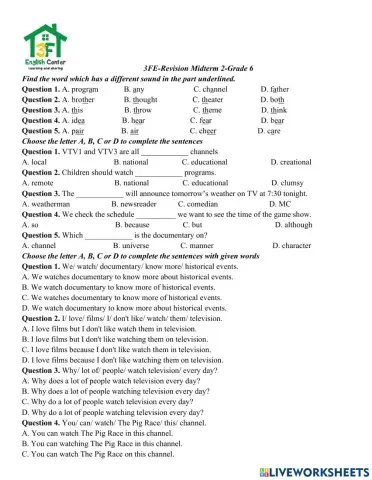
3FE-G6-Midterm2

English as a Second Language (ESL)

Choose the letter A, B, C or D to complete the sentences with given words
Question 1. We/ watch/ documentary/ know more/ historical events.
A. We watches documentary to know more about historical events.
B. We watch documentary to know more of historical events.
C. We watches documentary to know more of historical events.
D. We watch documentary to know more about historical events.
Question 2. I/ love/ films/ I/ don't like/ watch/ them/ television.
A. I love films but I don't like watch them in television.
B. I love films but I don't like watching them on television.
C. I love films because I don't like watch them in television.
D. I love films because I don't like watching them on television.
Question 3. Why/ lot of/ people/ watch television/ every day?
A. Why does a lot of people watch television every day?
B. Why does a lot of people watching television every day?
C. Why do a lot of people watch television every day?
D. Why do a lot of people watching television every day?
Question 4. You/ can/ watch/ The Pig Race/ this/ channel.
A. You can watch The Pig Race in this channel.
B. You can watching The Pig Race in this channel.
C. You can watch The Pig Race on this channel.
D. You can watching The Pig Race on this channel.
Question 5. Television/ a tool/ gain/ education/ information.
A. Television is a tool to gain education and information.
B. Television is a tool gaining education and information.
C. Television are a tool to gain education and information.
D. Television are a tool gaining education and information.
Rearrange the sentences to make meaningful sentences
Question 6. on/ The/ is/ at 20:00/ Saturday/ program/ on.
A. The program is on at 20:00 on Saturday.
B. The program is at 20:00 on Saturday on.
C. The program on is at 20:00 on Saturday.
D. The program on is on at 20:00 Saturday.
Question 7. in/ I’m/ game shows/ interested/ watching.
A. I’m watching in interested game shows.
B. I’m game shows interested watching in.
C. I’m interested in watching game shows.
D. I’m in watching interested game shows.
Question 8. favorite/ TV/ comedy/ My/ is/ program.
A. My favorite TV program is comedy.
B. My favorite TV program comedy is.
C. My favorite comedy TV program is.
D. My favorite comedy is TV program.
Question 9. time/ is/ TV/ a/ waste/ Watching/ of
A. Watching TV is a time waste of.
B. Watching time is a waste of TV.
C. Watching TV is time of a waste.
D. Watching TV is a waste of time.
Question 10. watch/ you/ How often/ TV/ do?
A. How often watch do you TV?
B. How often do you watch TV?
C. How often you do watch TV?
D. How often TV do you watch?
Choose the best answer
Question 11. He is a good football player.
A. He can’t play football
B. He isn’t good at football.
C. He love playing football.
D. He plays football well.
Question 12. My brother is a fast runner.
A. My brother runs fast.
B. My brother runs fastly.
C. My brother ran fast.
D. My brother ran fastly.
Question 13. I do judo every Tuesday and Thursday.
A. I do judo three times a week.
B. I do judo once a week.
C. I do judo twice a week.
D. I do judo four times a week.
Question 14. I like watching sports more than playing sports.
A. I prefer watching sports to playing sports.
B. I enjoy playing sports.
C. My favorite sports is tennis.
D. The most interesting sports is tennis.
Question 15. Helen's favorite sport is table tennis.
A. Helen hates playing table tennis.
B. Helen hates playing sports table tennis.
C. Helen enjoys playing table tennis.
D. Helen enjoys playing sports table tennis.
Question 16. Did you fly to Los Angeles?
A. Did you went to Los Angeles on foot?
B. Did you go to Los Angeles by plane?
C. Did you go to Los Angeles on foot?
D. Did you went to Los Angeles by plane?
Question 17. The world has seven continents.
A. There are seven continents in the world.
B. Seven continents have the world.
C. There is the world in seven continents.
D. The world there is seven continents.
Question 18. Africa is large. Asia is larger.
A. Asia is largest than Africa.
B. Africa is larger than Asia.
C. Asia is larger than Africa.
D. Africa is largest than Asia.
Question 19. Mr. and Mrs. Black have a son, John.
A. John is Mr. and Mrs. Black’s son.
B. John is Mr. and Mrs. Black’s father.
C. John is Mr. and Mrs. Black’s mother.
D. John is Mr. and Mrs. Black’s parents.
Question 20. Mr. Peter drives to Amsterdam every month.
A. Mr. Peter goes to Amsterdam by plane every month.
B. Mr. Peter goes to Amsterdam by horse every month.
C. Mr. Peter goes to Amsterdam by car every month.
D. Mr. Peter goes to Amsterdam by bike every month.
Choose the letter A, B, C or D to complete the sentences with given words
Question 21. Students/ do/ lot of/ outdoor/ activity.
A. Students do a lot of outdoor activities.
B. Students does a lot of outdoor activities.
C. Students doing a lot of outdoor activities.
D. Students did a lot of outdoor activities.
Question 22. I/ more/ interested/ go swimming/ my sister.
A. I more interested at going swimming than my sister.
B. I’m more interested at going swimming than my sister.
C. I more interested in going swimming than my sister.
D. I’m more interested in going swimming than my sister.
Question 23. In/ first half/ the match/ our team/ score/ goal.
A. In the first half of the match, our team score a goal.
B. In the first half of the match, our team scored a goal.
C. In the first half on the match, our team scored a goal.
D. In the first half on the match, our team score a goal.
Question 24. The first/ sport competition/ held/ Greece/ 776 B.C.
A. The first sport competition is held in Greece in 776 B.C.
B. The first sport competition was held in Greece in 776 B.C.
C. The first sport competition is held on Greece in 776 B.C.
D. The first sport competition was held on Greece in 776 B.C.
Question 25. Playing/ volleyball/ interesting.
A. Playing volleyball are interesting.
B. Playing the volleyball is interesting.
C. Playing volleyball is interesting.
D. Playing the volleyball are interesting.
Choose the letter A, B, C or D to complete the sentences with given words
Question 26. been to/ is/ What/ destination/ exciting/ you/ have/ the most?
A. What destination you is the most exiting have been to?
B. What is the most exiting destination you have been to?
C. What you have been to is the most exiting destination?
D. What is the most you have been to exiting destination?
Question 27. Malaysia’s/ its/ Kuala Lumpur/ and/ is/ largest city/ capital.
A. Kuala Lumpur is Malaysia's capital and its largest city.
B. Malaysia's Kuala Lumpur is capital and its largest city.
C. Kuala Lumpur is its largest city Malaysia's capital and.
D. Kuala Lumpur is Malaysia's its largest capital and city.
Question 28. seeing/ I/ London/ London Eye/ in/ enjoy/ the.
A. I enjoy seeing the London Eye in London.
B. I enjoy London seeing the London Eye in.
C. I enjoy seeing in London the London Eye.
D. I enjoy the London Eye seeing in London.
Question 29. Singapore/ located/ Southeast Asia.
A. Singapore is located in Southeast Asia.
B. Singapore was located in Southeast Asia.
C. Singapore is located on Southeast Asia.
D. Singapore was located on Southeast Asia.
Question 30. It’s/ fantastic/ spend/ a day/ New York.
A. It’s fantastic to spend a day in New York.
B. It’s fantastic spending a day in New York.
C. It’s fantastic to spend a day at New York.
D. It’s fantastic spending a day at New York.

Clothes and weather reading

English as a Second Language (ESL)

  1. My Clothes and the Weather


Hi! I am Jack. I am 8. I am happy today!

Today is a sunny day. I am wearing a T-shirt and shorts. I like sunny days because I can play football with my friends. When it is windy, I wear a jacket and a scarf. I don't like windy days because I can't fly my kite.

When it is snowy, I wear my coat, boots, and a sweater. I like snowy days because I can jump in the snow!

When it is cloudy, I wear jeans and a shirt. I don't like cloudy days because I can't swim in the pool.

When it is hot, I wear a dress or a skirt. I can dance and play volleyball with my friends.

When it is cold, I wear trousers and a hat. I can run outside and have fun!


No matter the weather, I love to play and have fun in my clothes!


▎Questions:

1. What do I wear on a sunny day?

   • a) A coat

   • b) A t-shirt and shorts

   • c) A sweater

2. Why don't I like windy days?

   • a) I can't play football

   • b) I can't fly a kite

   • c) I can't swim

3. What do I wear when it is snowy?

   • a) A dress

   • b) A coat, boots, and a sweater

   • c) Shorts and a t-shirt

4. What do I wear when it is cloudy?

   • a) A hat

   • b) Jeans and a shirt

   • c) A sweater and trousers

5. What do I do when it is hot?

   • a) I play in the snow

   • b) I dance and play volleyball

   • c) I play computer games


▎T/F Statements:

1. I wear a t-shirt and shorts on a sunny day. (T) (F)

2. I like windy days because I can fly a kite. (T) (F)

3. When it is snowy, I wear a coat and boots. (T) (F)

4. When it is cloudy, I wear a sweater. (T) (F)

5. When it's hot, I wear a dress or a skirt. (T) (F)


Draft 1

Grammar - Language Arts

# Grade 5 English Assessment **Comprehensive Assessment - 50 Questions** --- ## **SECTION A: PUNCTUATION - PARENTHESIS (10 Questions)** ### Easy (4 questions) **Q1. Multiple Choice** Which punctuation mark is NOT used for parenthesis? - A) Commas - B) Brackets - C) Dashes - D) Apostrophes **Answer:** D --- **Q2. True or False** This sentence uses parenthesis correctly: "My teacher Mr. Collins (who loves cricket) assigned us homework today." **Answer:** True --- **Q3. Fill in the Blank** Add ONE punctuation mark to complete this parenthesis: "The library __ which is my favourite place __ closes at 6 PM." **Answer:** Commas (accepts: commas / , ) --- **Q4. Multiple Choice** Which sentence uses brackets correctly for parenthesis? - A) The concert [it was amazing] ended late. - B) The concert (it was amazing ended late). - C) The concert it was (amazing) ended late. - D) The concert it was amazing [ended late. **Answer:** A --- ### Medium (4 questions) **Q5. Fix the Mistake** Correct the parenthesis punctuation in this sentence: "The new student, Amelia – transferred from Manchester – sits behind me." **Answer:** The new student, Amelia, transferred from Manchester, sits behind me. OR The new student – Amelia, transferred from Manchester – sits behind me. (Accept either consistent pair) --- **Q6. Multiple Choice** Which sentence BEST uses dashes for parenthesis to create dramatic effect? - A) The winner, surprisingly, was announced. - B) The winner (surprisingly) was announced. - C) The winner – surprisingly – was announced. - D) The winner "surprisingly" was announced. **Answer:** C --- **Q7. Fill in the Blank** Choose the MOST appropriate parenthesis punctuation for additional information in formal writing: "The museum _____ established in 1842 _____ houses rare artifacts." **Answer:** Brackets or ( ) (accepts: brackets, parentheses, ( )) --- **Q8. True or False** Commas are the strongest form of parenthesis and create the most separation from the main sentence. **Answer:** False --- ### Difficult (2 questions) **Q9. Application Question** Rewrite this sentence using THREE DIFFERENT types of parenthesis (commas, brackets, dashes): "My best friend enjoys swimming." Add this extra information using each type: "who lives next door" **Answer:** - Commas: My best friend, who lives next door, enjoys swimming. - Brackets: My best friend (who lives next door) enjoys swimming. - Dashes: My best friend – who lives next door – enjoys swimming. --- **Q10. Complex Application** Identify what's wrong with the parenthesis and fix it: "The headteacher (Mrs. Rahman, announced – surprisingly) that we would have extra break time." **Answer:** The headteacher, Mrs. Rahman, announced (surprisingly) that we would have extra break time. OR The headteacher – Mrs. Rahman – announced (surprisingly) that we would have extra break time. (Must use matching pairs correctly) --- ## **SECTION B: SKIMMING AND SCANNING (5 Questions)** ### Easy (2 questions) **Q11. Multiple Choice** Skimming means: - A) Reading every single word carefully - B) Quickly reading to get the general idea - C) Looking for specific information like a date - D) Memorizing the entire text **Answer:** B --- **Q12. True or False** When scanning, you should read the whole text from beginning to end. **Answer:** False --- ### Medium (2 questions) **Q13. Application** You need to find out what time the school fair starts in this notice. Should you use SKIMMING or SCANNING? **Answer:** Scanning --- **Q14. Multiple Choice** Which of these would you do when SKIMMING a story? - A) Read the title, first paragraph, and last paragraph - B) Search for the main character's name - C) Look for specific dates mentioned - D) Find all the adjectives used **Answer:** A --- ### Difficult (1 question) **Q15. Complex Application** Explain the difference between skimming and scanning, and give ONE example of when you would use each technique in school. **Ans

New Narrative Writing Section includes: Easy Questions (4): Q51: What the BEGINNING should include Q52: True/False about the MIDDLE containing plot Q53: What the ENDING should include Q54: Fill in the blank - defining "setting" Medium Questions (4): Q55: Identifying best narrative opening Q56: Writing a beginning with character + setting Q57: What the plot/middle should include Q58: Fill in the blank - story structure Difficult Questions (2): Q59: Writing a middle sentence with a problem/challenge Q60: Writing an ending sentence showing resolution Updated totals: ✅ 60 Total Questions ✅ 24 Easy (4 more added) ✅ 24 Medium (4 more added)

Grammar points

English Grammar

  • Present Simple Tense

    • Structure: Subject + base verb (s/es for he/she/it)
    • Example: "I work in an office." / "She goes to school every day."
  • Present Continuous Tense

    • Structure: Subject + am/are/is + verb-ing
    • Example: "I am studying right now." / "They are playing football."
  • Past Simple Tense

    • Structure: Subject + past form of verb
    • Example: "She visited the museum yesterday." / "I watched a movie last night."
  • Past Continuous Tense

    • Structure: Subject + was/were + verb-ing
    • Example: "I was reading when the phone rang." / "They were sleeping at 10 PM."
  • Future Simple Tense (will)

    • Structure: Subject + will + base verb
    • Example: "I will call you tomorrow." / "They will come to the party."
  • Future with "going to"

    • Structure: Subject + am/are/is + going to + base verb
    • Example: "I’m going to visit my grandparents." / "He is going to study abroad."
  • Present Perfect Simple

    • Structure: Subject + have/has + past participle
    • Example: "I have finished my homework." / "She has lived in this city for five years."
  • Comparatives and Superlatives

    • Comparatives: Subject + verb + adjective + -er / more + adjective (for longer adjectives)
      • Example: "This book is cheaper than that one." / "She is more intelligent than him."
    • Superlatives: The + adjective + -est / most + adjective (for longer adjectives)
      • Example: "This is the tallest building." / "He is the most hardworking person."
  • There is/There are

    • Structure: There + is/are + noun
    • Example: "There is a book on the table." / "There are many people in the park."
  • Can (ability and permission)

    • Structure: Subject + can + base verb
    • Example: "I can swim." / "Can I go to the bathroom?"
  • Some and Any

    • Some: Used in positive statements, offers, and requests.
      • Example: "I have some friends." / "Would you like some tea?"
    • Any: Used in negative statements and questions.
      • Example: "I don’t have any money." / "Do you have any pens?"
  • First Conditional

    • Structure: If + present simple, will + base verb
    • Example: "If it rains, I will stay at home." / "If I see her, I will say hello."
  • Second Conditional

    • Structure: If + past simple, would + base verb
    • Example: "If I were rich, I would travel the world." / "If she studied more, she would pass the exam."
  • Prepositions of Place and Time

    • Examples: "in," "on," "at"
    • "The book is on the table." / "We have a meeting at 3 PM." / "I live in New York."
  • Questions with Wh- words

    • Examples: "What," "Where," "When," "Why," "How"
    • "What is your name?" / "Where do you live?" / "How are you?"

สร้างและปรับแต่งใบงานสำหรับทุกห้องเรียน

LiveWorksheets ทำให้คุณครู ผู้ปกครอง และผู้สอนแบบโฮมสคูล สามารถออกแบบและมอบสื่อการเรียนรู้ที่น่าสนใจได้อย่างง่ายดาย เพียงอัปโหลดไฟล์ PDF หรือเริ่มต้นสร้างใหม่ทั้งหมด คุณก็สามารถทำได้ทุกอย่าง ไม่ว่าจะเป็นใบงานคณิตศาสตร์แบบโต้ตอบ ใบงานอ่านจับใจความ ใบงานการคูณ หรือใบงานสำหรับเด็กอนุบาล ด้วยขั้นตอนเพียงไม่กี่คลิก เครื่องมือแก้ไขแบบลากและวางของเรารองรับทุกระดับชั้นและทุกวิชา ช่วยให้คุณปรับเนื้อหาให้ตรงกับแผนการสอน การบ้าน หรือแบบทดสอบ ครูสอนภาษาอังกฤษ (ESL) ยังสามารถสร้างใบงาน ESL แบบเฉพาะ เพิ่มตารางเสียงภาษาอังกฤษ หรือออกแบบกิจกรรม ESL เพื่อให้การเรียนสนุกและมีส่วนร่วมมากขึ้น สร้างกิจกรรมที่ปรับระดับได้ ตรวจอัตโนมัติ ช่วยประหยัดเวลา และสนับสนุนการเรียนรู้ของนักเรียนให้ดียิ่งขึ้น

คลังสื่อการเรียนรู้ครบวงจรสำหรับ K-12 และ ESL

เข้าถึงใบงานที่พร้อมใช้หลายพันชุด ครอบคลุมทุกวิชาในระดับ K-12 รวมถึงใบงานอนุบาล ใบงานคณิตศาสตร์ แบบฝึกการคูณ แบบฝึกอ่านจับใจความ และทรัพยากร ESL เลือกค้นหาตามชั้นเรียน วิชา หรือระดับทักษะ เพื่อให้ได้สิ่งที่คุณต้องการ ไม่ว่าจะสำหรับห้องเรียนประถม ทบทวนในระดับมัธยมต้น หรือการฝึกในระดับมัธยมปลาย ครู ESL ยังสามารถสำรวจคลังใบงาน ESL และกิจกรรมภาษาอังกฤษที่ออกแบบมาเพื่อรองรับผู้เรียนทุกระดับ เนื้อหาใหม่ถูกเพิ่มเข้ามาอย่างต่อเนื่อง LiveWorksheets จึงเป็นทรัพยากรที่ยืดหยุ่นและช่วยสร้างผลลัพธ์การเรียนรู้ที่ยั่งยืน