Reading Worksheet - PFlores

English as a Second Language (ESL)

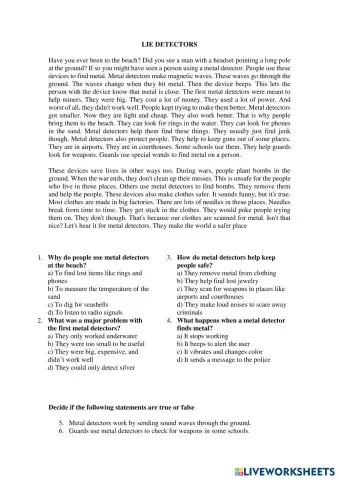
Have you ever been to the beach? Did you see a man with a headset pointing a long pole at the ground? If so you might have seen a person using a metal detector. People use these devices to find metal. Metal detectors make magnetic waves. These waves go through the ground. The waves change when they hit metal. Then the device beeps. This lets the person with the device know that metal is close. The first metal detectors were meant to help miners. They were big. They cost a lot of money. They used a lot of power. And worst of all, they didn't work well. People kept trying to make them better. Metal detectors got smaller. Now they are light and cheap. They also work better. That is why people bring them to the beach. They can look for rings in the water. They can look for phones in the sand. Metal detectors help them find these things. They usually just find junk though. Metal detectors also protect people. They help to keep guns out of some places. They are in airports. They are in courthouses. Some schools use them. They help guards look for weapons. Guards use special wands to find metal on a person.

These devices save lives in other ways too. During wars, people plant bombs in the ground. When the war ends, they don't clean up their messes. This is unsafe for the people who live in those places. Others use metal detectors to find bombs. They remove them and help the people. These devices also make clothes safer. It sounds funny, but it's true. Most clothes are made in big factories. There are lots of needles in these places. Needles break from time to time. They get stuck in the clothes. They would poke people trying them on. They don't though. That's because our clothes are scanned for metal. Isn't that nice? Let's hear it for metal detectors. They make the world a safer place

Unit 1 Grammar 02

GEP3

Talking About Past Habits and Situations

Names: ………………………………………………………….

"Used to" and "Would"

1. Explanation

🔹 "Used to"

We use "used to" to talk about:
Past habits (things we did regularly in the past but don’t do now).
Past states (situations that were true in the past but have changed).

📌 Form:

  • Positive: I used to play football every weekend.
  • Negative: I didn’t use to like coffee.
  • Question: Did you use to have long hair?

🚫 We don't use "would" for past states. I used to have long hair. (Correct). I would have long hair. (Incorrect)

🔹 "Would"

We use "would" to talk about:
Repeated past actions and habits (but NOT past states).

📌 Form:

  • Positive: When I was a child, I would visit my grandma every Sunday.
  • Negative: She wouldn’t eat vegetables when she was younger.

🚫 No question form with "would" for past habits. Use "Did you use to...?" instead.

2. Exercises

A. Complete the Conversations

Fill in the blanks using "used to," "didn't use to," "would," or "wouldn't."

  1. A: You’re so fit now! But I remember you ______________ (not/exercise) much before.
    B: Yeah, I ______________ (spend) all my weekends watching TV.
  2. A: ______________ (you/play) the piano when you were a child?
    B: Yes! I ______________ (practice) every day, but I stopped when I was 15.
  3. A: My grandpa ______________ (tell) me bedtime stories when I was little.
    B: That’s sweet! My parents ______________ (not/read) to me much, but I loved books.

B. Rewrite the Sentences

Rewrite the sentences using "used to" or "would" where possible.

  1. I often played outside with my friends after school.
    → _______________________________________
  2. She was very shy when she was younger.
    → _______________________________________
  3. My brother always helped me with my homework.
    → _______________________________________
  4. They had a small shop in our town.
    → _______________________________________

C. Past vs. Now

Look at the situations below. Write one sentence about the past and one about now using "used to" and "but now..."

  1. I hated vegetables before. Now, I eat them every day.
    → I ________________ vegetables, but now I ________________.
  2. My parents were strict. Now, they are more outgoing.
    → They ________________, but now ________________.
  3. I didn’t enjoy studying English before. Now, I love it!
    → I ________________, but now ________________.

D. Short Paragraph Exercise

Write a short paragraph (4–5 sentences) about how your life has changed. Use "used to," "didn’t use to," "would," and "wouldn’t."

Example:
"When I was a child, I used to be very shy. I wouldn’t talk much in class, and I used to feel nervous meeting new people. I used to love playing outside, and my friends and I would ride our bikes every day. Now, I’m more confident, and I love socializing."

....................................................................................................................................................................................................................................................................................................................................................................................................................................................................................................................................................................................................................................................................................................................................................................................................................................................................................................................................................................................................................................................................................................................................

Talking About Past Habits and Situations

Names: ………………………………………………………….

"Used to" and "Would"

1. Explanation

🔹 "Used to"

We use "used to" to talk about:
Past habits (things we did regularly in the past but don’t do now).
Past states (situations that were true in the past but have changed).

📌 Form:

  • Positive: I used to play football every weekend.
  • Negative: I didn’t use to like coffee.
  • Question: Did you use to have long hair?

🚫 We don't use "would" for past states. I used to have long hair. (Correct). I would have long hair. (Incorrect)

🔹 "Would"

We use "would" to talk about:
Repeated past actions and habits (but NOT past states).

📌 Form:

  • Positive: When I was a child, I would visit my grandma every Sunday.
  • Negative: She wouldn’t eat vegetables when she was younger.

🚫 No question form with "would" for past habits. Use "Did you use to...?" instead.

2. Exercises

A. Complete the Conversations

Fill in the blanks using "used to," "didn't use to," "would," or "wouldn't."

  1. A: You’re so fit now! But I remember you ______________ (not/exercise) much before.
    B: Yeah, I ______________ (spend) all my weekends watching TV.
  2. A: ______________ (you/play) the piano when you were a child?
    B: Yes! I ______________ (practice) every day, but I stopped when I was 15.
  3. A: My grandpa ______________ (tell) me bedtime stories when I was little.
    B: That’s sweet! My parents ______________ (not/read) to me much, but I loved books.

B. Rewrite the Sentences

Rewrite the sentences using "used to" or "would" where possible.

  1. I often played outside with my friends after school.
    → _______________________________________
  2. She was very shy when she was younger.
    → _______________________________________
  3. My brother always helped me with my homework.
    → _______________________________________
  4. They had a small shop in our town.
    → _______________________________________

C. Past vs. Now

Look at the situations below. Write one sentence about the past and one about now using "used to" and "but now..."

  1. I hated vegetables before. Now, I eat them every day.
    → I ________________ vegetables, but now I ________________.
  2. My parents were strict. Now, they are more outgoing.
    → They ________________, but now ________________.
  3. I didn’t enjoy studying English before. Now, I love it!
    → I ________________, but now ________________.

D. Short Paragraph Exercise

Write a short paragraph (4–5 sentences) about how your life has changed. Use "used to," "didn’t use to," "would," and "wouldn’t."

Example:
"When I was a child, I used to be very shy. I wouldn’t talk much in class, and I used to feel nervous meeting new people. I used to love playing outside, and my friends and I would ride our bikes every day. Now, I’m more confident, and I love socializing."

....................................................................................................................................................................................................................................................................................................................................................................................................................................................................................................................................................................................................................................................................................................................................................................................................................................................................................................................................................................................................................................................................................................................................


Mandailing-Task

English for Young Learners

The moon shines down on the land of a remote village in Padang Bolak. The sound of howling coyotes was carried by the night breeze. Sampuraga looked up at the moon with an uneasy feeling.

His landlord's words three days ago made it difficult for him to close his eyes. “Still not sure, Raga?” asked Tondi, who faithfully accompanied Sampuraga. “I'm capable of migrating, what's the harm in just walking a long way?” replied Sampuraga.

Tondi sighed for a moment before speaking again, “But Raga, what about...” Before Tondi could continue, a woman with a frail body and bleached hair appeared from behind the door.

“Umak...” called Sampuraga. “Nape modom ho, amang? (Haven't you slept yet, son?)” asked the old woman approaching Sampuraga.

“Ahadei, amang?” she continued. Hearing the question, Sampuraga looked down.

“I cooked holat with your favorite pakkat but you didn't eat it. You have been sleeping late for the past three days. Tell me about it with Umak,” said the old woman. “Raga wants to migrate Umak,” said Sampuraga.

The request made Mrs. Sampuraga's blood boil, “Do you want to leave Umak?” Raga revealed his heart. “Raga wants to change our fate by going to Mandailing. Giot pasonang Umak do au so ke au marantau (I want to please my mother that's why I'm going overseas)” Sampuraga explained.


“Saotik peindaadong hu bayangkanmarsarak dot hu (Not even a little bit I imagine amang inda can hu pasonang ho (I apologize for not being able to make you happy),” said Mrs. Sampuraga softly. “Umak...” Sampuraga replied no less softly.

Sampuraga immediately knelt before his mother. “Thank you Umak! Raga promised to come back after he succeeded,” Sampuraga promised his mother. Tondi, who witnessed the emotional event in front of him, could not hold back his tears.

For days Sampuraga walked with Tondi through the wilderness and various villages. They finally arrived at a place called Pidoli, Mandailing. Sampuraga was mesmerized after seeing the prosperity and well-being in the Pidoli region.

“Raga, look!” pointed Tondi at a crowd. “Try approaching the merchant,” he continued. Raga took Tondi's advice by introducing himself and expressing his desire to work for the merchant.

The merchant granted Sampuraga's request. Thanks to the tenacity and honesty always taught by his mother, Sampuraga won the trust of his employer. After a long time, Sampuraga was asked to become the merchant's son-in-law.

“Since the beginning of our meeting, I have always believed that you are a diligent and good young man. I have never met a young man as good as you, would you like to be my son-in-law?” asked the master expressing his wish. “I would gladly marry your daughter,” Sampuraga said happily. “Soon I will be very rich!” said Sampuraga. Tondi, who heard this, was stunned because he caught the arrogant tone of his words.

The news of Sampuraga's marriage to a noble princess quickly spread throughout the country, including his mother who was unsure of the truth. She traveled step by step to reach the land of Pidoli in Mandailing.

Upon arriving in the land of Pidoli, the old woman was greeted by the sound of gondang sambilan, indicating a festive occasion. She was surprised to see a young man she recognized sitting side by side with a beautiful princess.

Sampuraga's mother broke through the front row of the crowd and shouted her son's name. “That's Umak's voice...” whispered Tondi, who was accompanying Sampuraga. “Ah, no way!” argued Sampuraga when he heard a familiar voice.

“Sampuraga, it's me, your umak, son!” exclaimed his mother. Tondi repeatedly reassured Sampuraga but Sampuraga was suddenly embarrassed and angry. “You ugly old woman! How dare you. My Umak has been dead for a long time!” said Sampuraga.

“How dare you Sampuraga! How dare you disown your umak,” his mother hissed. “Bow down Raga! Ro ma ho mangido maaf selagi mangolu umakmu (Come you son apologize while your mother lives),” ordered Tondi. However, Sampuraga called the guards to chase his mother away.

After leaving the party with tears in her eyes, Sampuraga's mother prayed, “God, if the young man is really Sampuraga then teach him a lesson. For the greatest sin is to disobey one's parents.”

The sky seemed to change suddenly until lightning struck each other. Rain fell heavily followed by the sound of thunder. All the invitees including Sampuraga and his wife tried to run for their lives. Unfortunately, the place sank in no time.

Sampuraga's party venue turned into a pool of extremely hot water. The locals believed that everything was the incarnation of Sampuraga's wedding party that was cursed. The local people then named the place as “Kolam Sampuraga”.

Preposition

English language

PREPOSITIONS PREP006

Complete the sentence with the correct preposition from the choices given.

1. We are very excited __________________ our trip to Spain next week. (AT, WITH, ABOUT, OVER)

2. I am very fond __________________ drinking green tea. (FOR, OF, ABOUT, AT)

3. Almost all politicians were involved __________________ the scandal. (IN, AT, WITH, FROM)

4. I am looking forward ______________ having a meeting with you next week. (WITH, AT, TO, FROM)

5. At the moment, she is recovering __________________ her injuries. (AT, OF, FROM, WITH)

6. I’m dreaming ________________ becoming a famous scientist one day (FOR, WITH, ABOUT, INTO)

7. My cousin is married __________________ a famous American (WITH, FOR, TO, FROM)

8. I am responsible __________________ training the new recruits. (AT, ABOUT, WITH, FOR)

9. Many people took advantage __________________ the low prices offered by the new shop (OF,

FOR, WITH, TO)

10.I was not quite satisfied __________________ the exam results. (AT, FOR, WITH, ABOUT)

11.The president was thankful __________________ everyone who helped in the campaign (TO,

WITH, FOR, AT)

12.Everyone in this town will benefit __________________ the new hospital (FROM, WITH, AT, INTO)

13.For two full days, the man was fighting __________________ his life. (UP,WITH, AT, FOR)

14.My dad shouted __________________ me because I didn’t do what he said (TO, AT, WITH,

TOWARDS)

15.She insisted __________________ helping me with the dishes. (ON, WITH, FOR, ABOUT)

16.Almost all car companies care __________________ the environment (FOR, AT, ABOUT,WITH)

17.Wearing a seat belt can protect you ____________ being killed in a car. (WITH, OF, ABOUT, FROM)

18.Ten people were killed when a bus collided __________________ a car (INTO, WITH, AT, TOWARDS)

19.The customers came to the shop to complain _____________ their service (ABOUT, AT, ON, FOR)

20.Our atmosphere consists __________________ oxygen, nitrogen and carbon dioxide (INTO, OF,

WITH, FOR)

21.We decided __________________ buying the new car. (AGAINST, WITH, AT, OF)

22.Many children depend __________________ their parents for money. (ON, AT, WITH, TO)

23.He graduated __________________ Oxford university (ON, FROM, OUT OF, WITH)

24.The advertising campaign resulted __________________ hundreds of new customers for the

company. (TO, FOR, UP, IN)

25.As a scientist, I specialize __________________ marine biology (AT, IN, FOR, WITH)


ACTIVIDAD 7. INTERACTIVE WORKSHEET

Inglés Instrumental IV

Name:

Grade:

School:


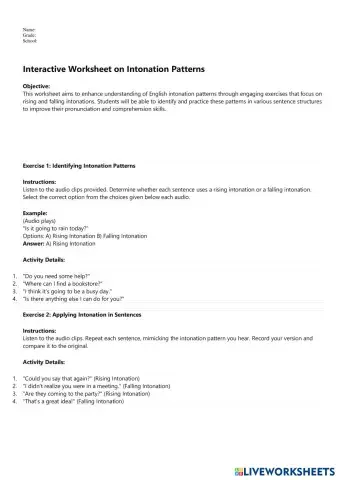
Interactive Worksheet on Intonation Patterns

Objective:
This worksheet aims to enhance understanding of English intonation patterns through engaging exercises that focus on rising and falling intonations. Students will be able to identify and practice these patterns in various sentence structures to improve their pronunciation and comprehension skills.


Exercise 1: Identifying Intonation Patterns

Instructions:
Listen to the audio clips provided. Determine whether each sentence uses a rising intonation or a falling intonation. Select the correct option from the choices given below each audio.

Example:
(Audio plays)
"Is it going to rain today?"
Options: A) Rising Intonation B) Falling Intonation
Answer: A) Rising Intonation

Activity Details:

  1. "Do you need some help?"
  2. "Where can I find a bookstore?"
  3. "I think it’s going to be a busy day."
  4. "Is there anything else I can do for you?"


Exercise 2: Applying Intonation in Sentences

Instructions:
Listen to the audio clips. Repeat each sentence, mimicking the intonation pattern you hear. Record your version and compare it to the original.

Activity Details:

  1. "Could you say that again?" (Rising Intonation)
  2. "I didn’t realize you were in a meeting." (Falling Intonation)
  3. "Are they coming to the party?" (Rising Intonation)
  4. "That’s a great idea!" (Falling Intonation)

EXERCISE B.


M: Can I speak to Fred Warner, please?

F: He's in a meeting now. I'll ask him to call you at quarter past ten when he comes out.

M: I'm seeing a customer then. I can phone at twelve o'clock.

F: He'll be in another meeting then. Call at half past before he goes for lunch.

M: OK.


Read each word, find the stress and rewrite the word with the stress in capital letters. (Look at the example)

WORDS

STRESS

WORD

STRESS

beautiful

BEAUtiful

intelligent


motivation


honest


cheerful


unpleasant


dishonest


unfriendly


temperature


sunny


Ket 5 - Part 1 - Test 1

English

Part 1- Test 1 -Ket 5 – Youtube  [ Listening A2 , KET 5, Test 1 , Part 1]


Question 1          One.  How will Jill go to the football match?

Man:  Are you going to drive to the football match, Jill?

Woman: I was going to, but I think parking will be difficult.

Man: That's what I thought. I'm going to walk, if you want to come with me.

Woman: OK then — that's cheaper than the bus, and it's always late anyway!


   Question 2          Two. Who's going to visit the woman?

Woman: My sister's son is coming to stay with me tomorrow.

Man: Oh, that’s nice. I met him a long time ago, when he was ten years old, didn't I ?

Woman: Well, he's a father now, you know. But he's not bringing the baby with him.

Man:    Oh, what a pity!


Question 3            Three. What will Ruby do tonight?

Girl:  Mum, Kate's just phoned. She wants me to go to the cinema this evening.

Woman: You can't go out, Ruby, if you haven't finished your school work.

Girl:  But I have! And I've even cleaned my shoes.

Woman: That's all right then.


Question 4             Four. How much did the woman's desk cost?

Man:    I've just spent sixty pounds fifty on a new desk. Very expensive!

Woman: Well, I paid sixty-six pounds fifty for mine.

Man: I saw one for fifty-five pounds, but it wasn't very good.

Woman: A good desk costs more than fifty-five pounds.


Question 5               Five. Where is the man's watch?

Man:  I can't find my watch anywhere!

Woman: Did you take it off when you did the washing-up last night?

Man: I've looked in the kitchen and it's not there.

Woman: Here it is. You left it on the bath before you went to bed.


Student Worksheet Leaflet : Marc Chagall – From Goal to Success

Reading Comprehension - English Language

Name: ____________________ 

SUCCESS

to set a goal 


to work hard


to face obstacles


to acquire new skills


to stay humble and hungry


Before Reading – Think & Discuss 

1. What do you think makes a person successful? 


2. Have you ever seen a painting with flying people, animals, or dream-like scenes? How did it make you feel? 


Reading Comprehension 

Read the biography of Marc Chagall . Then answer the questions.


True (T) or False (F)? Correct the false sentences. 


1. _ Marc Chagall was born in Paris. 

   → Correction: _____________________________________ 


2. He came from a wealthy family. 

 → Correction: _____________________________________ 


3.  He stopped painting during World War II. 

 → Correction: _____________________________________ 


4.  His art often included memories of his childhood. 

 → Correction: _____________________________________ 


5. He only painted on canvas. 

 → Correction: _____________________________________ 


6. He painted his most famous works in Paris.

 → Correction: _____________________________________ 

7. Unfortunately, Chagall`s paintings didn`t see many exhibitions during his lifetime.

 → Correction: _____________________________________ 


Find the evidence in the text. Give the real sentences from the text

To set a goal 

_________________________________________________

to work hard

_________________________________________________

to face obstacles

_________________________________________________

to acquire new skills

_________________________________________________

to stay humble and hungry

_________________________________________________


A picture description

  • Useful vocabulary

a flying couple, a violinist, a vibrant colour palette, floating figures, distorted perspective, symbols of childhood / love / hometown, euphoria of love, soaring happiness, nostalgia for the goal, connection to roots, the artist at work, between his homeland and new life


Topics to highlight while describing

  • How does this picture reflect Chagall`s goals, dreams, obstacles etc
  • What do main figures symbolize in the picture?


Reflection 

  • Marc Chagall never gave up on his dream, even when life was hard. 
  • What is your dream or big goal? What will help you achieve it? 


Past Simple vs Present Perfect

Practical English


  1. 1. Match the time expressions with the correct tense:

A:

• Since 2015

• Yesterday

• Just

• Last week

• Already

• Two days ago

• Ever

• In 2001


B:

1. Past Simple

2. Present Perfect


  1. 2. Fill in the blanks with the correct verb form:

1. We __________ (visit) the Louvre when we were in Paris.

2. She __________ (never / try) sushi before.

3. He __________ (finish) his homework an hour ago.

4. I __________ (just / call) you, but you didn’t answer.

5. They __________ (move) to New York in 2019.

6. She __________ (not / see) this movie yet.


  1. 3. Choose the correct option:

1. I (have seen / saw) this film twice.

2. She (wrote / has written) three books so far.

3. They (bought / have bought) a car last summer.

4. He (has lived / lived) in Rome for ten years, but now he’s in Milan.

5. We (just finished / have just finished) our project.


  1. 4. Rewrite the sentences using the other tense:

1. I have never been to Japan. → (Past Simple)

2. He bought a new phone last month. → (Present Perfect)

3. They have visited Spain several times. → (Past Simple)

4. She didn’t call me yesterday. → (Present Perfect)

5. We have known each other for five years. → (Past Simple)


  1. 5. Correct the mistakes in the sentences:

1. I have seen him yesterday. ❌

2. He has buy a new laptop. ❌

3. They lived here since 2010. ❌

4. We didn’t never go to that restaurant. ❌

5. Have you ever went to London? ❌


IGNORANCE

English Language Arts (ELA)

Children of certain very naive clan were taught by ignorant mullah. He was illiterate and couldn’t even read in Uzbek. He gave every boy a paper with some lines scratched. The lesson he instructed the, was as follows:
— The price for wedding is the horse.
— The birth of child is great happiness and is followed with great reward.
— The price for giving a name is a strong horse.
— The price for circumcision is three camels.
— The price for pardoning sins is five camels.
Once some other mullah who was wise and literate visited that aul. When he entered madrasah, illiterate mullah start talking to some boy as if teaching him a lesson, though indeed he was addressing the other mullah:
— There is no need to talk much, who needs this chatting? I have fifteen camels and one horse. The half is mine and other half will be yours.

B
One Tatar once run out from his house on midnight not even taking a hat. He was followed by his scared wife and kinds. Tatar run first, as fast as he could, broke into his neighbor’s house and started looking for the best place to hide.
“What happened?” — the neighbor asked him.
Tatar gathered his breath for a moment and told his story, “For a very long time imps and jinns have been dwelling in my house. Every night when we go to bed, shaitans[19] summon on our roof, they play there, and bump and knock through all the night. I have summoned mullahs to my home for several times already, they said lot of prayers and I spent lot of money, but I still can’t get rid of them. This night imps started run and bump as they do it usually; I lay sleepless also. Suddenly one jinn broke through the roof and jump right upon me. I got up, passed over him and run away. When I was running, I accidentally touched his horns. Apyrai, I didn’t even know shaitans have got horns!
The neighbor was a man wise, so he said, “Let’s go to your house with lantern and take a look at it in the light.
They have asked three or four men with them and went to Tatar’s house. When they entered, they saw that the roof was made of bulrush and was not very sound, and in the middle of the roof there was a hole. Then they looked around the house, and in the corner they saw a nanny goat. It was lying calmly and chewed something.
In a while they heard little goatlings crying on the roof. The goat also heard it, it got up and begun to bleat. Goatlings then descended from the roof through the hole as well, and joined their mother. It turned out, that the nanny goat and goatlingsbelonged to that Tatar and his neighbors. In the nights they came to eat hay, with which the roof was covered, and played there. The nanny goat, that was found in the house, was simply too big, so it broke down inside, leaving the hole in the roof.

Sumative Test

English for Specific Purposes (ESP)

Dialog 1

A: Excuse me, sir.

B: Yes?

A: Do you mind not to smoke here?

B: What’s your problem? There’s no sign that says it’s forbidden to smoke in this area. It means that I can smoke here.

A: That’s true, but this is a public area. Your cigarette is harmful for all people here.

B: People aren’t complaining except you.

A: I don’t want to make a scene here, so I suggest you to smoke somewhere else. Can’t you see? There’re many children here.

B: All right. I’ll leave and smoke somewhere else.

A: Thank you. I appreciate that.

  1. 1. What is the right statement about  the dialog?
  1. A. Allow to Smoke
  2. B. Forbidden to smoke
  3. C. Smoking area.
  4. D. Cigarette good for everybody.
  5. E. People aren’t complaining.
  1. 2. What is the dialog about?
  1. Asking help
    B. Offering help
    C. Refusing something
    D. Accepting an offer
    E. Suggestion

Dialog 2

Complete the dialog

A: I need to lose weight. How do I start to do that?

B: If I were you, 3. _______________ and start exercising regularly.

A: Okay. Do you know what kind of exercise that’s best for losing weight?

B:4._______________. She’s an athlete, so she must at least know something about exercising to lose weight.

 A: That’s worth a try.

B: Do you need her number? I have it if you want.

A: Sure. Thanks.

  1. 3. A. you better eat something delicious.
  2. B. I shouldn’t tell you.

C. I would reduce my food portions little by little

D. you should do exercising.

E. I don’t know, don’t asking me.

  1. 4. A. I don’t know.
  1. B. I think you should ask that to Meghan.
  2. C. I should jogging every day.
  3. D. You should go to gym.
  4. E. You must jogging everyday.
  5. 5. Mossad : Shall we ….tomorrow morning?

Rapan : Sure, We won’t miss the first flight.

  1. A. get up late
  2. B. get up early
  3. C. to get up late
  4. D. to get up early
  5. E. to go up late
  1. 6. Alfredo : I submitted my essay to English teacher yesterday, but I haven’t received and response from her

Yani :…………………….. go and ask her?

  1. A.shall us
  2. B. why don’t we
  3. C. I think
  4. D. I will do
  5. E. you call
  1. 7. "You should order the bag online because it's cheaper."

The sentence above is used for . . . . .

A. Accepting suggestion

B. Asking for suggestion

C. Giving suggestion

D. Condition sentence

E. Giving Offer

8. The expressions below are for accepting suggestion, except . . . . .

A. I'd better not.

B. Let's do that.

C. I'm up for it.

D. I like your idea

E. Yes, I should.

9.Erika: Look at the sign. You …. not stop here.

Wulan: Oh, I’m sorry. I didn’t see it.

A. Must

B. Have to

C. Had

D. should

E. Will

10. You are at school at the break time, and you see a student's parent trying to look for his son. What probably you say?

a. May I help you?

b. Who are you?

c. Who are you looking for?

d. Can I show you where the office is?

E. What are you doing?

  1. 11. Steve: I don’t understand chemistry at all.
    Banno: ………….

The suitable expression to complete the dialogue is …
A. How about having dinner with me?
B. How about going to the beach?
C. How about studying together with me?
D. How about calling the police?
E. How about going to cinema?

  1. 12. Ronaldo: Sir, would you like me to close the window for you?
    Mr. Adi: Yes, please. It’s very cold inside.

The underlined sentence express:
A. Asking help
B. Offering help
C. Refusing something
D. Accepting an offer
E. Suggestion

  1. 13. Gina : what’s the matter with you father?

Rony : He has a bad cough

Gina : Why don’t he go to……

  1. A. take a rest
  2. B. see the doctor
  3. C. take a nap
  4. D. go to work
  5. E. have morning coffee
  1. 14. Gil : What would you do tonight?

 Joe : I don’t know. I need your ……

Gil : I suggest you study hard

  1. A. suggest
  2. B. suggestion
  3. C. suggested
  4. D. suggesting
  5. E. helping
  1. 15. Nona : ……the lesson

 Mega : How about asking your teacher to explain it again?

  1. A. I don’t understand
  2. B. I wonder
  3. C. I don’t like
  4. D. I don’t explain
  5. E. I  love
  1.  16. Mossad : Shall we ….tomorrow morning?

Rapan : Sure, We won’t miss the first flight.

  1. A. get up late
  2. B. get up early
  3. C. to get up late
  4. D. to get up early
  5. E. to go up late
  6. 17. Alfredo : I submitted my essay to English teacher yesterday, but I haven’t received and response from her

Yani :…………………….. go and ask her?

  1. A. shall us
  2. B. why don’t we
  3. C. I think
  4. D. I will do
  5. E. you call
  1. 18.….…I help you, sir?
  1. A. can
  2. B. may
  3. C. will
  4. D. would
  5. E. could
  1. 19…… you come to fix my car tomorrow?
  1. A. can
  2. B. may
  3. C. will
  4. D. would
  5. E. could
  1. 20 …….mind taking this for us?
  1. A. can
  2. B. may
  3. C. will
  4. D. would
  5. E. could


Media

English language

STUDENTS THINK FAKE NEWS IS FACT AND ARE USING IT IN THEIR SCHOOLWORK, SAY TEACHERS

Teachers are frustrated that students can’t accept that some stories on social networks are false, while experts suggest that students need better education about online dangers. Students believe that fake news is a fact, and are repeating it in lessons and using it in written work, teachers have warned. More than a third of teachers say their students have used false information that they found online, according to a survey by a teacher’s union.

The union’s general secretary Chris Keates said that the information was "worrying" and it showed that internet companies have a lot of power to influence people’s opinions, especially young people. International education experts are becoming more worried about the situation and say that teachers will need to teach children how to spot fake news. Others were frustrated that students didn’t believe that news they had seen on Facebook and other social media sites was not true, even when the problem was explained to them. One teacher said that students often thought that fake news sites were real, and also that anything that President Donald Trump said was a fact. Last week, German officials said they would give fines of up to 50 million euro to social networks if they didn’t take down illegal fake news posts. The new law would give social networks 24 hours to delete or block the content and seven days to concentrate on more complicated cases. Commenting on the results of the survey, Ms. Keates said that she was worried about the trend, particularly because many young people have never known a world without internet, and are less able to judge whether information that they read online is real or fake. She added that: "It is important for children and young people to be made aware that not everything they see and read online is real."

She said that teachers are trying to help educate students about using false information, but added that it was important for internet providers and websites to take responsibility for any material that is available, and also to deal with people who misuse their services. Last month, Andreas Schleicher, the director of education and skills at OECD (The Organization of Economic co-operation and Development) said that in the modern age, being able to tell the difference between what is real and what is fake is a critical skill. He added that: "This is something that we believe schools can do something about."

Adapted from the Independent by Rachel Pells, April 12th, 2017

สร้างและปรับแต่งใบงานสำหรับทุกห้องเรียน

LiveWorksheets ทำให้คุณครู ผู้ปกครอง และผู้สอนแบบโฮมสคูล สามารถออกแบบและมอบสื่อการเรียนรู้ที่น่าสนใจได้อย่างง่ายดาย เพียงอัปโหลดไฟล์ PDF หรือเริ่มต้นสร้างใหม่ทั้งหมด คุณก็สามารถทำได้ทุกอย่าง ไม่ว่าจะเป็นใบงานคณิตศาสตร์แบบโต้ตอบ ใบงานอ่านจับใจความ ใบงานการคูณ หรือใบงานสำหรับเด็กอนุบาล ด้วยขั้นตอนเพียงไม่กี่คลิก เครื่องมือแก้ไขแบบลากและวางของเรารองรับทุกระดับชั้นและทุกวิชา ช่วยให้คุณปรับเนื้อหาให้ตรงกับแผนการสอน การบ้าน หรือแบบทดสอบ ครูสอนภาษาอังกฤษ (ESL) ยังสามารถสร้างใบงาน ESL แบบเฉพาะ เพิ่มตารางเสียงภาษาอังกฤษ หรือออกแบบกิจกรรม ESL เพื่อให้การเรียนสนุกและมีส่วนร่วมมากขึ้น สร้างกิจกรรมที่ปรับระดับได้ ตรวจอัตโนมัติ ช่วยประหยัดเวลา และสนับสนุนการเรียนรู้ของนักเรียนให้ดียิ่งขึ้น

คลังสื่อการเรียนรู้ครบวงจรสำหรับ K-12 และ ESL

เข้าถึงใบงานที่พร้อมใช้หลายพันชุด ครอบคลุมทุกวิชาในระดับ K-12 รวมถึงใบงานอนุบาล ใบงานคณิตศาสตร์ แบบฝึกการคูณ แบบฝึกอ่านจับใจความ และทรัพยากร ESL เลือกค้นหาตามชั้นเรียน วิชา หรือระดับทักษะ เพื่อให้ได้สิ่งที่คุณต้องการ ไม่ว่าจะสำหรับห้องเรียนประถม ทบทวนในระดับมัธยมต้น หรือการฝึกในระดับมัธยมปลาย ครู ESL ยังสามารถสำรวจคลังใบงาน ESL และกิจกรรมภาษาอังกฤษที่ออกแบบมาเพื่อรองรับผู้เรียนทุกระดับ เนื้อหาใหม่ถูกเพิ่มเข้ามาอย่างต่อเนื่อง LiveWorksheets จึงเป็นทรัพยากรที่ยืดหยุ่นและช่วยสร้างผลลัพธ์การเรียนรู้ที่ยั่งยืน