EUPHORIA COMPUTER PRACTICE WORKSHEET CLASS II

Vocabulary - Language Arts

Student Instructions: How to Complete the Practice Worksheet

​Read Each Question Carefully

​Do not rush through the questions. Read every sentence carefully, especially scenario-based and riddle questions, to identify key words (like input, output, portable, or storage).

​Section-Wise Directions:

​Section A (Multiple Choice Questions): Select or circle only one correct option for each question.

​Section B (Fill in the Blanks): Use the clue box provided at the top of the section. Each word/phrase from the clue box is used exactly once.

​Section C (True or False): Read the entire statement before deciding. Circle or write True if the statement is correct, or False if it contains incorrect information.

​Section D (Scenario & Riddles): Think about real-life situations. Write precise, single-word or short-phrase answers (e.g., Web Camera, Microphone).

​Section E (Classification Challenge): Fill in the bracket with the single letter corresponding to the device type:

​I for Input devices

​O for Output devices

​S for Storage devices

​General Tips for Competition Success:

​Double-Check Your Answers: Before submitting, review your paper to make sure you haven't left any question unanswered.

​Focus on Key Terms: Remember the fundamental definitions:

​Input: Sending data into the computer.

​Output: Getting processed results from the computer.

​Storage: Saving data for future use.

​Spelling Matters: Make sure to spell device names correctly when writing them down in short-answer questions.

Our Senses

Psychology

Our five senses include __________, _____________, _______________, ______________,_____________

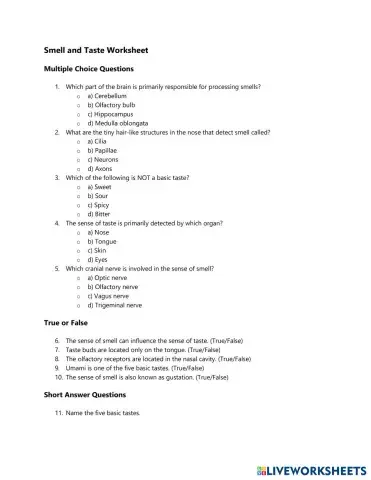
Sure! Here's a worksheet with 25 questions about the senses of smell and taste:

Smell and Taste Worksheet

Multiple Choice Questions

  1. Which part of the brain is primarily responsible for processing smells?

    • a) Cerebellum
    • b) Olfactory bulb
    • c) Hippocampus
    • d) Medulla oblongata
  2. What are the tiny hair-like structures in the nose that detect smell called?

    • a) Cilia
    • b) Papillae
    • c) Neurons
    • d) Axons
  3. Which of the following is NOT a basic taste?

    • a) Sweet
    • b) Sour
    • c) Spicy
    • d) Bitter
  4. The sense of taste is primarily detected by which organ?

    • a) Nose
    • b) Tongue
    • c) Skin
    • d) Eyes
  5. Which cranial nerve is involved in the sense of smell?

    • a) Optic nerve
    • b) Olfactory nerve
    • c) Vagus nerve
    • d) Trigeminal nerve

True or False

  1. The sense of smell can influence the sense of taste. (True/False)

  2. Taste buds are located only on the tongue. (True/False)

  3. The olfactory receptors are located in the nasal cavity. (True/False)

  4. Umami is one of the five basic tastes. (True/False)

  5. The sense of smell is also known as gustation. (True/False)

Short Answer Questions

  1. Name the five basic tastes.
  2. Describe the role of the olfactory bulb in the sense of smell.
  3. How do taste buds detect different flavors?
  4. Explain how the sense of smell can affect the sense of taste.
  5. What is the function of cilia in the nasal cavity?

Fill in the Blanks

  1. The sense of taste is also known as __.
  2. __ are the sensory receptors for smell.
  3. The __ nerve carries signals from the taste buds to the brain.
  4. __ is the taste associated with savory flavors.
  5. The __ is the part of the brain that processes smell information.

Matching

  1. Match the taste with its description:

    • Sweet
    • Sour
    • Salty
    • Bitter
    • Umami

    a) Associated with amino acids and savory flavors b) Often found in citrus fruits c) Commonly found in sugary foods d) Typically found in salty snacks e) Often associated with bitter compounds like caffeine

  2. Match the term with its definition:

    • Olfactory bulb
    • Taste buds
    • Cilia
    • Papillae
    • Olfactory nerve

    a) Structures on the tongue that contain taste receptors

  3. b) Hair-like structures in the nasal cavity

  4. c) Nerve that transmits smell information to the brain

  5. d) Brain structure involved in processing smells e) Small bumps on the tongue that contain taste buds

Essay Questions

  1. Discuss the relationship between the senses of smell and taste and how they work together to create the perception of flavor.
  2. Explain the process of olfaction from the detection of odor molecules to the perception of smell in the brain.
  3. Describe how different factors, such as age and health, can affect the senses of smell and taste.

Feel free to adjust or add more questions as needed! If you need any further assistance, just let me know.

สร้างและปรับแต่งใบงานสำหรับทุกห้องเรียน

LiveWorksheets ทำให้คุณครู ผู้ปกครอง และผู้สอนแบบโฮมสคูล สามารถออกแบบและมอบสื่อการเรียนรู้ที่น่าสนใจได้อย่างง่ายดาย เพียงอัปโหลดไฟล์ PDF หรือเริ่มต้นสร้างใหม่ทั้งหมด คุณก็สามารถทำได้ทุกอย่าง ไม่ว่าจะเป็นใบงานคณิตศาสตร์แบบโต้ตอบ ใบงานอ่านจับใจความ ใบงานการคูณ หรือใบงานสำหรับเด็กอนุบาล ด้วยขั้นตอนเพียงไม่กี่คลิก เครื่องมือแก้ไขแบบลากและวางของเรารองรับทุกระดับชั้นและทุกวิชา ช่วยให้คุณปรับเนื้อหาให้ตรงกับแผนการสอน การบ้าน หรือแบบทดสอบ ครูสอนภาษาอังกฤษ (ESL) ยังสามารถสร้างใบงาน ESL แบบเฉพาะ เพิ่มตารางเสียงภาษาอังกฤษ หรือออกแบบกิจกรรม ESL เพื่อให้การเรียนสนุกและมีส่วนร่วมมากขึ้น สร้างกิจกรรมที่ปรับระดับได้ ตรวจอัตโนมัติ ช่วยประหยัดเวลา และสนับสนุนการเรียนรู้ของนักเรียนให้ดียิ่งขึ้น

คลังสื่อการเรียนรู้ครบวงจรสำหรับ K-12 และ ESL

เข้าถึงใบงานที่พร้อมใช้หลายพันชุด ครอบคลุมทุกวิชาในระดับ K-12 รวมถึงใบงานอนุบาล ใบงานคณิตศาสตร์ แบบฝึกการคูณ แบบฝึกอ่านจับใจความ และทรัพยากร ESL เลือกค้นหาตามชั้นเรียน วิชา หรือระดับทักษะ เพื่อให้ได้สิ่งที่คุณต้องการ ไม่ว่าจะสำหรับห้องเรียนประถม ทบทวนในระดับมัธยมต้น หรือการฝึกในระดับมัธยมปลาย ครู ESL ยังสามารถสำรวจคลังใบงาน ESL และกิจกรรมภาษาอังกฤษที่ออกแบบมาเพื่อรองรับผู้เรียนทุกระดับ เนื้อหาใหม่ถูกเพิ่มเข้ามาอย่างต่อเนื่อง LiveWorksheets จึงเป็นทรัพยากรที่ยืดหยุ่นและช่วยสร้างผลลัพธ์การเรียนรู้ที่ยั่งยืน